

Saved Bookmarks
| 1. |
Using Ohm's law, calculate the resistance of combination of few resistances joined in series. |
Answer» Solution :Resistance in series. Resistances are SAID to be connected in series if they are joined end to end and the same (i.e. total) current flows through each one of them. Since there is a single path for moving CHARGE, the same current must flow through each resistor. 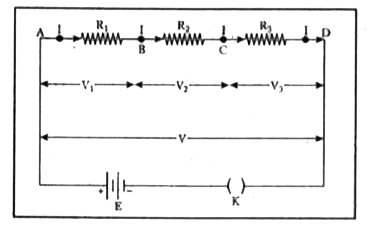 Let `R_(1),R_(2) and R_(3)`=three resistances connected in series. I=current flowing through `R_(1),R_(2) and R_(2)` V=potential difference across A and D `V_(1),V_(2) and V_(3)=`potential difference across `R_(1),R_(2) and R_(3)` RESPECTIVELY. It is clear from the circuit diagram that `V=V_(1)+V_(2)+V_(3)`. . . (1) According to Ohm.s law, `V_(1)=IR_(1),V_(2)=IR_(2) and V_(3)=IR_(3)`. . (2) let `R_(S)` be the resultant resistance. Obviously, when such a resistance is connected between A and D and a potential V is applied across its ends, it allows a current I through it. `therefore V=IR_(S)`. . (3) Substituting respective VALUES in eqn. (3) `IR_(S)=IR_(1)+IR_(2)+IR_(3)=I(R_(1)+R_(2)+R_(3))` or `R_(S)=R_(1)+R_(2)+R_(3)`. . (4) Hence when a NUMBER of resistances are connected in series, the total or resultant resistance is equal to the sum of the individual resistances. If there are n resistances and each is equal to R and if they are connected in series, then their resultant is given by `R_(S)=R+R+R+R`. . . n times. or `R_(S)=nR`. . . (5) i.e. `R_(S)`=number of resistances`xx` value of each resistance. Thus effective resistance increases. |
|