

Saved Bookmarks
| 1. |
Water stands upto height h behind the dam as shown in the figure. The front view of the dam gate is also shown in the adjoining figure. Density of water is rho and acceleration due to gravity is g. If atmospheric pressure force is also considered, then the point of application of total force acting on the dam due to water above O is |
|
Answer» `(h)/(rr4r)` 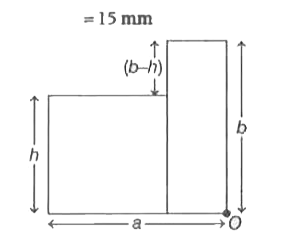 Force on dam = PRESSURE of water `xx` Area = {(density of water) (ACCELERATION due to gravity) (height of water/2} `xx` {(width of dam) (height of water)} `F = (RHO g (h)/(2)) xx [(b -h).h]` `= (rho g)/(2) (BH^(2) - h^(3))` At equilibrium, atmospheric pressure = pressure on dam So, `(dF)/(dh) = 0` `rArr (del)/(del h) {(rho g)/(2) (bh^(2)- h^(3))} = 0` `rArr (rho g)/(2) (2bh - 3h^(2)) = 0` `rArr 2bh - 3h^(2) = 0` `rArr 2b = 3h rArr b= 3h//2` `b-h = (3h)/(2) - h = h//2` is the location where the total weight of water acts at a particular point. To find the point of action of total force, `y_(R ) = (I_(xc))/(y_(c )A) + y_(c )` where, `y_(R )`= location where point of force acts, A = area, `y_(c )`= location where total weight acts = h/2 and `I_(xc)` = moment of inertia (here rectangular plate). `=(1)/(12) Ah^(2) = (1)/(12) bh^(3)` so, `y_(R ) = ((1//12) bh^(3))/((1//2)h.bh) + (1)/(2)h` `= (1)/(6) h + (1)/(2) h = (2)/(3)h` (from the top) So, `y_(R ) = (h)/(3)` (above the base) `= (2)/(3)h` (from the top) 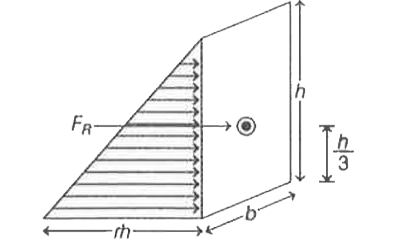
|
|