

Saved Bookmarks
| 1. |
What is amplification ? Explain the working of a common emitter amplifier with necessary diagram. |
|
Answer» Solution :Amplification `:` The process of RAISING the strength of a weaksignal is called amplification and the device which accomplishes this job is called an AMPLIFIER. Amplifiers are of two types.(1) Power amplifier(2) Voltage amplifier. Amplification factor `:`The ratio between output voltage to the input voltage is called amplification factor. `A = ( V _(0))/( V_(i))` Common emitter transistor amplifier `:` 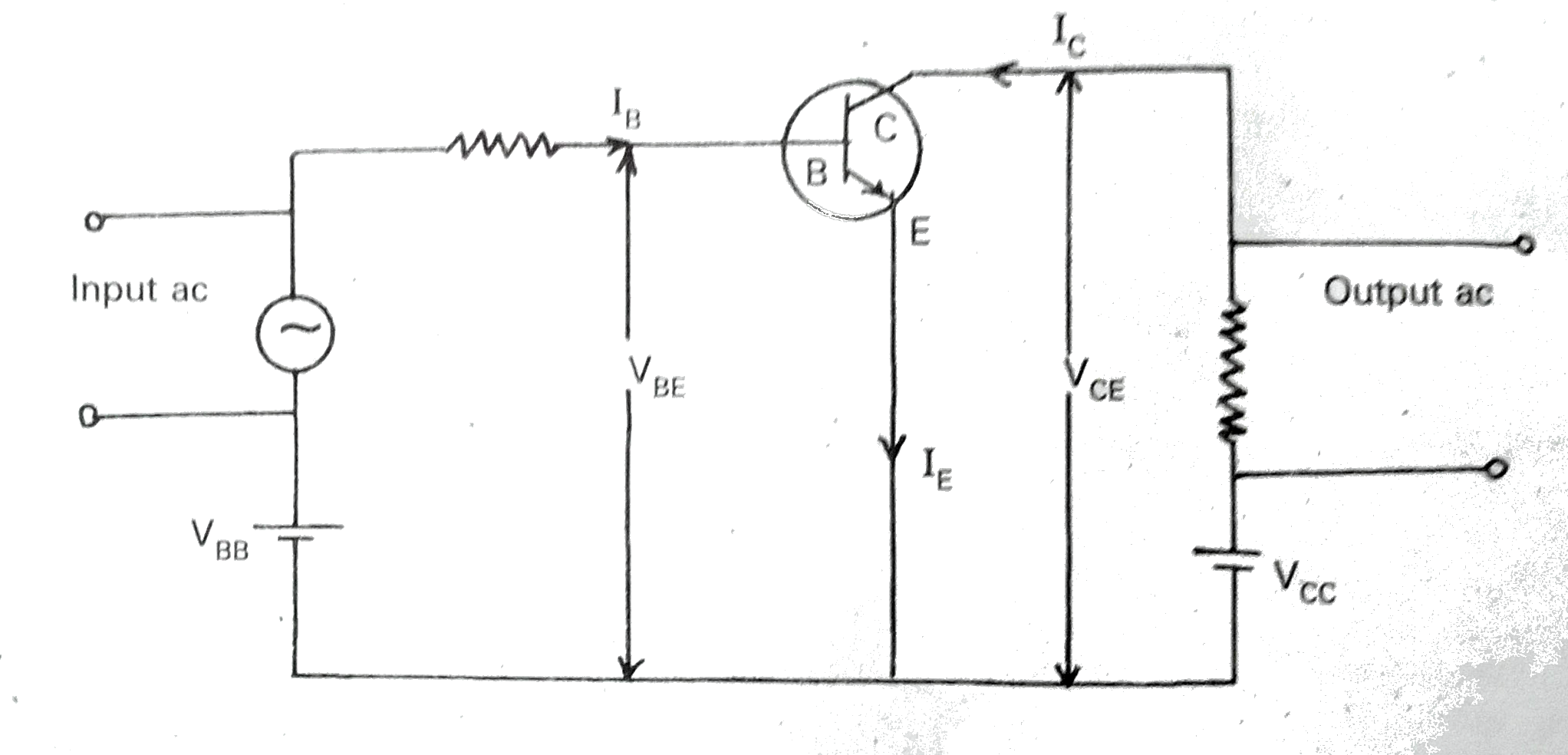 Then-p-n common emitteramplifier circuit is shown in figure. In this circuit the battery `V _(B B )` provides the biasing voltage `V_(B E)` for the base emitter junction. The emitter junction is forward biased and the battery `V _( C C ) ` provides the biasing voltage `V _(C E)` for the emitter collector junction.The junction is reverse biased . Most of the electron from emitter cross the base region and move into the collector. The input signal to the amplified is connected in series with the biasing battery`( V_(B B))` .A load resistance `R_(L)` is connectedin the collector circuit and output voltage is taken across `R_(L)`. As the base emitter voltage`( V_(BE ))` changes due to input signal, the base current changes `( I_(B ))`. This results in large change in collector current `( Delta I_(C ))`. The change in collector emitter voltage `( Delta V_(CE))` is taken across `R_(L) `. Thus amplified output is obtained across `R_(L)`. Current gain `( beta)``:` The ratio of change in collector current to the change in base current is called current gain (or ) current amplification factor. `beta= ( Delta I_(C ))/(Delta I_(B))` Voltage gain `( A _(V )) :` It is the ratio of change in output voltage `( Delta V _(C E))`to the change in input voltage `( Delta V_(BE ) )`. Voltage gain `= (Delta V_(C E))/( DeltaV_(BE))= betaxx ( R_(L))/( R_(i))` Power gain `:` It is definedas the productof current gain and voltage gain. Powergain `( A _(p))=` Current gain `xx `Voltage gain. |
|