

Saved Bookmarks
| 1. |
What is an electric dipole? Derive expression of electric field intensity at a point on its axial line. |
Answer» Solution :Electric dipole is a set of two equal and opposite charges separation by certain finite distance. Consider an electric dipole consisting of CHARGE -q and +q, separated by a distance 2a and placed in free space. Let P be a POINT on the axial line joining the two charges of the dipole at a distance r from the centre O of the dipole. 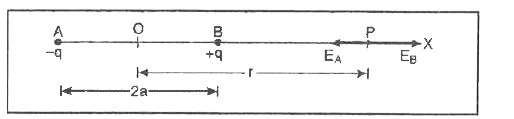 The electric field `vecE` at point P due to dipole will be the resultant of the electric field `vecE_(A)` (due to charge -q at point A) and `vecE_(B)` (due to charge +q at point B) i.E., `vecE=vecE_(A)+vecE_(B)` Now, `|vecE_(A)|=(1)/(4piepsi_(0))*(q)/(AP^(2))=(1)/(4piepsi_(0))*(q)/((r+a)^(2))`(along PA) and `|vecE_(B)|=(1)/(4piepsi_(0))*(q)/(BP^(2))=(1)/(4piepsi_(0))*(q)/((r-a)^(2))`(along PX) Obviously, `|vecE_(B)|` is greater than `|vecE_(A)|`. Since `vecE_(A) and vecE_(B)` act along the same line but in opposite DIRECTION, the magnitude of the electric field at point P is given by `|vecE|=|vecE_(B)|-|vecE_(A)|` or `E=(1)/(4piepsi_(0))*(q)/((r-a)^(2))-(1)/(4piepsi_(0))*(q)/((r+a)^(2))`(along PX) `=(1)/(4piepsi_(0))*q[((r+a)^(2)-(r-a)^(2))/((r^(2)-a^(2))^(2))]` or `E=(1)/(4piepsi_(0))*(q(4ra))/((r^(2)-a^(2))^(2))` Now, q(2a)=p, the magnitude of the electric dipole moment of the dipole. therefore, `E=(1)/(4piepsi_(0))*(2pr)/((r^(2)-a^(2))^(2))`(along PX) It may be noted that direction of electric field at a point on axial line of the dipole is from charge -q to +q i.e. same as that of electric dipole moment of the dipole. when the point P is very far away from the electric dipole, then `a^(2) lt lt r^(2)`. therefore. `E=(1)/(4piepsi_(0))*(2pr)/(r^(4))` or `E=(1)/(2piepsi_(0))*(p)/(r^(3))` |
|