

Saved Bookmarks
| 1. |
What is capacitor ? And explain capacitance. Give its SI unit. |
|
Answer» Solution :A capacitor is a system of two conductors separated by an insulator which is shown in figure. DefinitionArrangement in which two good conductors of arbitrary shape and VOLUME are arranged close to one another, but separated from each other is called capacitor."  Suppose the conductors have charges `Q_(1)` and `Q_(2)` and potentials `V_(1)` and `V_(2)` . The potential difference is `V=V_(1)-V_(2)` . Single conductor can be used as a capacitor by assuming the other at infinity. The conductors may be charged by connecting them to the two terminals of a battery. Q is called the charge of the capacitor, though this infact is the charge (magnitude) on one of the conductors . The total charge of the capacitor is zero. The electric field `vecE` in the capacitor is from + Q charge to - Q charge it is proportional to the charge Q. `:. E prop Q` The potential difference V is the work done per unit positive charge in taking a small test charge from the conductor 2 to I against the field Hence, V is ALSO proportional to the charge Q. `:. V prop Q ` Hence ratio `(Q)/(V)` is constant . `:. C = (Q)/(V)` C is the capacitance of capacitor . Definition of Capacitance : The ratio of the amount of charge on the plate of parallel capacitor and the potential difference between two PLATES is known as capacitance of capacitor. Hence, capacitance is independent of Q or V. The capacitance of capacitor depends on the following. (1) Geometrical configuration, shape, size,separation of the system of two conductors. (2) Nature of dielectric separating the two conductors. (3) Presence of a capacitor near to other capacitor. The magnitude of capacitance of capacitor does not depend on the following. (1) Types of material of conductor. (2) Amount of electric charge on the conductor. SI unit of capacitance is `("Coulomb")/("Volt")` and in memory of the great scientist Michael Faraday it is known as Farad Its symbol is F. `:. 1 F = (1C)/(V)`and dimensional formula `[:M^(-1)L^(-2)T^(4)A^(2)]` Practically used smaller units : `1 mu F= 10^(-6)F` `mu mu F= 1 pF= 10^(-12)F` `n F= 10^(-9) F` A capacitor with fixed capacitance symbolically shown as while the one with variable capacitance known as 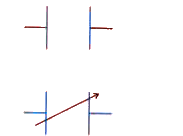
|
|