

Saved Bookmarks
| 1. |
What is diffraction ? Discuss diffraction pattern obtainable from a single slit. |
|
Answer» Solution :Diffraction : The phenomenon of bending of light at the edges of an obstacle and light enters into the geometrical shadow is KNOWN as diffraction of light. Example : The silver lining surrounding the profile of a mountain just before sun rise. Diffraction of light at a single slit: (i) Consider a narrow slit AB of wvidth d. A parallel beam of light of wave length A falling normally on a single slit. (ii) Let the diffracted light be focussed by means of a convex lens on a SCREEN. (ii) The secondary wavelets travelling normally to the slit, ie., along the direction of `OP_(0)`. Thus P is a bright central image. (iv) The secondary wavelets travelling at an angle e with the normal are focussed at a point P, on the screen. (v) In order to find out intensity at P, draw a perpendicular AC on BR. (vi) The path difference between secondary wavelets = BC `=AB sin theta =a sin theta (therefore sin theta =theta)` Path difference `(lambda)=a theta .....(1)` (vii) Experimental observations shown in figure, that the intensity has a central maximum at `theta=0` and other secondary maxima at`theta=(n+1/2)lambda/a` and has minima at `theta=(nlambda)/(a)` (viii) From equation`(1), theta=(lambda)/(a)` Now we divide the slit into two equal halves, each of size `(a)/(2)` (ix) We can SHOW that the intensity is zero for `theta=(nlambda)/(2)` where n= 1, 2, 3 .... (x) It is also to see why there are maxima at 0 (xi) Consider `theta=(3lambda)/(2a)` which is midway between two of the dark fringes. (xii) If we take the first two THIRDS of the slit, the path difference between two ends is Intensity (xiii) The first two third of the slit can be DIVIDED into two halves which have a path difference. The contribution of two halves cancel and only remaining one third of the slit contributes to the intensity minima. 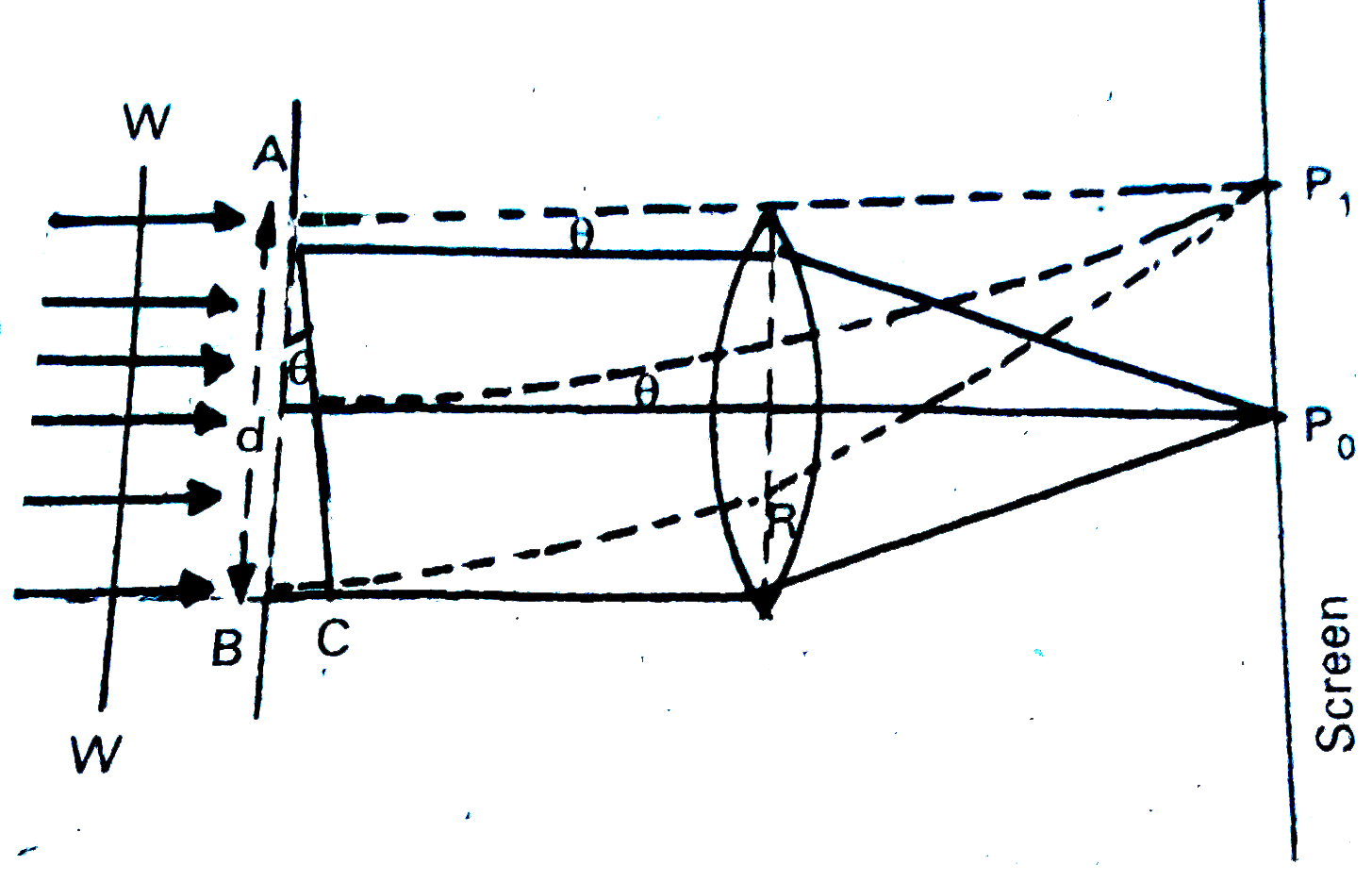 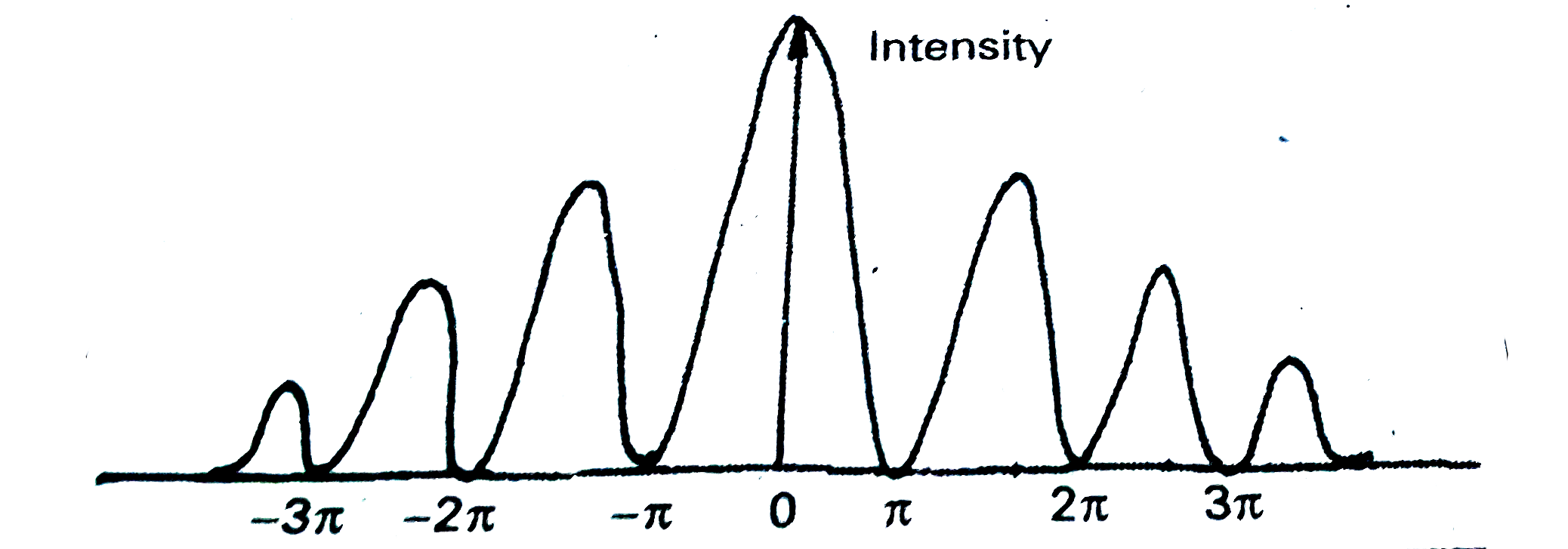
|
|