

Saved Bookmarks
| 1. |
What is Doppler effect ? Obtain an expression for the apparentfrequencyof sound heard when the observer is in motionwith respectto a source at rest. |
|
Answer» SOLUTION :Doppler Shift `:` Due to the relative MOTION, when the source comes closer to listener, the apparentfrequency is GREATER thanactual frequency and source away from listener, the apparentfrequencyis less than actualfrequency . So the difference in apparent and actual frequencies is known as Doppler shift. Expression for the apparent frequenyheard by a moving observer `:` Case (1) `:` Whenobserver is moving towards source `:` Let `' upsilon_(0)'`be velocityof listener 'O' , moving towards the stationary source 's' as shown in figure. So observer will receive more number of waves in each second. The distance travelled by observer in one second `= upsilon_(0)` The number of extra waves received by the observer`= (upsilon_(0))/(lambda)` We known `v = v lambdaimplies lambda = ( upsilon)/(v)` Where `upsilon` = Velocity of sound v =Frequency of sound 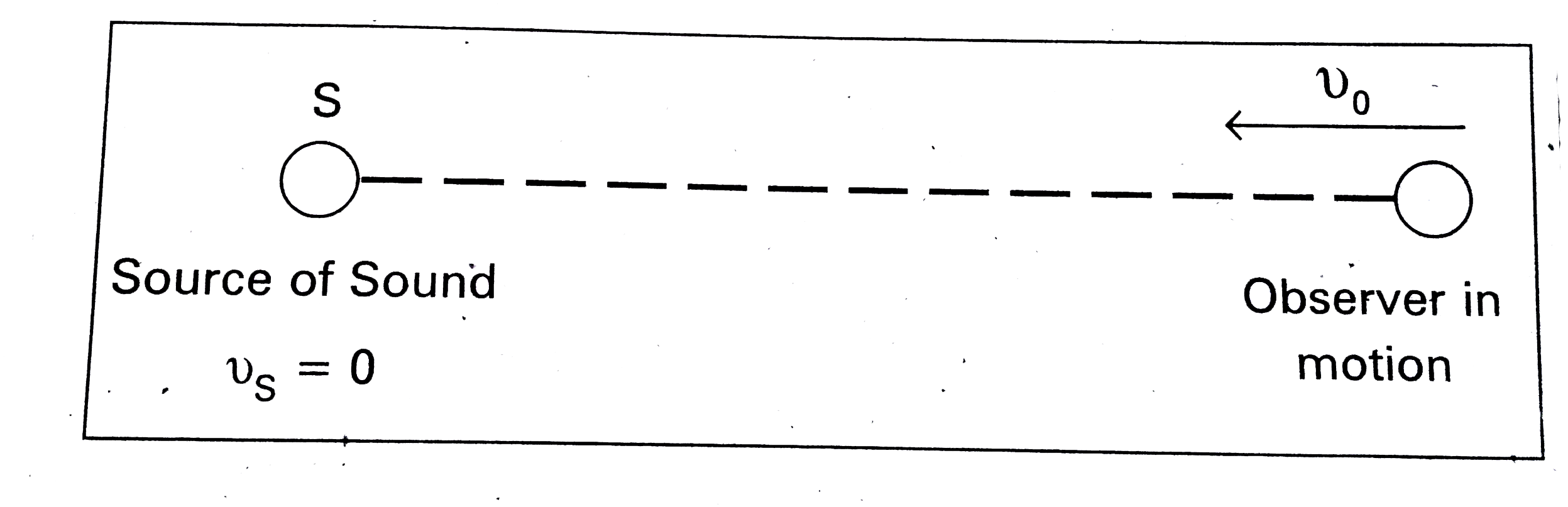 If 'v' is apparent frequency heard by him then `v' = v+ ( upsilon_(0))/(lambda) = v+ ( upsilon_(0).v)/(upsilon)``[:' lambda = ( upsilon)/( v)]` ` v' = v [ 1+ ( upsilon_(0))/(v)]` `v' = v [ ( upsilon+ upsilon_(0))/(upsilon)]` 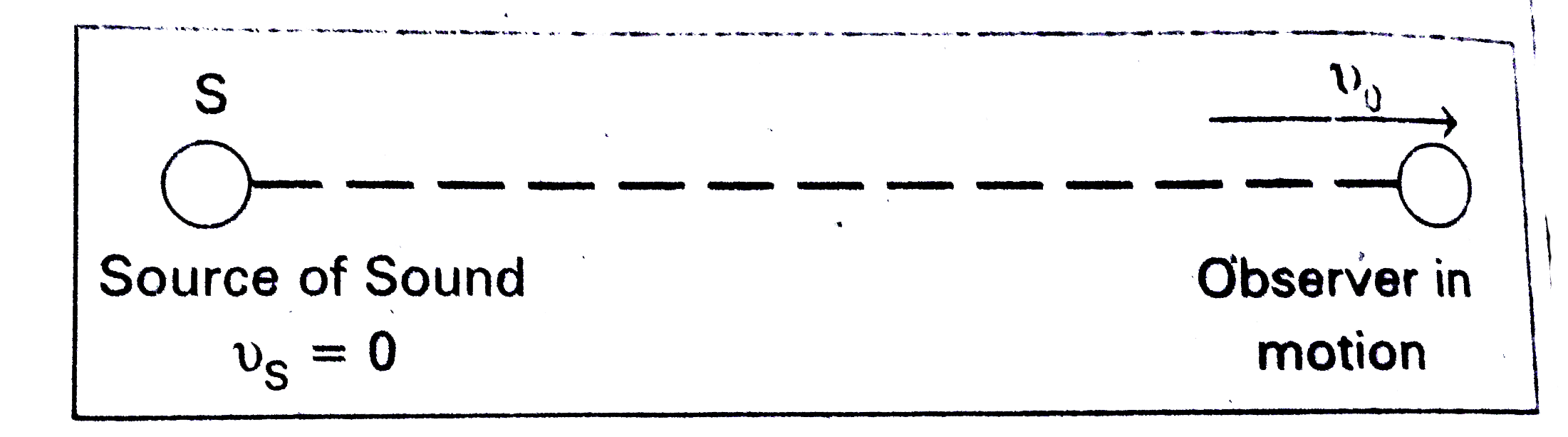 Therefore the apparent frequency is greater than actual frequency . Case (2) `:` When ovserveris moving away from REST source`:` If the observer is moving away from the stationary source then he loses the number or waves `(( v_(0))/(lambda))` `:.` Apparent frequency `v' =v- (upsilon_(0))/( lambda) = v - ( upsilon_(0).v)/( v)` `v' = [ ( v-v_(0))/(v)].v ` Hence the apparent frequency is less than actual frequency. |
|