

Saved Bookmarks
| 1. |
What is potentiomter ? What is its principle ? How will you find the internal resistance of a cell by a potentiometer? |
|
Answer» SOLUTION :Potentiometer. It is an instrument used to compare to e.m.f. of two cells ND to find the internal resistance of a cell. Principle. It is based on the principle that when a constant currents is passed through a wire of uniform area of cross-section, the potential drop across any portion of the wire is directly proportional tot he length of that portion. 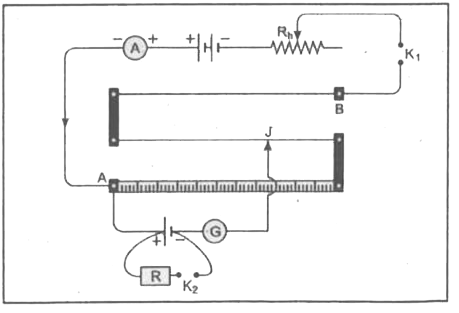 Internal resistance of a cell. The resistance offered by the electrolyte of the cell to the flow of the ions through the electrolyte is called internal resistance of the cell. To determine internal resistance of a cell by a potentiometer. The circuit used for FINDING the internal resistance of a cell is as shown in the figure. A constant CURRENT I is maintained through the potentiometer wire with the help of the rheostat. potentiometer wire with the help of the rheostat. Plug in the key `K_(2)` is kept out and the jockey is moved over the potentiometer wire so as to balance the e.m.f. E of the cell, whose intenral resistance is to befound. let `l_(1)` be the balancing length of the potentiometer wire between point A and jockey J. then `Epropl_(1)`. . (1) With the help of resistance box S, introduce resistance, say S and then put in key `K_(2)`. now find the balance point for the terminal potential difference V between the two poles of the cell. if `l_(2)` is the balancing length, then `Vpropl_(2)`. . (2) From equation (1) and (2), we have `(E)/(V)=(l_(1))/(l_(2))`. . (3) Since internal resistance (r) of cell is given by `r=[(E)/(V)-1]R` USING equation (3), we get `r=[(l_(1))/(l_(2))-1]R=[(l_(1)-l_(2))/(l_(2))]R`. |
|