

Saved Bookmarks
| 1. |
What is rectification ? Explain the working of a full wave rectifier. |
|
Answer» Solution :Rectification `:` The process of converting on alternating currentintoa direct current is called rectification. The device used for this purpose is called RECTIFIER. 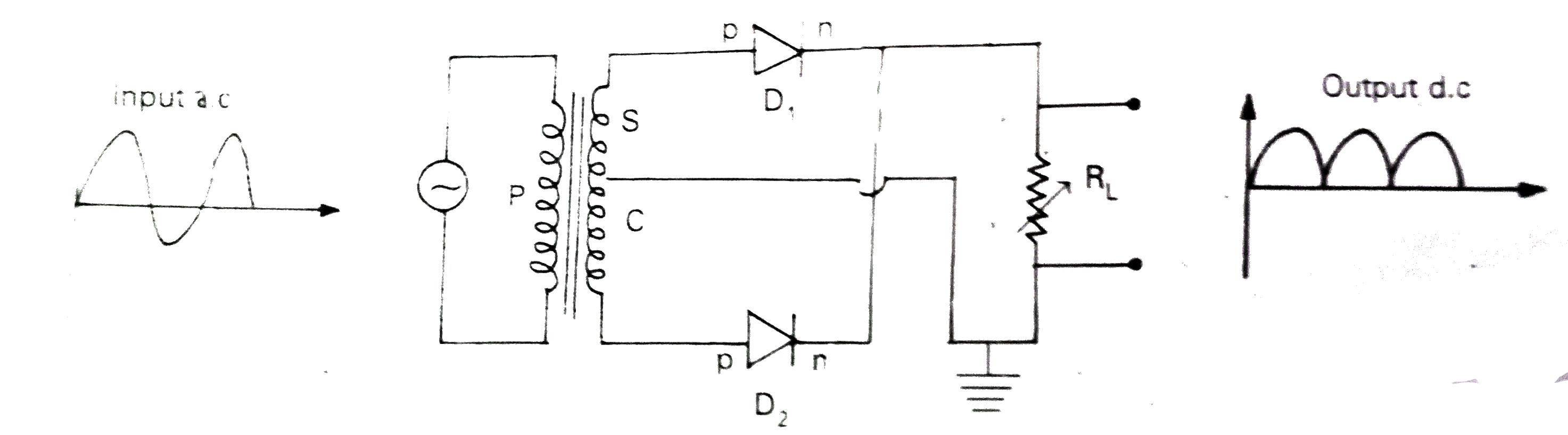 (i) A full wave rectifier can be constructed with the help of two diodes `D_(1)` and `D_(2)`. (ii) The secondary transformer is centre tapped at C and its ends are connected to the p regions oftwo diods `D_(1)` & `D_(2)`. (iii) The OUTPUT voltage is measured across the load resistance `R_(L)`. (iv) During positive half CYCLES of ac, the diode `D_(1)` is forward biased and current flows through the load resistance `R_(L)`. At this time`D_(2)` will be reverse biasedand will be in switch off position. (v) During NEGATIVE half cyclesof ac, the diode`D_(2)` is forwardbiased and the current flows through `R_(L)`.At this time `D_(1)` will be reverse biased and will be in switch off position. (VI) Hence positive output is obtainedfor all the input ac signals. (viii)The efficiency of a rectifier is defined as the ratio between the output dc power to theinput ac power. `eta = ( P_(dc))/(P_(ac))= ( 0.812R_(L))/( r_(f) + R_(L))` The maximumefficiencyof a full wave rectifier is `81.2%` |
|