

Saved Bookmarks
This section includes 7 InterviewSolutions, each offering curated multiple-choice questions to sharpen your Current Affairs knowledge and support exam preparation. Choose a topic below to get started.
| 1. |
Why do boron halides act as Lewis acids ? |
|
Answer» ACIDIC NATURE |
|
| 2. |
Boron compounds behave as Lewis acids because of their |
|
Answer» ACIDIC nature |
|
| 3. |
Boron compounds behave as Lewis acid because of their |
|
Answer» ACIDIC nature |
|
| 4. |
Boron carbide, B_(4)C is widely used |
|
Answer» in making ACETYLENE 
|
|
| 5. |
Boron cannotform whichone of the following anions ? |
|
Answer» `BF_(6)^(3-)` |
|
| 6. |
Boron cannot form which one of the following anions? |
|
Answer» `BH_(4)^(-)` |
|
| 8. |
Boron and silicon resemble in all respect except |
|
Answer» both form acidic oxides |
|
| 9. |
Born- Hyber cycle below respesents the energy changes occurring as 298K, jwhen MO(s) is formed from its elements, wherx x, y,z, a, b,c and d are enthalpy change elements, for corresponding pro0cesses respectively DeltaH_("sub")"of" M=180kJ//mol I.E_(1)(M)=218kJ//mol I.E_(2)(M)=384kJ//mol DeltaH_("atomisation")"of" O_(2)=640kJ//mol DeltaH(OrarrO^(-))=-142kJ//mol DeltaH(OrarrO^(-2))=-844kJ//mol "Enthaply change of reaction" 2M^(2+)(g)+20^(2-)(g)rarr2MO(s), is: |
|
Answer» `-2000kJ//mol` |
|
| 10. |
Born- Hyber cycle below respesents the energy changes occurring as 298K, jwhen MO(s) is formed from its elements, wherx x, y,z, a, b,c and d are enthalpy change elements, for corresponding pro0cesses respectively DeltaH_("sub")"of" M=180kJ//mol I.E_(1)(M)=218kJ//mol I.E_(2)(M)=384kJ//mol DeltaH_("atomisation")"of" O_(2)=640kJ//mol DeltaH(OrarrO^(-))=-142kJ//mol DeltaH(OrarrO^(-2))=-844kJ//mol In terms of x,y,z,a,b, c and d enthalpy change for the reaction, 2M(s)+O_(2)(g)rarr2MO(s),is: |
|
Answer» `2x+2y+2z+2a+2b+2c+2d` |
|
| 11. |
Born- Hyber cycle below respesents the energy changes occurring as 298K, jwhen MO(s) is formed from its elements, wherx x, y,z, a, b,c and d are enthalpy change elements, for corresponding pro0cesses respectively DeltaH_("sub")"of" M=180kJ//mol I.E_(1)(M)=218kJ//mol I.E_(2)(M)=384kJ//mol DeltaH_("atomisation")"of" O_(2)=640kJ//mol DeltaH(OrarrO^(-))=-142kJ//mol DeltaH(OrarrO^(-2))=-844kJ//mol If DeltaH_(f)"of MO(s) is " -196kJ//mol then lattice energy of MO (s) will be : |
|
Answer» `-2000 KJ//mol` |
|
| 12. |
Born Haber cycle is based on |
|
Answer» LAW of CONSERVATION of MASS |
|
| 13. |
Boric aicd has polymeric layer structure in which plannar BO_(3) units are joined by |
|
Answer» COVALENT BONDS 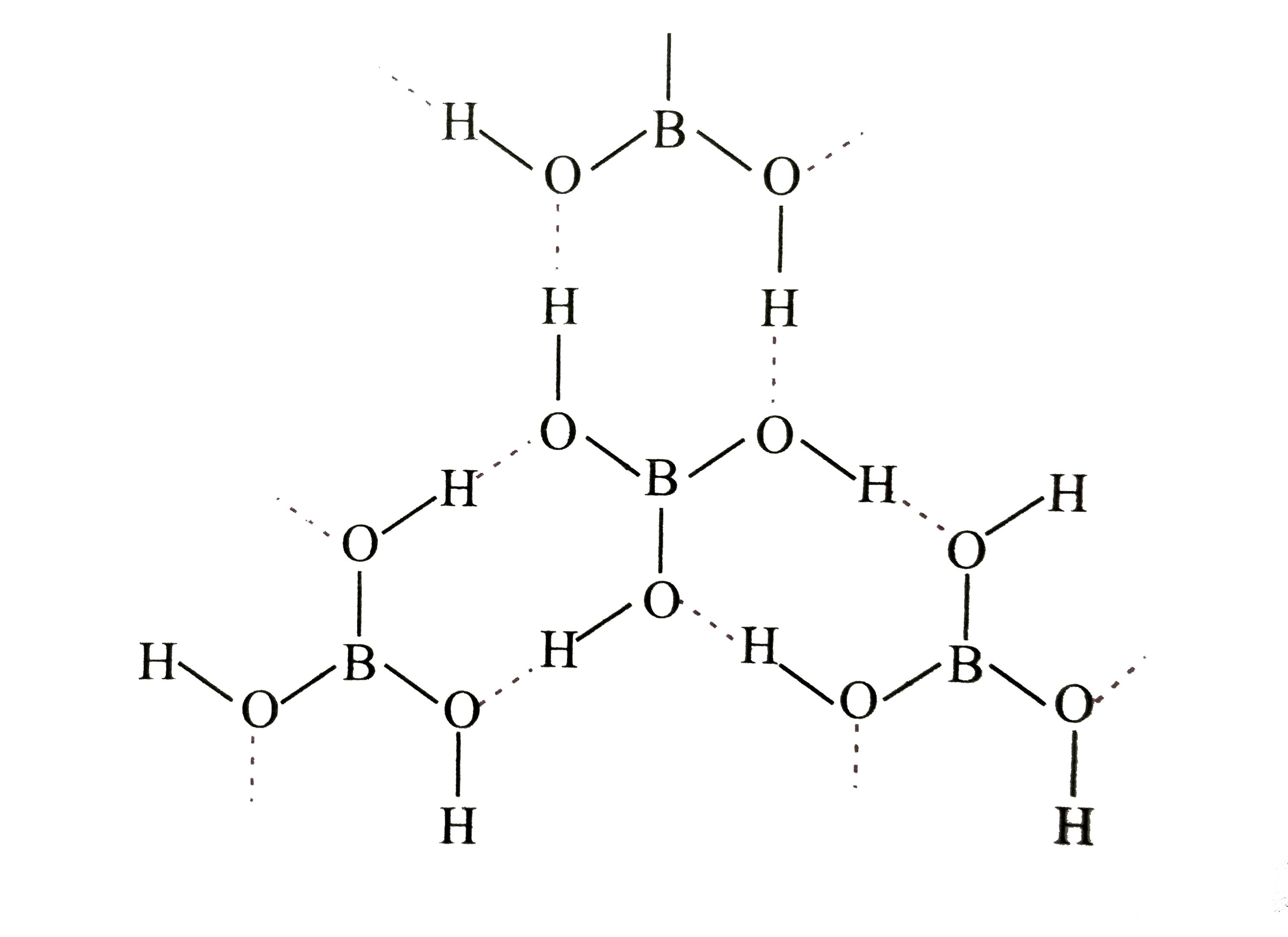
|
|
| 14. |
Boric acid on heating at 150^(@)C gives |
|
Answer» `B_(2)O_3` `4HBO_(2) overset(150^@C-160^@C)rarrH_(2)B_(4)O_(7)+H_(2)O` |
|
| 15. |
Boric acid is used in carom boards for smooth gliding of pawns because |
|
Answer» `H_(3)BO_(3)` molecules are loosely chemically bonded and hence soft |
|
| 17. |
Boric acid is prepared from borax by the action of |
|
Answer» hydrochloric ACID `overset(100^@C)rarrHBO_2overset(150-160^@C)rarrunderset("tetraboric acid")(H_2B_4O_7)` |
|
| 18. |
Boric acid is polymeric. Why ? |
| Answer» Solution :The PRESENCE of hydrogen BONDS MAKES it POLYMERIC . | |
| 19. |
Boric acid is polymeric due to (a) its acidicnature , (b) the presence of hydrogenbonds (c ) itsmonobasicnature ,(d) its geomtry |
| Answer» Solution :Boric ACIDIS polymericdue to the presence ofH-bonds. THEREFORE , option B its correct. | |
| 20. |
Boric acid is polymeric due to (a) its acidic nature , (b)the presence of hydrogen bonds (c) its monobasic nature ,(d)its geometry |
|
Answer» its acidic nature |
|
| 21. |
Boric acid is polymeric due to ….. |
|
Answer» its acidic nature |
|
| 22. |
Boric acid is polymer due to |
|
Answer» its ACIDIC NATURE |
|
| 23. |
Boric acid is an acid becauseits molecule |
|
Answer» CONTAINS replacement `H^(+)` ion 
|
|
| 24. |
Boric acidis an acid because its molecule |
|
Answer» containsreplaceable `H^(+)` ion 
|
|
| 25. |
Boric acid is an acid because its molecule.... |
|
Answer» accepts `OH^-` from WATER RELEASING proton. |
|
| 26. |
Boric acid is an acid because its molecule |
|
Answer» Contains replaceable `H^(+)` ion |
|
| 27. |
Boric acid is a very weak acid but in presence of certain organic compounds, it acts as a strong acid. Which one of the following organic compounds can affect such change? |
|
Answer» Glycerol |
|
| 28. |
Boric acid is an acid because its mole |
|
Answer» CONTAINS REPLACEABLE H^+ion |
|
| 29. |
Boric acid, H_3 BO_3 is a mild antiseptic and is often used as an eye wash. A sample contains 0.543 mol H_3 BO_3. What is the mass of boric acid in the sample?. |
|
Answer» SOLUTION :Molecular mass of `H_(3)BO_(3)=(1xx3)+(Hxx1)+(16xx3)` = 62 Boric acid SAMPLE contains 0.543 mole. Mass of 0.543 mole of Boric acid = Molecular mass `XX` mole = `62xx0.543` = 33.66 G |
|
| 30. |
Boric acid (H_(3)BO_(3)) is : |
|
Answer» tribasic |
|
| 31. |
Boric acid (H_(3)BO_(3)) has |
|
Answer» Trigonal STRUCTURE |
|
| 32. |
Boric acid (H_(3)BO_(3)) has Alumnium and its compounds |
|
Answer» Trigonal sttructure |
|
| 33. |
Boric acid (H_3 BO_3) has |
|
Answer» Trigonal STRUCTURE |
|
| 34. |
Boric acid can be titrated against sodium hydroxide using methyl orange as indicator only in thepresence of polyhydroxy compound like catechol, mannitol, etc. Explain . |
|
Answer» Solution :`B(OH)_(3)` reacts with `NaOH`to formsodium METABORATE. `B(OH)_(3) + NaOH rarr Na^(+) BO_(2)^(-) + 2H_(2)O` The end pointduringthe titrationof `H_(3)BO_(3)` with `NaOH`is not SHARP since `NaBO_(2)` undergoesexcessive HYDROLYSIS to give back `H_(3)BO_(3)` and `NaOH` `NaBO_(2) + 2H_(2)O hArr B(OH)_(3) + NaOH` HOWEVER,when certainpolyhydroxycompounds such as catechol, glycerol, mannitol or sugarsor any other cis-1,2,3is added totitration solution, the metaborate ION combaines withpolyhydroxy compound toform a complex.  Due to formation of this complex, `BO_(2)^(-)` ion does not undergo hydrolysis. As a result, boric acid betweenas a strongmonobasicacid and the end point can thus be easily detected. |
|
| 35. |
Boric acid B(OH)_(3) is weak monobasic acid reacts with alkali to form borates. The most common borate of boric acid is borax represented as Na_(2)(B_(4)O_(5)(OH)_(4)).8H_(2)O which is made up of two tetrahedral and two triangular units. On dissolution in water, these tetrahedral and triangular units are sepeated. Borax is useful primary standard for titra tion against acids.Oxidation state of boron atom in borax is / are |
|
Answer» `+3` only `4x = 12 implies x =+3` |
|
| 36. |
Boric acid B(OH)_(3) is weak monobasic acid reacts with alkali to form borates. The most common borate of boric acid is borax represented as Na_(2)(B_(4)O_(5)(OH)_(4)).8H_(2)O which is made up of two tetrahedral and two triangular units. On dissolution in water, these tetrahedral and triangular units are sepeated. Borax is useful primary standard for titra tion against acids.The number of B - O - B linkage in borax is / areThe number of B - O - B linkages = |
|
Answer» 2  The NUMBER of `B-O-H` LINKAGES = 5 |
|
| 38. |
Borazine is called 'inorganic benzene' in view of its ring structure with alternate BH and NH groups. Which of the following statements is correct about borazine ? |
|
Answer» Each B and N atom is `sp^(2)` HYBRIDIZED  `6PI` electrons, B and N undergoes `sp^(2)` hybridisation. Borazine posses polar bonds, NUMBER of electrons same in benzene and borazine. |
|
| 39. |
Borax when heated on platinum wire forms a glass like bead which is made up of : |
|
Answer» SODIUM tetraborated `Na_(2)B_(4)O_(7). 10 H_(2)O OVERSET("heat")RARR Na_(2)B_(4)O_(7) overset("heat")rarr underset("Transparent bead")(2NaBO_(2) + B_(2)O_(3))` |
|
| 40. |
Borax is used in |
|
Answer» QUALITATIVE analysis |
|
| 41. |
Borax is used as |
|
Answer» PRESERVATIVE |
|
| 42. |
Borax is Na_(2)B_(4)O_(7).10 H_(2)O consider the following statements about boran |
|
Answer» 2 boran atoms have 4 B - O BONDS where as other two have 3 B - O bonds |
|
| 43. |
Borax is coverted into crystalline boron by the following steps Borax overset("X")rarr H_(3)BO_(3)overset("Y")underset(Deltas)rarr B. X and Y are respectively |
|
Answer» HCl , Cu |
|
| 44. |
Borax glass is a mixture of |
|
Answer» `NaBO_2+B_(2)O_3` `underset("[sodium meta borate + BORIC anhydride]")(NaBO_2+B_(2)O_3)` |
|
| 45. |
Borax bead test is not given by |
|
Answer» Copper SALTS |
|
| 46. |
Borax bead is a mixture of |
|
Answer» `NaBO_2 + B_2 O_3` |
|
| 47. |
Boranes have general formula |
|
Answer» `B_(N)H_(n+2)` |
|
| 48. |
Boran forms a number of hydrides having the general formulae BnH_(n+4) and BnH_(n+6). These are called boranes the simplest hydride of boran is diborane. Borane contains special types of bonds known as multicentric bonds. Borans have high heat of combustion.Which hydrid doesnot exist. |
| Answer» Solution :`BH_(3)` because of its structure. | |
| 49. |
Boran Nitride is not isoelectronic with ? |
|
Answer» `C_(2)` |
|
| 50. |
Boran forms a number of hydrides having the general formulae BnH_(n+4) and BnH_(n+6). These are called boranes the simplest hydride of boran is diborane. Borane contains special types of bonds known as multicentric bonds. Borans have high heat of combustion.From B_(2)H_(6), all the following can be prepared, except |
|
Answer» `H_(3)BO_(3)` |
|