Saved Bookmarks
This section includes 7 InterviewSolutions, each offering curated multiple-choice questions to sharpen your Current Affairs knowledge and support exam preparation. Choose a topic below to get started.
| 1. |
Choose the incorrect statement |
|
Answer» Empirical formula shows the actual NUMBER of atoms of different ELEMENTS in one MOLECULE of the compound |
|
| 2. |
Choose the incorrect pari: |
|
Answer» Photochemical smog : `NO_(2)` and `O_(3)` |
|
| 3. |
Choose the incorrect pair. |
|
Answer» `-OH, -SH, -NH_(2)` Positive mesomeric effect |
|
| 4. |
Choose the incorrect pair. |
|
Answer» 1) Work is defined as force MULTIPLIED by the DISPLACEMENT : -w=F. x |
|
| 5. |
Choose theIncorrect pair |
|
Answer» Acid MAKING elements : S,P |
|
| 6. |
Choose the disprotionation reaction among the following redox reactions |
|
Answer» `3 Mg (s) N_(2)(g)rarrMg_(3)N_(2)(s)` |
|
| 7. |
Choose the disproportionation reaction among the following redox reactions. |
|
Answer» `3Mg_((s))+N_(2_((g))) to Mg_(3)N_(2_((s)))`. |
|
| 9. |
Choose the corrent pair. |
|
Answer» `H_(2(G)) + I_(2(g)) hArr 2HI_((g)) : Delta n_(g) = -ve` |
|
| 10. |
Choose the correct statement (s) (i) The energy of an electron in an atom is always negative, because it is negatively charged. (ii) The charge of an electron in an atom is positive (iii) When an electron is at an infinite distance from the nucleus so that there is no electrical interaction , then orbitarily the energy of electron is taken to be zero (iv) As the electron moves closer to the nucleus, energy is released and so its energy becomes less than zero i.e., negative. |
|
Answer» all are correct |
|
| 11. |
Choose the correct statements from the following: |
|
Answer» Beryllium is not readily attacked by acids because of the PRESENCE of an oxide film on the surface of the METAL. LIKE `Al_(2)O_(3), BeO` is amphoteric in nature. |
|
| 12. |
Choose the correct statements from the following . |
|
Answer» Beryllium is not readilyattacked by ACIDS because of the presence of an oxide film on the SURFACE of the METAL . |
|
| 13. |
Choose the correct statements from the following : |
|
Answer» Beryllium is not READILY attacked by acids because of the presence of an oixde film on the surface of the metal |
|
| 14. |
The correct statement among the following |
|
Answer» A node is a POINT in space where the wave-funtion Y has zero AMPLITUDE . number of radial nodes = n-l-1 nodes of peaks = n-1 |
|
| 15. |
Choose the correct statement(s) amongthe following : |
|
Answer» Internal energyof `H_(2)O` remainsconstantduringconverstion of liquid into its vapour at connstant TEMPERTURE . |
|
| 16. |
Choose the correct statement(s) |
|
Answer» The MAXIMUM positive oxidation state shown by any element is equal to the TOTAL number of electrons (s and p) in valence shell |
|
| 17. |
Choose the correct statements: |
|
Answer» Temperature, enthalpy and entropy are state functions (b) `Delta T = 0 rArr Delta E = Delta H= 0` (c ) even if `Delta n_(g) = 0, S` may change (d) Reversible isothermal, `Delta S = (q_("rev"))/(T) = R "ln" (V_(2))/(V_(1)) = R "ln " (P_(1))/(P_(2))` |
|
| 18. |
Choose the correct statements |
|
Answer» Except beryllium ,all other alkaline EARTH metals combine with hydrogen on heating to GORM hydirde `(MH)_(2)` |
|
| 19. |
Choose the correct statement(s) : |
|
Answer» Large REDUCING nature of Be is due to large hydration energy and large VALUE of enthalpy of atomization |
|
| 20. |
Choose the correct statement The use of .^(12)C scale has superseded the older scale of atomic mass based on .^(16)O isotope, one important advantage of the former being |
|
Answer» The atomic masses on `.^(12)C` scale BECAME whole numbers. |
|
| 21. |
Choose the correct statement The use ""^(12)C Scale has suspended the older scale of atomic mass based in ""^16O isotope, one important advantage of the former being |
|
Answer» the atomic masses on `""^12C` scale became WHOLE NUMBERS. |
|
| 22. |
Choose the correct statement (s) regarding the given compound |
|
Answer» It will not show G.I.  Restricted ROTATION across Restricted ROTATION across this bond show geometrical isomers becomse all conditions are statified. `to` It has 2 DBE |
|
| 23. |
Choose the correct statement/s: |
|
Answer» PH of ACIDIC buffer SOLUTION decreases if more salt is added |
|
| 24. |
Choose the correct statement from the ones given below for the two anilinium ion structures . |
|
Answer» II is not acceptable canonical structure because carbonium ions are less stable than AMMONIUM ions. |
|
| 25. |
Choose the correct statement for the reaction |
|
Answer» (B) is formed more rapidly at higher (b) Undergoes INTERMOLECULAR H-bonding. |
|
| 26. |
Choose the correct statement. |
|
Answer» 1) Raoult's law is applicable to volatile SOLID solute in liquid solvent |
|
| 27. |
Choose the correct statement |
|
Answer» In REDOX reaction, number of ELECTRONS lost is more than number of electrons gained |
|
| 28. |
Choose the correct statement . |
|
Answer» Ce , Gd , U are Lanthanoids |
|
| 29. |
Choose the correct set of True/False for following statements |
|
Answer» Silver chloride in mor soluble in very concentrated sodium choride SOLUTION than in pure water. |
|
| 30. |
Choose the correct reactivity order from the following |
|
Answer» `-CONH_(2) gt -COOR gt -NO_(2) gt -X gt -R` |
|
| 31. |
Choose the correct pari: |
|
Answer» CCF : GREEN house effect |
|
| 32. |
Choose the correct pair. |
|
Answer» Chlorobenzene + chloral : DDT |
|
| 33. |
Choose the correct pair. |
|
Answer» `"(a)"+C(CH_(3))_(3) gt .^(+)CH(CH_(3))_(2) gt CH_(2) - CH_(3) gt CH_(3)` Relative stability of CARBOCATION |
|
| 34. |
Choose the incorrect pair |
|
Answer» SODIUM carbonate : `Na_(2)CO_(3)` |
|
| 35. |
Choose the correct pair. {: ( "(a) Homolytic clevage : ", " carbocation"),( "(b)Homolytic clevage : ", " carbanion") , ("(c) Homolytic clevage : " , "free radicals"),(" (d)Hetrolytic clevage :" ,"free radicals"):} |
|
Answer» |
|
| 36. |
Choose the correct pair |
|
Answer» Fluorine oxidation state is -1 |
|
| 37. |
Choose the correct order regarding the bond order : |
|
Answer» `O_2^(2-) GT O_2^(+) gt O_2^(-) gt O_2` `O_2^(+) = 2.5, O_2= 2, O_2^(-) = 1.5, O_2^(2-) = 1` |
|
| 38. |
Choose the correct order of ionization energy. |
|
Answer» `NgtOgtF` |
|
| 39. |
Choose the correct order of atomic redii of flourine and neon (in pm) out of the options given below and justify your answer. {:((i) 72"," 160, (ii) 160","160),((iii) 72","72, (iv) 160"," 72):} |
| Answer» Solution :Atomic RADIUS of F is smaller than that of NEON. Therefore, option (i) 72, 160 is correct. | |
| 40. |
Choose the correct order of atomic radii of fluorine and neon (in pm) out of the options given below and justify your answer. (i) 72, 160 (ii) 160, 160 (iii) 72, 72 (v) 160 ,72 |
| Answer» Solution :Atomic radius of F is expressed in terms of covalent radius while, atomic radius of neon is USUALLY expressed in terms of van der WAALS. radius. van der Waals. radius of an element is always larger than its covalent radius. THEREFORE, atomic radius of F is smaller than atomic radius of Ne (F = 72 PM, Ne = 160 pm) | |
| 41. |
Choosethe correctorder ofatomic radiiof fluorineand neon (in pm)out of theoptionsgivenbelow and justifyyouranswer. (i)72, 160(ii)160,160(iii)72, 72(iv)160 ,72 |
| Answer» SOLUTION :F has acovalentradiu whileNe hasa van derWaalsradius . Sinceby definitionvan derWaalsradiiarebiggerthan covalentradiithereforeatomicradiusof F issmaller(72 PM) whileNe (160pm) hasbiggeratomicradius . Thusoption (i) ISCORRECT . | |
| 42. |
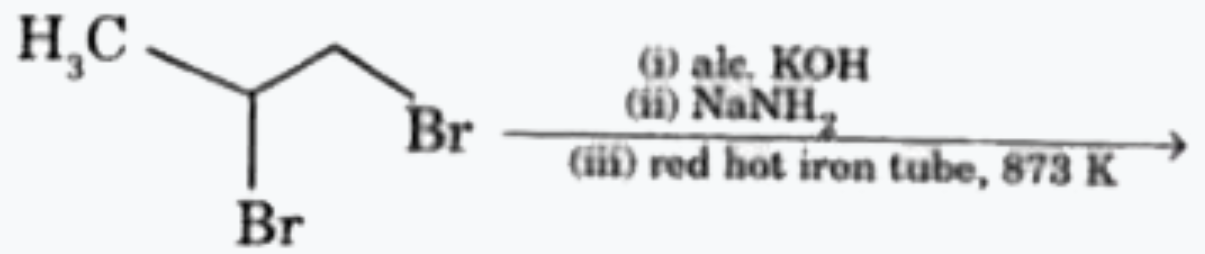
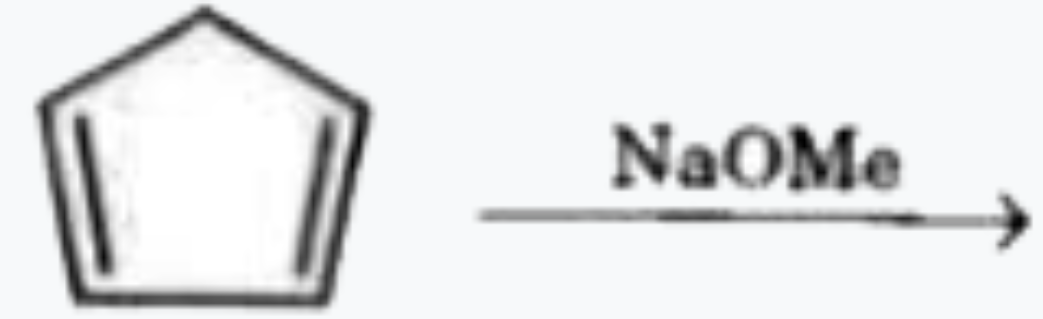
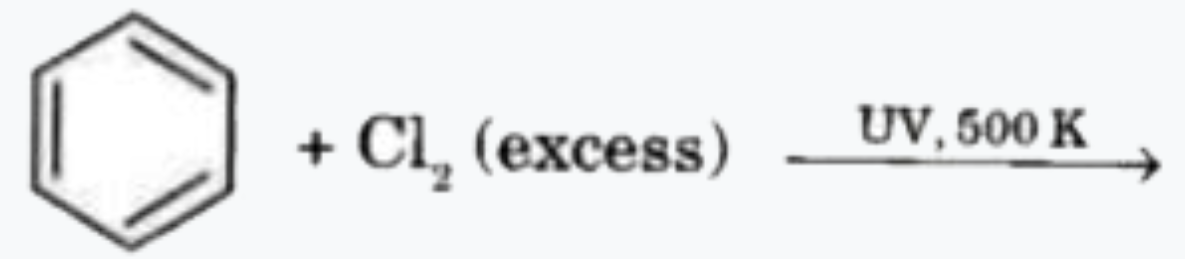
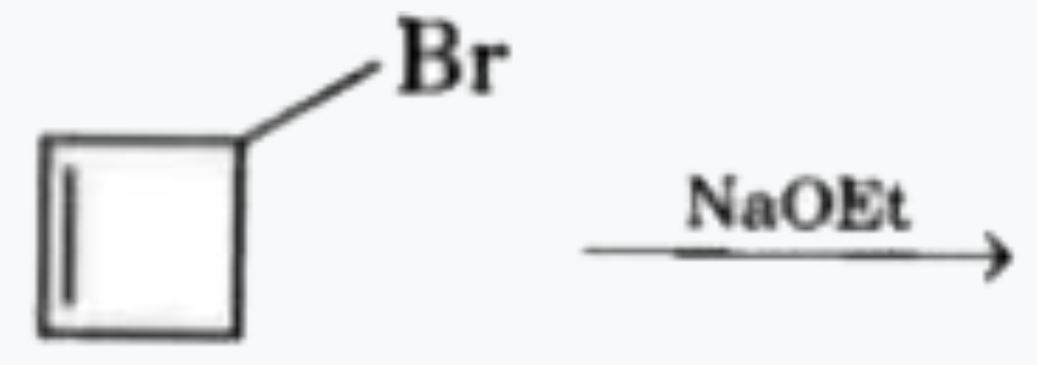
Choose the correct option(s) that give(s) an aromatic compound as the major product. |
|
Answer»

|
|
| 43. |
Choose the correct options: |
|
Answer» Favourable conditions for formation of graphite are high pressure and low TEMPERATURE from equilibrium diamond `(d=3.5g//ml)hArr` graphite `(d=2.3g//ml),Delta=-1.9kJ//"mole"` |
|
| 44. |
Choose the correct option : T stands for True, F stands for False (A) d-block elements are known as transition metals. (B) Ionization enthalpy of Be gt B. (C) Elements of Group-1 exhibit only +1 oxidation state. (D) Group 17 contains only gaseous elements |
|
Answer» TFTF |
|
| 45. |
Choose the correct option. T stands for True and F stands for False. (i) Tritium can be obtained from natural sources. (ii) In ionic hydride, the oxidation state of hydrogen is +1. (iii) The four atoms of oxygen in H_2O_2 are in the same plane. (iv) Na_2Co_3 removes temporary and permanent hardness of water. |
|
Answer» TFFF |
|
| 46. |
Choose the correct option from the following to prevent soil pollution. |
|
Answer» Use CHEMICAL fertilizers in the farm. |
|
| 47. |
Choose the correct option for the reaction given below. C_(6) H_(12) O_(6(s)) + 6O_(2(g)) to 6CO_(2(g)) + 6H_(2) O_((l)) |
|
Answer» `Delta H lt Delta U` |
|
| 48. |
Choose the correct option for bond order and stability for Be_(2) molecule. |
|
Answer» 2, stable |
|
| 49. |
Choose the correct option as directed. |
|
Answer» `CsH gt KH gt NaH gt LIH` (Order of stability) The stability of the HYDRIDES of the elements from a particular group decreases with increasing atomic number (going down the group). `CH_(4)lt NH_(3)lt H_(2)O` Dipole moment depends upon the difference between the electronegativities of the bonded ATOMS, and the internuclear separation. `PH_(3)lt AsH_(3)lt NH_(3)lt SbH_(3)` Boiling point increases with an increase in molecular mass, `NH_(3)` being an exception because of strong hydrogen bonding. `Cl lt S lt N lt O lt F` The strength of hydrogen bonding depends upon the ELECTRONEGATIVITY and the size. Higher electronegativity and smaller size increases the strength of hydrogen bonding. |
|