Saved Bookmarks
This section includes 7 InterviewSolutions, each offering curated multiple-choice questions to sharpen your Current Affairs knowledge and support exam preparation. Choose a topic below to get started.
| 1. |
Choose the correct match. |
|
Answer» `18mlH_(2)O` at `4^(@)C` contains `6.023xx10^(24)` electrons b) 11200 ml = 0.5 moles of `CO_(2)` = 1 moles of O atoms c) 5600 ml at 2 atm implies 11200 at 1 atm = 0.5 moles of `CH_(4)=4xx0.5` = 2 moles of H atoms d) 5600 ml at STP implies 0.25 moles of `CH_(4)` molecules |
|
| 2. |
Choose the correct enol content order of the following compounds in their pure liquid state I) CH_(3)COCH_(3)II) CH_(3)COCH_(2)COOC_(2)H_(5)III) C_(6)H_(5)COCH_(2)COOC_(2)H_(5) IV) CH_(3)COCH_(2)COCH_(3)V) C_(6)H_(5)COCH_(2)COCH_(3) |
|
Answer» II gt III gt IV gt I gt V 
|
|
| 3. |
Choose the correct answer.A thermodynamic state function is a quantity |
|
Answer» USED to DETERMINE heat changes |
|
| 4. |
Choose the correct answerWho proposed the dual nature of light to all forms of matter? |
|
Answer» JOHN Dalton |
|
| 5. |
Choose the correct answerWhich one of the following is the time independent Schrodinger wave equation? |
|
Answer» `/_\x./_\pgt=H/(4PI)` |
|
| 6. |
Choose the correct answerWhich one of the following is the Correct increasing order of the effective unclear Charge felt by an electron ? |
|
Answer» `sgtpgtdgtf` |
|
| 7. |
Choose the correct answerWhich of the following provides the experimental justification of magnetic quantum number? |
|
Answer» ZEEMAN EFFECT |
|
| 8. |
Choose the correct answerWhich of the following is the expected configuration of Cr (Z = 24)? |
|
Answer» `1s^(2)2S^(2)2P^(6)3s^(2)3p^(6)3d^(4)4s^(2)` |
|
| 9. |
Choose the correct answerWhich of the following is the actual configuration of Cr (Z = 24)? |
|
Answer» `1s^(2)2s^(2)2P^(6)3s^(2)3p^(6)3d^(4)4s^(2)` |
|
| 10. |
Choose the correct answerWhich of the following experiment proves the presence of an electron in an atom |
|
Answer» Rutherford's x-ray SCATTERING experiment |
|
| 11. |
Choose the correct answerWhich of the following is not use in writing electronic configuration of an atom? |
|
Answer» AUFBAU PRINCIPLE |
|
| 12. |
Choose the correct answerWhat are the values of n,l, m and s for 3Px electron? |
|
Answer» 3,2,1,0 |
|
| 13. |
Choose the correct answer in each of the followingand explain with reason(i)NaCl, KCl, MgCl_(2), CaCl _(2)- most ionic (ii) Ba to Ba^(2+)-, Be to Be^(2+), Cs to Cs^(+), Li^(+)-maximum ionization energy (iii)AlCl_(3), All_(3), MgI_(2), NaI - most covalent (iv) RbF, CsF, NaF, KF - highest lattice energy (v)Li^(-), Be^(-), B^(-), C^(-) - least stable species (vi)CIO_(3) ,XeF_(4), SF_(4), I_(3)^(-) - maximum number of lone pairs of electrons on central atom |
|
Answer» Solution :(i) KCl - on the basis of Fajan's rule that larger the size of the cation greater is the ionic bonding . Here , the cation ` K^(+)`has largestsize (anion `Cl^(-)` is same in all cases ) (ii) ` Be to Be^(2+)` has MAXIMUM ionization energy becausesmaller the atom , more is the energy needed to remove the electron, i.e., ionization energy , Also , removal of two electrons requires more energy . (iii) `AII_(3)` on the basis of Fajan's rules (IV) `Be^(-)`- This is becuae`Li^(-) = 1s^(2) 2x^(2), Be^(-) =1s^(2) 2s^(2)SP^(1)` In `Li^(-)`, addition of electron has taken place in 2s orbital . In ` Be^(-)` , addition of electron has taken place in 2p orbital leaving its 2s orbital COMPLETELY filled `EA_(1)` for Beis more positivethen ` EA_(1) for Li` . Thus , ` Be^(-)` is LEAST stable (vi) ` I_(3)^(-)`- No of lone pairs of electrons are ` I_(3)^(-) = 3 ,XeF_(4) = 2, SF_(4) = 1, CIO_(3)^(-) = 1 ` |
|
| 14. |
Choose the correct answerIdentify the quantum number for 4dx2-y2 electron |
|
Answer» 4,2,-2, +1/2 |
|
| 15. |
Choose the correct answerHow many Orbitals are possible in 3rd energy level? |
|
Answer» 16 |
|
| 16. |
Choose the correct answer for the reaction,N_2(g) +3H_2(g) -> 2NH_3(g), Delta_rH = -91.8 kJmol^-1The concentration of H_2(g) at equilibrium can be increased by |
|
Answer» LOWERING the temperature |
|
| 17. |
Choose the correct answer. A thermodynamic state function is a quantity (i) used to determine the heat changes (ii) whose value is independent of path (iii) used to determine pressure - volume work (iv)whose the value depends on temperature only. |
| Answer» SOLUTION :WHOSE VALUE is INDEPENDENT of PATH | |
| 18. |
Choose the correct alternative (more than one may be correct)(B.M.C.=Bimolecular collision)(at constantV) (n-is constant throughout). |
|
Answer» `LAMBDA` is constant. |
|
| 19. |
Choose the correct answer. A thermodynamic state function is a quantity.... |
|
Answer» used to determine HEAT changes. |
|
| 20. |
Choose incorrect option(s) for the given reaction: |
|
Answer» `A(s)+B(g)hArrC(g)`: At equilibrium, if pressure is INCREASED, no effect on equilibrium. |
|
| 21. |
Choose correct statements (s) regarding the following reactions. Cr_(2)O_(7)^(2-)(aq)+3SO_(3)^(2-)(aq)+8H^(+) rarr 2Cr^(3+)(aq)+3SO_(4)^(2-)(aq)+4H_(2)O |
|
Answer» `Cr_(2)O_(7(aq))^(2-)+3SO_(2(g))+2H_((aq))^(+)rarr 2Cr_((aq))^(3+) rarr 2Cr_((aq))^(3+)+3SO_(4(aq))^(2-)+H_(2)O_((l))` OXIDATION half equation : `SO_(2)+2H_(2)O rarr SO_(4)^(2-)+4H^(+)+2e^(-)`...(i) Reduction half equation : `Cr_(2)O_(7)^(2-)+14H^(+)+6e^(-)rarr 2 Cr^(3+)+7H_(2)O` ...(II) MULTIPLYING eqn. (i) by 3 and adding to eqn. (ii) we get `Cr_(2)O_(7)^(2-)+3SO_(2)+2H^(+) rarr 2 Cr^(3+)+3SO_(4)^(2-)+H_(2)O` |
|
| 22. |
Choose correct ordect orders: |
|
Answer» `BeSO_(4)ltMgSO_(4)LT CaSO_(4)ltSrSO_(4)ltBaSO_(4)` |
|
| 23. |
Choose correct option to match column-A with column-B |
|
Answer» `(i) rarr d, (ii) rarr f, (iii) a, (iv) rarr b`<BR>`(i) rarr d, (ii) rarr c, (iii) E , (iv) rarr f` (ii) `underset("n-butane")(CH_(3)CH_(2)CH_(2)CH_(3)) overset(AlCl_(3))rarr underset("isobutane(g)")(CH_(3)- underset(underset(CH_(3))(|))(CH)-CH_(3))` (iii) `CH_(3)CH_(2)Br + KOH overset("alcohol")rarr underset("ethene")(H_(2)C=CH_(2)) + KBr + H_(2)O` (iv) `CH_(2)=CH_(2) + Cl_(2) rarr CH_(2)Cl - CH_(2)Cl` 1, 2-di-chloro ethane (e) |
|
| 24. |
Choose correct option by identifyingX, Y and Z in the following reactions: X overset(Delta)to Y+CO_(2) uarr Y+Z to Ca_(3)(PO_(4))_(2) |
|
Answer» <P>`X=CaCO_(3), Y=CaO, Z=P_(4)O_(6)` `underset("oxide")underset("Calcium")underset((Y))(6CaO_((s)))+underset("pentoxide")underset("Phosphorous")underset((Z))(P_(4)O_(10(s))) overset(Delta)to underset("PHOSPHATE")underset("Calcium")(2Ca_(3)(PO_(4))_(2(s)))` |
|
| 25. |
[{:(CH(OH)COOH),(|),(CH(OH)COOH):}] on reduction with HI consumed four moles of HI. The reduction product formed is |
|
Answer» `CH_(3)CH_(2)CH_(2)CH_(3)` |
|
| 26. |
(A) & (B)are isomers ,Isomer (B) is : |
|
Answer»

|
|
| 27. |
CHO - CHO overset(-OH)rarr? |
|
Answer» `CH_(3)OH + CH_(3)OH` This is CALLED as Internal Cannizzaro's Reaction |
|
| 28. |
Chloropicrin is used as ………………… . |
| Answer» SOLUTION :SOIL STERILIZING AGENT | |
| 29. |
Chloropicrin is prepared by adding nitric acid to_____ |
| Answer» Solution :`CHCl_(3)` | |
| 30. |
Chlorophyll, the green colouring matter of plants contains 2.68% of magnesium by mass. Calculate the number of magnesium atoms present in 2.5 g of chlorophyll. |
|
Answer» |
|
| 31. |
Chlorophyll present in green leaves of plants absorbs light at 4.620 xx 10^(14) Hz. Calculate the wavelength of radiation in nanometer. Which part of the electromagnetic spectrum does it belong to ? |
|
Answer» Solution :`lambda=(c )/(V)=(3.0 xx10^(8)) (ms^(-1))/(4.620 xx10^(14) HZ)` `0.6494 xx10^(-4) m` =649.4 nm visiblelight |
|
| 32. |
Chlorophyll present in green leaves of plants absorbs light at 4.620 xx 10^(4)Hz. Calculate the wavelength of radiation in nanometer. Which part of the electromagnetic spectrum does it belong to ? |
| Answer» SOLUTION :`lamda = (c)/(v) = (3.0 XX 10^(8) ms^(-1))/(4.620 xx 10^(14) s^(-1)) = 0.6494 xx 10^(-6) m = 649.4 xx 10^(-9) m = 649.4 NM` Thus, it lies in the visible light | |
| 33. |
Chlorophyll is a compound of calcium. |
|
Answer» |
|
| 35. |
Chlorophy in greenplantabsorbthe light4.620 xx 10^(14) Hzthen findthe lengthof thedline andalsostatethe regionin spectra. |
| Answer» SOLUTION :`649.4 nmvisiblespectrum | |
| 36. |
Chloroform reacts with nitric acid to produce |
|
Answer» NITRO toluene |
|
| 37. |
Chloroform reacts with nitric acid to produce …………………… . |
|
Answer» nitro-toluene |
|
| 38. |
Chloroform is passed from methane according to the reaction : CH_(4)(g) + 3Cl_(2)(g) rarr CHCl_(3)(l) + 3HCl(g) Calculate Delta Hfor the reaction given that enthalpies of formation of HCl(g), CH_(4)(g)and CHCl_(3)(g) are - 92.0 ,-74.9 and -134.3kJ per mole respectively. |
|
Answer» `[ ( - 134.3) + 3 (-92.0 ) ]-[( - 74.9 ) + 0]` ` = - 335.4kJ MOL^(-1)` |
|
| 39. |
Chloroform is kept with a little ethyl alcohol in a dark coloured bottle. Why? |
|
Answer» Solution :(i) Chloroform is slowly oxidised by air in the presence of light to an extremely poisonous gas, carboxyl chloride (phosgene), it is therefore stored in closed dark COLOURED bottles completely filled so that air is kept out. (II) With the use of 1% ethanol we can stabilise chloroform, because ethanol can convert the poisonous `COCl_2`gas into non poisonous diethyl CARBONATE. `COCl_2 + 2C_2 H_5OH to CO(OC_2H_5)_2 + 2HCl` |
|
| 40. |
Chloroform is kept with a little ethyle alcohol in dark coloured bottle, why? |
|
Answer» Solution :(i) Chloroform is slowly oxidised by air in the presence of light to an EXTREMELY posionous gas, carboxyl chloride (phosgene), it is THEREFORE stored in closed dark coloured bottles completely filled so that air is kept out. (ii) With the USE of 1% ethanol we can stabilise chloroform, ethanol can covert the poisonous `COCl_(2)` gas into non poisonous diethyl carbonate. `COCl_(2) + 2C_(2)H_(5)OH rarr CO(OC_(2) H_(5))_(2) + 2HCl` |
|
| 41. |
Chloroform is kept with a little ethyl alcohol in a dark coloured bottle why? |
|
Answer» SOLUTION :Chloroform undergoes oxidation in the presence of LIGHT and AIR to form phosgene (carbonyl chloride). `UNDERSET("Chloroform")(CHCl_(3))+(1)/(2) O_(2) underset("light")overset("air")to underset("Phosgene")(COCl_(2))+HCl` Since phosgene is very poisonous, its presence makes chloroform unfit for use as anaesthetic. |
|
| 42. |
Chloroform is converted to methylene-chloride by the action of ……………… . |
| Answer» SOLUTION :`ZN + HCL and H_2//Ni` | |
| 43. |
Chlorofluorocarbon releases which of the following chemical harmful to ozone ? |
|
Answer» Fluorine |
|
| 44. |
Chloroethane is treated with alcoholic potassium hydroxide. The product formed is |
| Answer» Answer :C | |
| 45. |
Chlorobenzene when heated with aqueous ammonia in the presence of Cu_(2)O under pressure gives : |
|
Answer» Aniline 
|
|
| 46. |
Chlorobenzene reactws with CuCN at 523 K in the presence of ____ |
|
Answer» NaOH |
|
| 47. |
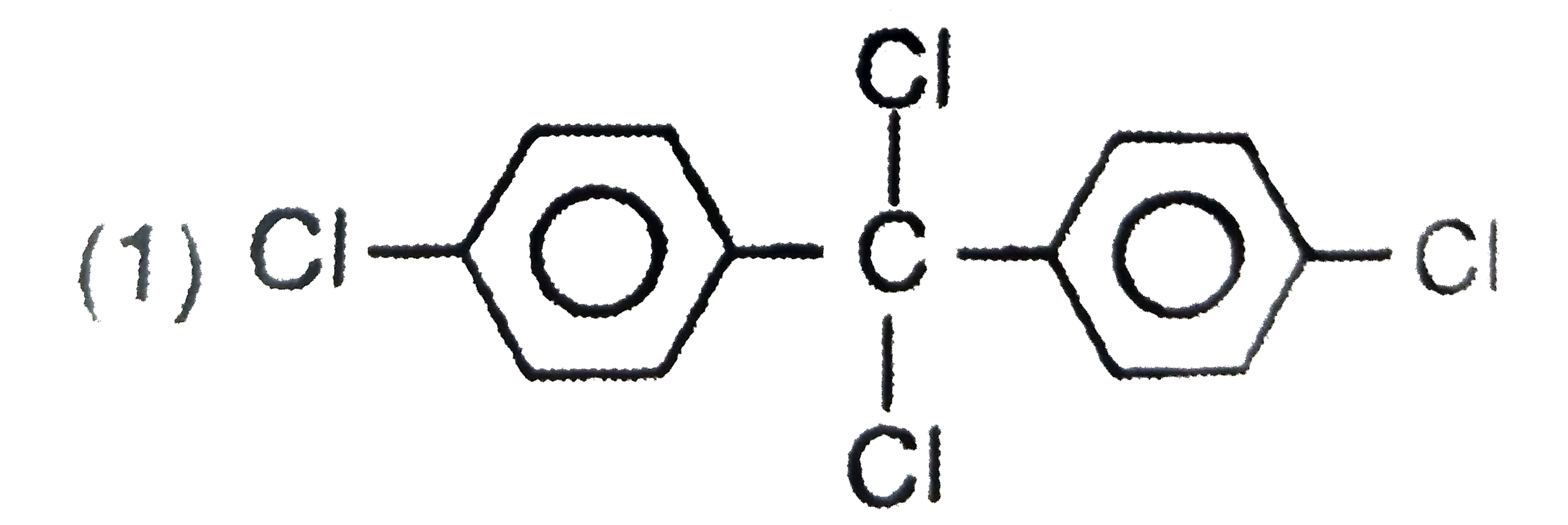
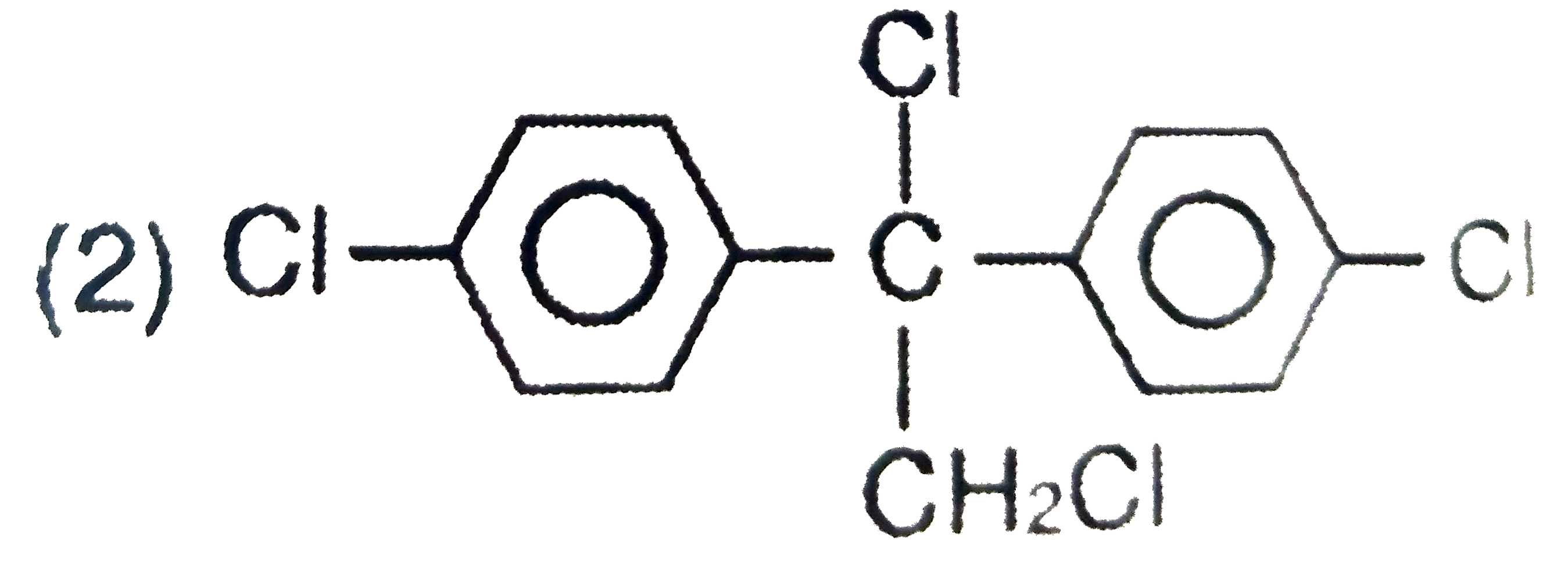
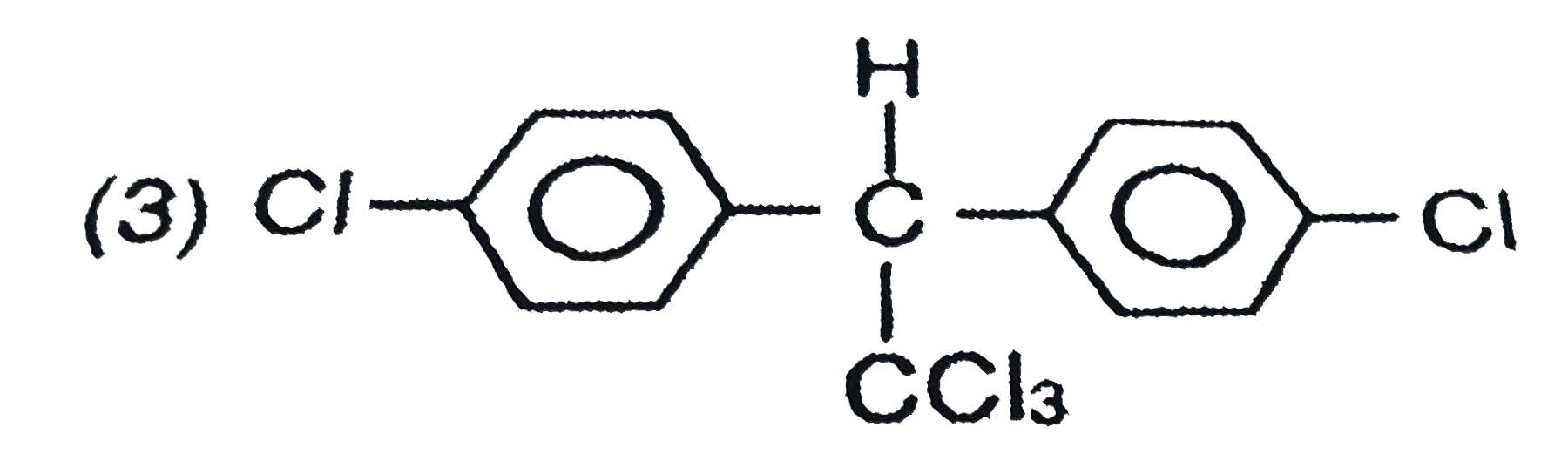
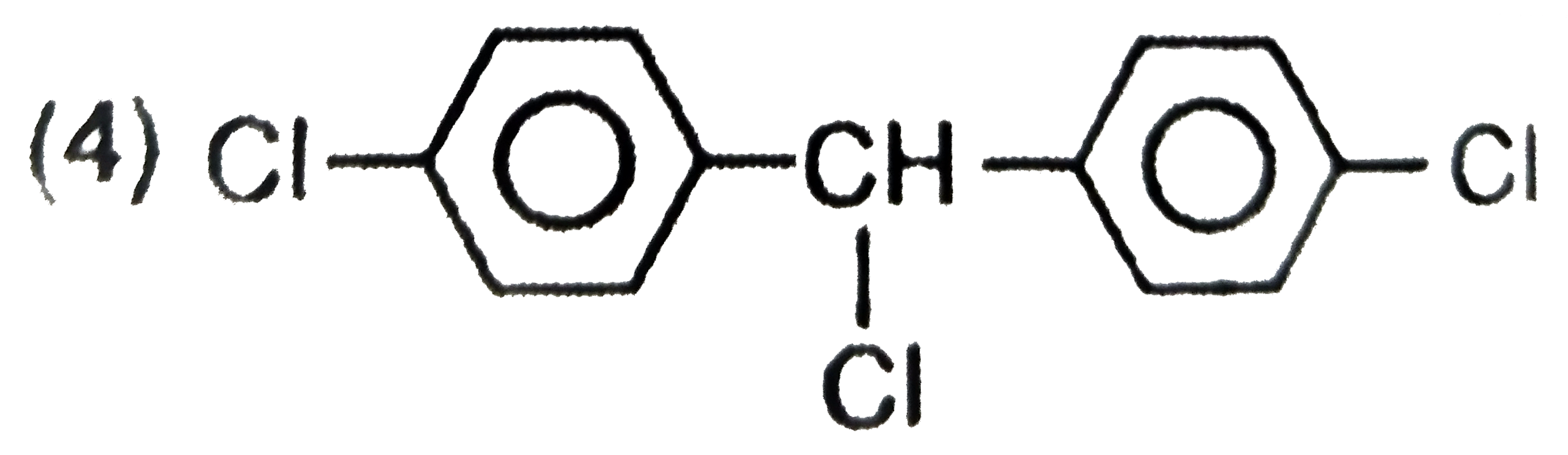
Chlorobenzene reacts with trichloroacetaldehyde in the presence of H_2SO_4 The major product formed is : |
|
Answer»
|
|
| 48. |
Chlorobenzene on treatment with sodium in dry ether gives diphenyl. The name of the reaction is |
|
Answer» FITTIG reaction |
|
| 49. |
Chlorobenzene is o,p-directing in electrophilic substitution reaction. The directing influence is explained by : |
|
Answer» `+m` of PH |
|