

Saved Bookmarks
This section includes 7 InterviewSolutions, each offering curated multiple-choice questions to sharpen your Current Affairs knowledge and support exam preparation. Choose a topic below to get started.
| 1. |
Chlorobenzene can be obtained from benzene diazonium chloride by |
|
Answer» Gattermann's REACTION 
|
|
| 2. |
Chloroacetic acid is a stronger acid than acetic acid. This can be explained using.... |
|
Answer» `-M` EFFECT |
|
| 3. |
Chloro acetic acid (molecular weight M) is converted into Cl_(2) and CO_(2). Which statement is correct? |
|
Answer» chlorine is reduced Cl is oxidized C is oxidized `E=(m)/(n-f),n-f=n-f_(cl)+n-f_(c)` `=1xx1+6xx2=13` |
|
| 4. |
Chloro benzene is.....reactive than benzene towards electrophilic substitution and directs the incoming electrophile to the............ Position |
|
Answer» More ortho/para |
|
| 5. |
Chlorine reacts with cold dilute caustic soda to give sodium chloride, sodium hypochlorite and water. |
|
Answer» Solution :a) The skeleton equation is written as `Cl_(2)+NaOHrarrNaCl +NaOCl+H_(2)O` B) Focusing on the oxidation numbers `overset(0)(Cl_(2))+overset(+1)(Na)overset(-2)(O)overset(+1)(H)RARROVERSET(+1)(Na)overset(-1)(Cl)+overset(+1)(Na)overset(-2)(O)overset(+1)(Cl)+overset(+1)(H_(2))overset(-2)(O)` c) LOCATING atoms undergoing change in oxidation numbers `overset(0)(Cl_(2))+NaOHrarrNaoverset(-1)(Cl)+NaOoverset(+1)(Cl)+H_(2)O` d) Determining the change in oxidation numbers  E) Cris - crossing these change in the oxidation numbers `Cl_(2)+NaOHrarr NaCl +NaOCl+H_(2)O` F) Balancing the atoms other than hydrogen and oxygen `Cl_(2)+2NaOHrarrNaCl +NaOCl+H_(2)O` This is the balanced equation. |
|
| 6. |
Chlorine occurs in nature in the form of the isotopes CI^35 (atomic mass = 34.969 amu) and CI^37 (atomic mass = 36.966 amu) in the ratio 75.53% and 24.47%. Calculate the average atomic mass of chlorine. |
|
Answer» |
|
| 7. |
Chlorine is used to purify drinking water. Excess of chlorine is harmful. The excess of chlorine is removed by treating with sulphur dioxide. Present a balanced equation for this redox change taking place in water. |
|
Answer» Solution :GIVEN redox reaction…. `OVERSET(0)(Cl_(2(s)))+overset(+4)(SO_(2(AQ)))+H_(2)O_((l))tooverset(-1)(Cl_((aq))^(-))+overset(+6)(SO_(4(aq))^(-2))` Half reaction … O.H.R. : `overset(+4)(SO_(2(aq)))tooverset(+6)(SO_(4(aq))^(-2))` R.H.R. : `overset(0)(Cl_(2(s)))tooverset(-1)(Cl_((aq))^(-))` Balancing while adding electron. O.H.R. : `SO_(2(aq))toSO_(4(aq))^(-2)+2e^(-)` R.H.R. : `Cl_(2(s))+2e^(-)to2Cl_((aq))^(-)` In O.H.R., balancing the H and O atom by `H_(2)O` and balancing according to MEDIUM and adding both the reaction. 
|
|
| 8. |
Chlorine is used to purify drinking water Excess of chlorine is harmful The excess chlorine is removed by treating with suphur dioxide present a balanced equation for the reaction for this redox change taking place in water |
|
Answer» SOLUTION :The skeletal equation is `CI_(2)(aq)+SO_(2)+H_(2)(l)rarrCI^(-)(aq)+SO_(4)^(2-)(aq)` Reduction HALF equation `CI_(2)(aq)rarrCI^(-)(aq)` oxidation half equation `overset(+4)SO_(2)(aq)rarroverset(+6)SO_(4)^(2-)(aq)` oxidationaddding Eq (i) and Eq (II) we have `SO_(2)(aq)+2H_(2)O(l)rarrSO_(4)^(2-)(aq)+4H^(+)(aq)+2e^(=)` adding Eq (i) and Eq (ii) we have `CI_(2)(aq)+SO_(23)+2H_(2)O(l)rarr2CI^(-)(aq)+SO_(4)^(2-)(aq)+4H^(+)(aq)` this represents the balance redox reaction |
|
| 9. |
Chlorine is used purify drinking water . Excess of chlorine is harmful . The excess of chlorine is removed by treating with sulphur dioxide . Present a balanced equation for this redox change taking place in water . |
|
Answer» Solution :The SKELETAL equation is : `Cl_2(g) +SO_2(AQ) + H_2O(l) rarr Cl^(-) (aq) +SO_4^(2-) (aq)` Reduction half equation : `Cl_2(aq) rarr Cl^(-) (aq)` Balancing Cl ATOMS `Cl_2(aq) rarr 2Cl^(-) (aq)` Balancing O. N. by adding electrons : `overset0(Cl_2)(aq)+2e^(-)rarr2Cl^(-)(aq) ""...(i)` Oxidation half equation : `SO_2(aq) rarr SO_4^(2-)(aq)` Balancing O.N. by adding electrons `OVERSET(+4)(SO_2)(aq) rarr overset(+6"")(SO_4^(2-))(aq)+2e^(-)` Balancing CHARGE adding `H^+` ions `SO_2(aq) rarr SO_4^(2-) (aq) +2e^(-) +4H^(+)(aq)` Balancing O atoms by adding `H_2O` `SO_2(aq) +2H_2O(l) rarr SO_4^(2-) (aq) +2e^(-) +4H^(+) (aq) ""...(ii)` Adding equations (i) and (ii) we gat `Cl_2(aq) + SO_2(aq) +2H_2O(l) rarr 2Cl^(-)(aq) +SO_4^(2-) (aq) +4H^(+) (aq)` |
|
| 10. |
Chlorine is prepared in the laboratory by treating manganese dioxide (MnO_2) with aqueous hydrochloric acid according to the reaction: 4HCl(aq) + MnO_(2)(s) to 2H_(2)O(l) + MnCl_(2)(aq) + Cl_(2)(g). How many grams of HCI react with 5.0g of manganese dioxide? |
|
Answer» Solution :The GIVEN reaction is: `underset("4 moles " 4 xx 36.5 = 146 g)(4HCL(aq)) + underset("1 mole " 55 + 32 = 87 g)(MnO_(2)(s)) to 2H_(2)O(l) + MnCl_(2)(aq) + Cl_(2)(g)` `therefore 87 g` of `MnO_(2)`react with HCI = 146 g `therefore 5.0 g` of `MnO_(2)` will react with HCI = `146/87 xx 5.0 = 8.39 g` |
|
| 11. |
Chlorine is prepared in the laboratory by treating manganese dioxide (MnO_(2)) with aqueous hydrochloric acid according to the reaction : 4 HCl_((aq)) + MnO_(2(s)) rarr 2H_(2)O_((l)) +MnCl_(2(aq)) + Cl_(2(g)) How many grams of HCl react with 5.0 g of manganese dioxide ? |
|
Answer» `4 xx 36.5 ""87` `87 g MnO_(2) = 4xx 36.5 g HCl` `5 g Mno-(2) = "" (?)` `= (4xx36.5 xx 5)/(87) = 8.39` gm HCl For COMPLETE reaction of 87 gm` MnO_(2)`, 8.39 g HCl |
|
| 12. |
Chlorine is prepared in the laboratory by treating manganese dioxide (MnO_(2)) with aqueous hydrochloric acid according to the reaction.4HCl_((aq))+MnO_(2)rarr2H_(2)O+MnCl_(2_((aq)))+Cl_(2_((aq)))How many grams of HCI react with 5.0 g of manganese dioxide ?Atomic mass of Mn = 55 g). |
|
Answer» Solution :1 MOLE of `MnO_(2)` = 55 + 32 =87 g. 87g of `MnO_(2)` reacts with 4 MOLES of HCI. i.e. = 4 `xx` 36.5 = 146 g of HCI. `:.` 5 g of `MnO_(2)` will react with`146/87 xx` 5.0 = 8.40 g . |
|
| 13. |
Chlorine is passed into dilute cold KOH solution. What are the oxidation numbers of chlorine in the products formed ? |
| Answer» ANSWER :D | |
| 15. |
Chlorine has two different oxidation states in which of the following compound |
|
Answer» `Cl_(6)O_(6)` |
|
| 16. |
Chlorine has +1 oxidation state in |
|
Answer» HCI |
|
| 17. |
Chlorine has fractional average atomic mass. Justify this statement. |
|
Answer» Solution :Chlorine molecule has two isotopes as in `""_(17)Cl^(35) , ""_(17)Cl^(37)` in the RATIO of 77 : 23, so when we are calculating the AVERAGE ATOMIC mass, it becomes fractional. The average relative atomic mass of Chlorine =`((35xx77)+(37xx23))/100 = 34.46` amu |
|
| 18. |
Chlorine gas is prepared by reaction of H_2SO_4 with MnO_2 and NaCl. What volume of Cl_2 will be produced at STP if 50 g of NaCl is taken in the reaction ? |
|
Answer» 1.915 L `{:("2 moles","1 MOLE"),("(2 X 58.5 = 117 G )", "22.4 L (STP)"):}` 117g of NaCl `-= 22.4L " of " Cl_2` 50g of NaCl`-=(22.4)/(117)xx50=9.57 L " of " Cl_2` at STP |
|
| 19. |
Chlorine exists in two isotopic forms, Cl-37 and Cl-35 but its atomic mass is 35.5. This indicates the ratio of Cl-37 and Cl-35 is approximately |
| Answer» Solution :If `Cl-37 and Cl-35` exist in the ratio of `1 : 3`, the average value COMES out to be 35.5 | |
| 20. |
Chlorine dioxide (CIO_(2)) is used to kill bacteria in mett soft drinks and dariy products being an unsatble compund it can be synthesized by the following reaction CI_(2) +NaCIO_(2) rarr 2CIO_(2)+2NaCI Identify the substacne oxidised and reduced |
Answer» Solution :The GIVEN redox reaction is  Here `CI_(2)` is reduced to NacI while `NaCIO_(2)` is oxidised to `CIO_(2)` |
|
| 21. |
Chlorine atoms catalyse the decomposition of ozone in the layers of earth's atmosphere and thus causing heating. This Cl comes from:- |
|
Answer» Teflon |
|
| 22. |
Chlorine atom does not differ from chloride ion in the number of which of the following? |
|
Answer» Protons |
|
| 23. |
Chlorination of toluene in presence of light and heat followed by treatment with aqueous NaOH gives |
|
Answer» <P>`o-`CRESOL 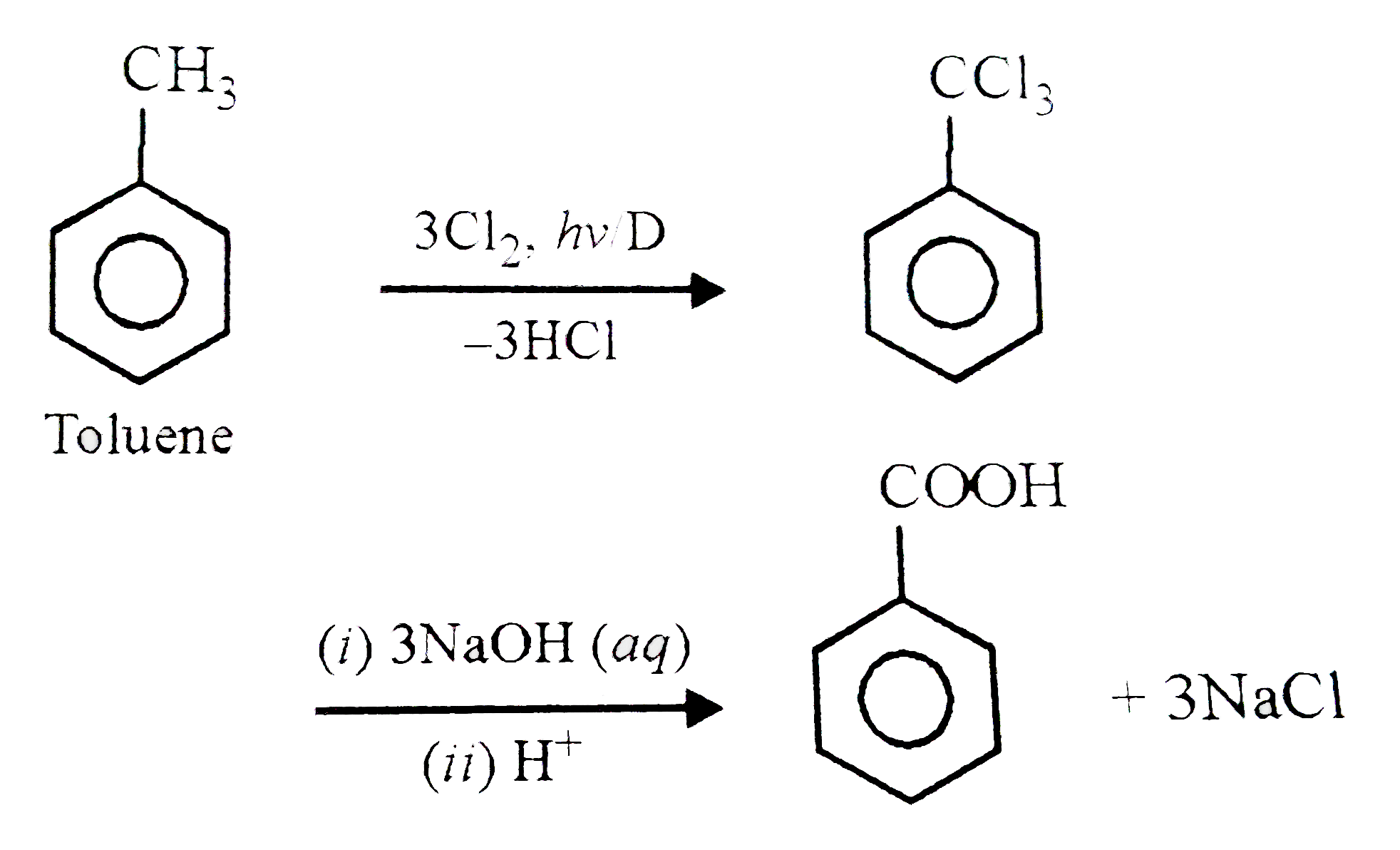
|
|
| 24. |
Chlorination of methane does not occur in dark because |
|
Answer» methane can form FREE radicals in presence of sunlight ohnly `Cl_(2) overset(h upsilon)to Cl^(**)+Cl^(**)` |
|
| 25. |
Chlorination of calcium hydroxide produces bleaching powder . Write its chemical equation. |
|
Answer» Solution :Bleaching powder is obtained by passing `Cl_(2)` into `CA(OH)_(2)` . THOUGH bleaching powder is often written as `Ca(O Cl)_(2)` , it is ACTUALLY a MIXTURE . `3Ca (OH)_(2) + 2Cl_(2) to Caunderset("Bleaching powder")((O Cl)_(2) . Ca(OH)_(2)) . CaCl_(2). 2H_(2)O` |
|
| 27. |
Chlorination of alkanes is a photochemical process. It is initiated by the process of |
|
Answer» heterolysis |
|
| 29. |
Chloride of which element will be coloured ? |
|
Answer» Ag |
|
| 30. |
Chloride of an element A gave a neutral solution in water. In the periodic table the element A belongs to |
|
Answer» First group |
|
| 31. |
Chlorideof metal Y wasfoundtobedeliquescent and oncrystallisationformedadeliqrate.The metalY is_______. |
| Answer» ANSWER :B | |
| 32. |
Chloride ion and potassium ion are isoelectronic, then |
|
Answer» Their sizes are same |
|
| 33. |
Chile saltpetre, a source of NaNO_(3) also contains NalO_(3). The NalO_(3) can be used as a source of iodine,produced in the follwng reactions: IO_(3)^(-) + 3HSO_(3)^(-) rarr I^(-) + 3H^(+) + 3SO_(4)^(2-) ....(1) 5I^(-) + IO_(3)^(-) + 6H^(+) rarr 3I_(2(s)) + 3H_(2)O ....(2) One litre of chile salphere soltuion containg 5.08g NaIO_(3) is treated with stochiometric quanity of NaHSO_(3). Now an additional amountof same solutionis addedto reactiion mixture to bring about the secoundreaction. How manygrams of NaHSO_(3) are required in step i and what additional volume of chile salphetre must be added in step II to bring in complete conversion of I^(-) to I_(2)? |
|
Answer» |
|
| 35. |
Chile salt peter a source of NaNO_(3) also contains NaIO_(3) the NaIO_(3) is a source of I_(2) produced as shown in the following equation: Step I: IO_(3)^(ɵ)+3HSO_(3)^(ɵ)+3SO_(4)^(2-) Step II: 5I^(ɵ)+IO_(3)^(ɵ)+6H^(o+)to3I_(2)(s)+3H_(2)O One litre sample of chile salt peter solution containing 6.6 g NaIO_(3) is treated with NaHSO_(3) Now an additional amount of same solution is added to the reaction mixture to bring about the second titration. Calculate the weight of NaHSO_(3) requried in step I and what additional volume of chile salt peter mist be added in step II to bring out complete conversion of I^(ɵ) to I_(2). |
|
Answer» Solution :`[MW of NaIO_(3)=198,Mw of NaHSO_(3)=104]` (a). `6E^(-)+IO_(3)^(ɵ)toI^(ɵ)(n=6)` (b). `10e^(-)+2IO_(3)^(ɵ)toI_(2)(n=(10)/(2)=5)` (c). `HSO_(3)^(ɵ)toSO_(4)^(2-)+2e^(-)(n=2)` (d). `2I^(ɵ)toI_(2)+2e^(-)(n=(2)/(2)=1)` `m" Eq of "NaHSO_(3)=m" Eq of "NaIO_(3)` `=NxxV=(6.6xx10^(3))/((198)/(6))=200` `m" Eq of "NaHSO_(3)=200` `(Wxx10^(3))/((104)/(2))=200` `W_(NaHSO_(3))=10.4g` Also m" Eq of "`I^(ɵ)` formed in step I using n-factor of `6=200` `6e^(-)+IO_(3)^(ɵ)toI^(ɵ)` In step II, the valence factor or n-factor of `IO_(3)^(ɵ)` IS 5. `IOe^(-)+2IO_(3)^(ɵ)toI_(2)(n=(10)/(2)=5)` Thus m" Eq of "`I^(ɵ)` formed using n-factor of `1=(200)/(6)` m" Eq of "`NaIO_(3)` used in step `II=(200)/(6)` `NxxV=(200)/(6)` `(6.6)/((198)/(5))xxV_(mL)=(200)/(6)` `V_(NaIO_(3))=(200xx198)/(6xx5xx6.6)=200mL` |
|
| 36. |
Chief source of water and soil pollution is |
|
Answer» Mining |
|
| 37. |
Chief source of soil and water pollution is |
|
Answer» AGRO industry |
|
| 38. |
Chief air pollutant which is likely to deplete ozone layer is |
|
Answer» Suphur dioxide |
|
| 39. |
Chemists work with standardised solution, a solution whose concentration is known. The requirements to standardise the solution are : 1. the volume of the solution. 2. the number of moles of solute in that volume. A primary standard solution is used in determining the molarity of a solution. To find the molarity of HCl, 0.317 g of Na_(2)CO_(3), the primary standard dissolved in water, is used in titrating the solution of HCl. 22.9 mL of acid are required to neutralise the sodium carbonate. This is the needed volume (first requirement). The stoichiometric equation is used to know the second requirement. 2HCl(aq.)+Na_(2)CO_(3)(aq.) to 2NaCl+H_(2)O+CO_(2) uarr Solution of Na_(2)CO_(3) in water will be : |
|
Answer» acidic |
|
| 40. |
Chemists work with standardised solution, a solution whose concentration is known. The requirements to standardise the solution are : 1. the volume of the solution. 2. the number of moles of solute in that volume. A primary standard solution is used in determining the molarity of a solution. To find the molarity of HCl, 0.317 g of Na_(2)CO_(3), the primary standard dissolved in water, is used in titrating the solution of HCl. 22.9 mL of acid are required to neutralise the sodium carbonate. This is the needed volume (first requirement). The stoichiometric equation is used to know the second requirement. 2HCl(aq.)+Na_(2)CO_(3)(aq.) to 2NaCl+H_(2)O+CO_(2) uarr What fraction of na_(2)CO_(3) will be neutralised by HCl in presence of phenolphthalein indicator ? |
|
Answer» `1//3` |
|
| 41. |
Chemists work with standardised solution, a solution whose concentration is known. The requirements to standardise the solution are : 1. the volume of the solution. 2. the number of moles of solute in that volume. A primary standard solution is used in determining the molarity of a solution. To find the molarity of HCl, 0.317 g of Na_(2)CO_(3), the primary standard dissolved in water, is used in titrating the solution of HCl. 22.9 mL of acid are required to neutralise the sodium carbonate. This is the needed volume (first requirement). The stoichiometric equation is used to know the second requirement. 2HCl(aq.)+Na_(2)CO_(3)(aq.) to 2NaCl+H_(2)O+CO_(2) uarr The suitable indicator in the above titration will be : |
|
Answer» phenolphthalein |
|
| 42. |
Chemists work with standardised solution, a solution whose concentration is known. The requirements to standardise the solution are : 1. the volume of the solution. 2. the number of moles of solute in that volume. A primary standard solution is used in determining the molarity of a solution. To find the molarity of HCl, 0.317 g of Na_(2)CO_(3), the primary standard dissolved in water, is used in titrating the solution of HCl. 22.9 mL of acid are required to neutralise the sodium carbonate. This is the needed volume (first requirement). The stoichiometric equation is used to know the second requirement. 2HCl(aq.)+Na_(2)CO_(3)(aq.) to 2NaCl+H_(2)O+CO_(2) uarr What is the molarity of HCl in the above case ? |
|
Answer» 0.261 M |
|
| 43. |
Chemists work with standardised solution, a solution whose concentration is known. The requirements to standardise the solution are : 1. the volume of the solution. 2. the number of moles of solute in that volume. A primary standard solution is used in determining the molarity of a solution. To find the molarity of HCl, 0.317 g of Na_(2)CO_(3), the primary standard dissolved in water, is used in titrating the solution of HCl. 22.9 mL of acid are required to neutralise the sodium carbonate. This is the needed volume (first requirement). The stoichiometric equation is used to know the second requirement. 2HCl(aq.)+Na_(2)CO_(3)(aq.) to 2NaCl+H_(2)O+CO_(2) uarr Equivalent mass of Na_(2)CO_(3) in the above equation will be : |
|
Answer» 106 |
|
| 44. |
Chemistry is not useful in ........... |
|
Answer» DIGESTION of food |
|
| 45. |
Chemistry is a science of .......... of the substance. |
|
Answer» COMPOSITION |
|
| 46. |
Chemically soap is |
|
Answer» SODIUM STEARATE |
|
| 47. |
Chemically borox is |
|
Answer» sodium metaborate |
|
| 49. |
Chemical name of Rochelle's salt is- |
|
Answer» sodium ammonium tartrate |
|