

Saved Bookmarks
This section includes 7 InterviewSolutions, each offering curated multiple-choice questions to sharpen your Current Affairs knowledge and support exam preparation. Choose a topic below to get started.
| 1. |
Complete the equation HCOOHunderset(373k)overset(conc.H_(2)SO_(4))(to) |
|
Answer» |
|
| 2. |
Complete the equation : [Fe(H_(2)O)_(6)]^(2+)+NOto |
|
Answer» Solution :NO reduces `Fe^(2+)" to "Fe^(+)` and itself GETS oxidised to nitrosonium ion `(NO^(+))`. The two species then combine to FORM a BROWN complex. `[Fe(H_(2)O)_(6)]^(2+)(aq)+NO(G)tounderset(("Brown complex"))underset("Pentaaquanitrosonium iron (I)")([Fe^(+)(H_(2)O)_(5)NO^(+)](aq)+H_(2)O(I))` |
|
| 4. |
Complete the chemical reactionsMnO_4(aq)+H_2O_2(aq)rarr |
| Answer» SOLUTION :`2MnO_4^-(AQ)+5H_2O_2(aq)+6H^+rarr2Mn^2+(aq)+8H_2O(L)+5O_2(G)` | |
| 5. |
Complete the chemical reactions PbS (s)+H_2O_2 (aq) rarr |
| Answer» SOLUTION :`PBS(s)+4H_2O_2(AQ)rarrPsSO_4(s)+4H_2O(L)` | |
| 6. |
Write expressions for the equilibrium constance for the following reactions. CuO(s)+H_2(g)iff Cu(s)+H_2O(g) |
| Answer» Solution :`CAO(s)+H_2O(g)rarrCa(OH)_2(aq)` | |
| 7. |
Complete the chemical reactions AlCl_3(s)+H_2O(l)rarr |
| Answer» SOLUTION :`AlCl_3+H_2O(L)rarrAl(OH)_3+HCl(AQ)` | |
| 8. |
Complete the chemical reactionsCa_3N_2(s)+H_2O(l)rarr |
| Answer» SOLUTION :`Ca_3N_2(s)+6H_2O(L)rarr3Ca(OH)_2(AQ)+2NH_3(aq)` | |
| 9. |
Complete the below reaction : (i) CH-=CH+2H_(2) underset(523-573K)overset(Ni,)rarr (ii) CH_(3)C-=CH + 2H_(2) underset("or Raney nickel, " Delta)overset("Pd or Pt")rarr (iii) 1-chlorobutane + H_(2) overset(Zn, H^(+))rarr (vi) CH_(3)CH_(2)CH_(2)CH_(3) underset(HCl, Delta)overset("Anhy, " AlCl_(3))rarr |
Answer» Solution :(i) `CH_(3)CH_(3)` (II) `CH_(3)CH_(2)CH_(3)`  (iv) `UNDERSET("n-butane")(CH_(3)CH_(2)CH_(2)CH_(3))underset(HCL, Delta " ISOMERISATION")overset("Anhy, "AlCl_(3))rarr underset("(Isobuane)")underset("2-Methyl propane")(CH_(3)-overset(CH_(3))overset(|)(CH)-CH_(3))` |
|
| 10. |
Complete the chemical equatio : Ca_(3)(PO_(4))_(2)+SiO_(2)+Coverset("Heat")to |
|
Answer» <P> Solution :`Ca_(3)(PO_(4))_(2)+6SiO_(2)+10Coverset(1773K)to6CaSiO_(3)+P_(4)+10CO` |
|
| 11. |
Boric acid is polymeric due to ----- |
|
Answer» |
|
| 13. |
Complete combustion of C_(4)H_(10), CO_(2) is a by product. Where C_(4)H_(10) has its isomers on oxidation it gives alcohol as by product. Give reaction and explain them ? |
|
Answer» Solution :`C_(4)H_(10)` complete OXIDATIO combustion gives `CO_(2)`, there is oxidation. In these C-C and C-H bonds are broken. `underset("Butane")(C_(4)H_(10(g))) + (13)/(2)O_(2(g)) rarr 4CO_(2(g)) + 5H_(2)O_((L)) + 2875/84 kJ mol^(-1)` `C_(4)H_(10)` gas is used as fuel. Isomer of `C_(4)H_(10)`, formation of ALCOHOL there is bond C-H oxidises to C-C and the other bonds C-C and C-H are not broken. `underset("2-Methylpropane")((CH_(3))_(3)C-H) overset(KMnO_(4), (O)^(+))rarr underset("2-Methylpropane-2-ol")((CH_(3))_(3)C-OH)` `C_(4)H_(10)("Butane") ""rarr "Alcohol"` Butane is not used as fuel but reaction gets oxidizes. |
|
| 14. |
Complete combustion of a hydrocarbon gives 0.66 g of CO_(2) and 0.36g of H_(2)O. Find the empirical formula of the compound. |
|
Answer» Solution :Let the mass of the substance taken = w g `:. % C = (12)/(44) xx(0.66)/(w) xx 100 = (18)/(w)` and `% H = (2)/(18) xx (0.36)/(w) xx 100 = (4)/(w)` Ratio of ATOMS, `C : H = (18)/(w) xx (1)/(12) : (4)/(w) xx (1)/(1) = 3 : 8` Hence, E.F. = `C_(3)H_(8)`. |
|
| 15. |
Complete catalytic hydrogenation of napthalene gives decalin (C_(10)H_(18)). The number of isomers of decalin formed and the total number of isomers of decalin possible are respectively. |
|
Answer» 1,2 |
|
| 16. |
Complete and balance the following equations: 1. ClO_(2)+O_(2)^(2-)rarrClO_(2)^(Ө)+ ? (Basic medium) 2. Cl_(2)+IO_(3)^(Ө)rarrIO_(4)^(Ө)+? (Basic medium) 3. Cu+NO_(3)^(Ө)+?rarrCu^(2+)+NO_(2)+? 4. H_(2)S+K_(2)CrO_(4)+H_(2)SO_(4)rarr? 5. Fe^(2+)+MnO_(4)^(Ө)rarrFe^(3+)+Mn^(2+)+? 6. Zn+HNO_(3)rarr?+N_(2)O+? 7. HI+HNO_(3)rarr?+NO+H_(2)O |
|
Answer» SOLUTION :1. Since `ClO_(2)` is reduced `[e^(-)+ClO_(2)rarrClO_(2)^(Ө)]` so `O_(2)^(2-)` must be oxidised `[O_(2)^(2-)rarrO_(2)+2e^(-)]` Oxidation: `O_(2)^(2-)rarrO_(2)+CANCEL(2e^(-))` Reduction `{:(cancel(e^(-))+ClO_(2)rarrClO_(2)^(Ө)"]"xx2),(ulbar(O_(2)^(2)+2ClO_(2)rarrO_(2)+2ClO_(2)^(Ө))):}` 2. Since `IO_(3)^(Ө)` is oxidised `[IO_(3)^(Ө)rarrIO_(4)^(Ө)+2e^(-)]` So `Cl_(2)` must be reduced `[Cl_(2)+2e^(-)rarr2Cl^(Ө)]` Basic MEDIUM Oxidation: `2overset(Ө)OH+H_(2)O+IO_(3)OVERSET(Ө)rarrIO_(4)^(Ө)+cancel(2e^(-))+2H_(2)O` Reduction: `{:(2e^(-)+Cl_(2)rarr2Cl^(Ө)),(ulbar(2overset(Ө)OH+IO_(3)^(Ө)+Cl_(2)rarrIO_(4)^(Ө)+@cl^(Ө)+H_(2)O)):}` 3. Since `Cu` is oxidised `[CurarrCu^(2+)+2e^(-)]`, so `NO_(3)^(Ө)` must be reduced `[e^(-)+NO_(3)^(Ө)rarrNO_(2)]` Oxidation : `CurarrCu^(2)+cancel(2e^(-))` Reduction: `{:(2H^(o+)+cancele^(-)+NO_(3)^(Ө)rarrNO_(2)+H_(2)O"]"xx2),(ulbar(Cu+4H^(o+)+2NO_(3)^(Ө)rarrCu^(2+)+2NO_(2)+2H_(2)O)):}` 4. Since `S^(2-)` is oxidised to `S(S^(2-)rarrS+2e^(-)"]"`, so `CrO_(4)^(2-)` is reduced to `Cr^(3+)(3e^(-)+CrO_(4)^(2-)rarrCr^(3+))` Oxidation: `S^(2-)rarrS+cancel(2e^(-))"]"xx3` Reduction: `{:(8H^(o+)+cancel(3e^(-))+CrO_(4)^(2-)rarrCr^(3+)+4H_(2)O"]"xx2),(ulbar(3S^(2-)+16H^(o+)+2CrO_(4)^(2-)rarr3S+2Cr^(3+)+8H_(2)O)):}` Add, `4K^(o+)` and `5SO_(4)^(2-)` to both SIDES. The net redox reaction is `3H_(2)S+2K_(2)CrO_(4)+5H_(2)SO_(4)rarr3S+Cr_(2)(SO_(4))_(3)+2K_(2)SO_(4)+8H_(2)O` 5. Since `Fe^(2+)` is oxidised to `Fe^(3+) ( Fe^(2+)rarrFe^(3+)+e^(-))` , so `MnO_(4)^(Ө)` must be reduced to `Mn^(2+)` `(5e^(-)+MnO_(4)^(Ө)rarrMn^(2+))` Oxidation: `5Fe2^(+)rarr5Fe^(3+)+cancel(5e^(-))` Reduction: `{:(8H^(o+)+cancel(5e^(-))+MnO_(4)^(Ө)rarrMn^(2+)+4H_(2)O),(ulbar(5Fe^(2+)+8H^(o+)+MnO_(4)^(Ө)rarr5fe^(3+)+Mn^(2+)+4H_(2)O)):}` 6. Since `HNO_(3)` is reduced to `N_(2)O[8e^(-)+2HNO_(3)rarrN_(2)O]`, so `Zn` must be oxidised to `Zn^(2+)[ZnrarrZn^(2+)+2e^(-)]` Oxidation `4Znrarr4Zn^(2+)+cancel(8e^(-))` Reduction: `{:(8H^(o+)+cancel(8e^(-))+MnO_(4)^(Ө)rarrN_(2)O+5H_(2)),(ulbar(4Zn+8H^(o+)+2HNO_(3)rarr2Zn^(2+)+N_(2)O+5H_(2)O)):}` or `4Zn+10HNO_(3)rarr4Zn(NO_(3))_(2)+N_(2)O+5H_(2)O` 7. Since `NHO_(3)` is reduced to `NO[3e^(-)+HNO_(3)rarrNO]`, so `I^(Ө)` must be oxidised to `I_(2) [ 2I^(Ө)rarrI_(2)+2e^(-)]` Oxidation: `cancel(3H^(o+))+cancel(3e^(-))+HNO_(3)rarrNO+2H_(2)O"]"xx2` Reduction: `{:(2HIrarrI_(2)+cancel(2e^(-))+cancel(2H^(o+))"]"xx3),(ulbar(2HNO_(3)+6HIrarr3I_(2)+2NO+4H_(2)O)):}`. |
|
| 17. |
Complete and balance the followig equations: (a) [Fe(CN)_(6)]^(4-)+H^(oplus)+MnO_(4)^ɵ rarr Fe^(3+)+CO_(2)+NO_(3)^ɵ+Mn^(2+) (b) Cu_(3)P+Cr_(2)O_(7)^(2-) rarr Cu^(2+)+ H_(3)PO_(4)+Cr^(3+) (c) P_(4)S_(6)+H^(oplus)+NO_(3)^ɵ rarr NO +H_(3)PO_(4)+SO_(2)+H_(2)O (d) AuCl_(4)^ɵ+Zn rarr Au+Zn^(2+)+? (e) Zn+oversetɵ(O)H rarrZn(OH)_(4)^(2-)+?. |
|
Answer» Solution :`(CN)_(6)^(6-) rarr CO_(2)+NO_(3)^ɵ` Proceed as in the above illustration `underset(6x=-24)overset(-4 xx6)(C_(6)) underset(24-(-24)=48e^(-))(rarr) underset(underset(6x=24)(6x-24 =0))(6CO_(2)+48e^(-))` ....(i) `underset(6x =18) overset(+3 xx 6)(N_(6)) underset(30-18 =12e^(-))(rarr) underset(underset(6x=30)(6x-36=-6))(6NO_(3)^ɵ+12e^(-))`....(ii) `Fe^(2+) rarr Fe^(3+) + e^(-)` `ulbar([Fe^(2+)overset(-6)((CN)_(6))]^(4-)rarr 6CO_(2)+6NO_(3)^ɵ +61 e^(-)+Fe^(3+) (iv))` Balance equation (iv) in acidic medium `30H_(2)O +[Fe(CN)_(6)]^(4-) rarr 6CO_(2)+6NO_(3)^ɵ+Fe^(3+) +61e^(-)+6 oversetɵ(O)H] xx5`....(v) Balance the reduction reaction of `MnO_(4)^ɵ` to `Mn^(2+)` `8H^(oplus)+5e^(-)+MnO_(4)^ɵ rarr Mn_(-)^(2+)+4H_(2)O]xx61`....(vi) Add equation (v) and (vi) to get the final redox reaction. `5[Fe(CN)_(6)]^(4-)+188H^(oplus)+61 MnO_(4)^ɵ rarr5Fe^(3+)` `+30CO_(2)+30NO_(3)^ɵ +61Mn^(2+) +94H_(2)O` (b) `overset(+1 xx3-3)((Cu_(3)P)) rarr 3Cu^(2+) +H_(2)PO_(4)` `Cu_(3)^(3+) rarr 3Cu^(2+)+3e^(-)` `underset(x=-3)overset(3x=3)(P^(3+)) rarr underset(underset(x=5)(3+x-8=0))overset(3x=6)(H_(3)PO_(4)+8e^(-))` `ulbar(Cu_(3)P rarr 3Cu^(2+)+H_(3)PO_(4)+11e^(-))` Balance the half oxidation reaction in acidic medium `4H_(2)O+Cu_(3)P rarr 3Cu^(2+)+H_(3)PO_(4)+11e^(-)+5H^(oplus)`...(i) Balance the half reduction reaction of `Cr_(2)O_(7)^(2-)` to `2Cr^(3+)` `14 H^(oplus)+6e^(-)+Cr_(2)O_(7)^(2-) rarr 2Cr^(3+)+7H_(2)O`....(ii) Multiply equation (i) by 6 and equation (ii) by 11 and add them to get the final redox reaction `6Cu_(3)P+124H^(oplus)+11Cr_(2)O_(7)^(2-) rarr 18 Cu^(2+)+6H_(3)PO_(4)+22Cr^(3+)+53H_(2)O` (C) `overset(+3xx 4-2 xx6)(P_(4)S_(6)) rarrH_(3)PO_(4)+SO_(2)` `underset(4x=12) overset(+12)(P_(4)) rarr underset(underset(4x=20)(12+4x-32=0))(4H_(3)PO_(4)+8e^(-))` `underset(6x=-12)overset(-12)(S_(6)) rarr underset(underset(6x=24)(6x-24=0))(6SO_(2)-36e^(-))` `underline(P_(4)S_(6) rarr 4H_(3)PO_(4)+6SO_(2)+44e^(-))`....(i) Balance equation (i) in acidic medium `28H_(2)O+P_(4)S_(6) rarr 4H_(3)PO_(4) +6SO_(2)+44e^(-)+44H^(oplus)` ....(ii) Balance the half reduction reaction of `NO_(3)^ɵ` to `NO`. `4H^(oplus)+3e^(-)+ underset(underset(x-5)(x-6=-1))(NO_(3)^ɵ)rarr underset(underset(x=2)(x-2=0))(NO+2H_(2)O)`....(iii) Multiply equation (ii) by 3 and equation (iii) by 44 and add them to get the final redox equation. `3P_(4)S_(6)+44H^(oplus)+44NO_(3)^ɵ rarr 12H_(3)PO_(4)+44NO +18SO_(2) +4H_(2)O` `(overset(+3-1xx4)(AuCl_(4)))^ɵ rarr Au` `underset(ulbar(2Au^(3+)+3Zn rarr 2Au+3Zn^(2+)))([3e^(-)+ underset(Zn rarr Zn^(2+)+2e^(-))(Au^(3+)rarr Au)]_(xx3)^(xx2)` To balance other and ions add `8Cl^ɵ` to both SIDES `2AuCl_(4)^ɵ+3Zn rarr 2Au +3Zn^(2+)+8CL^ɵ` Zn is oxidised to `Zn^(2+)`, so `H_(2)O` is reduced to `overset ɵ(O)H` and `1//2 H_(2)` `{:(Zn rarr Zn^(2+)+cancel(2e^(-))),(cancele^(-)+H_(2)O rarr oversetɵ(O)H +(1)/(2)H_(2)"]"xx2),(ulbar(Zn +2H_(2)rarr Zn^(2+)+oversetɵ(O)H+H_(2))):}` To balance other ions, add `2 oversetɵ(O)H` to both sides. So the net balanced redox equation is `Zn+oversetɵ(2OH)+2H_(2)O rarr [Zn(OH)_(4)]^(2-)+H_(2)`. |
|
| 18. |
Complet the following equation Na_(2)O_(2)+overset(?)("_______")rarrNa_(2)SO_(4)+H_(2)O_(2) |
| Answer» SOLUTION :`Na_(2) O_(2) + H_(2) SO_(4)toNa_(2)SO_(4)+H_(2)O` | |
| 19. |
Compared with aliphatic hydrocarbons, the number of hydrogens in aromatic hydrocarbons is |
|
Answer» Less |
|
| 20. |
Compared the 2nd Ionisation enthalpies and Hydration enthalpies of Alkali and Alkaline earth metals/ions. |
|
Answer» Solution :Alkali metals have higher value of 2nd IONIZATION ENTHALPY than alkaline earth metals since they achieve as STABLE noble GAS configuration after loosing 1 electron from `ns^(1)` shell. Alkaline earth metal ions have higher value of HYDRATION enthapy because of their small ionic size than alkali metals. |
|
| 21. |
Compared to aqueous solution of pH = 9, how many times the proton is concentrated in a solution of pH=6? |
|
Answer» SOLUTION :If `pH=9. [H^+] = 10^(-9) M.` If `pH=6,[H^+]= 10^(-6)`M NUMBER of times the proton is concentrated `= (10^(-6))/(10^(-9))=10^3` Proton of a solution with pH = 6 is 1000 times concentrated compared to that of pH = 9. |
|
| 22. |
Compare the structures of ice & water. |
|
Answer» Solution :(i) Water molecules form strong hydrogen bonds with one another For example, each water molecule is linked to four others through hydrogen bonds The strong hydrogen bonding prevails over a short range and therefore the denser packing in water. (II) In ICE, each atom is SURROUNDED tetrahedrally by four water molecules through hydrogen bonds. That is , the presence of two hydrogen atoms and two lone pairs of electron on oxygen atoms in each water molecules allows formation of three dimensional STRUCTURE. This arrangement creates an open structure, which accounts for the lower DENSITY of ice compared with water at `0^(@)C` |
|
| 23. |
Compare the structures of H_2O and H_2O_2. |
Answer» Solution :In the gas phase WATER is a bent molecule with a bond angle of `104.5^@`, and O-H bond length of 95.7 pm as shown in fig.  It is a highly polar molecule. Its orbital overlap picture is shown in figure. In the liquid phase water molecules are associated TOGETHER by hydrogen bonds. The crystalline form of water is ice. At atmospheric PRESSURE ice crystallises in the hexagonal form, but at very low temperatures it condenses to cubic form. Density of ice is less than that of water. Therefore, an ice CUBE floats on water. In winter season ice formed on the surface of a lake provides thermal insulation which ensures the survival of the aquatic life. |
|
| 24. |
Compare the structures of H_(2)O and H_(2)O_(2) |
Answer» Solution :In WATER, Ois `sp^(3)` hybridized. Due to stronger lone PAIR-lone pair repulsions than BOND pair-bond pair repulsions, the HOH bond angle decreases from `109.5^(@)` to `104.5^(@)` Thus water MOLECULE has a bent structure.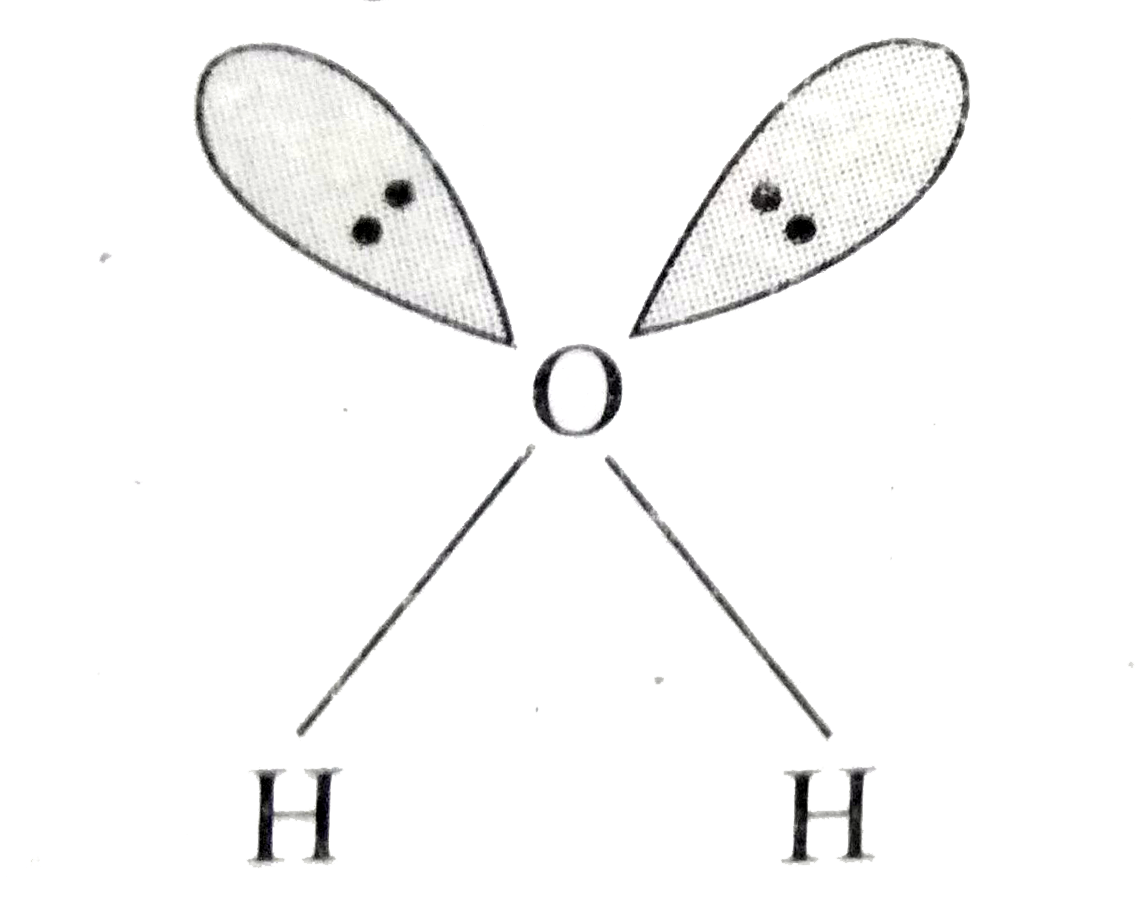 `H_(2)O_(2)` has a non-planar structure. The O H bonds are in different planes. Thus, the str `H_(2)O_(2)`is like an open book. 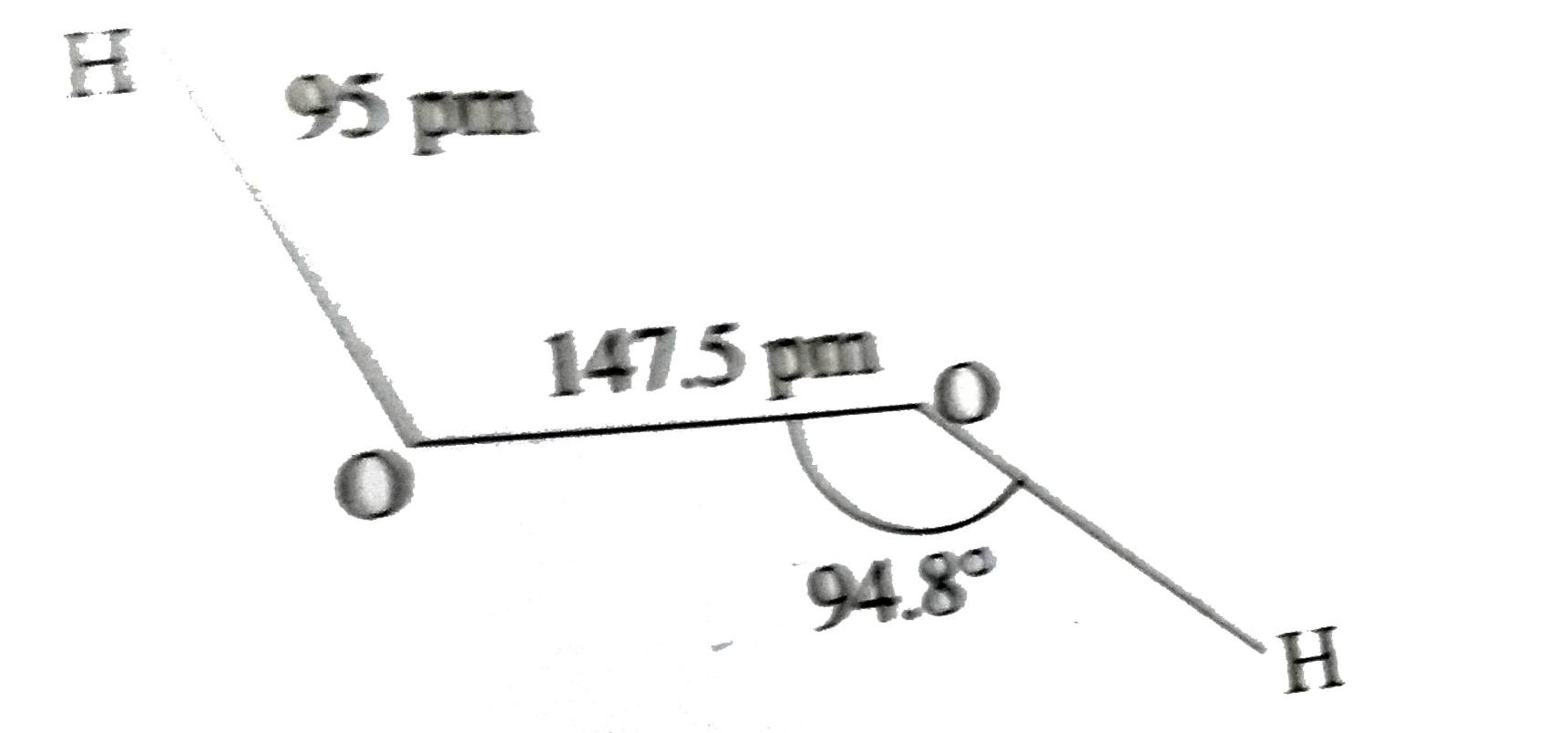
|
|
| 25. |
Compare the structures of H_(2)O and H_(2)O_(2). |
| Answer» Solution :The structure of `H_(2)O` is angular white that of `H_(2)O_(2)` is non LINEAR just like two opposite open pages of a BOOK. For actual structure of `H_(2)O` CONSULT section 9-7 and for `H_(2)O_(2)`, please see section 9-16 | |
| 26. |
Compare the structures of H_2O and H_2O_2 . |
Answer» SOLUTION :
|
|
| 27. |
Compare the structure of H_(2)O and H_(2)O_(2) . |
| Answer» Solution :In water , O is `sp^(3)` -hydridized . Due to stronger lone PAIR-lone pair repulsions than BOND pair-bond pair repulsions, the HOH bond angle decreases from `109.5^(@) ` to `104.5^(@)` . Thus, water is a bent molecule . `H_(2)O_(2)` has a non-planar structure . The two oxygen atoms are linked to each other by a SINGLE covalent bond (i.e., peroxide bond) and each oxygen is further linked to a hydrogen atom by a single covalent bond.d The two O-H bonds are, however, in different planes. The DIHEDRAL angle between the two planes being `111.5^(@)` in the gas phase . Thus, the structure of `H_(2)O_(2)` is like that of an open book. | |
| 28. |
Compare the stabilities of the following intermediates : underset((a))(H-underset(H) underset(|)overset(+)C-H) underset((b))(H-underset(H) underset(|)overset(+)C-H ) |
| Answer» SOLUTION :`(B) GT (a)`. This is because +I EFFECT of D is more than H . | |
| 29. |
Compare the stabilities of the following intermediates : underset((a))(H-=C-CH_(2)-CH_(2)) underset((b))(H_(2)C-CH-CH_(2)-overset(+)(CH_(2))) |
| Answer» SOLUTION :`(B) gt (a)` . This is because -I EFFECT of ALKYNE is more than that of alkene . | |
| 30. |
Compare the stabilities of the following intermediates : underset((a))(Cl-CH_(2)-overset(+)(CH_(2)) underset((b))(Cl-CH_(2)-CH_(2)-overset(+)(CH_(2)) |
| Answer» Solution :`(B) GT (a)` .This is because -I effect of chlorine is exerted to a greater extent in structure (a) , which MAKES the carbocation less stable . | |
| 31. |
Compare the stabilities of the following intermediates : underset((a))(CH_(3)-O-overset(+) (CH_(2))) underset((b))(CH_(3)-CH_(2)-overset(+)(CH_(2)) |
| Answer» SOLUTION :`(a) gt (B)` . This is because structure is RESONANCE STABILIZED . | |
| 32. |
Compare the stabilities of the following intermediates : |
| Answer» Solution :`(a) GT (B)` .This is because `-CH_(3)` is more EFFECTIVE than `-CD_(3)` in EXHIBITING hyperconjugation. | |
| 33. |
Compare the stabilities of the following intermediates : |
| Answer» SOLUTION :`(a) gt (b)` .This is because benzyl CARBOCATION is more STABLE than ALLYL carbocation. | |
| 34. |
Compare the stabilities of the following intermediates : |
| Answer» SOLUTION :`(B) GT (a)` . This is because +I EFFECT of D is more than H . | |
| 35. |
Compare the stabilities of the following intermediates : |
| Answer» SOLUTION :`(a) gt(B)` .This is because structure (a) has more resonating STRUCTURES than (b). | |
| 36. |
Compare the stabilities of the following intermediates : |
| Answer» SOLUTION :`(b) GT (a)` .This is because STRUCTURE (b) is more resonance STABILIZED than structure (a) | |
| 37. |
Compare the stabilities of the following intermediates : |
|
Answer» Solution :The order of STABILITIES of the GIVEN INTERMEDIATES is as FOLLOWS : `(b) gt (a)` . This is because tertiary carbocation is more STABLE than the primary |
|
| 38. |
Compare the stabilities of the following carbanions : underset((a))(H_(2)C =CH-bar(N)H)" " underset((b))(HN = CH -bar(N)H) |
| Answer» Solution :`(B) gt (a)` .STRUCTURE (b) is more stable because on drawing the RESONATING structure , there is negative CHARGE on NITROGEN . | |
| 39. |
Compare the stabilities of the following carbanions : underset((a))(Cl-overset(Cl) overset(|)underset(Cl) underset(|)C-bar(C)H_(2)) underset((b))(F - overset(Cl)overset(|)underset(F)underset(|)C-bar(C)H_(2)) |
| Answer» Solution :`(B) gt (a)` This is because -I EFFECT EXERTED by FLUORINE is more than that of chlorine . | |
| 40. |
Compare the stabilities of the following carbanions : underset((a))(Cl-underset(Cl)underset(|)C -Cl) underset((b))(F - underset(F) underset(|)(barC)-F ) |
| Answer» Solution :`(a) GT(B)` .This is because NEGATIVE CHARGE is delocalized over the vacant d - orbital of CHLORINE . | |
| 41. |
Compare the stabilities of the following carbanions : underset((a))(CH_(3)-CH_(2)-CH_(2)) underset((b))(NO_(2) -CH_(2)-CH_(2)) |
| Answer» Solution :The COMPARISON for the satbility of CARBANIONS is as follows :`(B) gt (a)` . This is because - I effect of `-NO_(2)` is more than `CH_(5)` | |
| 42. |
Compare the stabilities of the following carbanions : |
| Answer» SOLUTION :`(a) GT (B)` . This is because negative CHARGE is delocalized over `-NO_(2)` group . | |
| 43. |
Compare the stabilities of the following carbanions : |
| Answer» Solution :`(B) GT (a)` Structure (a) is more stable because on DRAWING the RESONATING structure , there is negative charge on oxygen . | |
| 44. |
Compare the stabilities of the following carbanions : |
| Answer» Solution :`(c ) GT (b) gt (a)` .Structure (c ) is more STABLE due to DELOCALIZATION of CHARGE over the vacant d - ORBITAL of phosphorus . | |
| 45. |
Compare the stabilities of the following carbanions : |
| Answer» SOLUTION :`(a) gt (b)` .This is because negative CHARGE is delocalized over the VACANT d - orbital of SULPHUR . | |
| 46. |
Compare the stabilities of the following carbanions : |
| Answer» Solution :`(a) gt (B)` ,This is because GREATER number of resonating STRUCTURES can be drawn for structure (a) | |
| 47. |
Compare the stabilities of the following carbanions : |
| Answer» Solution :`(a) gt (b)` .This is because greater NUMBER of RESONATING STRUCTURES can be drawn for STRUCTURE (a) | |
| 48. |
compare the stabilities of the fallowing two compounds (A) and( B) A: cis:-1-ethyl-3-methyl cyclohexaneB: trans -1-ethyl -3-methyl cyclohexane |
|
Answer» A is more stable |
|
| 49. |
Compare the stabilites of the following alkenes H_(2)C =overset(CH_(3))overset(|)C-CH_(2)-CH_(3) |
| Answer» SOLUTION :`(a) GT (b)` .This is because structure (a) has more `ALPHA `- hydrogen . | |
| 50. |
Compare the stabilites of the following alkenes CH_(3)-O-CH=CH_(2) CH_(3) -CH =CH-CH_(3) |
| Answer» Solution :`(a) GT (B)` .This is because structure (a) is resonance STABILIZED . | |