

Saved Bookmarks
This section includes 7 InterviewSolutions, each offering curated multiple-choice questions to sharpen your Current Affairs knowledge and support exam preparation. Choose a topic below to get started.
| 1. |
Convert 27^@C to Kelvin (K) and choose the correct option |
|
Answer» 210K |
|
| 2. |
Convert 25^@C to Fahrenheit(F) and choose the correct alternative? |
|
Answer» 77F |
|
| 3. |
Convert 0.5 atmospheres pressure into mm of mercury. |
|
Answer» Solution :1 atm = 760 mm of HG `:. 0.5` atm PRESSURE = `(760 mm XX 0.5 atm)/(1 atm)` `= 380.0 mm of Hg. ` |
|
| 5. |
Conversion of ethyl alcohol into acetaldehyde is an example of |
|
Answer» REDUCTION |
|
| 6. |
Conversion of benzene to chlorobenzene in the presence of CuCl_2//HClis named as ……………….. . |
| Answer» SOLUTION :GATTERMANN REACTION | |
| 7. |
Conversion of benzene to chlorobenzene in the presence of CuCl_2//HCl is named as ......... |
|
Answer» FITTIG REACTION |
|
| 8. |
Conversion of benzene to acetophenone can be brought by |
|
Answer» WURTZ reaction |
|
| 9. |
Conversation of graphite into diamond is .. ........ reaction. |
|
Answer» Endothermic |
|
| 10. |
Controlled oxidation of alkanes. |
|
Answer» Solution :Alkanes on heating with a regulated supply of dioxygen or air at high pressure and in the presence of suitable catalyse give a variety of oxidation products. (i) `UNDERSET("Methane")(2CH_(4))+O_(2) underset("100 atm.")overset(cu 573 K)rarr underset("Methanol")(2CH_(3)OH)` ...(i) (ii) `CH_(4) + O_(2) overset(Mn_(2)O_(3), Delta)rarr underset("Methanol")(HCHO)+H_(2)O` ...(ii) (iii) `underset("Ethane")(3CH_(3)CH_(3))+3O_(2) underset(Delta)overset((CH_(3)COO)_(2)Mn)rarr underset("ETHANOIC ACID")2CH_(3)COOH + 2H_(2)O` ...(iii) (iv) Ordinarily alkanes resist oxidation but alkanes having tertiary H atom can be oxidized to corresponding alcohols by potassium permanganate. `underset("2-Methylpropane")((CH_(3))_(3)CH)underset(+(O))overset(KMnO_(4))rarr underset("2Methylpropane-2-ol")((CH_(3))_(3)C-OH)` ..(iv) |
|
| 11. |
Control rods used in nuclear reactor are made of |
|
Answer» Iron |
|
| 12. |
Contrast the action of heat on the following with reason: a. Na_(2)CO_(3) and CaCO_(3) b. MgCl_(2).6H_(2)O and CaCl_(2).6H_(2)Oc. Ca(NO_(3))_(2) and NaO_(3) |
|
Answer» SOLUTION :(a). On heating, the DECAHYDRATE loses water of crystallisation to form monohydrate. Above `373 K`, they completely become anhydrous and become a powder. `Na_(2)CO_(3).10H_(2)Ooverset(373 K)(rarr)Na_(2)CO_(3).H_(2)O+9H_(2)O` `NaCO_(3).H_(2)O overset(above)underset(373 K)(rarr)underset((soda ash))(Na_(2)CO_(3))+H_(2)O` The `Na_(2)CO_(3)` or soda ash is thermally very stable and does not decompose UPON heating. When `CaCO_(3)` is heated above `1200 K`, it decompose to evolve carbon dioxide. `CaCO_(3)overset(1200 K)(rarr)CaO+CO_(2)` (b). When `MgCl_(2).6H_(2)O` is heated, it decomposes to give magnesium oxide `(MgO)`. `MgCl_(2).6H_(2)OrarrMgO+5H_(2)O+2HCl` The halide of calcium is hyproscopic. The `CaCl_(2)6 H_(2)O` get dehydrated upon heating. `CaCl_(2).6 H_(2)O overset(heat)(rarr)CaCl_(2)+6 H_(2)O` On this basis it is used as a dehydrating agent. (c ). When calcium nitrate is heated, it decompose and forms the oxide. `2Ca(NO_(3))_(2)overset(Heat)(rarr)2CaO+4NO_(2)+O_(2)` When sodium nitrate is heated strongly it gives nitrates and evolve oxygen. `2NaNO_(3)overset(Heat)(rarr)2NaNO_(2)+O_(2)uarr.` |
|
| 13. |
Continuous use of which fertilizer increase the acidity of soil ? |
|
Answer» Urea |
|
| 14. |
Containers A and B have same gas. Pressure, volume and temperature of A are all twice that of B. Then the ratio of the number of molecules of A and B are |
|
Answer» <P>`1:2` For A, `P_(1)=2P,=2P,V_(2)=2P,T_(2)=2T` Applying ideal gas EQUATION, Pv=nRT. `(P_(1)V_(1))/(n_(1)RT_(1))=(P_(2)V_(2))/(n_(2)RT_(2))" or " (PV)/(n_(1)RT)=(2pxx2V)/(n_(2)R(2T))` or `(n_(2))/(n_(1))=(2)/(1)` |
|
| 15. |
Containers A, B and C of equal volume contain oxygen, neon and methane respectively at the same temperature and pressure. The correct increasing order of their masses is |
|
Answer» `A lt B lt C` `:.` Masses of `O_(2)`,NE and `CH_(4)` will be in the ratio `32:20:16`. |
|
| 16. |
Construct a Born-Haber cycle and use it to calculate the first electron affinity of chlorine. DeltaH_(atom(CI))= +122 kJ mol^(-1) "" DeltaH_(atom(Mg))=+148 kJ mol^(-1) DeltaH_("1st ionisation energy" (Mg))=+738 KJ mol^(-1) "" DeltaH_(2nd " ionisation cnergy"(MgCI_(2))= +1451 kJ mol^(-1) DeltaH _("lattice energy "(MgCI_(2))= -2526 kJ mol^(-1) "" DeltaH_(2nd " formation "(MgCI_(2)) =-641 kJ mol^(-1) |
| Answer» SOLUTION :-348 kJ/mol | |
| 17. |
Constitutional isomers is possible between memebers of which of the following types of compounds? |
|
Answer» amines and AMIDES |
|
| 18. |
Constitutional isomerism is also known as structural isomerism. The isomers which differ in the connectivity of their atoms are called constitutional isomers. Which of the compound will show tautomerism? |
|
Answer» acetoxime 
|
|
| 19. |
Constitutional isomerism is also known as structural isomerism. The isomers which differ in the connectivity of their atoms are called constitutional isomers. Which pair is correctly matched? |
|
Answer» n-butane and isobutane, METAMERS |
|
| 20. |
Considerting x-axis as the internuclear axis, which out of the following atomic orbitals will form a sigma bond? a. 1s and 1s b. 1s and 2p_(x) c. 2p_(3) and 2p_(y) d. 1s and 2s |
|
Answer» Solution :The sigma bond is formed by axial overlap along INTERNUCLEAR axis and is present in the following CASES. In the case a,b and C can form sigma bond, and d canot form sigma bond. a. 1s and 2s b. 1s and `2p_(x)` d. 1s and 2s `2p_(y)` and `2p_(y)` atomic orbitals are INVOLVED in the sidwise overlap leading to the formation of `PI` bond. |
|
| 21. |
Considering x- axis as the internuclear axis,which out of the following will not form a sigma bond and why? |
|
Answer» `1S & 1s` |
|
| 22. |
Considering x-axis as the internuclear axis, which out of the following will not form a sigma bond and why ? (a) s and1s(b) 1s and 2p_(x) (c) 2p_(y) and 2p_(y) (d)1s and 2s. |
|
Answer» Solution :Only (C)will not form a `sigma ` - bond because taking x-AXIS as the intermolucular axis , there will be LATERAL (sideway) overlap between the TWO ` 2p_(y)` orbitals forming `pi` bond . |
|
| 23. |
Considering X-axis as the internuclear axis which out of the following will not form a sigma bond and why ? (a) 1s and 1s(b) 1s and 2p_(x) (c) 2p_(y) and 2p_(y)(d) 1s and 2s |
|
Answer» Solution :`{:((a) 1s and 1s),((B) 1s and 2p_(x)),((d)1s and 2s):}} {:("All these THREE"),("overlap an intrnuclear"),("axis so it FORM" sigma"bond"):}`. (c) `2p_(y)` & `2p_(y)` are not overlap on intranuclear axis but remain parallel so it form `PI` bonds. |
|
| 24. |
Considering x - axis as the internuclear axis which out of the following will not form a sigma bond and why? (a) 1s and 1s (b) 1s and 2p_(x) (c ) 2p_(y) and 2p_(y) (d) s and 2s. |
| Answer» Solution :Only (c ) will not form a `sigma` BOND because taking x - axis as the internuclear axis, there will be SIDEWISE OVERLAP between the TWO `2p_(y)` orbitals forming a `pi-` bond . All other will form `sigma-` bond. | |
| 25. |
Considering x-axis as the internuclear axis which out of the following will not form a sigma bond and why ? |
|
Answer»
(2) 1s, `2p_(x)` (3) `2p_(y),2p_(y)` (4) 1s, 2s. |
|
| 26. |
Considering x-axis as molecular axis, which out of the following will form a sigma bond. (i) 1s and 2p_(y) (ii) 2p_(x) and 2p_(x) (iii) 2p_(x) and 2p_(y) (iv) 1s and 2p_(z) |
Answer» Solution :Along X-AXIS as molecular axis only `2p_(x)` and `2p_(x)` can from a SIGMA bond  `2p_(x)+2p_(y)` and 1s and `2p_(2)` ALSO cannot FORM `sigma` bond. |
|
| 27. |
Considering x-axis as molecular axis, which out of the following will form a sigma bond. (i) 1s and 2p_(y) (ii) 2p_(x)and 2p_(x) (iii) 2p_(x)and 2p_(z) (iv) 1s and 2p_(z) |
Answer» SOLUTION :Along X-axis as molecular axis, only `2p_(x) and 2p_(x)` can form a sigma BOND 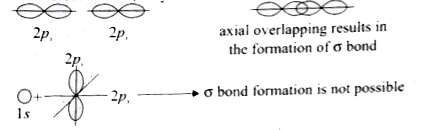 `2p_(x)+2p_(y)and 1_(s)and 2p_(z)` also cannot form `sigma` bond. |
|
| 28. |
Considering x- axis as molecular axis, which out of the following will form a sigma bond. (i) 1s " and " 2p_(y)""(ii) 2p_(x)" and " 2p_(x) (iii) 2p_(x)" and " 2p_(z)""(iv) 1s " and " 2p_(z) |
Answer» SOLUTION :Along x-AXIS as molecular axis, only `2p_(x)" and " 2p_(x)` can from a SIGMA bond.   `2p_(x) + 2p_(y)" and " 1s " and " 2p_(z)` ALSO cannot form `sigma` bond. |
|
| 29. |
Considering the van der Waals equation of state (P+a//V^(2))(V-b) =RT for ammonia (NH_(3)) and nitrogne (N_(2)) the value of a for NH_(3) is larger than that of N_(2) Ammonia has a lower molecular weight than nitrogen . |
| Answer» SOLUTION :Both are CORRECT but does not GIVE correct EXPLANATION . | |
| 30. |
Considering van der Waals equation of state for a real gas (P+n^(2)a//V^(2))(V-nb) =nRT the constant 'a' for O_(2) is less than that for H_(2)O_(g) The molar mass of O_(2) is almost twice that of H_(2)O . |
| Answer» SOLUTION :EXPLANTION is CORRECT REASON for STATEMENT | |
| 31. |
Considering the state of hybridization of carbon atoms, find out the molecule among the following which is linear ? |
|
Answer» `CH_(3) - CH= CH - CH_(3)` ` UNDERSET(DARR)(sp^(3)) ""underset(darr)(sp)"" underset(darr)(sp) sp^(3)` `H_(3) C - C equiv C -underset("Linear")(CH_(3))` |
|
| 32. |
Considering the following titration curve and answer the questions that follows: 20 mL of the solution being titrated is present initially the approximate value of ionization constant of the species being titrated is |
|
Answer» `0.1 M` `:. K_(a) = 10^(-4)` |
|
| 33. |
Considering the following titration curve and answer the questions that follows: 20 mL of the solution being titrated is present initially The point of optimal buffering on the curve is |
|
Answer» P `["salt"] = ["acid"]` and `pH= pK_(a)` |
|
| 34. |
Considering the following titration curve and answer the questions that follows: 20 mL of the solution being titrated is present initially The species being titrated is |
|
Answer» weakbase |
|
| 35. |
Considering the following titration curve and answer the questions that follows: 20 mL of the solution being titrated is present initially The initial concentration of the species being titrated is |
|
Answer» `0.1 M` `pH = 7 + 1/2 pK_(a) + 1/2"log" C` and `N_(A)V_(A) = N_(B)V_(B) = C` |
|
| 36. |
Considering the fact that N_(2) makes up about 79% of the atmosphere, why don't animals use the more abundant N_(2) instead of O_(2) for biological reactions. |
| Answer» Solution :Animals need large amount of energy to move around and maintain the body TEMPERATURE. Therefore, to obtain the required energy, it is much easier for them to break WEAKER double bond `(493.4 KJ mol^(-1))` of `O_(2)` than breaking the much STRONGER triple bond `(941.4 kJ mol^(-1))` of `N_(2)`. | |
| 37. |
considering the elements F,Cl, O and N, the correct order their chemical reactivity in terms of oxidising property is |
|
Answer» `F gt Cl gt O gt N` |
|
| 38. |
Considering the elements F, CI, O and N, the correct order of their chemical reactivity in terms of oxidizing property is |
| Answer» SOLUTION :OXIDATION ABILITY is in the order : F > Cl > O > N | |
| 39. |
Considering the elements F, CI, O and N, the correct order of their chemical reactivity in terms of oxidizing property is ........ |
|
Answer» F>Cl> O>N |
|
| 40. |
Considering the elements E CI, O and N, the correct order of their chemical reactivity in terms of oxidizing property is : |
|
Answer» `FGT Cl gt O gt N ` |
|
| 41. |
Consideringthe elements F , C1 , O and N thecorrectorderof theirchemicalreactivityin termsofoxidisingproperty is : ( a) F gt C1 gt O gt N ( b) F gt O gt C1 gt N ( c)C1 gt F gt O gt N ( d)O gt F gt NC1 |
| Answer» Solution :WITHINA periodthe oxidisingcharacter increases from leftto right . ThereforeamongF, O and Noxidisingpowerdecreasesin the order : `F gt Ogt N`. Howeverwithin a groupoxidising POWER decreases from top to bottom. Thus F is STRONGER oxidisingagentthan C1. Furtherbecause Ois moreelectronegativethan C1 thereforeO is a strongeroxidisingagent than C1 Thusoveralldecreasingorderof oxidisingpower is `: F gt O gt C1 gt N` i.e.,OPTION( b) is correct. | |
| 42. |
Considering the elements B,Al,Mgand K, the correct order of their metallic charcter is |
|
Answer» `B gt AL gt Mg gt K` |
|
| 43. |
Consideringthe elements B, C ,N, F andSi thecorrectorderof their non- metallic character is : (a) B gt C gt Si gt N gt F ( b) Si gt C gt B gt N gt F( c) F gt N gt C gt B gt Si ( d)F gt N gt C gt Si gt B |
| Answer» Solution :In aperiodthe NON metalliccharacterincreases fromleftto right . ThusamongB ,C ,NAND f,non - metalliccharacterdecreases inthe ORDER `: F gtN gt C gt B` However withina group non- metallic character DECREASES from top to bottom. ThusC is morenon- metallic than Si.Thereforethe CORRECT sequence ofdecreasingnon- metalliccharacter is `: F gt N gt C gt B gt Si` i.e.,option ( c) iscorrect. | |
| 44. |
Considering the elements B,C,N,F and Si, the correct order of their non-metalllic character is |
| Answer» Solution :F > N > C > B >SI | |
| 45. |
Considering the elements B, C, N, F and Si, the correct order of their non-metallic character is : |
|
Answer» `B gt C gt SI gt N gt F ` |
|
| 46. |
Considering the elements B, Al, Mg, and K, the correct order of their metallic character is : |
|
Answer» `B GT Al gt Mg gt K` |
|
| 47. |
Considering the elements B,Al, Mg and K, the correct order of their metallic character is |
| Answer» Solution :K > MG > AL >B | |
| 48. |
Considering the elements B, AI, Mg and K, the correct order of their metallic character is: |
|
Answer» B>Al>Mg>K |
|
| 49. |
Considering theelements B ,A1, Mg and K, the correctorderof theirmetalliccharacteris : (a) B gt A1 gt Mg gt K ( b)A1 gt Mg gt B gt K( c)Mg gt A1 gt K gt B( d)K gt Mg gt A1 g B |
| Answer» Solution :In a periodelectronegativityincreasesand HENCETHE metallic character decreases as wemove from left to right. Thereforemetalliccharacterof K, MG and A1decreasesin the order : `K GT Mg gt A1` . However, within agroupthe electronegativitydecreasesand hencethe metalliccharacterincreases from top to bottom. ThusA1 ismoremetallicthan B. Thereforethe CORRECTSEQUENCE ofdecreasing metalliccharacter is `: K gt Mg gt A1 gt B` i.e., option( d) iscorrect. | |
| 50. |
Considering the elements B, C, N, F and Si, the correct order of their non-metallic character is |
|
Answer» B >C>SI>F>Si |
|