

Saved Bookmarks
This section includes 7 InterviewSolutions, each offering curated multiple-choice questions to sharpen your Current Affairs knowledge and support exam preparation. Choose a topic below to get started.
| 1. |
Correct order f keto content for following compound is : Me_(3)C-overset(O)overset(||)C-CH_(2)-overset(O)overset(||)C-CM_(3) Me_(2)CH-overset(O)overset(||)C-CH_(2)-overset(O)overset(||)C-CHMe_(3) MeCH_(2)-overset(O)overset(||)C-CH_(2)-overset(O)overset(||)C-CH_(2)Me |
|
Answer» `RgtQgtP` |
|
| 2. |
Correct order for enolic content for a compound : |
|
Answer» `IGT II gt III` |
|
| 3. |
Correct name for the given compound CH_(3)-CH_(2)-underset(CH_(2)CH_(3))underset(|)(C)H-CH_(2)-underset(CH_(3))underset(|)(C)H-CH_(2)-CH_(3) is |
|
Answer» 3-ethyl-5-methylheptane |
|
| 4. |
Correct matching about composition of portland cement is {:("List - I","List - II"),("I) "Al_(2)O_(3),"A) "50-60%),("II) "CaO,"B) "20-25%),("III) "SiO_(2),"C) "5-10%),("IV) "MgO,"D) "2-3%):} |
|
Answer» `{:("UL(I),ul(II),ul(III),ul(IV)),(C,A,B,D):}` |
|
| 5. |
Correct IUPAC name of the following compound is |
|
Answer» 3-(Hepta-2,4,6-trientyl)-4-bromo cyclopenta -2,4, -dien-1-ol |
|
| 6. |
Correct IUPAC name of{:(""CH_3),(""|),(CH_3-CH_2-C=CH-CH-CH_2-CH_3),(""|),(CH_3-CH_2-CH-CH_2-CH_2-CH_2-CH_3):} |
|
Answer» 5,6 - DIETHYL - 3 - methyldec -4- ene |
|
| 7. |
Correct IUPAC name of |
|
Answer» 5,6-Diethyl-3-methyl dec-4-ene |
|
| 8. |
Correct IUPAC name of {:(CH_(3)-CH_(2)-C=CH-overset(CH_(3))overset("|")("C")H-CH_(2)-CH_(3)),("|"),(CH_(3)-CH_(2)-CH-CH_(2)-CH_(2)-CH_(2)-CH_(2)):} is |
|
Answer» 5,6-Diethyl-3-methyl dec-4-ene |
|
| 9. |
Correct IUPAC name for H_(3)C-underset(C_(2)H_(5))underset(|)(CH)-underset(C_(2)H_(5))underset(|)(CH)-CH_(3) is.............. . |
|
Answer» 2-ethyl-3-methylpentane 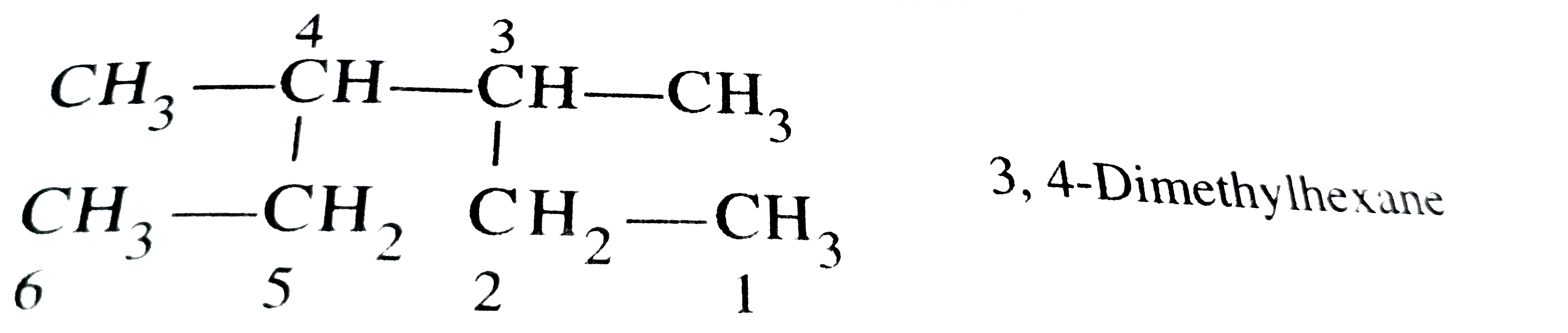
|
|
| 10. |
Correct IUPAC name for H_(3)C- underset(underset(C_(2)H_(5))(|))(CH)- underset(underset(C_(2)H_(5))(|))(CH)-CH_(3) is …….. |
|
Answer» 2-ethyl-3-methylpentane `overset(1)(C )H_(3)- overset(2)(C )H_(2) - underset(underset(CH_(3))(|))overset(3)(CH)-underset(underset(CH_(3))(|))overset(4)(CH)-overset(5)(CH_(2))-overset(6)(CH_(3))` Two methyl SUBSTITUTES are PRESENT so it is dimethyl and their positin is on `3^(rd) and 4^(th)` carbon `THEREFORE` Name is 3, 4-dimethylhexane |
|
| 11. |
Correct gradation of basic character |
|
Answer» `NH_(3) GT CH_(3)NH_(2) gt NF_(3)` |
|
| 12. |
Correct energy value order is |
|
Answer» `NS NP ND(n-1)F` |
|
| 13. |
Correct basic strength order is : |
|
Answer» `R GT q gt p gt s` |
|
| 14. |
Copper wire test for halogens is known as |
|
Answer» Liebig's TEST |
|
| 15. |
Copper sulphate crystals contain 25.45% Cu and 36.07% H_2O. If the law of constant proportions is true, calculate the weight of Cu required to obtain 40g of crystalline copper sulphate. |
|
Answer» |
|
| 16. |
Copper reduces NO_3^(-) into NO_2 depending upon concentration of HNO_3 in solution Assuming [Cu^(2+)]=0.1M, "and" P_(NO)=P_(NO_2)=10^(-3)bar, at which concentration of HNO_3, Thermodynamic tendency for reduction of NO_3^(-) into NO and NO_2 by copper is same ? Given: E_(cu^(2+)|cu)^(@)=+0.34 "volt", E_(NO_3^(-)|NO)^(@)=+0.96 "volt",E_(NO_3^(-)|NO_(2))^(@)=+0.76 "volt"] |
|
Answer» `10^(1.23)M` |
|
| 17. |
Copper reacts with nitric acid . A brown gas is formed and the solution turns blue. The equation may be written as : Cu+NO_3^(-) rarr NO_2+Cu^(2+) Balance the equation by oxidation number method. |
|
Answer» Solution :Step 1 : Skeleton EQUATION `Cu+NO_3^(-) rarr NO_2+Cu^(2+)` Step 2 : Writing oxidation numbers of each atom `overset(0)(Cu)+overset(+5-2)(NO_3^(-))rarroverset(+4-2)(NO_2)+overset(+2)(Cu^(2+))` Step 3. 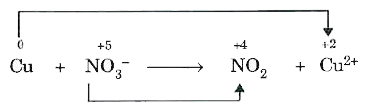 The oxidation number copper has increased from 0 to 2 while that of nitrogen has decreased from +5 to +4. Step 4 . Show the increases / DECREASE of oxidation number O.N. increases by 2 per atom 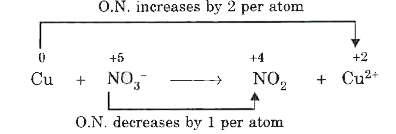 Step 5 : Balance the increased /decrease in oxidation number by multiplying `NO_3^(-)` by 2 and Cu by 1. `Cu+2NO_3^(-) rarr NO_2+Cu^(2+)` Step 6. Balance other atoms except H and O as `Cu+2NO_3^(-) rarr 2NO_2+Cu^(2+)` Step 7. Reaction TAKES place in acidic medium , so add `H^+` ions to the side deficient in `H^+` and blance H and O atoms : `Cu+2NO_3^(-) +4H^(+) rarr 2NO_2+Cu^(2+) + 2H_2O` |
|
| 18. |
Copper oxide test is used to detect .... |
|
Answer» Carbon & HYDROGEN |
|
| 20. |
Copper is the most noble of first row transition metals and occurs in small deposits in several countries. Ores of copper include chalanthrite. (CuSO_(4).5H_(2)O), atacanrite [Cu_(2)Cl(OH)_(3)] cuprite (Cu_(2)O), copper glance (Cu_(2)S) nad malachite [Cu_(2)(OH)_(2)CO_(3)]. However, 80% of the world copper production comes from the ore chalcopyrite (CuFeS_(2)). The extraction of ore chalcopyrite (CuFeS_(2)). The extraction of copper from chalcopyrite involves partial roasting, removal of iron nad selfreduction. In self reduction, hte reducing spent is |
|
Answer» S |
|
| 21. |
Copper is the most noble of first row transition metals and occurs in small deposits in several countries. Ores of copper include chalanthrite. (CuSO_(4).5H_(2)O), atacanrite [Cu_(2)Cl(OH)_(3)] cuprite (Cu_(2)O), copper glance (Cu_(2)S) nad malachite [Cu_(2)(OH)_(2)CO_(3)]. However, 80% of the world copper production comes from the ore chalcopyrite (CuFeS_(2)). The extraction of ore chalcopyrite (CuFeS_(2)). The extraction of copper from chalcopyrite involves partial roasting, removal of iron nad selfreduction. Iron is removed from chalcopyrite as |
|
Answer» FeO |
|
| 22. |
Copper is the most noble of first row transition metals and occurs in small deposits in several countries. Ores of copper include chalanthrite. (CuSO_(4).5H_(2)O), atacanrite [Cu_(2)Cl(OH)_(3)] cuprite (Cu_(2)O), copper glance (Cu_(2)S) nad malachite [Cu_(2)(OH)_(2)CO_(3)]. However, 80% of the world copper production comes from the ore chalcopyrite (CuFeS_(2)). The extraction of ore chalcopyrite (CuFeS_(2)). The extraction of copper from chalcopyrite involves partial roasting, removal of iron nad selfreduction. Partial roasting of chalcopyrite produces |
|
Answer» `Cu_(2)S` and FEO |
|
| 23. |
Copper is purified by electrolysis in water solution and most of the impurities in the blister copper are left behind in solution. Why can not aluminium be unpaired in a similar manner ? |
|
Answer» Because AL ions are not PRODUCED in solution |
|
| 24. |
Copper (I) is diamagnetic whereas Copper (II) is paramagnetic. Give reason |
| Answer» Solution :CU (I) has `d^(10)` CONFIGURATION, i.e., all ELECTRONS are paired WHEREAS Cu (II) has `d^(9)` configuration, i.e., has no unpaired electron | |
| 25. |
Copper forms two oxides following law of variable proportions. One gram of each oxide in hydrogen gas gave 0.799 g and 0.888 g of the metal respectively. Give the composition of these oxides. |
|
Answer» SOLUTION :OXIDE (A) : weight of copper =0.799g weight of oxygen =0.201 G weight of metal per gram of oxygen =3.97g Oxide (B): WT of copper =0.888g weight of oxygen =0.112 g weight of metal per gram of oxygen =7.93g The ratio of weights of METALS reacting with same weight of oxygen =1:2 The oxides are CuO and `Cu_(2)O` |
|
| 26. |
Copper forms two oxide Cu_(2)O_(x) and Cu_(2)O_(y). For the same amount of metal,twice as much oxygen was used to form first oxide than to second oxide. What is the ratio of X and Y? |
|
Answer» |
|
| 27. |
Copper dissolves in dilute nitric acis but not in dilute HCI Explain |
| Answer» Solution :Since `E^(@)` of `Cu^(2+)//Cu` electrode (+0.34 V) is higher than that of `H^(+)//H_(2)` electrode (0.0V) therefore `H^(+)` ions cannot oxidise Cu to `Cu^(2+)` ions and hence Cu does not dissolve in dil HCI in CONTRAST the electrode potential of `NO_(3)^(-)//NO` electrode (+0.97 V) is HIGER than that of COPPER electrode and hence it can oxidise Cu to `Cu^(2+)` ions and hence Cu dissolve in dil `HNO_(3)` thus cu dissolves in dil `HNO_(3)` DUE to oxidation of Cu by `NO_(3)^(-)` ions and not by `H^(+)` ions | |
| 28. |
Copper dissolves in dilute HNO_3 but not in dilute HCl. Explain. |
| Answer» Solution :Since `E^@` of `Cu^(2+)|Cu` electrode ,(+0.34V) is higher than that of `H^+|1/2H_2` (0.0V) , therefore , `H^+` IONS cannot oxidise Cu to `Cu^(2+)` ions and consequently, COPPER does not dissolve in dil . HCl on the other hand , the electrode potential of `NO_3^(-)` ion, `NO_3^(-) |NO(+0.97V)` is higher than that of copper electrode and hence , it can oxidise `Cu" to "Cu^(2+)` and hence copper DISSOLVES in dil . `NHO_3^(-)`. | |
| 29. |
Copper crystallizes into a fcc lattice with edge length 3.61xx10^(-8) cm. Show that the calculated density is in agreement with its measured value of 8.92 "g cm"^(-3). |
|
Answer» SOLUTION :`rho=(ZxxM)/(a^3xxV_0)` For fcc LATTICE of copper , Z=4 Atomic mass of copper , `M=63.5 "g MOL"^(-1)` `therefore rho=(4xx63.5 "g mol"^(-1))/((3.61xx10^(-8) cm)^3xx(6.022xx10^23 "mol"^(-1)))=8.97 "g cm"^(-3)` which is in CLOSE agreement with the measured value. |
|
| 30. |
Copper crystallizes into a fcc lattice with edge length3.61 xx 10^(-8) cm, show that the calculated density is in agrrement with its measured value of8.92 " g cm"^(-3) . |
|
Answer» Solution : ` p = ( Z xxM)/(a^(3) xx V_(0))` For FCC lattice of copper , Z =4Atomic mass of copper, M = ` 63.5 " G mol"^(-1)` ` p = (4 xx 63.5 " g mol"^(-1))/((3.61 xx 10^(-8) "cm")^(3) xx ( 6.022 xx 10^(23)"mol"^(-1))) =8.97 " g cm"^(-3)` which is in CLOSE agreement with the MEASURED with the measured value . |
|
| 31. |
Copper crystallises into a fee lattice. Its edge length is 3.62 xx 10^(-8) cm. Calculate the density of copper (atomic mass of Cu=63-5 u, N_A= 6-022 xx 10^(23) mol^(-1)). |
|
Answer» `rho=(ZxxM)/(a^3xxN_0)=(4xx63.5 "g mol"^(-1))/((362xx10^(-10)cm)^3xx6.02xx10^23 mol^(-1))=8.9 "g cm"^(-3)` Alternatively, `rho="Mass of unit CELL "/"Volume of unit cell "=(4xx(63.5 "g mol"^(-1)//6.02xx10^23 mol^(-1)))/((362xx10^(-10)cm)^3)=8.9 g cm^(-3)` |
|
| 32. |
Copper crystallises in fcc lattice with a unit cell edge of 361 pm. The radius of copper atom is |
|
Answer» 108 pm |
|
| 33. |
Copper crystal has a face-centred cubic lattice structure. Atomic radius of copper atom is 128 pm. Calculate the density of copper. Atomic mass of copper=63.5 |
|
Answer» `RHO=(ZxxM)/(a^3xxN_0)=(4xx63.5 "g MOL"^(-1))/((362xx10^(-10)cm)^3xx6.02xx10^23 mol^(-1))=8.9 "g cm"^(-3)` ALTERNATIVELY, `rho="MASS of unit cell "/"Volume of unit cell "=(4xx(63.5 "g mol"^(-1)//6.02xx10^23 mol^(-1)))/((362xx10^(-10)cm)^3)=8.9 g cm^(-3)` |
|
| 34. |
Copper crystal has a face -centred cubic lattice structure. Atomic radius of copper atom is 128 pm. Calculate the density of copper . Atomic mass of copper = 63.5 orCopper crystallises into a fcc lattice, its edge lengthis3.62 xx 10^(-8)cm. Calculate the dinsity of copper(atomic mass of Cu= 63.5 u,N_(A) = 6.022 xx 10^(23)"mol"^(-1)) |
|
Answer» `p = (Z xx M)/(a^(3) xx N_(0)) = ( 4xx 63.5 "g MOL"^(-1))/((362xx10^(-10)"cm")^(3) xx (6.02 xx 10^(23)"mol"^(-1)))= 8.9"cm"^(-3)` Alternatively, `p = ( "MASS of unit cell")/("volume of unit cell") = ( 4xx(63.5 "g mol"^(-1)//6.02xx10^(23)"mol"^(-1)))/((362xx 10^(-10)"cm")^(3))= 8.9 "g cm"^(-3)` |
|
| 35. |
Copper becomes green when exposed to moist air for a long period. This is due to: |
|
Answer» the FORMATION of a layer of CUPRIC oxide on the surface of copper. |
|
| 36. |
Copper and chlorine compounds makes blue fire work. Why? |
|
Answer» Solution :To produce colours, fire works EXPERTS BURN the METAL and chlorine together in a vapour, where the two elements are gases instead of solid. (ii) The burning excites the electron pushing them into a higher than normal the electrons returns to their normal level, they release their extra energy as a colour BURST of light. (iii) True blue fireworks are the hardest to make since the compound copper breaks down in a HOT flame |
|
| 37. |
Coordination number of Zn in ZnS (Zine blende) is |
|
Answer» 4 `THEREFORE" Co-ordination number of " S^(2-) = " Co-ordination number of " Zn^(2+) = 4` |
|
| 38. |
Coordination number of (K) is: |
|
Answer» 2 (F) `Na_(2)S_(2)O_(3)` (H) `[Bi(S_(2)O_(3))_(3)]^(3-)` (X) `rarr HCOOH (C) H_(2)` (E) `Na_(2)SO_(3)` (G) `Bi_(2)(S_(2)O_(3))_(3)` (I) `Ag_(2)S_(2)O_(3)` (J) `Ag_(2)S` (K) `[Ag(S_(2)O_(3))_(2)]^(3-)` |
|
| 39. |
Coordination number of cation is minimum in |
|
Answer» NaCI |
|
| 40. |
underset(COOH)overset(COOH)(|) and underset(COOH)overset(COOK)(I) behave is acids as well as reduing agents. Then which of the following are correct statements? |
|
Answer» When behaves as reducing agent, then its equivalent weights are EQUAL to HALF of its MOLECULAR weight respectively |
|
| 41. |
Convert the following pressure in to atmosphere.(a) 735 torr (b) 985 mL bar (c ) 1.42xx10^(5)Nm^(-2)[Note : (a) 1 atm = 760 torr, (b) 1 atm = 1.013 bar(c ) 1 atm = 1.01325xx10^(5)N m^(-2) |
|
Answer» |
|
| 42. |
Convert the following into specified units : (a) 100 s into ns |
|
Answer» Solution :(a) `therefore 1s = 10^(9)` ns The CONSERVATION factor would be: `1 = (10^(9) ns)/(ns)` `100s = 100 s xx 1 = 100 s xx (10^(9)ns)/(1s) = 1.0 xx 10^(11) ns` (b) `therefore 1 km = 10^(3) m` `therefore` The conversion factor would be `1 = (10^(3) m)/(1 km)` `therefore 60 km = 60 km xx 1 = 60 km xx (10^(3) m)/(1 km)` `=6.0 xx 10^(4) m` ( c) `therefore 1 kg = 10^(3) g` and `1 g = 10^(3) mg` 1kg = `10^(3) xx 10^(3) = 10^(6) mg` Hence, the conversion factor would be `1=(10^(6) mg)/(1 kg)` `=2.00 xx 10^(8) mg` (d ) `therefore 1 cm = 10^(-2) m` `therefore 1 cm^(3) = 10^(-2) xx 10^(-2) xx 10^(-2) m^(3) = 10^(-6) m^(3)` Hence, the conversion factor would be: `1 = (10^(-6) m^(3))/(1 cm^(3))` `1000 cm^(3) = 1000 cm^(3) xx1` `=1000 cm^(3) xx (10^(-6) m^(3))/(1 cm^(3))` (e ) `therefore 1 pm = 10^(-12)m` and `1m = 10^(8) nm` `therefore 1pm = 10^(-12) xx 10^(9) = 10^(-3) nm` ( f) `therefore 1G = 10^(-3) g` `therefore` The conversion factor would be: `1=(10^(-3) kg)/(1kg)` `therefore 75 g = 75 g xx 1 = 75 g xx (10^(-3) kg)/(1 kg)` `=(7.5 xx 10^(-2)) kg` (g) `therefore 1 mum = 10^(-6) m` and `1m = 10^(2) cm` `1mu m =10^(-6) xx 10^(-2) = 10^(-4) cm` Hence, the conversion factor is: `1 = (10^(-4) cm)/(1 mum)` `50 mum = 50 mum xx 1 = 50 mum xx (10^(-4) cm)/(1 mum)` `=5.0 xx 10^(-3) cm` |
|
| 43. |
Convert the following into specified units. (a) 10 years into hours (b) 15 metric tonnes into milligrams. |
|
Answer» |
|
| 44. |
Convert the following into basic units: (i) 28.7 pm(ii) 15.15 pm (iii) 25365 mg |
|
Answer» SOLUTION :(i) `28.7 pm = 28.7 "pm" xx (10^(-12) m)/(1 "pm") = 2.87 xx 10^(-11) m` (ii) `15.15 mu s = 15.15 mus xx (10^(-6) s)/(1 mu s) = 1.515 xx 10^(-5) s` (III) 25365 MG = `25365 xx (1 g)/(1000 mg) xx (1 kg)/(1000 g) = 2.5365 xx 10^(-2) kg` |
|
| 45. |
Convert the following into basic units : (i) 28.7 pm (ii) 15.15 pm(iii) 25365 mg |
|
Answer» `=2.87xx10^(-11)m` (ii) `15.15 "pm"xx(10^(-12)s)/(1"pm")=1.515xx10^(-11)s` (III) `25365 mgxx (1g)/("1000 mg")xx(1kg)/(1000g)=2.5365xx10^(-2)kg` |
|
| 46. |
Convert the following into basic units : (1) 37.6pm(2) 25.50 pm(3)75325 mg |
|
Answer»
|
|
| 47. |
Convert methane to methylene chloride |
| Answer» Solution :`UNDERSET("Methane") (CH_(4)) overset(Cl_(2)//hv) underset(-HCl) (to) CH_(3) Cl overset(Cl_(2)//hv)underset(HCl) (to) underset("Methylene CHLORIDE") (CH_(2) Cl_(2))` | |
| 48. |
Convert ethyne to benzene and name the process |
Answer» SOLUTION :CONVERSIONOF Ethylne intoBenzene  thisprocesis ONEOF the cyclicpolymerisationprocess. |
|
| 49. |
Convert bromoethane to ethane . |
| Answer» Solution :`underset("BROMOETHANE") (CH_(3) CH_(2) Br) + H_(2) OVERSET("Ni (or) Pd") underset(523 K) (to) underset("Ethane") (CH_(3) - CH_(3)) + HBr` | |
| 50. |
Convert 40 calories into joules. |
|
Answer» 40 calories = (40 calories) `XX` (conversion factor) = (40 calories) `xx (("4.184 J"))/(("1 calorie"))=167.36J`. |
|