

Saved Bookmarks
This section includes 7 InterviewSolutions, each offering curated multiple-choice questions to sharpen your Current Affairs knowledge and support exam preparation. Choose a topic below to get started.
| 1. |
Define equilibrium constant of a reaction.What is the unit of equilibrium constant. |
|
Answer» Solution :EQUILIBRIUM constnat `(K_(C)` is DEFINED as the ratioi of product of equilibrium concentrations of products to the product of equilibrium concentrations of reactants each concentration term being raised to its stoichiometric coefficient. Consider the FOLLOWING reaction at equilibrium. `aA+bBhArrcC+dD` Applying law of mass action `R_(f) prop [A]^(b)[B]^(b)""R_(f)=K_(f)[A]^(a)[B]^(b)` `R_(b)prop[C]^(c)[D]^(d)""R_(b)=K_(b)[C]^(c)[D]^(4)` At equilibrium `R_(f)=R_(b)` `K_(f)[A]^(a)[B]^(b)=K_(b)[C]^(c)[D]^(d)` `K_(C)=(K_(f))/(K_(b))=([C]^(c)[D]^(d))/([A]^(a)[B]^(b))` |
|
| 2. |
Define equilibrium constant. |
| Answer» Solution :At a GIVEN temperature. The RATIO of the product of ACTIVE masses of reaction products raised to the respective stoichiometric COEFFICIENTS in the balanced chemical equation to that of the REACTANTS is a constant, known as equilibrium constant. | |
| 3. |
Define environmental chemistry. |
| Answer» Solution :The study of chemical and biochemical processes OCCURRING in nature is called environment. Environmental chemistry DEALS with the study of the origin, transport, reactions, effects and FATES of chemical SPECIES in the environment. | |
| 4. |
Define Entropy. What is the value of Entropy change at equilibrium in a spontaneous reversible process? |
|
Answer» |
|
| 5. |
Define entropy. Predict whether entropy change in the followingprocesses would be positive or negative. (i) N_(2)O_(3)(g) rarr N_(2)O(g)+O_(2)(g)(ii) Freezing of water (iii) NH_(3)(g)+HCl(g) rarr NH_(4)Cl(s) |
|
Answer» |
|
| 6. |
What is entropy of Vaporization? |
|
Answer» Solution :The heat absobed , when one mole of liquid is boiled at its BOILING point reversibly, is CALLED MOLAR heat of vapourisation. The entropy change is given by `DeltaS_(V)=(DeltaH_(v))/(T_(b))` where `DeltaH_(v)` is Molar heat vaporisation. `T_(b)` is boiling point. |
|
| 7. |
Define entropy of transition. |
|
Answer» Solution :The HEAT absorbed , when ONE mole of solid melts at its MELTING point reversibly, is called molar heat of fusion. The entropy change isgiven by `DeltaS_(f)=(DeltaH_(f))/(T_(f))` where `DeltaH_(f)` is molar heat of fusion. `T_(f)` is melting point. |
|
| 8. |
Define Enthalpy of reaction or Enthalpy of combustion or Enthalpy of formation . |
| Answer» SOLUTION :REFER to the TEXT. | |
| 9. |
Define enthalpy of fomration. Calculate Enthalpy of formation of C_(2)H_(6(g)) given the enthalpy of combustion of C_(2)H_(4(g))C_(2)H_(6(g)) and H_(2(g)) as -140 kg/mol , -1550kJ/mol and -286 kJ/mol respectively. |
|
Answer» SOLUTION :`C_(2)H_(4(g))+CO_(2)(g))to2CO_(3(g))+2H_(2)O_((g))""Delta_(C)H^(@)=140` kJ/mol …………1 `H_(2(g))+1/2O_(2(g))toH_(2)O_((g))""Delta_(c)H^(@)=-286` kJ/mol………….2 `C_(2)H_(6(g))+7/2O_(2(g))to2CO_(2(g))+3H_(2)O_((g))""Delta_(c)H^(@)=-1550` kJ/mol.......3 REquired equation `C_(2)H_(4)(g)+H_(2)(g)toC_(2)H_(6)(g)""Delta_(f)H^(@)=?` Reverse equation (3) `2CO_(2)(g)+3H_(2)O(g)toC_(2)H_(6)(g)+7/2O_(2)(g)""Delta_(c)H^(@)=-1550` kJ/mol..........4 And equation 1,2and 4 `H_(2)(g)+1/2cancel(O_(2))(g)toH_(2)O(g)` `C_(2)H_(4)+3cancel(O_(2))(g)to2CO_(2)(g)+2cancel(H_(2)O)(g)` `2cancel(CO_(2))(g)+3H_(2)O(g)toC_(2)H_(6)(g)+7/2cancel(O_(2))(g)` `C_(2)H_(4)(g)+H_(2)(g)toC_(2)H_(6)(g)` `Delta_(f)H^(@)=15550` kJ/mol `-140` kJ/mol -286 kJ/mol `Delta_(f)H^(@)=1124` kJ/mol |
|
| 10. |
Define enthalpy of neutralization. |
|
Answer» Solution :The enthalpyof neutralizationis defindasthe changein ethalpyof thesystemwhenonegramequivalentof anacidis netralizedby onegramequivalentof a baseorviceversein DILUTESOLUTION . `H^(+ )""_((AQ))+OH_((aq))^(-)toH_2 O_((L))DeltaH=- 54.32 kJ` |
|
| 11. |
Define enthalpy of combustion. |
| Answer» Solution :Enthalpy of combustion of a SUBSTANCE is defined as "the change in enthalpy of a system when one mole of the substance is COMPLETELY burnt in excess of AIR or OXYGEN". It is denoted as `DeltaH_C` | |
| 12. |
Define Heat. Give its unit. |
|
Answer» Solution :Enthalpy is a thermodynamic PROPERTY of a system. Enthalpy (H) is DEFINED as sum of the internal energy (U) of a system and the product of pressure and volume of the system. H=U+PV Unit of enthalpy : KJ `MOL^(-1)` |
|
| 13. |
What is atomic mass unit (amu) ? |
| Answer» Solution :Empirical formula is the SIMPLEST formula which REPRESENTS the simplest whole number ratio of various atoms PRESENT in a COMPOUND. Molecular formula = N x Empirical formula) where ‘n’ = 1,2,3……... | |
| 14. |
Define enthalpy . |
|
Answer» SOLUTION :Enthalpy is a thermodynamic property of a system. Enthalpy H is defined as sum of the INTERNAL ENERGY ( U) of a system and the product of PRESSURE and volume of the system . That is , `H-U+PV` |
|
| 15. |
Define EMF of the cell |
| Answer» SOLUTION :EMF of a cell is DEFINED as the difference in the electrode potentials of the two HALF cells when the cell is not SENDING current throught the CIRCUIT | |
| 16. |
Define - Element and atom. |
|
Answer» Solution :Anatomis the ULTIMATE SMALLEST electricallyneutralbeingmadeup offundamentalparticlessuchas protonnuetonandelectron . An elementconsistsofn onlyonetypeof atomselementsare further dividedintometals, NON- metals, and METALLOIDS . |
|
| 17. |
Define electrovalcnt bond. |
| Answer» Solution :ELECTROSTATIC forces of attraction between oppositely CHARGED PARTICLES is called ELECTROVALENT BOND | |
| 18. |
Define electron negativity . How dose it differ electron affinity ? |
| Answer» SOLUTION :ELECTRONEGATIVITY is defined as measure of TENDENCY to attract shared PAIR of electrons towards itself in a covalently bound molecule. It has arbitrary bound atom whereas electron affinity is PROPERTY of isolated atom. | |
| 19. |
Define electron gain enthalpy or electron affinity. Give its unit. |
|
Answer» SOLUTION :The electron gain enthalpy of an element is the amount of energy released when an electron is ADDED to the neutral gaseous atom. `A + el ectron to A^(-) + en ergy (E.A)` UNIT of electron AFFINITY is KJ `mol e^(-1)` |
|
| 20. |
Define electrical work. Give its unit. |
|
Answer» Solution :(i)When a charged body MOVES from one POTENTIAL region to another electrical WORK is done. (II) If the electrical work done is QV. Where V is the potential difference and Q is the quantity of electricity. w=QV w=Coulomb . Volts w=Joule |
|
| 21. |
Define effective nuclear charge. Arrange s,p, d and f orditals in the decending order of their effective nuclear charge . |
|
Answer» Solution :The net nuclear charge experienced by VALENCE ELECTRONS in the outermost shell is called the effective nuclear charge.Zeff = Z - S ` sp gt p gt d gt f ` s-orbital is veryclose to each other therefore it will EXPERIENCE the maximum Effective nuclear charge. |
|
| 22. |
Define the Ebullioscopic constant |
|
Answer» SOLUTION :Ebullioscopic constnat `K _(b)` is equal to the elevation in BOILING point for 1 mole solution. `k _(b) = (RT _(b0 ^(2)M _("SOLVENT"))/(Deleta H_("vaponsation"))` |
|
| 23. |
Define disproportionation reactionn? Give one exmple |
Answer» SOLUTION :A REACTION in which the same species is both oxidised as well as reduced is CALLED a DISPROPORTIONATION reaction for example
|
|
| 24. |
Define dipolement of a polar bond. Show that BeF_(2) molecule has zero diplomoment. |
Answer» Solution :It is the product of magnitude of the CHARGE and the DISTANCE between the centres of positive and negative charges. The dipoles of two same bonds (B-F) are in opposite DIRECTIONS, Due to which the dipolement gets cancel each other. Hence `BeF_(2)` is non POLAR. |
|
| 25. |
Define dipole moment. |
|
Answer» SOLUTION : |
|
| 26. |
Define Dipolemoment. Write its applications. |
| Answer» Solution :the mathematical PRODUCT of the separation of the ends of a DIPOLE and the MAGNITUDE of the CHARGES | |
| 27. |
Define dipole moment ? Comment on structure& dipole moment of CO_(2), BF_(3) |
Answer» Solution :It is PRODUCT of electric charge and DISTANCE between the POSITIVE and NEGATIE species present in the molecule. 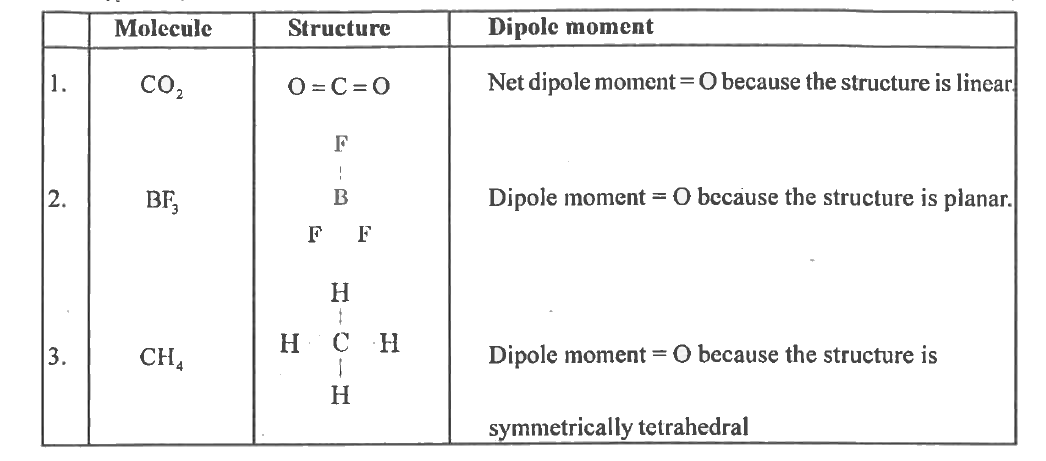
|
|
| 28. |
Define dipole moment. Give the mathematical expression of dipole moment |
| Answer» SOLUTION :`1//4 Qxxr` | |
| 29. |
Define Dimensional Analysis. |
|
Answer» e.g., A piece of metal is 3 inch long. What is its length in cm ? We know that 1 in `=2.54` cm From this equivalence, we can write `(1 "in")/(2.54 cm) = 1= (2.54 cm)/(1 "in")` Thus, `(1"in")/(2.54 cm) = 1 ` and `(2.54 cm)/(1 "in")=1` Thus, both of these are called unit factors. If some numberis multipled by these unit factors (i.e. 1), it will not beaffected otherwise. Say, the 3 in given above is multiplied by the unit factor So, `3 " in" = 3 "in" xx(2.54 cm)/(1"in ")=7.62 cm` e.g., A jug contains 2L of milk. Calculate the value of the milk in `m^(3)`. Since `1L = 1000 cm^(3)` and `1m = 100` cm which gives `(1m)/(100 cm) = 1 =(100 cm)/(1m)` To get `m^(3)` from the above unit factors, the first unit factor is TAKEN and it is cubed. `((1m)/(100 cm))^(3)RARR (1m^(3))/(10^(6)cm^(3))=(1)^(3)=1` Now `2L=2 xx 1000 cm^(3)` The above is multiplied by the unit factor `2xx1000 cm^(3) xx (1m^(3))/(10^(6)cm^(3))=(2m^(3))/(10^(3))=2xx10^(-3)m^(3)` |
|
| 30. |
Define degree of ionization or dissociation. |
| Answer» SOLUTION :It is RATIO of the NUMBER of ions or molecules produced to the TOTAL number of molecules. | |
| 31. |
Define Dalton's law of partial pressure. |
| Answer» Solution :It states that the TOTAL pressure of a MIXTURE of gases is the sum of partical PRESSUREOF the gases PRESENT `P_("total")=P_(1)+P_(2)+P_(3)....` | |
| 32. |
Define cyclic process. Give example. |
|
Answer» Solution :When a system returns to its original STATE after completing a series of changes, then it is said that a CYCLE is COMPLETED. This process is known as a cyclic process. For a cyclic process dU=0,dH=0,dP = 0,dV = 0 and dT=0. |
|
| 33. |
Define criticial temperature (T_(e)) |
| Answer» Solution :The maximum TEMPERATUREAT which a gas can be CONVERTED into liquid by APPLYING PRESSURE is called critical TEMPERATURE. | |
| 34. |
Define critical temperature. Write the value of critical temperatue for CO_(2). |
| Answer» Solution :The MAXIMUM temperature at which a gas can be CONVERTED into LIQUID by applying PRESURE. Critical temperature of `CO_(2)to 30.98^(@)C` | |
| 35. |
Define cracking and give an example. |
| Answer» Solution :Cracking, in petroleum REFINING, the PROCESS by which heavy hydrocarbon molecules are broken up into LIGHTER molecules by MEANS of heat and USUALLY pressure and sometimes catalysts. Cracking is the most important process for the commercial production of gasoline and diesel fuel. | |
| 36. |
Define cracking ? |
|
Answer» Solution :The thermal DECOMPOSITION of higher hydrocarbons into lower hydrocarbons in presence or ABSENCE of a catalyst is called CRACKING. For example . `underset"HEXANE"(C_6H_14) underset"6-7 ATM"overset"773 K"to ubrace(C_6H_12+H_2)_("Hexane" "" "Hydrogen")+ubrace(C_4H_8 + C_2H_6)_("Butene" " " "Ethane")+ubrace(C_3H_6+C_2H_4+CH_4)_("Propene" " " "Ethene" " " "Methane")` |
|
| 37. |
Define covalent radius. |
| Answer» Solution :COVALENT RADIUS is ONE half of the internuclear distance between two IDENTICAL atoms linked together by a single covalent bond. | |
| 38. |
Define covalent bond according to orbital concept. |
|
Answer» |
|
| 39. |
Define coordination number of a metal ion in an ionic crystal |
| Answer» Solution :In an IONIC crystal , coordination NUMBER of a METAL ion (+ve ion) is the number of negative ions surrounding the metal ion, i.e., which are present as its NEAREST neighbours. | |
| 40. |
Define coordination number of a metal ion an ionic crystal. |
| Answer» Solution :In an ionic CRYSTAL, coordination NUMBER of a mental ion ( +ve ion)is the NUMER of negative ions surrounding the metal ion, i.e, which are presnt as it NEAREST neighbours. | |
| 41. |
Define conformation . |
| Answer» Solution :Each carbon in alkanes is `sp^(3)` hybridized and the four GROUPS or atoms around the carbon are tetrahedrally BONDED. In alkanes having two or more carbons, there exists free rotation about `C-C` single bond. Such rotation LEAVES all the groups or atoms bonded to each carbon into an innite NUMBER of readily interconertible three dimensional ARRANGEMENTS. Such readily interconvertible three dimensional arrangement of a molecule is called conformations. | |
| 42. |
Define colligative properties. |
| Answer» Solution :For an ideal dilute solution the properties NAMELY RELATIVE lowering of vapour pressure elevation of boiling point depression in freezing point and OSMOTIC pressure do not depend on the chemical nature of the solute but DEPENDS only on the number of solute paticles (ions/molecules ) present in the solution These four properties are KNOW as coligative properties. | |
| 43. |
Define co-ordinate covalent bond. |
|
Answer» Solution :In certain bond FORMATION, one of the COMBINING atoms donates a PAIR of electrons (i.e.) two electrons which are necessaryfor the covalent bond formation, and these electrons are shared by both the combining atoms. These type of bonds are called co-ordinate covalent bond or co-ordinate bond. The combining atom which donates the pair of electron is called a donor atom and the other atom an acceptor atom. This bond is DENOTED by an arrow starting from the donor atom POINTING towards the acceptor atom. |
|
| 44. |
Define Chemical Equilibrium with an example. |
|
Answer» Solution :It is a state, where the rate of FORWARD reaction is equal to the rate of BACKWARD reaction or is also defined as " A state where the CONCENTRATION of ractant and PRODUCT ramain CONSTANT". Example: `H_(2)(g)+I_(2)(g)hArr2HI(g)` |
|
| 45. |
Define chemical equilibrium. |
|
Answer» Solution :If the OPPOSING PROCESSES involve chemical reactions, such an EQUILIBRIUM is called a 'chemical equilibrium' Example: `PCl_(5(g))hArrPCl_(3(g))+Cl_(2(g))` `H_(2(g))+I_(2(g))hArr2HI_((g))` |
|
| 46. |
Define chemical bond. |
| Answer» Solution :The interatomicattractive forces which HOLD the CONSTITUENT atoms/ions TOGETHER in a molecule are called CHEMICAL bonds. | |
| 47. |
Define cathode and anode. |
| Answer» Solution :Cathode is electrode TOWARDS which CATIONS are ATTRACTED. ANODE is electrode which attracts anions. | |
| 48. |
Define Bronsted Lowry theorey or Protonic theory with one example. |
|
Answer» Solution :A substance or molecule which donates a PROTON is CALLED acid. [Protogenic] A substance or molecule which accepts a proton is called abase. [Protophilic]. Example : `{:(,"Acid",,"Proton",,"Base"),(1,HCL,to,H^(+),+,Cl^(-)),(2,NH_(3),to,H^(+),+,NH_(2)^(-)),(3,NH_(2)^(-),to,H^(+),+,NH^(2-)),(4,H_(3)^(+)O,to,H^(+),+,H_(2)O),(5,H_(2)O,to,H^(+),+,OH^(-)):}` |
|
| 49. |
Define Boyle's temperature (or) Boyle's point. |
| Answer» SOLUTION :The temperature at which real gases OBEY IDEAL behaviour for appeciable rang of PRESSURE is called Boyl.s temperasture (or) Boyle.s point. | |