

Saved Bookmarks
This section includes 7 InterviewSolutions, each offering curated multiple-choice questions to sharpen your Current Affairs knowledge and support exam preparation. Choose a topic below to get started.
| 1. |
Gold number is a mesure of the |
|
Answer» Protective action by a lyophilic colloid on a LYOPHOBIC colloid |
|
| 2. |
Gold number gives the indication of |
|
Answer» gm-molecules of GOLD PER 1000 ml of colloidal solution |
|
| 3. |
Gold number is |
|
Answer» The NUMBER of mg of LYOPHILIC colloid which should be ADDED to 10 ML of ferric hydroxide sol so as to prevent its coagulation by the ADDITION of 1 ml of 10% sodium chloride solution |
|
| 4. |
Gold has a close packed structure which can be reviewed as spheres occupying 0.74of the total volume. If the density of gold is 19.3 gg/cc, calculate the apparent radius of a gold atom in the solid (Au=197 amu) |
|
Answer» Solution :As the packing FRACTION is 0.74 , packing can be hcp or FCC. Knowing that gold has fcc lattice, Z=4 `rho=(ZxxM)/(a^3xxN_0) "" THEREFORE 19.3=(4xx197)/(a^3xx6.023xx10^23) "or" a=4.07xx10^(-8)` CM For fcc, `r=a/(2sqrt2)=(4.07xx10^(-8))/(2xx1.414)=1.439xx10^(-8)` cm |
|
| 5. |
Gold has a close packed structure which can be reviewed as sphere occupying 0.74 of the total volume. If the density of gold is 19.3 g/cc. Calculate the apparent radius of a gold atom in the solid(Au = 197 amu)/ |
|
Answer» SOLUTION :As the packing fraction is 0.74 , packing can be hcp or FCC. KNOWING that gold has fcc lattice, Z = 4 p = ` ( Z xx M)/ (a^(3) xx N_(0))therefore19.3 = ( 4 xx 197)/ (a^(3)xx 6.023 xx 10^(23))ora= 4.07 xx 10^(-8) ` CM For fcc, ` r = a / (2sqrt2)= ( 4.07 xx 10^(-8))/ (2xx 1.414)= 1.439 xx 10^(-8) ` cm |
|
| 6. |
Gold crystallizes in a face - centred cubic lattice. If the length of the edge of the unit cell is 407 pm, calculate the density of gold as well as its atomic radius assuming it to be spherical . Atomic mass of gold =197 amu. |
|
Answer» |
|
| 7. |
Gold crystallizes in a face centred cubic lattice. If the length of the edge of the unit cell is 407 pm, calculate the density of gold as well as its atomic radius assuming it to be spherical. Atomic mass of gold = 197 amu |
|
Answer» |
|
| 8. |
Gold can easily dissolve in |
|
Answer» CONC.`HNO_3` |
|
| 9. |
Gold (atomic radius =0.144 nm) crystallises in a face centred unit cell. What is the length of the side of the cell ? |
| Answer» SOLUTION :For FCC, `a=2sqrt2r`=2 X 1.414 x 0.144 NM = 0.407 nm | |
| 10. |
Gold(atomic radius = 0.144 nm) crystallisesin a face centred unit cell.What is the length of theside of the cell. |
| Answer» SOLUTION :For FCC , ` a = 2 SQRT2 r = 2 XX 1.414 xx 0.144 NM= 0.407 nm ` ] | |
| 11. |
Gold (atomic mass 197 u, atomic radius = 0.144 m ) crystallizes in a face centred unit cell. Determine the density of gold |
|
Answer» Solution :For fcc unit cell , `r=a/(2sqrt2)` or `a=2sqrt2 r=2xx1.414 XX 0.144`NM = 0.407 nm =`0.407xx10^(-7)` CM `rho=(ZxxM)/(a^3xxN_0)=(4xx197 "g MOL"^(-1))/((0.407xx10^(-7)cm)^3 xx (6.02xx10^23 mol^(-1)))=19.4 g cm^(-3)` |
|
| 12. |
Go through the following flow sheet. Based on, it answer the questions given at the end of it. Yellow coloured solution (B) is of: |
|
Answer» `Na_(2)CrO_(4)` formed by oxidation of `Cr^(3+)` by `H_(2)O_(2)` in ALKALINE medium |
|
| 13. |
Go through the following flow sheet. Based on, it answer the questions given at the end of it. Select correct statement(s): |
|
Answer» `CO_(2)` makes the solution of (B) ACIDIC and CONVERTS (B) into `FeCI_(2)(C)`. |
|
| 14. |
Go through the following flow sheet. Based on, it answer the questions given at the end of it. Formation of (F) using (G), KCI (solid) and concentrated H_(2)SO_(4) is called: |
|
Answer» redox TEST of `Cr_(2)O_(7)^(2-)` |
|
| 15. |
Go through the following flow sheet. Based on, it answer the questions given at the end of it. Compounds D,E and F respectively are: |
|
Answer» `{:(D,E,F),((NH_(4))_(2)CrO_(4),CrO_(2)CI_(2),PbCrO_(4)):}` |
|
| 16. |
Go through the following flow sheet. Based on, it answer the questions given at the end of it. Compound (A) is: |
|
Answer» `CuCI_(2)` |
|
| 17. |
Glycrine can be purified by |
|
Answer» VACUUM distillation |
|
| 18. |
Glycol on reacting with phthalic acid gives |
|
Answer» Glycerol |
|
| 19. |
Glycol is used in the manufacture of |
|
Answer» Terylene |
|
| 20. |
Glycol is added to aviation petrol because |
|
Answer» It prevents freezing of petrol |
|
| 21. |
Glycine is an alpha-amino acid which exists in the form of Z witter ion as overset(+)NH_(3) CH_(2)CO O^(-). Write the formula of its conjugate acid and conjugate base. |
|
Answer» Solution :CONJUGATE acid `= overset(+)NH_(3)CH_(2)CO O^(-) + H^(+) = overset(+)NH_(3)CH_(2)CO OH` Conjugate base `= overset(+)NH_(3)CH_(2)CO O^(-) -H^(+)=NH_(2)CH_(2)CO O^(-)`. |
|
| 22. |
Glycine exists as the zwitter ion, N^(+)H_(3), CH_(2),COO^(-). Its conjugate base is |
|
Answer» `NH_2 CH_2COOH` |
|
| 23. |
Glycerol which decomposes at its boiling point can be purified by |
|
Answer» STEAM distillation |
|
| 24. |
Glycerol when trated with a mixture of conc. HNO_(3) and conc. H_(2)SO_(4) forms |
|
Answer» Acrolein |
|
| 25. |
Glycerol on warming with a small amount of hydriodic acid gas converted into |
|
Answer» `CH_(3)-CHI-CH_(3)` |
|
| 26. |
Glycerol on treatment with oxalic acid at 110^(@)C forms |
| Answer» Answer :A | |
| 27. |
Glycerol on reaction with excess HI yields |
|
Answer» ALKYL iodide |
|
| 28. |
Glycerol on oxidation with periodic acid gives |
|
Answer» `2HCHO + HCOOH` |
|
| 29. |
Glycerol on heating with phosphorus pentaoxide or with KHSO_(4) or conc. H_(2)SO_(4) produces a compound with bad odour. The compound is |
|
Answer» FORMIC ACID 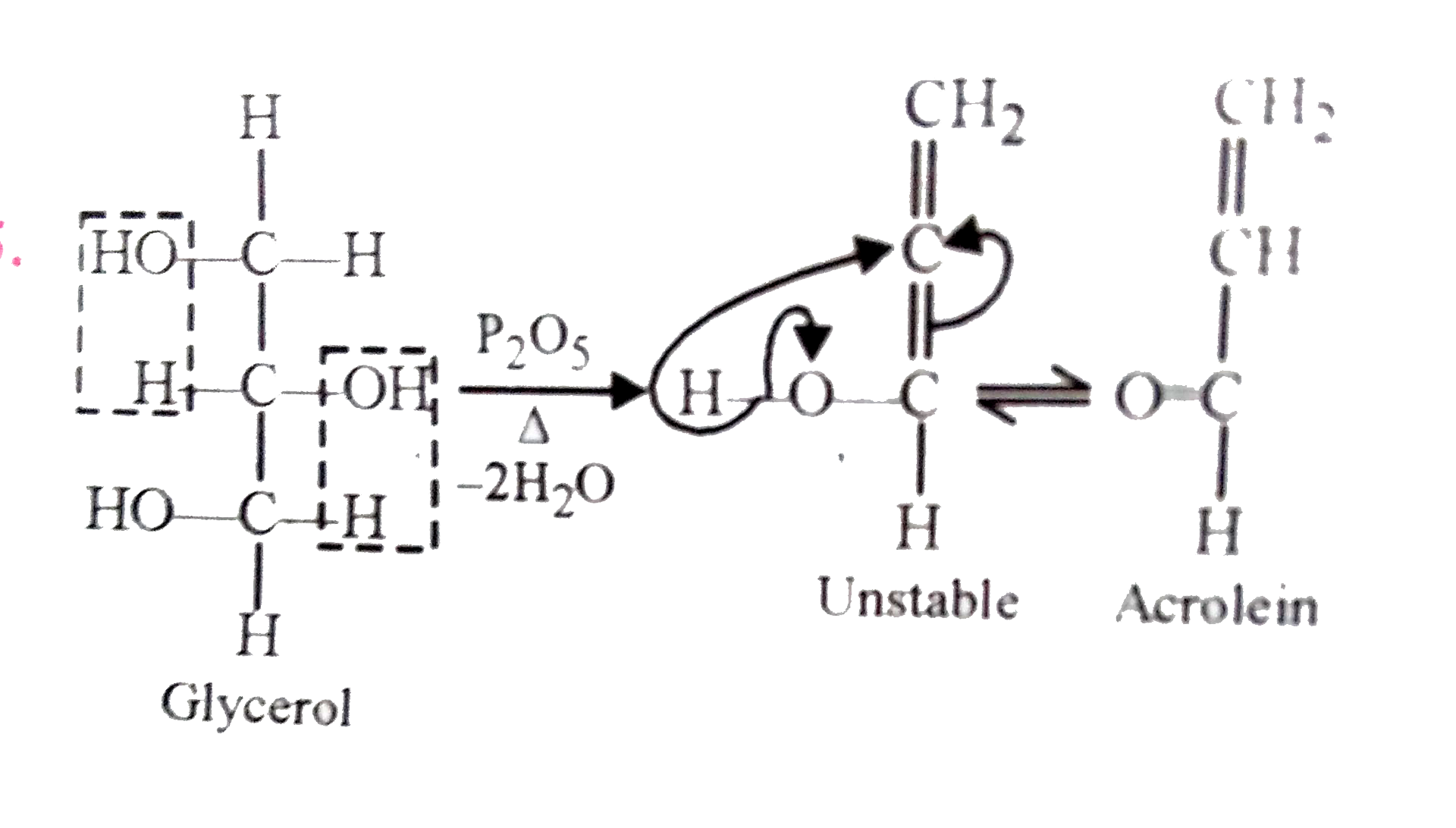
|
|
| 30. |
Glycerol on heating with a mixture of KMnO_(4) and H_(2)SO_(4) produces |
|
Answer» Ethanedioicacid |
|
| 31. |
Glycerol, on heating with oxalic acid at 110^(@)C gives |
|
Answer» Ethanol |
|
| 32. |
Glycerol is used |
|
Answer» as a sweetening AGENT in BEVERAGES and confectionary |
|
| 33. |
Glycerol is highyl viscous. It is due to the fact that |
|
Answer» it is HIGHLY polar |
|
| 34. |
Glycerol is a |
|
Answer» Primary ALCOHOL |
|
| 35. |
Glycerol changes to acrolein in the presence of |
|
Answer» Conc. `H_(2)SO_(4)` |
|
| 36. |
Glycerol is separated in soap industries by : |
|
Answer» Vacuum distillation |
|
| 37. |
Glycerol can be obtained from |
| Answer» Solution :From fats and propylene both. | |
| 38. |
Glycerol can be purified by |
|
Answer» STEAM distillation |
|
| 39. |
Glycerine is purified by (a) vacuum distillation (b) simple distillation (c) steam distillation (d) sublimation (e) solvent extraction |
|
Answer» |
|
| 40. |
Glucose underset((ii)P//KI)overset((i)HCN//H_(3)O^(o+))toP P is |
|
Answer» n-heptonoic acid 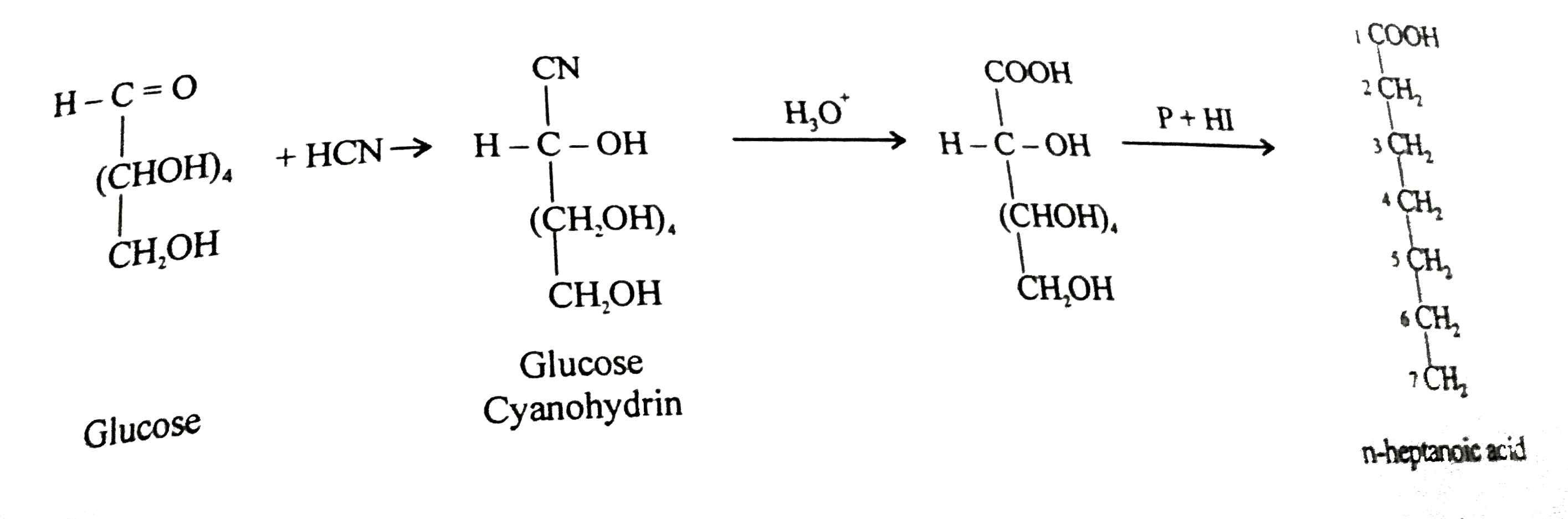
|
|
| 41. |
Glucose as well as fructose are oxidized by periodic acid. The number of moles of HCOOH formed from each mole of glucose and fructose are |
|
Answer» 5 and 5 |
|
| 42. |
Global warming can be prevented by |
|
Answer» Constructing more dams on rivers |
|
| 43. |
Glassy bead is obtained by heating |
|
Answer» `Na_2 B_4 O_7 10H_2 O` |
|
| 44. |
Glass reacts with IIF to produce |
|
Answer» `SiF_4` |
|
| 45. |
Glass is considered as a supercooled liquid. Give reason. |
| Answer» SOLUTION :On being heated, glass has the PROPERTY to flow like LIQUIDS as shown by greater thickness of the WINDOW panes at the bottom. Hence, it is called SUPERCOOLED liquid. | |
| 46. |
Glass is considered as a supercooled liquid, Give reason. |
| Answer» Solution :On being HEATED, glass has the PROPERTY to flow like LIQUIDS as shown by graeter THICKNESS of the window panes at the bottom. Hence, it is called supercooled liquid. | |
| 47. |
Glass is an extremely viscous liquid. Why ? |
|
Answer» Solution :GLASS is an extermely viscous liquid because it is so viscous that MEANS of its properties resemble solids. This observation PROVES that Glass is very thick liquid and glass is heavy at LOWER side. |
|
| 48. |
Glass is a |
|
Answer» micro-crystalline solid |
|
| 49. |
Glass is a ...... |
|
Answer» LIQUID |
|
| 50. |
Glacial acetic acid is obtained by |
|
Answer» distilling VINEGAR |
|