

Saved Bookmarks
This section includes 7 InterviewSolutions, each offering curated multiple-choice questions to sharpen your Current Affairs knowledge and support exam preparation. Choose a topic below to get started.
| 1. |
In graphite and diamond, the percentage of p-characterof the hybird orbitals iin hybridisation are respectively |
|
Answer» 33 and 75 |
|
| 2. |
In graphite, electrons are : |
|
Answer» LOCALISED on EVERY THIRD carbon |
|
| 3. |
In Glycolysis process during phosphorylation of Glucose equilibrium constant at 298 K is 3.6xx10^(-3) find of DeltaG^ө . What is indicates ? [R= 8.314 J K^(-1) "mol"^(-1) ] (DeltaG^ө gt 0 therefore Reaction is not spontaneous ) |
| Answer» SOLUTION :`13.81 "K MOL"^(-1)` | |
| 4. |
In given reaction calculate number of electron lose by iron : Fe+H_(2)OtoFe_(3)O_(4)+H_(2). |
|
Answer» Solution :`underset((0))underset(darr)(3FE)+2H_(2)Otounderset((+8))underset(darr)(Fe_(3)O_(4))+2H_(2)` Number of electrons loses = 8 |
|
| 5. |
In geometrical isomerism, boiling points are more for |
|
Answer» Cis isomer |
|
| 6. |
In gaseous state, nitric oxide is …………whil in the liquid or solid state it is ………….. |
|
Answer» |
|
| 7. |
In gaseous mixture contain 20%(W)/(W)H_(2) gas then calculate moles ? |
| Answer» SOLUTION :10 MOLES of `H_(2)` | |
| 8. |
In GaCl_(2), oxidation state of Ga is |
| Answer» Solution :In `GaCl_(2)`oxidation STATE of GA is +1 and +3 | |
| 9. |
In fully dissociated NH_(4)CI, [NH_(4)Cl_((g)) harr NH_(3(g)) + HCl_((g))] observed vapour density is |
|
Answer» less than the vapor density of pure `NH_(4)CI` `d=(D)/(2) lt D` |
|
| 10. |
In fuel cells,__ is converted into electrical energy |
|
Answer» NEUTRALISATION energy |
|
| 12. |
In Friedel - Craft acylation the amount of AlCl_3 that must be taken is |
|
Answer» in catalystic AMOUNT |
|
| 13. |
In Friedal-Craft's alkylation, catalyst is |
|
Answer» Anhydrous `ZnCl_2` |
|
| 14. |
In Freundlich adsorption isotherm to the value of 1/n is |
|
Answer» between 0 and 1 in all cases |
|
| 15. |
In Frankelstein reaction, the mechanism followed is ………….. . |
|
Answer» `S_(N^(1))` |
|
| 16. |
In formula and reaction the electron pair displacement is given by arrow and electron displacement is given by…….. |
Answer» SOLUTION : HALF HEADED, CURVED ARROW HALF HEADED, CURVED ARROW
|
|
| 17. |
In formation of methane the outermost p orbitals of carbon are at 90^(@) still bond angle is not 90^(@)? |
| Answer» Solution :As in METHANE 2s and 2p orbital combine and `sp^(3)` hybridization ta.lee PLACE. These `sp^(3)` hybrid orbitals are arrange at FOUR CORNER of tetrahedral so the angle is not `90^(@)`. | |
| 18. |
In following reaction which is reducing agent substance ? CH_(3)CHO+Ag_(2)OtoCH_(3)COOH+2Ag |
| Answer» SOLUTION :`CH_(3)CHO`. | |
| 19. |
In following reaction oxidation number of Br is convert into 0 to -5 : Br_(2)toBrO_(3)^(-) |
|
Answer» Solution :FALSE. `UNDERSET(0)underset(DARR)(Br_(2))tounderset(+5)underset(darr)(BrO_(3)^(-))` |
|
| 20. |
In following match column-I containing formula with column-II containing their name. |
|
Answer» SOLUTION :`(i) RARR (b), (c ), (d) , (e )` `(II) rarr (a), (f)` `(III) rarr (G)` |
|
| 21. |
In following isothermal graphs A, B and C at temperatures T_(1), T_(2) and T_(3), the correct order of temperatures will be : |
|
Answer» `T_(1) GT T_(2) gt T_(3)` |
|
| 22. |
In following chemical reaction by taking 159 g of Cu_(2)S,how much gram of SO_(3) produced ? (At. mass of Cu = 63.5, S = 32, O = 16 g/mole) (i) Cu_(2)S + O_(2) rarr Cu_(2)O + SO_(2) (ii) 2SO_(2)+O_(2) rarr 2SO_(3) |
|
Answer» 80 g `{:("ATOMIC mass"159xx2,80xx2),(""159,(?)):}` `rArr (159xx80xx2)/(159xx2)=80G` |
|
| 23. |
In fluorite (CaF_2) , Ca^(2+) ions forms the ______ structure whereas F^- ions are present in the _________ voids. |
|
Answer» |
|
| 24. |
Explain how the radii of the alkali metals vary in the group? Are they obeying the periodic law. |
|
Answer» Lithium fluoride is most SOLUBLE fluoride (in water) `F^(-)=Leflt NaFlt KF lt RbFlt CSF` colvanlend character theremalstability `=Li_(2)CO_(3)ltNa_(2)CO_(3)ltk_(2)CO_(3)ltltRbCO_(3)ltCs_(2)CO_(3)` basic strenth `=Li_(2)CO_(3)lt Na_(2)Oltk_(2)Olt Rb_(2)OltCs_(2)O` |
|
| 25. |
In Finkelstein reaction, the mechanism followed is ……………….. . |
| Answer» SOLUTION :`S_(N^2)` | |
| 26. |
In fermentation by zymase, ethyl alcohol and carbon dioxide are produced from which of the following sugars? |
|
Answer» Glucose |
|
| 27. |
In face-centred cubic unit cell, edge length is |
|
Answer» `(4)/(sqrt3)r`  `(4r)^(2) = a^(2) + a^(2)` `a = (4)/(sqrt2) r` |
|
| 28. |
In face-centred cubic (fcc) crystal lattice, edge length is 400 pm. Find the diameter of the greatest sphere which can be fitted into the interstitial void without distortion of the lattice. |
|
Answer» SOLUTION :For FCC, radius of atom (R)=`a/(2sqrt2)=400/(2sqrt2)` pm =141.4 pm As octahedral void is bigger in size than the tetrahedral void, the greatest sphere will fit into octahedral voids Radius of octahedral void (r)=0.414 R=0.414 X 141.4 pm = 58.54 pm `therefore` Diameter of the greatest sphere FITTING into the void =2 x 58.54 pm =117.08 pm |
|
| 29. |
In face centred cubic close packed structure octahedral sites are present at |
|
Answer» edge centres |
|
| 30. |
In ethylene, carbon monoxide and water is heated at high temperature, which of the following if formed |
|
Answer» `C_(4)H_(8)O_(2)` |
|
| 31. |
In evacuated closed vessel the total pressure is P bar at equilibrium. Write equilibrium constant K_p of the following reaction. Reaction : NH_4HS_((s)) hArr NH_(3(g)) + H_2S_((g)) |
|
Answer» Solution :`{:("REACTION:", NH_4HS_((s)) hArr , NH_(3(g))+ , H_2S_((g))), ("Initial concentration:",,Zero,Zero),("Partial pressure at EQUILIBRIUM:",,p_(NH_3),p_(H_2S)):}` TOTAL pressure at equilibrium = P bar, So, `THEREFORE p_(NH_3)=P/2 = p_(H_2S)` So, `K_p=(p_(NH_3))(p_(H_2S))` `therefore K_p=(P/2)(P/2)=P^2/4` `therefore P^2=4K_p` and `P=2sqrt(K_p)` |
|
| 32. |
In ethyl acetoacetate, it is the................form which is more stable while in acetylacetone, it is the..............form which is more stable. |
|
Answer» |
|
| 33. |
In ethanol, the bond that undergoes heterolysis during its esterfication with CH_(3)COOH//H_(2)SO_(4) is |
|
Answer» `C-C` 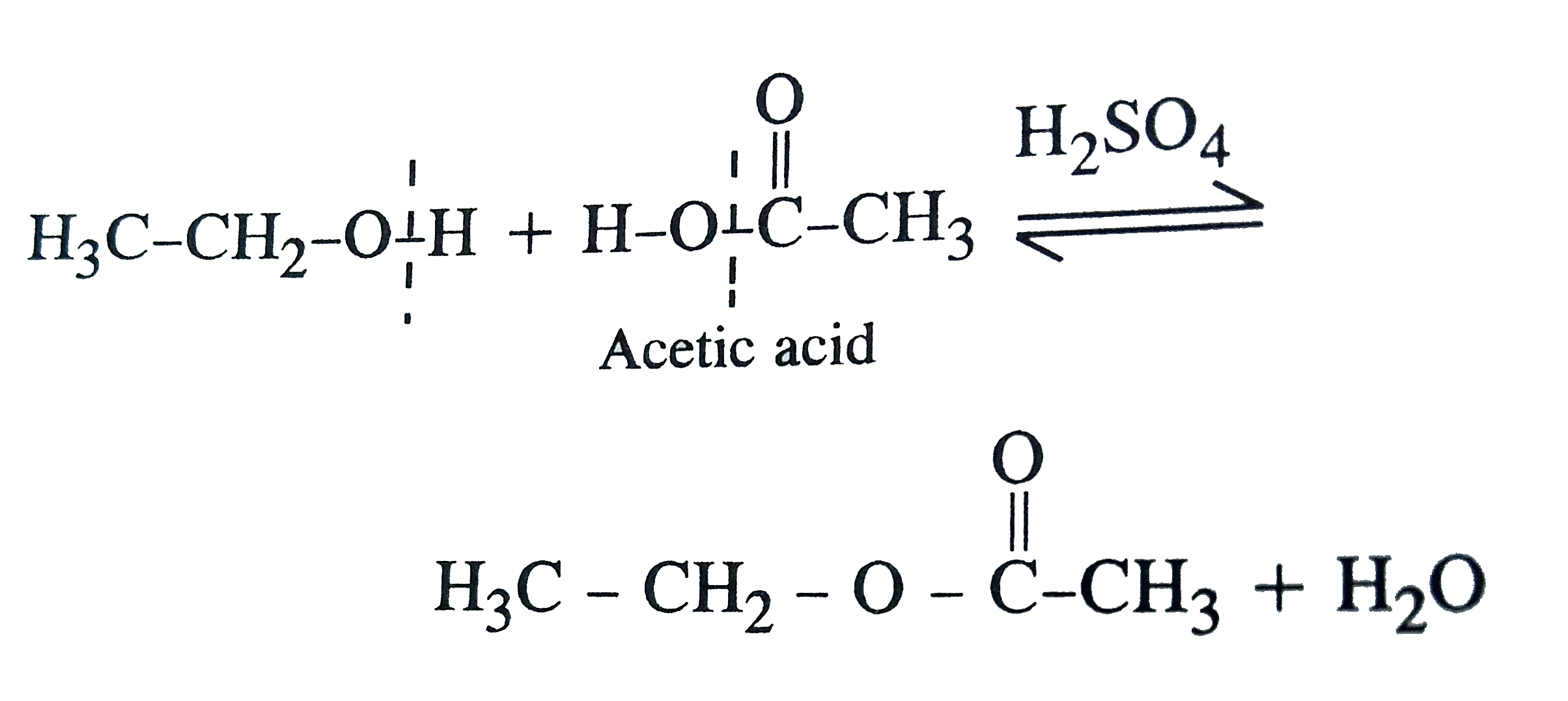
|
|
| 34. |
In estimation of Fe^(2+)by KMnO_(4) HNO_3cannot be used in place of H,SO, because |
|
Answer» `HNO_3`oxidised`Fe^(2+)` `H_(2) O rarr H^(+) +OH^(-)` Due to high discharge potential of `Cl^(-)`discharge FIRST. |
|
| 35. |
In estimation of C and H after absorption of CO_(2), H_(2)O is absorb or not? Why? |
| Answer» Solution :No, In the tube of absorption of FIRST KOH is kept so `H_(2)O` is also ABSORB after `CO_(2)`. So ACCURATE weight of `CO_(2) or H_(2)O` is not obtained | |
| 36. |
In emissionspectran_(2) to,n_(3)to n_(1)n_(4) to n_(1) ,n_(5) to n_(1)tansitionare respectively forenergyE_(1) ,E_(2) ,E_(3) ,E_(4)Sowhat is the order of energy ? |
| Answer» Solution :`E_(1) lt E_(2) lt E_(3) ltE_(4)` | |
| 37. |
In emissionspectran_(2) ton_(1) ,n_(3) to n_(2) , n_(4) to n_(3),n_(5) to n_(4)transitionare respectivelyfor energyof E_(1) ,E_(2) ,E_(3) ,E_(4)sowhat is the orderof energy. |
| Answer» Solution :`E_(4) lt E_(3)ltE_(2) lt E_(1)` | |
| 38. |
In electron …..Frominfinite state togroundstatein Hatom. Findthe emittedwavelength . |
| Answer» Solution :`LAMBDA= 9.115 xx 10^(8)m = 91 .15 nm` | |
| 39. |
In electromeric effect only_______are shifted. |
|
Answer» `ALPHA` pair of `e^-` |
|
| 40. |
In electromagnetic radiation, which of the following,…… rays has greater wavelength than visible light ? |
|
Answer» U.V-rays |
|
| 41. |
In electro-refining of metal the impure me |
|
Answer» |
|
| 42. |
In each reaction box write a single letter designating the best reagent and condition selected from the list at bottom of the page. |
|
Answer» Reaction 4: L,G,Reaction 5: B,L,C |
|
| 43. |
In each of the followings sets of compopunds write the decreasing order of % enol content. |
|
Answer» |
|
| 44. |
In each of the following sets of compounds write the decreasing order of % enol content. |
|
Answer» 3lt4lt2lt1 |
|
| 45. |
In each of the following sets of compounds write the decreasing order of % enol content |
|
Answer» |
|
| 46. |
in each of the following sections three organic halogen compunnds arae listed , in the box given entera number (1 to 3) indicating the of reactivity of the desigented (1 is most reactive and 3 is ,east). |
|
Answer» `S_(N^(1))`Substitution by `NaoCOCH_(3) "in methanol"` (b) `1^(@)` resonance stabilized transition state will be will more reactice . (c ) GOOD leaving group. |
|
| 47. |
In each of the following sets of compounds write the decreasing order % enol content. |
|
Answer» 4gt1gt3gt2 |
|
| 48. |
In each of the following questions, a statementof Assertion is given followed by a corresponding statementof Reason just below it. Of the statements, mark the correctanswer as Assertion. A catalyst does not influnce the value of the equilibrium constant .Reason . Catalystinfluences the rate of both forwardand backwardreaction equally . |
|
Answer» If both ASSERTION and reason are true, and reason is the true explanation of the assertion . |
|
| 49. |
In each of the following questions, a statementof Assertion is given followed by a corresponding statementof Reason just below it. Of the statements, mark the correctanswer as Assertion . For the reaction, 2NO(g0 + O_(2) (g) hArr 2 NO_(2) (g) ,increase in pressure favours the formation of NO_(2) Reason . The reaction is exothermic. |
|
Answer» If both ASSERTION and reason are TRUE, and reason is the true explanation of the assertion . |
|
| 50. |
In each of the following questions, a statementof Assertion is given followed by a corresponding statementof Reason just below it. Of the statements, mark the correctanswer as Assertion. When a catalyst is added to a reaction mixture in equilibrium , the amount of the products increases . Reason . The forward reaction becomes faster on adding the catalyst . |
|
Answer» If both assertion and reason are TRUE, and reason is the true EXPLANATION of the assertion . |
|