

Saved Bookmarks
This section includes 7 InterviewSolutions, each offering curated multiple-choice questions to sharpen your Current Affairs knowledge and support exam preparation. Choose a topic below to get started.
| 1. |
Isopropyl alcohol on treatment with excess hot conc. H_(2)SO_(4) gives a compounds X. X on treatment with HBr gives Y. Y when treated with sodium using ether as solvent gives |
|
Answer» n-Hexane |
|
| 2. |
Isopropyl alcohol on oxidation gives |
|
Answer» ACETONE |
|
| 3. |
Isoprene is a diene. How are the positions of double bonds located? |
|
Answer» Solution :The position of multiple bonds PRESENT between carbon atoms can be located by ozonolysis, Isoprene is an unsaturated HYDROCARBON with molecular formula `C_(5)H_(8)` One mole of isoprene on ozonolysis gives two moles of methanal and one mole of 2-oxopropanal. Hence isoprene has two double bonds on terminal carbon atoms and a branch on one of the double BONDED carbon atoms. ARRANGING the ozonolysis products in a sequence, we GET,  Hence isoprene is 2-methyl-1,3-butdiene. |
|
| 4. |
Isopiestic solution have: |
| Answer» Answer :A | |
| 5. |
Isopentyl is the common name for which alkyl group? |
|
Answer» `CH_(3)CH_(2)CH_(2)underset(CH_(3))underset("|")("C")H-` |
|
| 6. |
Isopentane can form four structurally isomeric mono bromo derivatives. How many of them are cally active? |
|
Answer» Solution :Mono bromo derivatives of ISO pentane are 1) `CH_(3)-overset(CH_(3))overset(|)CH-CH_(2)-CH_(2)-Br`  `CH_(3)-underset(Br)underset(|)overset(CH_(3))overset(|)C-CH_(2)-CH_(3)`  Among (4) isomers TWO are optically active due to the PRESENCE of chiral CENTRE |
|
| 7. |
Isopentane can form four structually isomeric mono bromo derivatives. How many of them are optically active? |
|
Answer» Solution :`ClCH_(2)-OVERSET(**)CH(CH_(3))-CH_(2)-CH_(3)` `CH_(3)-overset(**)CH(Cl)-CH(CH_(3))-CH_(3)` |
|
| 8. |
Isopentane and neopentane are the examples for ............... . |
| Answer» SOLUTION :CHAIN ISOMERISM | |
| 9. |
Isomers with the same molecular and same strctural formula are called |
|
Answer» GEOMETRICAL isomers |
|
| 10. |
Isomers which can be interconverted through rotation around a single bond are : |
|
Answer» conformers |
|
| 12. |
Isomerism exhibited by methyl formate and acetic acid is |
|
Answer» GEOMETRICAL |
|
| 13. |
isomera of a compound must have |
|
Answer» Same PHYSICAL properties |
|
| 14. |
Isoinerisin exhibited by secondary butyl chloride and tertiary.butyl chloride is |
|
Answer» Chain isomerism Secondary butyl CHLORIDE TERTIARY butyl chloride Both are DIFFER in chain arrangement. HENCE they are chain isomers. |
|
| 15. |
Isobutylene when subjected to hydroboration oxidation reaction yields |
|
Answer» sec-Buty alcohol 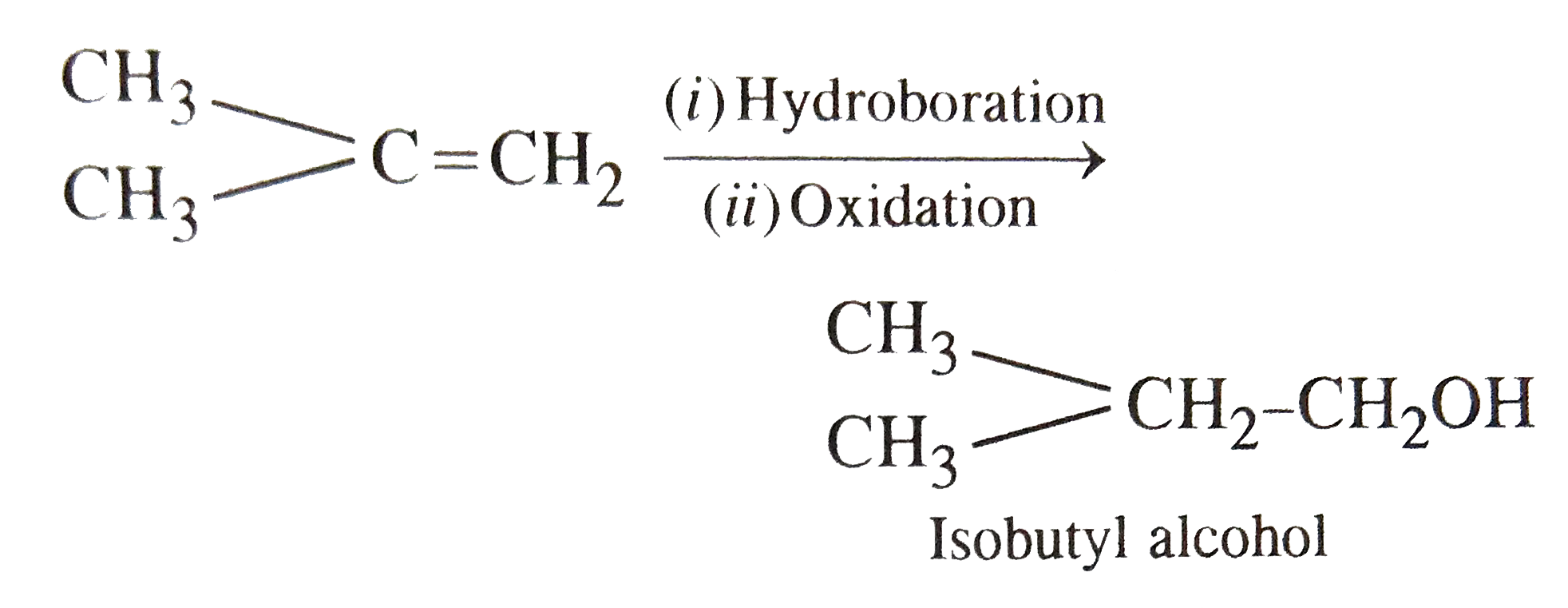 ANTI MARKOWNIKOFF PRODUCT is FORMED. |
|
| 16. |
Isobutyl and sec-butyl represent different alkyl groups. Do Isopropyl and sec-propyl also represent different alkyl groups ? Comment. |
Answer» Solution :Isobutyl group and sec-butyl group represent DIFFERENT structures since isobutyl group has a `CH_(3)` side CHAIN at position 2 and a free valency at position 1 while sec-butyl group has only a free valency at position 2 as shown below.  Since propyl group has three carbon ATOMS, it cannot have a `CH_(3)` side chain but an have only a free valency at position 2. Therefore, it should be actually called as sec-propyl. `underset("sec-Propyl or Isopropyl")(underset(1)(C)H_(3)-underset(2)overset(|)(C)H-underset(3)(CH_(3)))` But it is more commonly called as Isopropyl group which is a misnomer. Since there is no ambiguity, therefore, both isopropyl and sec-propyl represent the same alkyl group. |
|
| 17. |
Isobutyl alcohol in acidic medium gives tert-butyl alcohol, the reaction is |
|
Answer» ADDITION REACTION |
|
| 18. |
Isobuty alcohol (2 -mehyl 1 -1-propanol), (CH_(3))_(2)CHCH_(2)OH, can be transformed to each of the compounds (a through 1) listed in the left-hand column. In each case the number of steps the needed to accomplish the change is noted, and an answer box is noted, and answer box is provided for your reagent selections. Fourteen reagents (designated A through N) are listen in the right -hand column. corresponding to the desired compound. Write letters desiganating the raagent or reagents you believe will achieve the desired transformation in the box to the right of the product formula. In the case of a multi-step sequence write the reagents in the order they are to be used. In some cases you may wish to use a previously prepared compound as a reactant. If so, write the number (a to 1) corresponding to the desired compound. |
| Answer» SOLUTION :BASIC INFORMATION of ORGANIC REACTION. | |
| 20. |
Iso-octane is added to petrol |
|
Answer» to PRECIPITATE INORGANIC material |
|
| 23. |
Is zero a significant figure ? |
|
Answer» |
|
| 25. |
…..is used to convert alcohols directly into gasoline. |
| Answer» SOLUTION :ZSM-5 (A TYPE of ZEOLITE) | |
| 27. |
_____is used is fire extinguishers |
|
Answer» `C Cl_(2)=C Cl_(2)` |
|
| 28. |
______is used in the treatment of goitre |
|
Answer» Halothane |
|
| 29. |
__________is used in purification and refining of sugar. |
|
Answer» `CA(OH)_2` |
|
| 32. |
_________is used in dentistry, ornamental works and making casts of statues |
| Answer» SOLUTION :`CaSO_(4)1//2 H_(2)O` | |
| 33. |
Is this decomposition reaction of CaCO_3 get equilibrium in open vessel ?CaCO_(3(s)) hArr CaO_((s)) + CO_(2(g)) |
| Answer» SOLUTION :No, In open VESSEL if the COMPOUND is in GAS PHASE So, equilibrium is not established. | |
| 35. |
Is there multiple bond in CO_(2) ? Which is ? |
| Answer» SOLUTION :YES, double BOND present between C and O. Total two double bonds in it and two double bonds with CARBON and one double bond with each oxygen. | |
| 36. |
Is there any liquid transition element? If so name it? |
| Answer» SOLUTION :There is no liquid TRANSITION ELEMENT. (HG is liquid at room temperature. It is a d- block element, but not a transition element) | |
| 37. |
Is there any change in the hybridization of Boron and Nitrogen atoms as a result of the following reaction ? BF_(3)+NH_(3) rarr F_(3)BNH_(3) |
| Answer» SOLUTION :there is no CHANGE In HYBRIDIZATION | |
| 38. |
Is there any change in the hybridization of B and N atoms as a result of the following reaction? BF_(3) + NH_(3) rarr F_(3)B.NH_(3) |
|
Answer» Solution :In `BF_(3)` hybridization of B is `sp^(2)` but in `F_(3)`B. `NH_(3)` hybridization of B is `sp^(3)`. In `NH_(3)` hybridization of N `sp^(3)` but in `F_(3)`B. `NH_(3)` hybridization of N is `sp^(3)`. (In `F_(3)B. NH_(3)` B and F connected by co-ordinate COVALENT bond. B & N has four-four covalent bond. So B & N both has hybridization.) 
|
|
| 39. |
Is there any change in the hybridisation of B and N atoms as a result of the reaction , BF_(3) + NH_(3) to F_(3) B. NH_(3) ? |
|
Answer» Solution :In `BF_(3) B is sp^(2)`hybridised and in `NH_(3)` , N is `sp^(3)` hybridised . After the reaction, hybridisation of B CHANGES to `sp^(3)` but that Nremains unchanged . |
|
| 40. |
Is there an expansion or a contraction as titanium transforms from hep to body-centered Cubic ?The atomic radius of titanium is 145.8 pm in hep but 142.5 pm is bcc. |
|
Answer» Expansion of `3.2 %` packing fraction (f), and (2) different RADII `(V("bcc"))/(V("hcp"))=(f("hcp"))/(f("bcc"))xx(V("bcc"))/(V("hcp"))` f(hcp)=0.7404,f(bcc)=0.6802 `(V_("bcc"))/(V("hcp"))/(V_("hcp"))=(0.7404)/(0.6802)xx((142.5)^(3))/((145.8)^(3))=1.016` |
|
| 41. |
Is there any change in the hybridisation of B and N atoms as a result of the following reaction BF_3+NH_3rarrF_3B . NH_3 |
| Answer» Solution :Boron is `sp^2` hybridised in `BF_3` and NITROGEN is `sp^3` hybridised in `NH_3`. After the reaction,the hybridisation of B CHANGES to `sp^3`,but the hybirdisation of nitrogen REMAINS UNCHANGED. | |
| 42. |
…………is the structure of 1-chloro-2-, 4-dinitrobenzene |
Answer» SOLUTION :
|
|
| 43. |
Is the law of conservation of mass valid for nuclear reactions ? |
|
Answer» |
|
| 45. |
_______is the gold number of hydrophilic colloid, then greater is its protective power:- |
|
Answer» Higher |
|
| 47. |
is the final product obtained when one of the following reacted with base . |
|
Answer»

|
|
| 48. |
Is the following equation balanced ? C_(2)H_(5)OH + 2O_(2) to 2CO_(2) + 3H_(2)O |
| Answer» Solution :Not BALANCED because atoms of OXYGEN are not EQUAL on both SIDES. | |
| 49. |
Is the excluded volume of a real gas equal to the actual E volume of the molecules of a gas ? |
| Answer» Solution :No, the excluded VOLUME of a REAL GAS is four TIMES the actual volume of the molecules. | |
| 50. |
Is the definition given below for ionization enthalpy is correct? "Ionization enthalpy is defined as the energy required to remove the most loosely bound electron from the valence shell of an atom" |
|
Answer» SOLUTION :No. It is not correct. The accurate and absolute definition is as FOLLOWS: Ionization energy is defined as the MINIMUM amount of the energy REQUIRED to REMOVE the most loosely bound electron from the valence shell of the isolated neutral gaseous atom in its ground state. |
|


