

Saved Bookmarks
This section includes 7 InterviewSolutions, each offering curated multiple-choice questions to sharpen your Current Affairs knowledge and support exam preparation. Choose a topic below to get started.
| 1. |
Which of the following is not a vehicular pollutant ? |
|
Answer» CO |
|
| 2. |
Which one of the following hydrocarbons will form only one monochloro derivative with Cl_2//hv. |
|
Answer» `CH_3CH_2CH_2CH_2` |
|
| 3. |
What is an ideal gas? Why do the real gases show deviations from ideal behaviour? |
Answer» Solution :An IDEAL gas is defined as one in which all collisions between atoms or molecules are perfectly elecastic and in which there are no INTERMOLECULAR attractive forces. An ideal gas is a gas that obeys the ideal gas law, PV=nRT, where n is the number of MOLES of the gas, R is the ideal gas constant, pressure P. volume V. and TEMPERATURE T. 
|
|
| 4. |
Write structures of different isomeric alkyl groups corresponding to the molecular formula C_5H_11 . Write IUPAC names of the alcohols obtained by attachement of -OH group at different carbons of the chain. |
Answer» SOLUTION :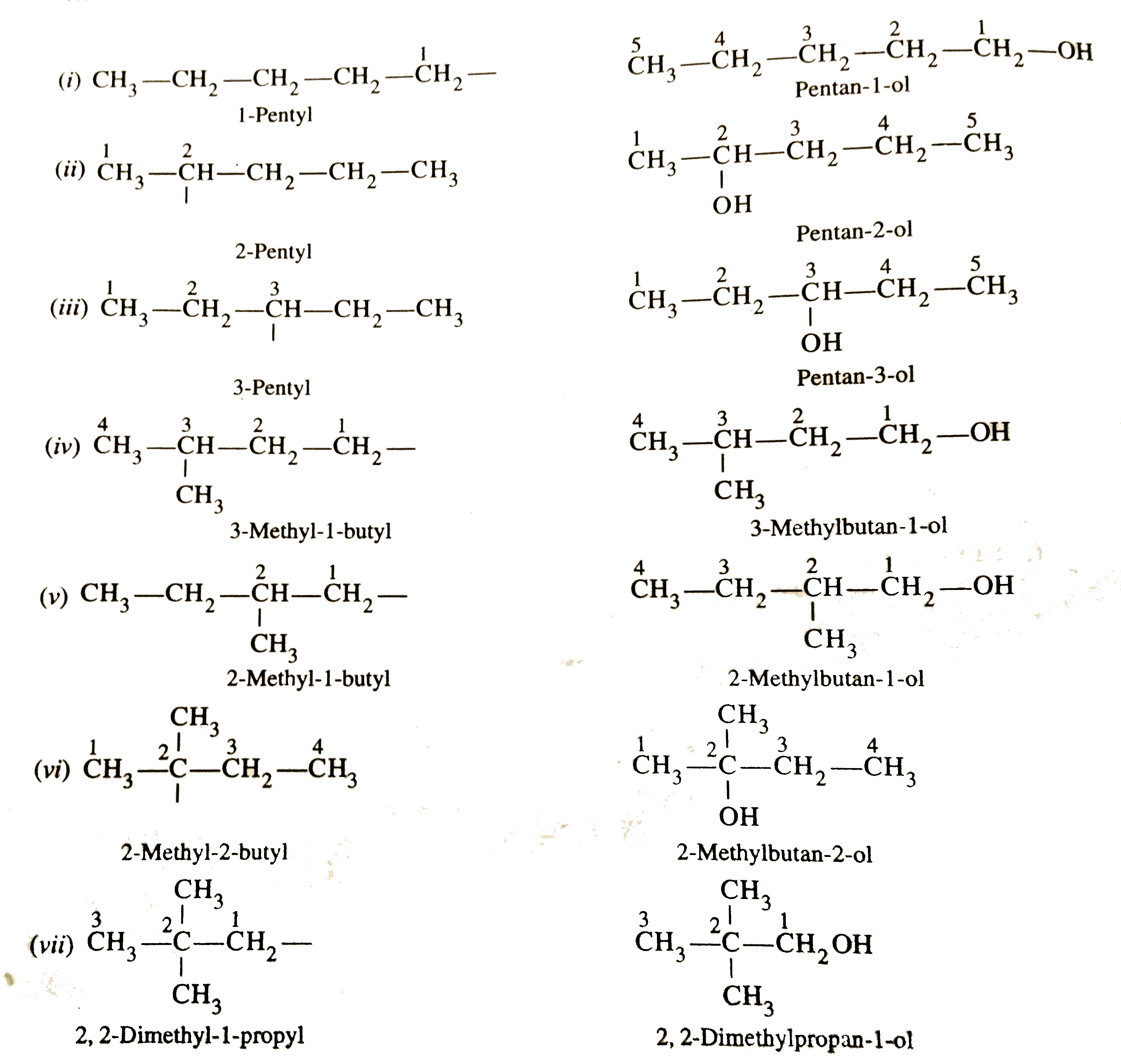
|
|
| 6. |
What are spontaneous reactions? What are the conditions for the spontaneity of a process? |
|
Answer» Solution :(i)A REACTION that does occur under the given set of conditions is called a spontaneous reaction. (II) The expansion of a gas into a evacuated bulb is a spontaneous process, the REVERSE process that is gathering of all molecules into one bulb is not spontaneous. This example shows that processes that occur spontaneously in one DIRECTION cannot take place in opposite direction spontaneously. (iii)Increase in randomness favours a spontaneous change. (iv ) If enthalpy change of a process is negative, then the process is exothermic and occurs spontaneously . Therefore `DeltaH` should be negative. (v)If entropy change of a process is positive, then the process occurs spontaneously, therefore `DeltaS`should be positive . (vi) If free energy of a process is negative, then the process occurs spontaneously, therefore `DeltaG`should be negative. (VII)For a spontaneous, irreversible process, `DeltaH lt 0 , DeltaS lt 0 , DeltaG lt 0` i.e., `DeltaH =-ve , DeltaS=+ve` and `DeltaG=-ve`. |
|
| 7. |
When benzene is heated in air, it burns with sooty flame producing (X) and (Y). As shown in the given reaction C_6H_6+(15)/(2) O_2 to (X) + (Y): Here , (X) and (Y) refer to |
|
Answer» `C_6H_5- OH, CO` `C_X H_Y + [X + (Y)/(4)]O_2 to XCO_2 + YH_2O` |
|
| 8. |
Which one of the following has greater active mass |
|
Answer» 200 GM of lime stone in 2 lit vessel gases = `(n)/(V_("(lit)"))` |
|
| 9. |
Which of the following is not a fundamental particle ? |
|
Answer» Proton |
|
| 10. |
What is an amphoteric oxide? Give the formula of an amphoteric oxide formed by an element of group-13. |
|
Answer» |
|
| 11. |
Trihalogen methane on hydrolysis with NaOH (aq). Gives : |
|
Answer» FORMIC acid |
|
| 12. |
Which of the following has largest de-Broglie wavelength, provided all have equal velocity |
|
Answer» CARBON DIOXIDE molecule |
|
| 13. |
Which type of hybridisation is observed for 'P' in PCl_5 ? |
|
Answer» `sp^3d` |
|
| 14. |
What will be the conjugate base for the Bronsted acids : HF, H_2SO_4 and HCO_3^- |
| Answer» SOLUTION :`F^(-), HSO_4^-` and `CO_3^(2-)` | |
| 15. |
Write the conjugate acid for the following (i) C_(2)H_(5)NH_(2) (ii) CH_(3)COO^(-) |
|
Answer» |
|
| 16. |
When compared , deltaG^(o) for the formation of Al_(2)O_3 ,the deltaG^(o) for the formation of Cr_(2)O_3 is |
|
Answer» same |
|
| 17. |
Write in ascending order of stability of 1^(@), 2^(@) and 3^(@) carbocation and free radicals |
| Answer» SOLUTION :`1^(@) LT 2^(@) lt 3^(@)` | |
| 18. |
Which one of the following is a linear molecule? |
|
Answer» `NO_(2)` |
|
| 19. |
What are A, B, C in the following reactions ? I. (CH_(3)CO)_(2)Ca overset(Delta)rarr x II. CH_(3)CO_(2)H underset("Red P")overset(HI)rarr Y III. 2CH_(3)CO_(2) overset(P_(4)O_(10))rarr z |
|
Answer» `{:(," "x," "y," "z,),(A,C_(2)H_(6),CH_(3)COOH,(CH_(3)CO)_(2)O,):}` |
|
| 20. |
When branched chain isomer of the hydrocarbon with molecular mass 72 u gives only one isomer of monosubstituted alkyl halide ? |
|
Answer» Neopentane |
|
| 21. |
The well known mineral fluorite is chemically calcium fluoride. It is well known that is one unit of this mineral, there are 4 Ca^(2+) ions and 8 F^- ions, and that Ca^(2+) ions are arranged in a fcc lattice. The F^- ions fill all the tetrahedral holes in the face-centred cubic lattice of Ca^(2+) ions. The edge of the unit cell is 5.46xx10^(-8) cm in length . The density of the solid is 3.18 "g cm"^(-3). Use this information to calculate Avogadro's number (Molar mass of CaF_2=78.08 "g mol"^(-1)) |
|
Answer» |
|
| 22. |
Total number of conformations possible in cyclohexane is |
|
Answer» Zero |
|
| 23. |
The unit of dipolement is |
|
Answer» Einstein |
|
| 24. |
X underset ( 170^(@) C )overset( Conc. H_2SO_4) to Y underset( C Cl_4)overset(Br_2) toQ underset (Delta)overset( alc. KOH) to Rifx is ethyl alcohol correct statement (s) about R is / are A) it decolourizes Bayer's reagent B) it gives benzene when subjected to polymerization C) it gives red precipitate with ammonical Cu_2Cl_2 D) it gives ethylene on hydrogenation in the presence of Lindlar's catalyst |
|
Answer» A , B & C <BR>B,C & D |
|
| 25. |
'X' is an oxide of potassium. If 'X' is coloured and paramagnetic, what are the hydrolysis products of X? |
|
Answer» SOLUTION :Superoxides are paramagnetic and coloured. Thus .X. is POTASSIUM SUPEROXIDE, `KO_(2)` Superoxides of alkali metals are hydrolysed by water to give `H_(2)O_(2)` and oxygen gas. `2KO_(2)+2H_(2)Orarr 2KOH+H_(2)O_(2)+O_(2)` |
|
| 26. |
Which of the following is/are true about silicones ? |
|
Answer» They are formed by hydroysis of `R_(2)SiCl_(2)` |
|
| 27. |
write the molecular orbital electronic configuration of C_2 molecule and calculate its bond order. |
|
Answer» SOLUTION :`sigma1s^2ltsigma* 1s^2ltsigma2s^2ltsigma2s^2ltpi2p_y=pi2p_x^2 B.O=`1/2(N_b-N_a)`=1/2[8-4]=4/2=2 |
|
| 28. |
Valence Bond Theory (VBT) and Molecular Orbit Theory (MOT) are two important theories of chemical bonding.Explain the geometry of PCl_5 molecule and account for its high reactivity. |
| Answer» SOLUTION :REFER to TEXT | |
| 29. |
The rms velocity of hydrogen is sqrt7 times the rms velocity of nitrogen. If T is the temperature of the gas : |
|
Answer» `T (H_(2)) = T (N_(2))` |
|
| 30. |
The solubility of A_(2)B=2xx10^(-3) "mol" L^(-1). What is solubility product? |
| Answer» SOLUTION :`8 XX 10^(-9)` | |
| 31. |
The relative number of atoms of different elements in a compound are as follows , A = 1.33 , R = 1 and C = 1.5 . The empirical formula of the compound is |
| Answer» Answer :C | |
| 32. |
What do you understand by : (a) Ammonal (b) Bentonite ( c) Rubies and Sapphire (d) Laps lazuli ( e) Emery paper. |
|
Answer» Solution :(a) AMMONAL : It is a MIXTURE of aluminium and ammonium nitrate and is used in bombs. (b) Bentonite : It is alumina-silca clay and is DROPPED frm aeroplanes in the SLURRY form over an area designted for fire suppression, i.e it is used as fire retardant. ( c) Rubies and sapphire aluminium silicate and is used as semiprecious stone. (d) Lapis lazuli : It is sodium aluminium silicate and is used as semiprecious stone. ( e) Emery paper : Impure from of CORUNDUM `(Al_(2)O_(3))` containing impurity of `Fe_(2) O_(3)` silica is called emery and is used in the manufacture of emery parper or sandpaper. This paper is used is used to polish metal. |
|
| 33. |
Which of the following statements is correct for metallic bond.? |
|
Answer» METALLIC bond possesses directional property. |
|
| 34. |
Write the structural formula for the following compounds. (a) Cyclohexa-1,4-diene (b) Ethynyl Cychlohexane. |
Answer» SOLUTION :
|
|
| 35. |
Which is does not exist |
|
Answer» `PbCl_(2)` |
|
| 36. |
Which is not true about the oxidation state of the following elements ? |
|
Answer» SULPHUR +6 to -2 |
|
| 37. |
What is the ratio of the time periods (T_1//T_2) on second orbit of H atom to 3rd orbit of He^+ |
|
Answer» `8//27` |
|
| 38. |
What are the limitations of Henry's law? |
|
Answer» SOLUTION :(i) Henry.s law is applicable at moderate TEMPERATURE and pressure only. (ii) Only the less soluble gases obey Henry.s law. (iii) The gases reacting with solvent do not obey Henry.s law. (IV) The gases obeying Henry.s law should not ASSOCIATED or dissociated while dissolving in the solvent. |
|
| 39. |
When the numerical value of the reaction quotient (Q) is greter than the equilibrium constant (K) in which direction does the reaction proceed to reach equilibrium ? |
| Answer» Solution :If `QgtK_(C')` the reaction will proceed in the REVERSE direction i.e., formation of reactants. | |
| 40. |
What is the composition of Permutit (Zeolite)? How does it works in softening of hard water? |
| Answer» Solution :Hydrated sodium aluminium silicate/ Sodium aluminium silicate……..1 It exchanges `MG^(2+)` and `CA^(2+)` IONS for its `NA^(+)` hence soften the hard WARTER. | |
| 41. |
Which type of attraction present in aqueous solution of NaCl ? |
| Answer» Solution :`Na_((aq))^(+)` and `Cl_((aq))^(-)` are there in AQUEOUS solution of NaCl. ATTRACTION force present between `NA^(+)` and `H_(2)O` molecule and `Cl^(-)` and `H_(2)O` molecules. This forces is ION dipole type. (This force are not van der Waal forces). | |
| 42. |
What is the difference between mesomeric effect and resonance effect ? |
| Answer» SOLUTION :Both are same | |
| 43. |
Which of the following will not liberate dihydrogen ? |
|
Answer» `Zn + H_(2)SO_(4)` (di.) |
|
| 44. |
Which mixture do not follow Dalton.s law ? Why ?(i) CO_(2)+O_(2)+N_(2)(ii) CO+O_(2)(iii) NH_(3)+HCl(iv) HCl+O_(2) |
|
Answer» Solution :(i), (iv) follow Dalton.s Law but (II), (III) do not follow Dalton.s law. Because they REACT each other and chemical REACTION occurs. `2CO+O_(2)to 2CO_(2), NH_(3)+HCl to NH_(4)Cl` |
|
| 45. |
Use (IE) and (EA) listed below to determine whether the following process is endothermic exothermic. Mg_((s)) + 2F_((g)) to Mg_((g))^(2+) + 2F_((g))^(-) (IE)_1 of Mg_((g))=737.7 "kJ mol"^(-1) (IE)_2 of Mg_((g))=1451 "kJ mol"^(-1) (EA) of F_((g))=-328 "kJ mol"^(-1) |
|
Answer» Exo |
|
| 46. |
When acetamide is treated with NaOBr, the product formed is |
|
Answer» `CH_(3)CN` |
|
| 47. |
Write examples of weak acids and weak bases and give ionic equilibrium in its aqueous solution. |
Answer» SOLUTION :
|
|
| 48. |
What is humification ? |
| Answer» Solution :The decomposition of organic material (LEAVES, ROOTS etc.) in the soil by microorganism to produce HUMUS is called humification | |
| 49. |
The variation of electron affinity is not as systematic as in the case of ____________. |
|
Answer» IONISATION energy |
|

 units
units