

Saved Bookmarks
This section includes 7 InterviewSolutions, each offering curated multiple-choice questions to sharpen your Current Affairs knowledge and support exam preparation. Choose a topic below to get started.
| 1. |
Assertion : In atomic form hydrogen consists of one proton and one electron. Reason : In elemental form hydrogen exists as a diatomic molecule and is called dihydrogen. |
|
Answer» If both assertion and reason are true and reason is the correct explanation of assertion. |
|
| 2. |
Assertion : In case of isoelectronic ions the ionic size increases with the increase in atomic number. Reason: The greater the attraction of nucleus , greater is the ionic radius. |
|
Answer» If both assertion and REASON are true and the reason is the correct EXPLANATION of the assertion 
|
|
| 3. |
Assertion. In a unit cell of NaCl , all Cl^- ions touch Na^+ ion as all well they touch each other . Reason. Radius ratio r_+//r_- in NaCl is 0.414. |
|
Answer» If both assertion and REASON are true, and reason is the true explanation of the assertion. Correct R . Actual RADIUS ratio `r_(Na^+)//r_(Cl^-)` is 0.525 and not 0.414 |
|
| 4. |
Assertion : In a gaseous reaction, the ratio of the volumes of gaseous reactants and products is in agreement with their molar ratio Reason :This is according to Avogadro's hypothesis. |
|
Answer» If both ASSERTION and REASON are CORRECT and reason is correct EXPLANATION for assertion |
|
| 5. |
Assertion : In a fission reaction a heavy nucleus is broken into three fragement of nearly equal mass . Reason: The binding energy per nucleon for a heavy nuclei is less than the binding energy per nucleon of the fragments. |
|
Answer» Both A and R are TRUE and R is the CORRECT explanation of A |
|
| 6. |
Assertion. If the length of the unit cell of LiCl having NaCl structure is 5.14 Å , the ionic radius ofCl^(-) ion is 1.82 Å.Reason . Anion-anion contact is retained in LiCl structurebeacause anions constitute the lattice. |
Answer» 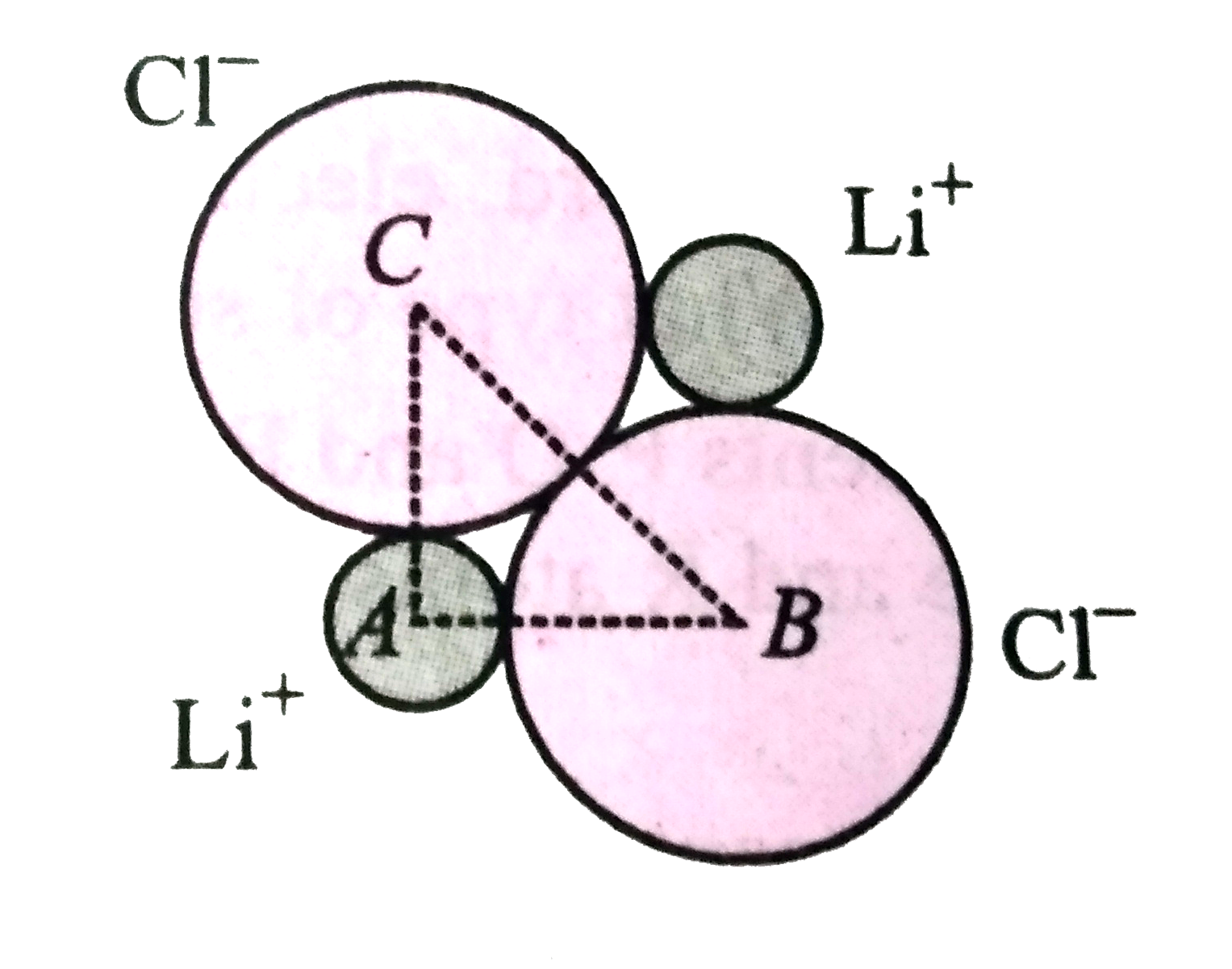 Interionic distance of LICL = `a/2` ` ( 5.14 Å)/2 = 2.57Å ` `BC = sqrt(AB^(2) + AC^(2)) = sqrt((2.57)^(2) + ( 2.57)^(2))`= 3.63 Å Radius of ` Cl^(-) "ION" = 1/2 BC = 1/2 xx 3.63= 1.81 Å` Hecne, R is the correct explanation of A. |
|
| 7. |
Assertion: If BOD level of water in a reservoir is less than 5ppm, it is highly polluted.Reason: High biological oxygen demand means low activity of bacteria in water |
|
Answer» |
|
| 8. |
Assertion : Ice cube floats on water. Reason : Density of ice is less than that of water. |
|
Answer» If both ASSERTION and REASON are TRUE and reason is the CORRECT EXPLANATION of assertion. |
|
| 9. |
Assertion : Hydrogen resembles halogens. Reason : It has high ionisation energy but still form H^+ ion. |
|
Answer» Both assertion and reason are TRUE and reason is the CORRECT explanation of assertion. |
|
| 10. |
Assertion : Hydrogen resembles both, alkali metals as well as halogens. Reason : Hydrogen forms oxides, halides and sulphides, and exists as diatomic molecule. |
|
Answer» If both assertion and reason are true and reason is the CORRECT EXPLANATION of assertion. |
|
| 11. |
Assertion : Hydrogen is the simplest atom Reason : Its nucleus contains only two protons |
|
Answer» Both ASSERTION and REASON are true and reason is the CORRECT EXPLANATION of assertion. |
|
| 12. |
Assertion: Hydrogen combines with other elements by losing, gaining or sharing electrons. Reason:Hydrogen forms electrovalent and covalent bonds with other elements . |
| Answer» SOLUTION :(a) REASON is the CORRECT EXPLANATION for ASSERTION. | |
| 13. |
Assertion : Hydrogen atom is combine with other element by exchange and sharing of electron. Reason : Hydrogen can be form electrovalent or covalent bond with other elements. |
|
Answer» Both ASSERTION (A) and REASON (R) are true and Reason (R) is the CORRECT EXPLANATION of Assertion (A) |
|
| 14. |
Assertion. Hydrogen has one electron in its orbit but it produces several spectral lines Reason. There are many excited energy levels available |
|
Answer» If both ASSERTION and REASON are TRUE, and reason is the true explanation of the arrertion |
|
| 15. |
Assertion : Hydrides of N, O and F have lower boiling points than the hydrides of their subsequent group members. Reason : Boiling point depends upon the molecular mass only. |
|
Answer» If both ASSERTION and reason are true and reason is the correct EXPLANATION of assertion. |
|
| 16. |
Assertion : Hydrides of group 13 elements are Lewis acids whereas hydrides of group 15-17 elements are Lewis bases. Reason : Group 13 hydrides have few electrons whereas group 15-17 hydrides have excess electrons which are present as lone pairs. |
|
Answer» If both assertion and REASON are true and reason is the correct EXPLANATION of assertion. |
|
| 17. |
Assertion : Hydrazine contains nitrogen but does not give Lassaigne's test for hydrogen. Reason : Hydrazine reacts with fused sodium to give H_(2) gas. |
|
Answer» If both assertion and Reason are true, and reason is the true explanation of the assertion. |
|
| 18. |
Assertion: Hybridisation influences the bond length and bond enthalpy in organic compound. Reason: More the s character of hybrid orbital, shorter and stornger will be the bond. |
|
Answer» If both ASSERTION and REASON are TRUE and reason is the CORRECT EXPLANATION of assertion |
|
| 19. |
Assertion. HNO_(3) renders ironpassive. Reason. Iron reacts with HNO_(3) to form ferric nitate. |
|
Answer» If both ASSERTION and reason are TRUE, and is the correct EXPLANATION of the assertion. |
|
| 20. |
Assertion : HNO_(3) makes iron passive. Reason : HNO_(3) forms a protective layer of ferric nitrate on the surface of iron. |
|
Answer» Both assertion and reason are correct STATEMENTS, and reason is the correct explanation of the assertion. |
|
| 21. |
Assertion : HNO_(2) can act both as a reducing agent and an oxidising agent. Reason : In HNO_(2), oxidation state of nitrogen is +3 which can change from -3 to +5. |
|
Answer» If both ASSERTION and REASON are TRUE and reason is the CORRECT EXPLANATION of assertion. |
|
| 22. |
Assertion : Higher order ionization constants (K_(a_(2)),K_(a_(3))) are smaller than the lower order ionization constant (K_(a_(1))) of polyprotic acid. Reason : Polyprotic acid solutions contain a mixture of acids. |
|
Answer» If both assertion and reason are TRUE and reason is the CORRECT explanation of assertion. |
|
| 23. |
Assertion: Heterolytic fission occurs readily in polar covalent bonds. Reason: Hyterolytic fission involves breaking of bond in such a way that the shared pair of electrons go with one atom. |
|
Answer» If both assertion and reason are true and reason is the correct explanation of assertion |
|
| 24. |
Assertion : HF_(z)^(-)ions exist in solid and liquid state but not exist in equines solution. Reason : The Hydrogen bond HF - HF is more but Jess strong them HF and H_(2)O . |
|
Answer» ASSERTION (A) and Reason (R) both are CORRECT and (R) GIVES correct EXPLANATION. |
|
| 25. |
Assertion: Helium has the highest value of ionization energy among all the elements known Reason: Helium has the highest value of electron affinity among all the elements known |
|
Answer» Both assertion and REASON are true and reason is correct explanation for the assertion |
|
| 26. |
Assertion : Heterolytic fission occurs readily in polar covalent bonds. Reason : Heterolytic fission involves the breaking of bonf in such a way that the shared pair of electrons goes with one atom. |
|
Answer» If both ASSERTION and reason are correct and reason is correct EXPLANATION for assertion. |
|
| 27. |
Assertion :Helium has the highest value of ionisation energy among all the elements known Reason : Helium has the highest value of electron affinity among all the elements known |
|
Answer» Both ASSERTION - and reason are TRUE and reason is correct EPLANATION for the assertion |
|
| 28. |
Assertion: Helium and beryllium have similar outer electronic configuration. Reason: Both are chemically inert. |
|
Answer» Both A and B TRUE and R is the CORRECT explanation A |
|
| 29. |
Assertion : Heavy water acts as a moderator in nuclear reactors. Reason : Heavy water absorbs fast moving electrons. |
|
Answer» Both A and R are true and R is the CORRECT explanation of A |
|
| 30. |
Assertion. Heatof neutralisation for both HNO_(3) and HCl with NaOH is53.7 kJ per mole. Reason. NaOH is a strong electrolyte// base |
|
Answer» If both A and R are TRUE,andR is the TRUEEXPLANATION of A. |
|
| 31. |
Assertion. Heat energy is completely transformed into work during the isothermal expansion of an ideal gas. Reason . During an isothermal process, the change in internal energy of a gas due to decrease in pressure is nullified by the change due to increase in volume. |
|
Answer» If both A and R are TRUE,andR is the TRUEEXPLANATION of A. |
|
| 32. |
Assertion : Haber's synthesis of NH_(3) is carried out in the presence of a catalyst. Reason: the catalyst shifts the position of the equilibrium of the reaction N_(2)(g)+3H_(2)(g) hArr 2NH_(3)(g) tothe product side. |
|
Answer» if both assertion and REASON are CORRECT and reason is correctexplanation for assertion. |
|
| 33. |
Assertion : H_(3)PO_(3) is a dibasic acid. Reason : Two H-atoms are directly attached to phosphorus 'P'. |
|
Answer» If both ASSERTION and REASON are CORRECT, and Reason is the correct EXPLANATION of Assertion. |
|
| 34. |
Assertion. H_(3)PO_(3) is a dibasic acid. Reason. There are two H atoms directly attached to P. |
|
Answer» If both ASSERTION and reason are TRUE, and is the correct explanation of the assertion. |
|
| 35. |
Assertion : H_(3)BO_(3) is monobasic Lewis acid but its salt Na_(3)BO_(3) exists. Reason : H_(3)BO_(3) reacts with NaOH to give Na_(3)BO_(3). |
|
Answer» If both Assertion and REASON are correct, and Reason is the correct EXPLANATION of Assertion. `3C_(2)H_(5)OH+H_(3)BO_(3) to (C_(2)H_(5))_(3)BO_(3)+3H_(2)O` `(C_(2)H_(5))_(3)BO_(3) +3NaOH to Na_(3)BO_(3)+3C_(2)H_(2)OH` |
|
| 36. |
Assertion: H_(2)O_(2) reduces Cl_(2) "to" HCl. Reason: H_(2)O_(2) is highly Cl_(2) "to" HCl |
| Answer» Solution :(C ) Correct REASON. `H_(2)O_(2)` can act as reducing agent | |
| 37. |
Assertion. H_(2)O_(2) liberates O_(2) when it reacts with acidified KMnO_(4) solution. Reason. KMnO_(4) oxidises H_(2)O_(2) to O_(2) |
|
Answer» |
|
| 38. |
Assertion . H_(2)O_(2) has higher boiling point than water. Reason. The dipole moment of H_(2)O_(2) is little more than that of H_(2)O. |
|
Answer» |
|
| 39. |
Assertion : H_(2)O_(2) is stored in wax-lined glass or plastic vessels. Reason : H_(2)O_(2) decomposes slowly on exposure to light. |
|
Answer» If both assertion and reason are true and reason is the CORRECT explanation of assertion. In the presence of metal surfaces or traces of alkali (PRESENT in glass containers), the above REACTION is catalysed. Hence, `H_(2)O_(2)` is STORED in wax-lined glass or plastic containers in dark. |
|
| 40. |
Assertion. H_(2)O_(2) can be used as an antichlor in bleaching . Reason. It oxidises HCl to Cl_(2). |
|
Answer» |
|
| 41. |
Assertion. H_(2)O is the only hydride of group 16 which is a liquid at ordinary temperature . Reason. In ice, each oxygen atom is surrounded by two covalent bonds and two hydrogen bonds. |
|
Answer» |
|
| 42. |
Assertion : H_2Ohas high melting point and boiling point than H_2S, H_2Se . Reason: H_2Ocontaining hydrogen bond |
|
Answer» Both Assertion (A) and Reason (R) are true and Reason (R) is the correct EXPLANATION of Assertion (A) |
|
| 43. |
Assertion . H_(2) O is the only hybride of group -16 which is liquid ordinary tempratyre . Reason . In ice , oxygen atom is surrounded by two covalent bonds and two hydrogen bonds . |
|
Answer» If both assertion and reason are correct, and reason is the correct explanation of the assertion. BOILING POINT. |
|
| 44. |
Assertion: H_(2) molecule is more stable than He. Reason : Non-bonding pair in He make it unstable. |
|
Answer» Assertion (A) and Reason (R) both are correct and (R) gives correct EXPLANATION. |
|
| 45. |
Assertion . H_(2)molecule is more stable than HeH molecule. Reason . The antibonding elelctron in the molecule destabilises is . |
|
Answer» If both assertion and reason are CORRECT, and reason is the correct explanation of the assertion. than HEH because bond order of `H_(2)` = 1 and that of Heh ` = (1)/(2)`(Higher the bond order , MOREIS the stability). |
|
| 46. |
Assertion . H_(2), Li_(2) and B_(2) each has a bond order of 1 and hence are equally stable. Reason . Stability of molecule/molecular ion depends only on bond order. |
|
Answer» If both assertion and reason are correct, and reason is the correct explanation of the assertion. Correct R. The stability of molecules/molecular ions does not DEPEND only on bond order . (It depends upon other factors LIKE bond length , number of ELECTRONS present in antibonding molecular orbitals, ETC.) |
|
| 47. |
Assertion : H^+ ion has a very low polarising power. Reason : Size of H^+ ion is very large |
|
Answer» Both assertion and REASON are TRUE and reason is the correct explanation of assertion. |
|
| 48. |
Assertion : H_2 act as a reducing agent and react with many organic compounds in presence of catalyst and give hydrogenated product. Reason: CH_2=CH_2+H_2 underset"390 K"overset"[Ni]" to CH_3-CH_3 |
|
Answer» Both Assertion (A) and REASON (R) are true and Reason (R) is the CORRECT EXPLANATION of Assertion (A) |
|
| 49. |
Assertion . H-S-H bond angle in H_(2)S is closer to90^(@) but H-O-H bond angle in H_(2)O is 104.5^(@). Reason . Lp-lp repulsion us stronger ub H_(2)Sthan in H_(2)O |
|
Answer» If both assertion and REASON are correct, and reason is the correct explanation of the assertion. repulsion are greater in `H_(2)O` than in `H_(2)S` because O-atom is smaller in SIZE than S-atom . |
|
| 50. |
Assertion : Graphite is good conductor of heat and electricity . Reason : All the electrons of graphite are arranged in C-C type and formsigma -bond. |
|
Answer» Statement Assertion and Reason both are RIGHT. Statement Reason is CORRECT EXPLANATION of statement Assertion. |
|