

Saved Bookmarks
This section includes 7 InterviewSolutions, each offering curated multiple-choice questions to sharpen your Current Affairs knowledge and support exam preparation. Choose a topic below to get started.
| 1. |
Classify each of the following as homolysis as homolysis or heterolysis. Identify the reaction intermediates produced , as free radical, carbocation and carbanion. |
Answer» SOLUTION :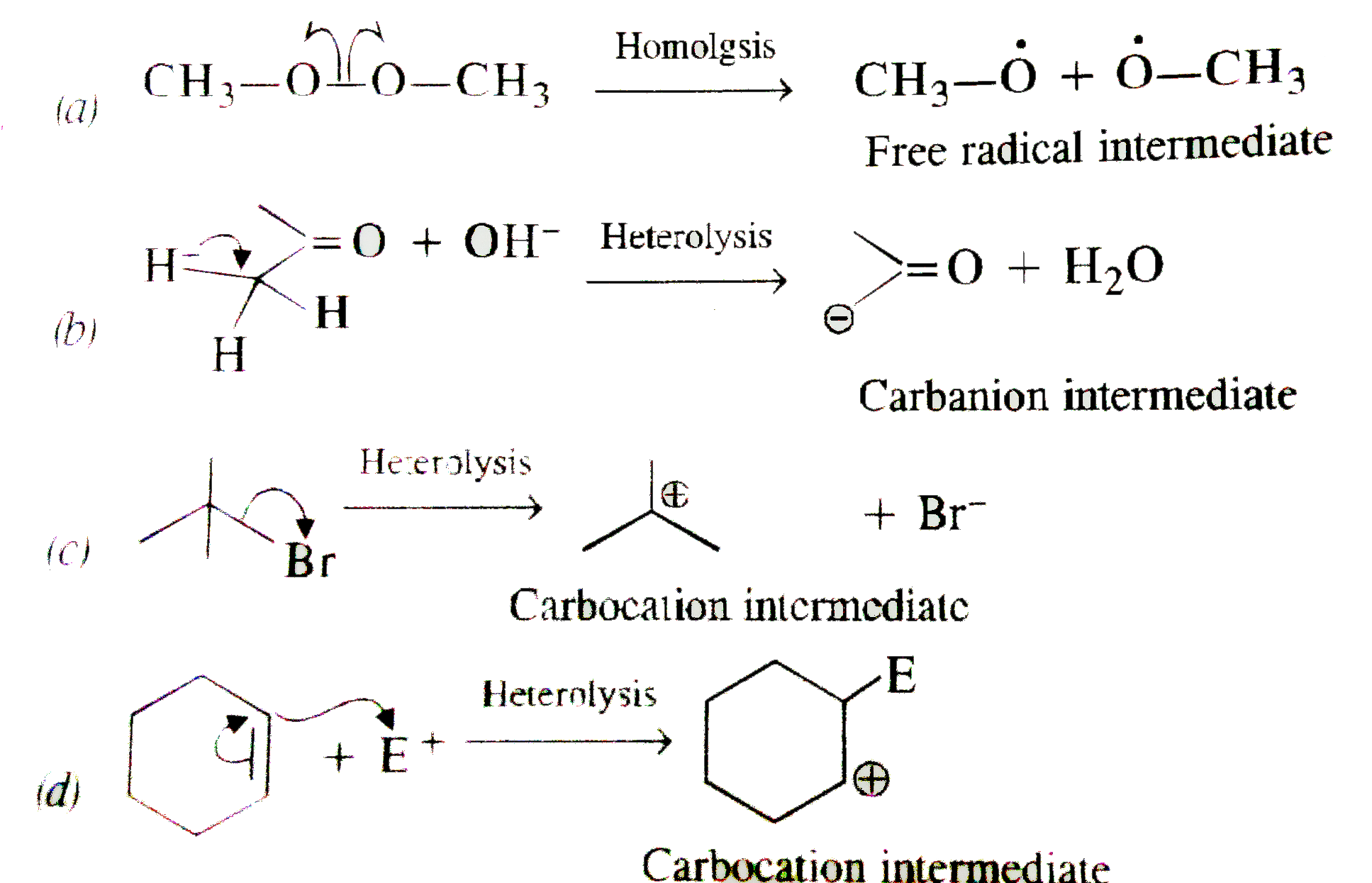
|
|
| 2. |
Classification of hydride according to Lewis structure is ……… |
|
Answer» LIH |
|
| 3. |
Classical smog occurs in places of : |
|
Answer» Excess of `NO_2` |
|
| 5. |
Smog is mainly due to |
|
Answer» Oxidies of SULPHUR & Carbon PARTICLES |
|
| 7. |
Cl_(2)+OH^(-)toClO^(-)+Cl^(-) For this reaction select T(Ture) or F(False). (1) This reaction occurs in basic medium. (2) Oxidation and Reduction occurs for Cl_(2). (3) Products are obtained by dissoication of Cl_(2). (4) In ClO^(-) oxidation number of Cl^(-) is (+1). |
|
Answer» TFTF |
|
| 8. |
Cl_(2) gas can be produced in the lab by the reaction, K_(2)Cr_(2)O_(7)+14HCl to 2KCl+2CrCl_(3)+7H_(2)O + 3 Cl_(2) If a 6.13 g sample that is 96% K_(2)Cr_(2)O_(7) is allowed to react with 320 mL of HCl solution density 1.15 g//mL and containing 30% by mass of HCl, what mass of Cl_(2) is generated ? |
|
Answer» |
|
| 9. |
Cl_(2) changes to Cl^( -) and ClO^(-) in cold NaOH. Equivalent mass of Cl_(2) will be. |
|
Answer» Molar mass/2 `Cl_(2) overset(NAOH)(to) 2ClO^(-) + 2e^(-)` `:.` Equivalent mass=`(" Molar mass")/("No. of electrons lost")=("Molar mass")/2` |
|
| 10. |
Cl-P-Cl bond angles in PCl_(5) molecule are |
|
Answer» `120^(@)and90^(@)` |
|
| 11. |
Cl_((g)) + e^(-) rarr Cl_((g))^(-) , E_A = -348 kJ//"mole" at 0 K. then DeltaH for same process at 300K (in kJ) [R=8J/mol/K] [Hint : DeltaH = EA - 5/2 RT]. |
| Answer» ANSWER :C | |
| 12. |
Cis-trans isomers have different dipole moments |
|
Answer» |
|
| 13. |
Cis-but-2-ene is polar and trans-but-2-ene is non-polar explain. |
|
Answer» Solution :`CH_(3)CH=CHCH_(3)` has 2 geometrical isomers : (i) Cis-but-2-ene (ii) TRANS-but-2-ene. ALWAYS cis-isomer dipole moment `(MU) gt` Trans-isomers. Isomers of But-2-ene are shown with its isomers and dipole moment.  Trans-but-2-ene has `2-CH_(3)` group, they are in opposite side therefore dipole MOMENTS of `C-CH_(3)` bonds CIRCLE, thus making the trans form non-polar. Cis isomers are polar because in Cis-but-2-ene has `2-CH_(3)` group and they are on same side of double bond. Electronegativity of `C_CH_(3)` are added, in which the dipole moment is more. therefore, cis-isomer is polar and trans isomer is non-polar. |
|
| 14. |
"cis-2-Butene"underset("Addition")overset(Br_2)to"product". Which statemetn about product is correct. |
|
Answer» Product formed by electrophilic addition  Product has two chiral centers Product contains a pair of enantiomus Produced is a racemic mixture |
|
| 15. |
Cis -2- butene and trans -2- butene are |
|
Answer» conformatonal isomers |
|
| 16. |
cis-2-butene and trans 2-butene are |
|
Answer» CONFORMATIONAL isomers |
|
| 17. |
cis -2 butene and trans -2- butene are ……………. |
|
Answer» CONFORMATION ISOMERS |
|
| 18. |
Cinnamic aldehyde can be converted into cinnamyl alcohol by |
|
Answer» `LiAlH_(4)` `underset("Cinnamic ALDEHYDE")(C_(6)H_(5)-CH=CHO+2[H]) overset(NaBH_(4))rarr underset("Cinnamyl ALCOHOL")(C_(6)H_(5)-CH=CH-CH_(2)OH)` |
|
| 19. |
CIF_(3)is which type from AB_(3) , AB_(3)E_(2) , AB_(3) E ? How ? |
| Answer» SOLUTION :It is `AB_(3) E_(2) `type. Because three Cl - F bond with Cl, i.e., `B_(3)` and two nonbonding `e^(-) ` pair on Cl. | |
| 20. |
Cl^(-) ion is more stable than Cl atom - Why? |
| Answer» Solution :DUE to octet CONFIGURATION, `CI^(-)` ion is more STABLE | |
| 21. |
Chrysobery is a mineral of |
|
Answer» Mg |
|
| 22. |
Chromyl chloride test can be given by how many of the following compounds easily? |
Answer» 
|
|
| 23. |
Chromium metal in basic medium is oxidised in air to give chromic tetrahydroxide anion. |
|
Answer» Solution :a) This IONIC skeleton EQUATION is written as `Cr+O_(2)OVERSET(OH^(-))rarrCr(OH)_(4)^(-)` b) Writing oxidation numbers `overset(0)(Cr)+overset(0)(O_(2))rarr[overset(+3)(Cr)(overset-2)(O)overset(+1)(H))_(4)]^(-)` c) Locating atoms undergoing change in oxidation numbers `overset(0)(Cr)+overset(0)(O_(2))rarr[overset(+3)(Cr)(overset(-2)(O)H)_(4)]^(-)` d) Dividing the reaction into two halves andbalancing in acidic medium. separately Oxidation half - reaction : `Crrarr[Cr(OH)_(4)]^(-)` Step 1 : Balance oxygen atoms `Cr+4H_(2)Orarr[Cr(OH)_(4)]^(-)` Step 2 : Balance hydrogen atoms `Cr+4H_(2)O+4OH^(-)rarr[Cr(OH)_(4)]^(-)+4H_(2)O` Step 3 : Balance the CHARGE `Cr+4H_(2)O+4OH^(-)rarr[Cr(OH)_(4)]^(-)+4H_(2)O+3e^(-)"....(a)"` Reduction half - reaction : `O_(2)rarr[Cr(OH)_(4)]^(-)` Step 1 : Balance chromium atoms `O_(2)+Crrarr [Cr(OH)_(4)]^(-)` Step 2 : Balance oxygen atoms `O_(2)+Cr+2H_(2)Orarr[Cr(OH)_(4)]^(-)` Step 3 : Balance hydrogen atoms `O_(2)+Cr+2H_(2)rarr[Cr(OH)_(4)]^(-)` Step 4: Balance charnge `O_(2)+Cr+2H_(2)O+e^(-)rarr[Cr(OH)_(4)]^(-)"....(b)"` Step 5 : Equalising the electrons and adding the two half reactions `"eq (a)"XX1+"eq (b)"xx"3, we get"` `{:(Cr+4H_(2)O+4OH^(-)rarr),(""[Cr(OH)_(4)]^(-)+4H_(2)O+3e^(-)),(Cr+4H_(2)O+4OH^(-)rarr),(""[Cr(OH)_(4)]^(-)+4H_(2)O+3e^(-)),(3O_(2)+3Cr+6H_(2)O+3e^(-)rarr2[Cr(OH)_(4)]^(-)),(bar(4Cr+3O_(2)+6H_(2)O+4HO^(-)rarr4[Cr(OH)_(4)]^(-))):}` This is the balnced equation. |
|
| 24. |
Chromite ore is processed through the following sequence In this sequence how many species (from A to H) show green colour? |
|
Answer» |
|
| 25. |
Chromic salts (Cr^(3+)) can be reduced to chromous salts (Cr^(2+)) by adding metals(s) to the salt solution acidified with dil. H_(2)SO_(4) |
|
Answer» Sn |
|
| 26. |
Chromatography technique is used for the separation of : |
|
Answer» SMALL SAMPLES of mixtures |
|
| 27. |
Chromatography technique has proved useful for the isolation and detection of (i) amino acids (ii) sugars (iii) plant pigments (iv) nonvolatile liquids |
|
Answer» (i), (ii), (III), (iv) |
|
| 28. |
chromatography is the mathod used to separate and purify compounds when present in small amounts |
|
Answer» |
|
| 29. |
Chromatography is a technique based on |
|
Answer» SOLUBILITIES of solute |
|
| 30. |
Chromatography is a recent and most effective technique which was used by Tsweff, a botanist for the separation of coloured substances into individual constutients. The name Chromatography means colour writing (In Greek , Chrome = colour, graphy = writing). However, the name as such has lost its significance. The technique can be used to separate constituents from any mixture whether coloured or colourless. (i) What is the basic of Chromatographic separation ? (ii) What is the value associated with it ? |
|
Answer» Solution :(i) CHROMATOGRAPHY is based on selective distribution of the various constituents of a MIXTURE between two PHASES, a stationary phase and a mobile phase. Different constituents migrate at different rates through stationary phase. (ii) Chromatography is very useful for the separation of constituents and their identification from a mixture available in very SMALL amount (even less than 5 MG or 1 mL). However, other methods of separation are not effective in such cases. |
|
| 31. |
Chosse the odd one out |
| Answer» SOLUTION :(b) Benzene . It isanaromatichydrocarbonwhereasothersare aliphatichydrocarbond. | |
| 32. |
Choose the wrong statements : |
|
Answer» `CO_2` is responsible for greenhouse effect. (d) is wrong because acid RAIN contains 60-70% `H_2SO_4` whereas `HNO_3` is 30-40% and least is HCI |
|
| 33. |
Choose the weakest acid among the following |
|
Answer» `F_(3)C COOH` |
|
| 35. |
Choose the reaction which may be used in metallurgical extractions : |
|
Answer» `CaO+P_(4)O_(10)rarr2Ca_(3)(PO_(4))_(2)` |
|
| 36. |
Choose the reaction sequence that would best accomplish the preparation of 2-methylcyclohexnol: |
|
Answer»
|
|
| 37. |
Choose the paramagnetic oxide in the following |
|
Answer» `Na_(2) O ` |
|
| 38. |
Choose the pairs of in which IE_(1) of first element is greater than IE_(1) of second element but in case of IE_(2) order is reversed- |
| Answer» ANSWER :A::D | |
| 39. |
Choose the odd one out. |
|
Answer» 1) Entropy |
|
| 40. |
Choose the odd one out |
|
Answer» COPPER |
|
| 41. |
Choose the odd one out . |
|
Answer» see -saw Acid hydrolysis of an ester is CHEMICAL equilibrium `CH_(3)COOCH_(3(aq))+H_(2)O_(aq) overset(H^+) hArr CH_(3)COOH_((aq)) + CH_(3)OH_((aq))` Whereas a,b,c are EXAMPLES of physical equilibrium. |
|
| 42. |
Choose the most appropiate pair of nitrogens that gets protonated in the following structures. |
|
Answer» 1 and 3 |
|
| 43. |
Choose the molecule which has only one pi bond between carbon atoms |
|
Answer» `CH_(2)=CH-CH=CH_(2)` |
|
| 44. |
Choose the incorret statement. |
|
Answer» In equilbirium mixture of ice and WATER kept in PERFECTLY in perfectly insuled flask. Mass of ice and water does not change with time |
|
| 45. |
Choose the incorret pair. |
|
Answer» Acid HYDROLYSIS of an ester : Homogeneous EQUILBRIUM |
|
| 46. |
Choose the incorrect statement in the following : |
|
Answer» BeO is almost insoluble but `BeSO_(4)` is soluble in water |
|
| 47. |
Choose the incorrect statement in the following . |
|
Answer» Surface TENSION is the force acting perunit length perpendicular to the LINE drawn on the surface of the liquid |
|
| 48. |
Choose the incorrect statement in respect of physisorption |
|
Answer» it is not SPECIFIC in nature |
|
| 49. |
Choose the incorrect statement about the following compounds . |
|
Answer» Compounds (I) and (II) are CONSTITUTIONAL isomers . |
|
| 50. |
Choose the incorrect statement. |
|
Answer» In ortho form of hydrogen molecule, the nuclear spins in the same direction. |
|


