Saved Bookmarks
This section includes 7 InterviewSolutions, each offering curated multiple-choice questions to sharpen your Current Affairs knowledge and support exam preparation. Choose a topic below to get started.
| 1. |
Every amino acids has a carboxyl group and an amino and each group can exist ian acidic form or a basic form depending on the pH of the solution in which the amino acid is dissolved. The carboxyl groups of the amino acids have pka values of approximately 2, the protonated amino group have pka values neare 9. therefore, in a very acidic solutions (pH near zero), both the groups will be in their acidic forms. At a pH of 7 (which is greater than the pka of the protonated amino group), the carboxyl group will be in its basic form and the amino group will be in its acidic form. in a strongly basic solution (say pH=11) both the groups will be in the basic form. underset("(neutral not isolated)")(R-underset(NH_(2))underset(|)(CH_(2))-overset(O)overset(||)(C)-OH)overset(H^(+))(hArr) underset("(A)")(R-underset(NH_(3))underset(|+)(CH)-OH) hArrunderset("(B)")(R-underset(NH_(3))underset(+|)(C)-overset(O)overset(||)(C)-O^(-))+H^(+) hArr underset("(C)")(R-underset(NH_(2))underset(|)(CH)-overset(O)overset(||)(C)-O) For C(anionic) of an amino acid exists in |
|
Answer» fairly basic SOLUTION |
|
| 2. |
Every amino acids has a carboxyl group and an amino and each group can exist ian acidic form or a basic form depending on the pH of the solution in which the amino acid is dissolved. The carboxyl groups of the amino acids have pka values of approximately 2, the protonated amino group have pka values neare 9. therefore, in a very acidic solutions (pH near zero), both the groups will be in their acidic forms. At a pH of 7 (which is greater than the pka of the protonated amino group), the carboxyl group will be in its basic form and the amino group will be in its acidic form. in a strongly basic solution (say pH=11) both the groups will be in the basic form. underset("(neutral not isolated)")(R-underset(NH_(2))underset(|)(CH_(2))-overset(O)overset(||)(C)-OH)overset(H^(+))(hArr) underset("(A)")(R-underset(NH_(3))underset(|+)(CH)-OH) hArrunderset("(B)")(R-underset(NH_(3))underset(+|)(C)-overset(O)overset(||)(C)-O^(-))+H^(+) hArr underset("(C)")(R-underset(NH_(2))underset(|)(CH)-overset(O)overset(||)(C)-O) Form A (cationic ) of an amino group exists in |
|
Answer» FAIRLY BASIC solution |
|
| 3. |
Even though electronegativity of chlorine is equal to that of nitrogen, chlorine is unable to form hydrogen bonds. It is due to |
|
Answer» Cl has three lone pairs on it |
|
| 4. |
Even though the use of pesticides increases the crop production, they adversely affect the living organisms. Explain the function and the adverse effects of the pesticides. |
|
Answer» Solution :(i) Pesticides are the chemicals that are used to kill or stop the growth of unwanted organims. But these pesticides can affect the health of HUMAN beings. Pesticides are classified as (a) insecticides, (6) Fungicides and (c) Herbicides. (a) Insecticides: Insecticides LIKE DDT, BHC, Aldrin can stay in soil for a long period of time and are absorbed by soil. They contaminate root crops like carrot, radish. (b) Fungicides: Organomercury compounds dissociate in soil to produce mercury which is highly toxic. (c) Herbicides: They are used to control unwanted plants and are also known as weed killers, EG, Sodium CHLORATE, sodium NITRATE. They are toxic to mammals. |
|
| 5. |
Even though nitrogen in ammonia is in sp^(3) hybridization, the bond angle deviate form 109^(@)28. Explain. |
| Answer» SOLUTION :nitrogenn in AMMONIA contains lone pairs of electrons. Due to repulsions between lone pairs and BOND pairs bond angle is less | |
| 6. |
Even though carbon and silicon are non metals, they have higher melting points than others because |
|
Answer» They exist as covalent SOLIDS in 3D networks |
|
| 7. |
Eutrophication is mainly caused by |
|
Answer» FOOD CHAINS |
|
| 9. |
Eutrophication causes reduction in ........ |
|
Answer» DISSOLVED oxygen |
|
| 10. |
Eutrophication causes reduction in |
|
Answer» DISSOLVED salts |
|
| 11. |
Europium is |
|
Answer» s-blackelement |
|
| 12. |
Europium (Eu) and Terbium (Tb) attain stable 4f^(7) configuraiton by wxhibiting oxidation states of |
|
Answer» `+2 and +4` |
|
| 13. |
Euivalent weights of two oxides of an element are 14 and 11 respectively. What is the ratio of atomicity of oxygen in the second oxide to first oxide? |
|
Answer» `A=6x,A=3yimplies(y)/(X)=2` |
|
| 14. |
Ethyne reacts with dil. H_2SO_4 in presence of mercury salts to give acetaldehyde but with dil. HCl under similar conditions, it gives vinyl chloride . Explain why ? |
Answer» Solution :FIRST of all, MERCURY ions form a complex (I) with aetylene . Since `H_2O` is more nucleophilic than `SO_4^(2-)` ion, it attacks the complex (I) to form first vinyl ALCOHOL which then tautomerises to give ACETALDEHYDE In case of dil. HCl, since , `Cl^-` ion is more nucleophilic than `H_2O` it reacts with complex (I) to form vinyl chloride. 
|
|
| 15. |
Ethyne molecule is linear |
|
Answer» SOLUTION :In ethyne molecule, both the carbon atoms have sp hybridised, having two unhybridised orbitals i.e., `2p_(x) and 2p_(y)`. The two sp hybrid orbitals of both the carbon atoms are oriented in OPPOSITE DIRECTION FORMING an angleof `180^(@)`. So ethyne molecule is linear. 
|
|
| 16. |
Ethyne is a stronger acid than propyne. Explain. |
Answer» Solution :Terminal alkynes `(R-C equiv C-H)` are weakly ACIDIC in nature because of `sp`-hybridised state of the triple bonded carbon ATOM. Due to substantial s-character `(50 %)`, the triple bonded carbon is electronegative in nature and this enables the release of `H^(+)` ION form `equiv C-H` bond. However, ethyne is a stronger acid than propyne. This is attributed to the electron releasing `+ I` effect of the methyl group which tends to increase the electron density on the triple bonded carbon atom is propyne. the release of `H^(+)` ion from propyne is more difficult than from ethyne or it is a weaker acid than ethyne. 
|
|
| 17. |
Ethylidene chloride on treatment with aquous KOH gives |
|
Answer» ACETALDEHYDE |
|
| 18. |
Ethylidene chloride on treatment with aqueous KOH gives ………………. . |
|
Answer» ACETALDEHYDE |
|
| 19. |
Ethylene glycol (C_(2) H_(6) O _(2)) can be used as an antifreeze in the radiator of a car. Calculate the temperature when ice will begin to separate from a mixture with 20 mass percent of glycol in water used in the car radiator. K_(f) for water = 1.86 K kg mol^(-1) and molar mass of ethylene glycol is 62 g mol ^(-1). |
|
Answer» Solution :Weight of solute `(W_(2))=20` mass PERCENT of solution means 20g of ethylene glycol Weight of SOLVENT (water) `W_(1) = 100 -20=80g` `Delta T_(f) = K _(f) m = (K _(f) xx W_(2) xx 1000)/( M _(2) xx W _(1)) = (1. 86 xx 20 xx 1000)/(62 xx 80) = 7.5 K` The temperature at which the ICE will begin to separate is the freezing of water after the addition of solute i.e. `7.5K` lower than the normal freezing point of water `(273 - 7.5) K = 265.5K` |
|
| 20. |
Ethylene readily undergoes….. |
|
Answer» addition |
|
| 21. |
Ethylene reacts with Br, to give 1,2-dibromoethane. The anti-addition takes place due to the formation of which intermediate ? |
|
Answer» `CH_2Br- overset(+)CH_2` |
|
| 22. |
Ethylene reacts with 1% cold alkaline KMnO_(4) to give |
|
Answer» Oxalic acid |
|
| 23. |
Ethylene oxide when treated with Grignard reagent yields. |
|
Answer» PRIMARY alcohol |
|
| 24. |
Ethylene on ozonolysis gives |
|
Answer» FORMALDEHYDE |
|
| 25. |
Ethylene may be obtained by the treatment of concentrated H_(2)SO_(4) and X at 160-170^(@)C. X is |
|
Answer» `C_(2)H_(5)OH` |
|
| 26. |
Ethylene on hydration gives |
|
Answer» Glycol |
|
| 27. |
Ethylene is prepared by |
|
Answer» Dehalogenation of chloroform |
|
| 28. |
Ethylene glycol when heated in the presence of H_(3)PO_(4) yields |
|
Answer» Ethanal |
|
| 30. |
Ethylene glycol on reaction with alkaline KMnO_(4) yields |
|
Answer» Ethanal |
|
| 31. |
Ethylene glycol is mixed with water and used as antifreezer in radiators because |
|
Answer» it has low vapour pressure |
|
| 32. |
Ethylene glycol is mixed with water and used as antifreezer in radiators because …………………….. |
| Answer» SOLUTION :it LOWERS the FREEZING POINT of WATER | |
| 33. |
Ethylene gives epoxy ethane on oxidation with |
|
Answer» `KMnO_(4)//OH^(-)` |
|
| 34. |
Ethylene can be separated from acetylene by passing the mixture through |
|
Answer» FUMING `H_2SO_4` |
|
| 35. |
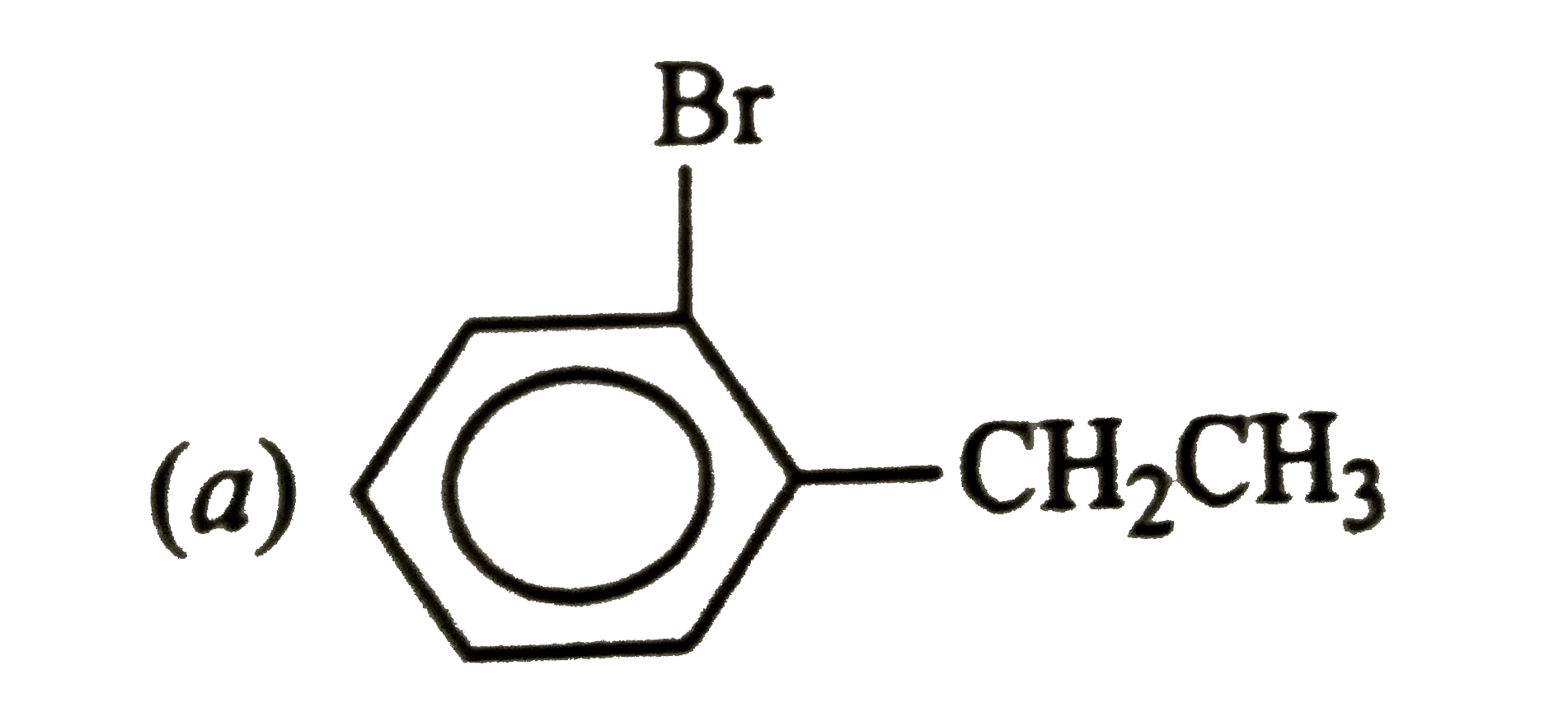
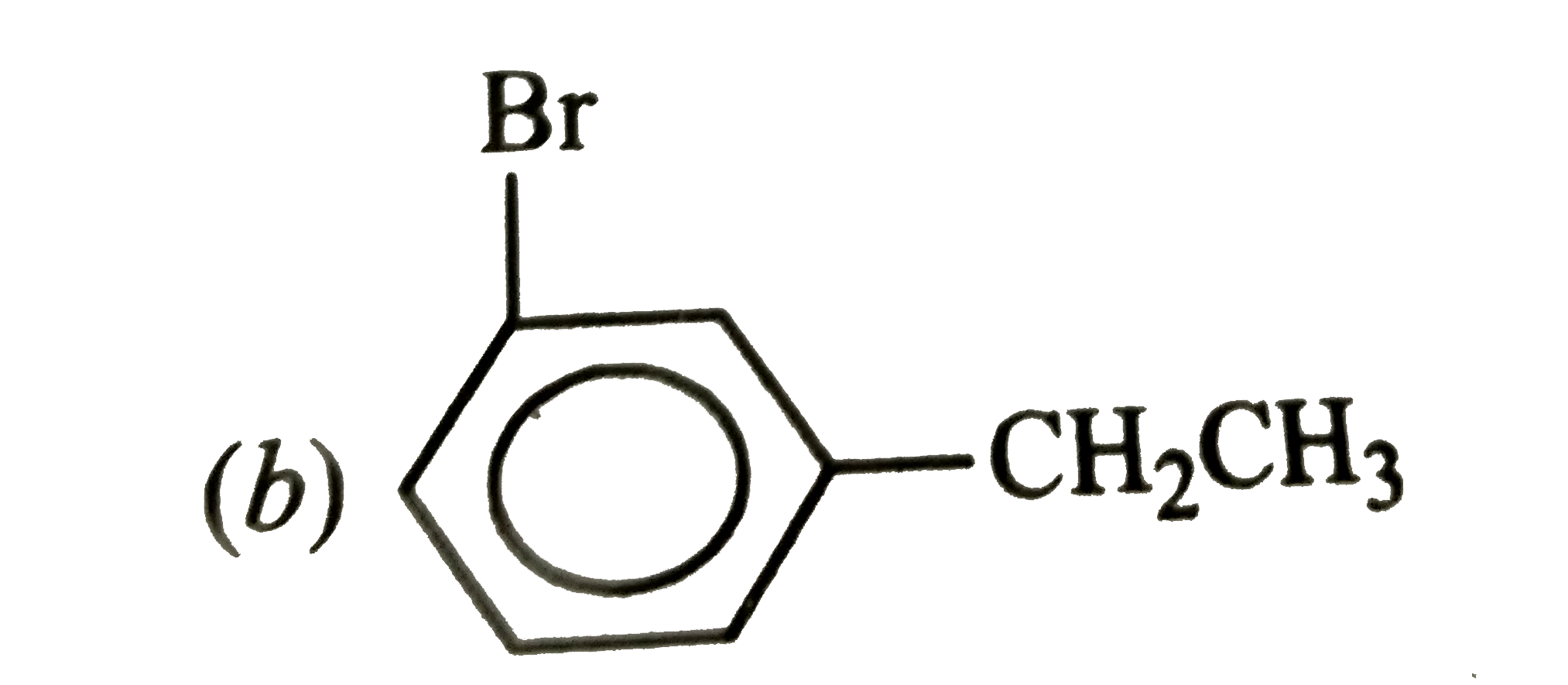
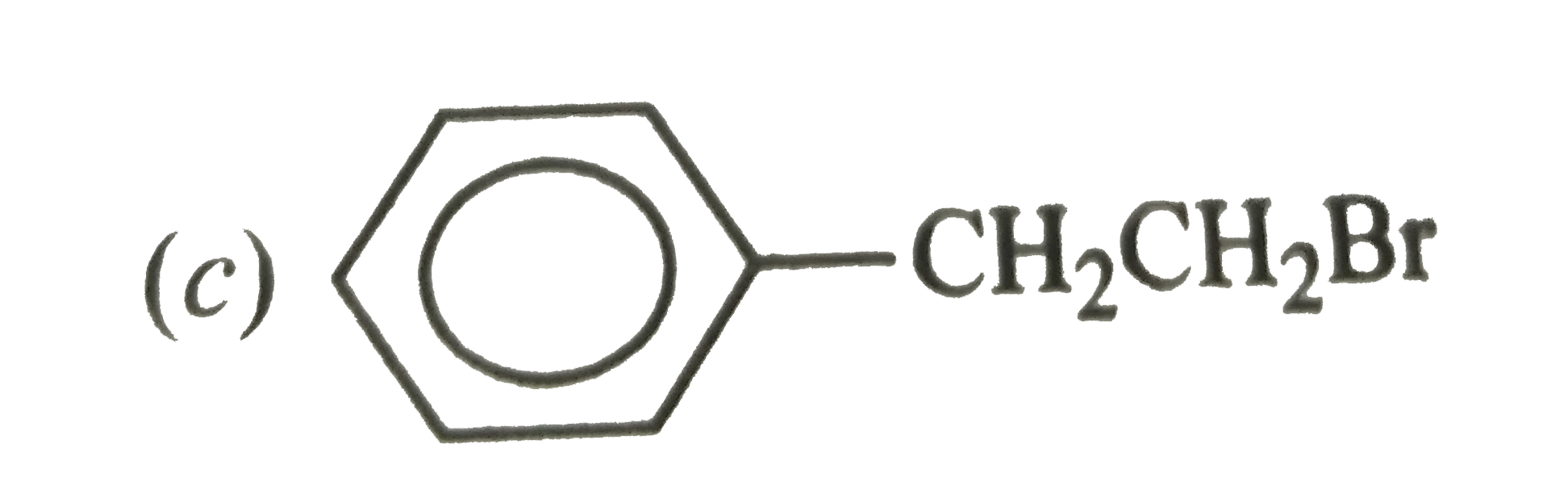
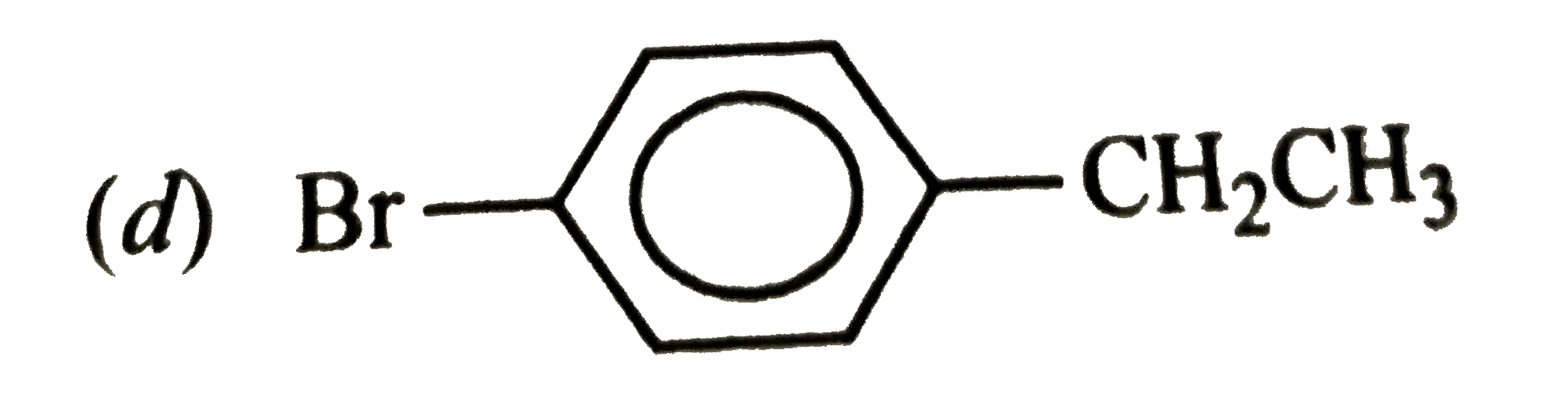
Ethylbenzene with bromine in presence of FeBr_3, predominantly gives |
|
Answer»
|
|
| 36. |
Ethylamine is a stronger base than acetamide. Assign reason. |
Answer» Solution :In acetamide, the carbonyl group is electron withdrawing in NATURE. It decrease the electron DENSITY on the nitrogen atom of the AMINO group due to conjugation. On the other hand, in ethylamine, the ethyl group has `+ I` 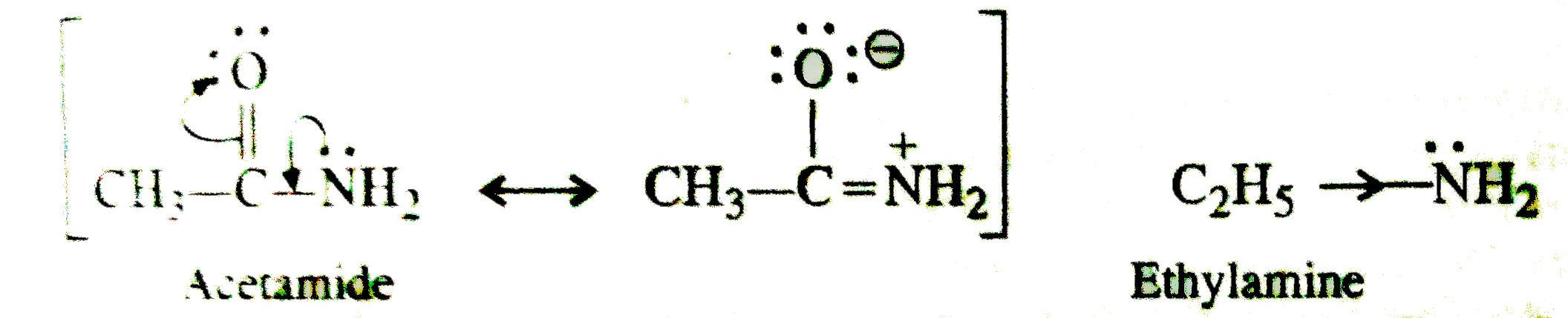 effect and it increases the electron density on the nitrogen atom. Therefore, electron releasing tendency is more in ethylamine than in acetamide or the FORMER is a stronger base. |
|
| 37. |
Ethylacetate and methyl propionate are |
|
Answer» FUNCTIONAL isomers |
|
| 38. |
Ethyl-methyl ether ethene is obtained by the action of methyl magnesium iodide with ………………… . |
| Answer» SOLUTION :Chloro-dimethyl-ether | |
| 39. |
Ethyl iodide and n-propyl iodide are allowed to under go wurtz reaction. The alkane which willnot be obtained in this reaction is |
|
Answer» Butane |
|
| 40. |
Ethyl formate reacts with methyl magnesium iodide followed by acid hydrolysis to yield …………………… . |
| Answer» SOLUTION :ACETALDEHYDE | |
| 41. |
Ethyl hydrogen sulphate is obtained by reaction of H_(2)SO_(4) on |
|
Answer» Ethylene |
|
| 42. |
Ethyl ethanoate on treatment with large excess of isopropyl alcohol in the presence of sodium isopropoxide yields |
|
Answer» isopropylacetate 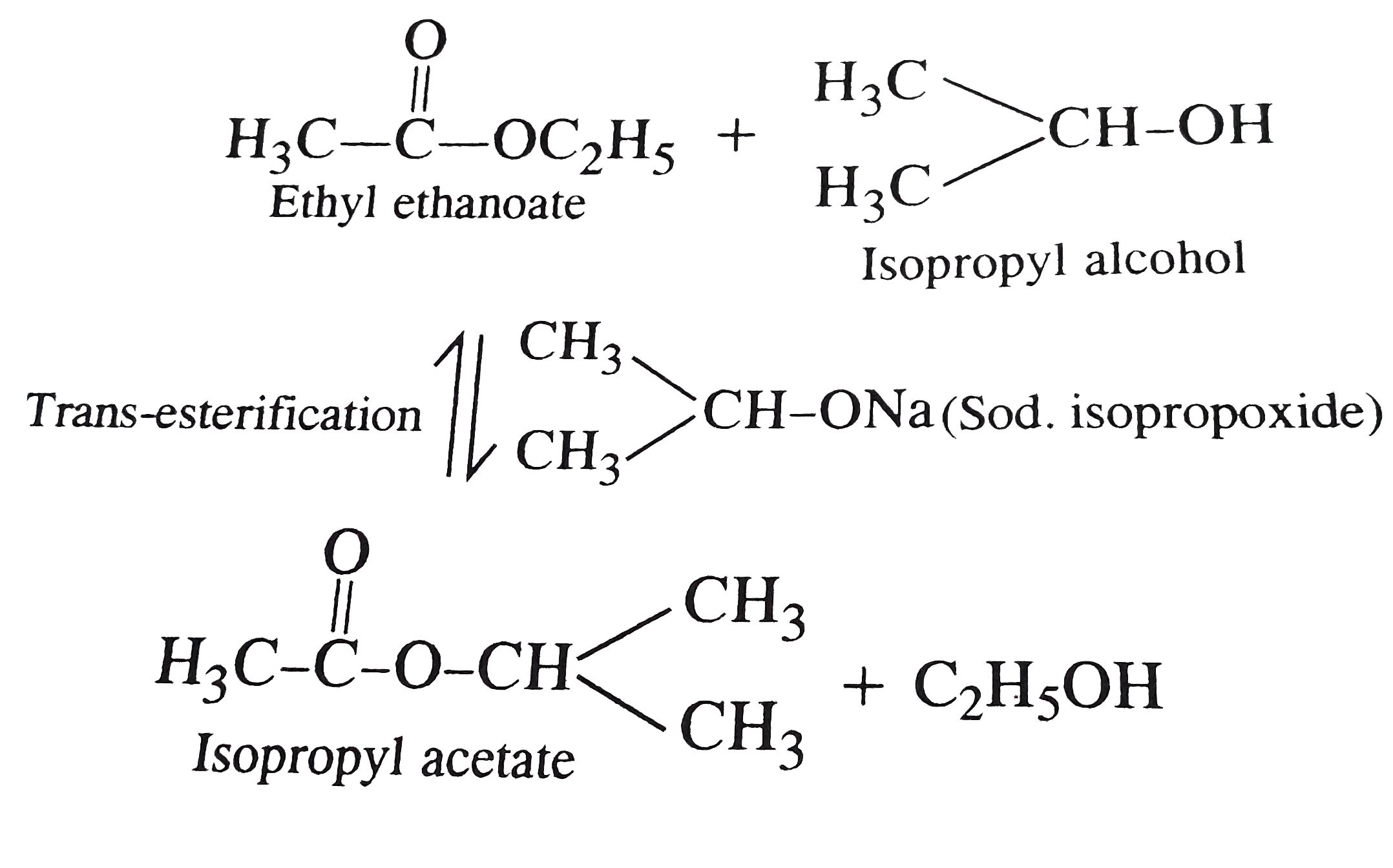
|
|
| 43. |
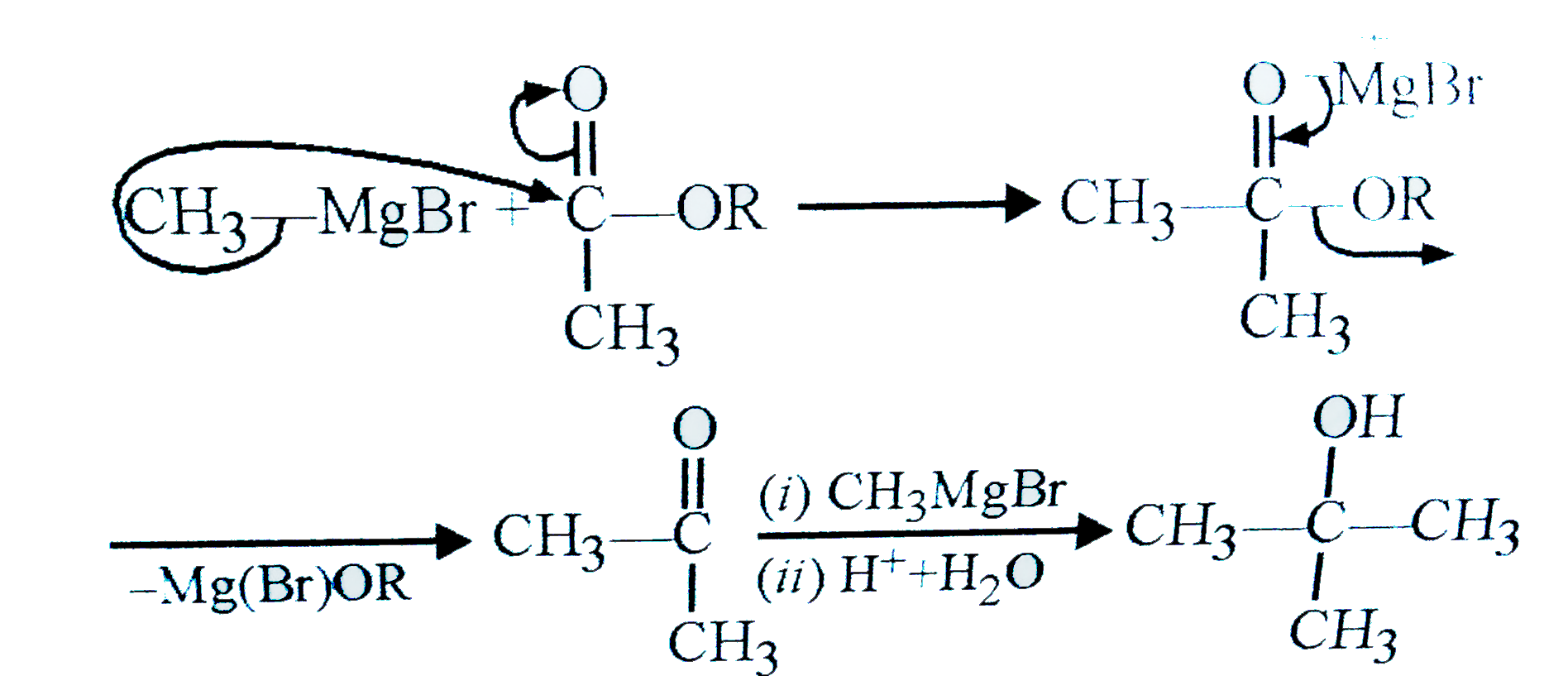
Ethyl ester underset("excess")overset(CH_(3)MgBr)rarrP. The product P is |
|
Answer»
|
|
| 44. |
Ethyl bromide reacts with sodium lead alloy to form____ |
| Answer» Solution :Tetra ethyl lead | |
| 45. |
Ethyl bromide reacts with alcoholic solution of KCN and AgCN to give different products having same molecular formula. These further react with other reagents to form different products. How will you convert ethyl bromide into ethanamide? Give reaction. |
| Answer» Solution :`CH_(3)CH_(2)BR OVERSET(alc. KCN)to CH_(3)CH_(2)CN overset(CONC. HCl)to CH_(3)CONH_(2)` | |
| 46. |
Ethyl bromide reacts with alcoholic solution of KCN and AgCN to give different products having same molecular formula. These further react with other reagents to form different products. Complete the reaction: CH_(3)CH_(2)Br overset(alc. KCN)to A overset(Na, C_(2)H_(5)OH)to B |
| Answer» Solution :`CH_(3)CH_(2)Br overset(alc. KCN)to CH_(3)CH_(2)CN overset(NA, C_(2)H_(5)OH)to CH_(3)CH_(2)CH_(2)NH_(2)` | |
| 47. |
Ethyl bromide reacts with alcoholic solution of KCN and AgCN to give different products having same molecular formula. These further react with other reagents to form different products. How will you convert ethyl bromide into N-methyl aminoethane? Give reaction. |
| Answer» Solution :`CH_(3)CH_(2)Br overset(alc.AgCN)to CH_(3)CH_(2)NC overset(NA, C_(2)H_(5)OH)to CH_(3)CH_(2)NHCH_(3)` | |
| 48. |
Ethyl bromide reacts with alcoholic solution of KCN and AgCN to give different products having same molecular formula. These further react with other reagents to form different products. How are these two compounds related? |
| Answer» SOLUTION :FUNCTIONAL ISOMERS | |
| 49. |
Ethyl bromide reacts with alcoholic solution of KCN and AgCN to give different products having same molecular formula. These further react with other reagents to form different products. Name the different products formed by reaction of ethyl bromide with KCN and AgCN. |
| Answer» SOLUTION :With KCN : ETHYL CYANIDE, with AgCN: Ethyl isocyanide | |