

Saved Bookmarks
This section includes 7 InterviewSolutions, each offering curated multiple-choice questions to sharpen your Current Affairs knowledge and support exam preparation. Choose a topic below to get started.
| 1. |
Ethyl bromide reacts with alcoholic AgCN to form ……………….. . |
| Answer» SOLUTION :`CH_3CH_2NC` | |
| 2. |
Ethyl bromide reacts with alcoholic AgCN to form …………….. |
|
Answer» `CH_3 CH_2 CN` |
|
| 3. |
Ethyl benzene with Br_(2) in the presence of FeBr_(3)gives |
|
Answer» PHENYL bromoethane |
|
| 4. |
Ethyl benzene on reaction with bromine in presence of FeBr_3, predominantly gives |
|
Answer»

|
|
| 5. |
Ethyl benzene on heating with Cl_2 gives A(C_8 H_9CI). A on reaction with alcoholic KOH gives B(C_8 H_8).Compounds A and B are, respectively |
|
Answer» `C_6H_5 - CH_2CH_2 CL and C_6H_5 - CH_2 - CH_2-OH ` 
|
|
| 6. |
Ethyl alcohol reacts with acetyl chloride to form |
|
Answer» Ethyl chloride |
|
| 7. |
Ethyl alcohol is oxidation with K_(2)Cr_(2)O_(7) gives |
|
Answer» Acetic acid |
|
| 8. |
Ethyl alcohol is industrially prepared from ethylene by |
|
Answer» Permanganate oxidation |
|
| 9. |
Ethyl alcohol is heated with conc. H_(2)SO_(4). The product formed is: |
| Answer» Answer :C | |
| 10. |
Ethyl alcohol is an organic compound but still freely soluble in water explain. |
|
Answer» Solution :The solubility of ethyl aclohol in water is due to the PRESENCE of intermolecular hydrogen BONDING between the TWO. `---H-OVERSET(H)overset(|)O---H-overset(C_(2)H_(3))overset(|)O---overset(H)overset(|)O---H-overset(C_(2)H_(3))overset(|)O---` Energy is released during teh attraction this helps in the dissolution of alcolol in water. |
|
| 11. |
Ethyl alcohol gives ethyl chloride with the help of |
|
Answer» `SOCl_(2)` |
|
| 12. |
Ethyl alcohol can be used for preparation of which of the following ? |
|
Answer» All the FOLLOWING compounds |
|
| 13. |
Ethyl acetate reacts with CH_(3)Mg Br to form |
|
Answer» Secondary alcohol |
|
| 14. |
Ethyl acetate is obtained when methyl magnesium iodide reacts with |
|
Answer» ETHYL formate 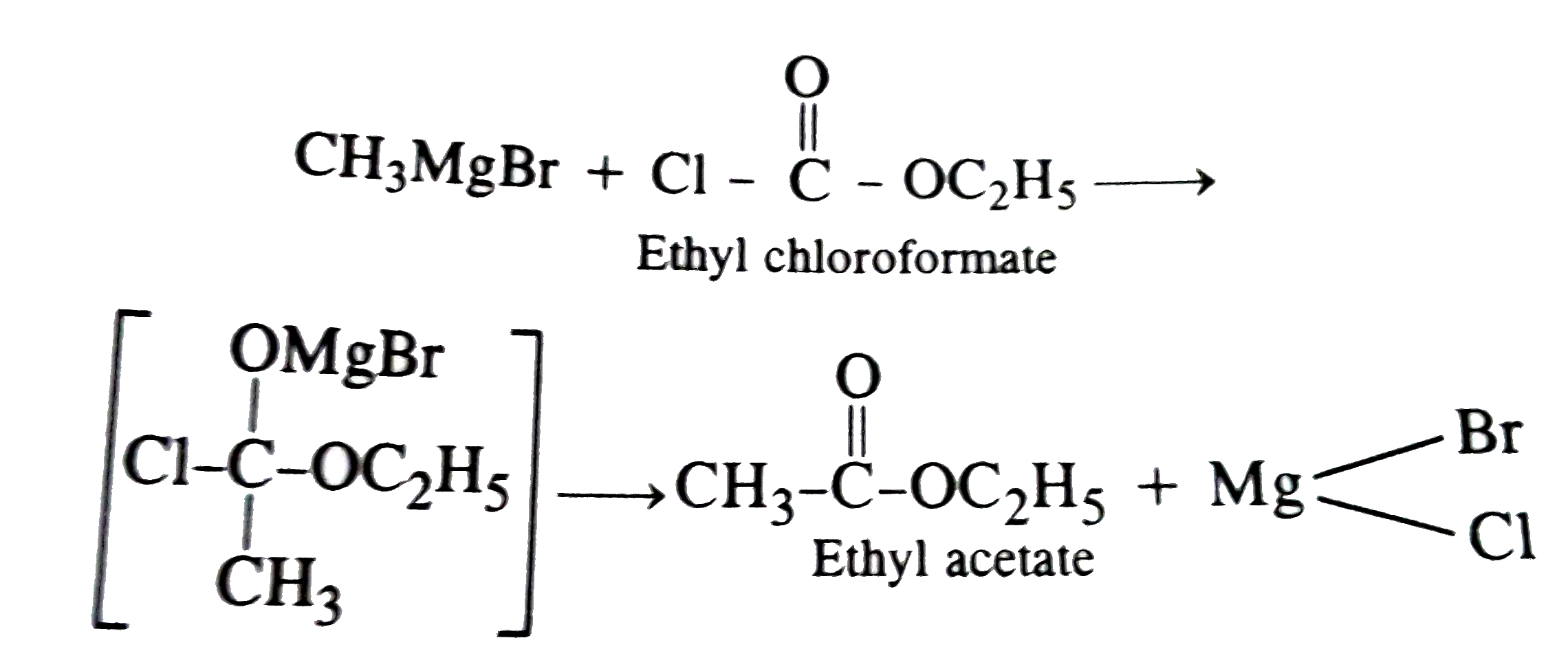
|
|
| 15. |
Ethyl acetate is formed by the reaction between ethanol and acetic acid and the equilibrium is represented as: CH_3COOH_((l)) + C_2H_5OH_((l)) hArr CH_3COOC_2H_(5(l)) + H_2O_((l)) (i)Write the concentration ratio (reaction quotient), Q_c for this reaction (note : water is not in excess and is not a solvent in this reaction) (ii) At 293 K, if one starts with 1.00 mol of acetic acid and 0.18 mol of ethanol, there is 0.171 mol of ethyl acetate in the final equilibrium mixture. Calculate the equilibrium constant. (iii) Starting with 0.5 mol of ethanol and 1.0 mol of acetic acid and maintaining it at 293 K, 0.214 mol of ethyl acetate is found after sometime. Has equilibrium been reached ? |
|
Answer» Solution :(i)`Q_c=([CH_3COOC_2H_5][H_2O])/([CH_3COOH][C_2H_5OH])` `{:("EQUILIBRIUM reaction :",CH_3COOH_((l))+,C_2H_5OH_((l)) hArr, CH_3COOC_2H_(5(l))+, H_2O_((l))),("INITIAL mol:",1.0,0.18,0,0),("Change in reaction :",-x,-x,+x,+x),("Mol at equilibrium :",(1.0-x),(0.18-x),x=0.171,x),(,=(1.0-0.171),=(0.18-0.171),0.171,=0.171),(,=0.829,=0.009,0.171,0.171),("Suppose Volume =V So, M:", 0.829/V, 0.009/V,0.171/V,0.171/V):}` `therefore K_c=([CH_3COOC_2H_5][H_2O])/([CH_3COOH][C_2H_5OH])=(0.171/V)(0.171/V)(V/(0.829))(V/0.009)=(0.171xx0.171)/(0.829xx0.09)`=3.9192 `{:("Equilibrium reaction :",CH_3COOH_((l)) + , C_2H_5OH_((l)) hArr , CH_3COOC_2H_(5(l))+,H_2O_((l))),("Initial mol:", 1.0,0.5,0,0),("Change in reaction :",-x,-x,+x,+x),("Mol at equilibrium:",(1.0-x),(0.5-x),x,x),(,=(1.0-0.214),=(0.5-0.214),=0.214,0.214),(,=0.786,=0.286,,),("At equilibrium M:",0.786/V,0.286/V,0.214/V,0.214/V):}` `therefore Q_c=([CH_3COOC_2H_5][H_2O])/([CH_3COOH][C_2H_5OH])=(0.214/V)(0.214/V)(V/0.786)(V/0.286)=(0.214xx0.214)/(0.786xx0.286)`=0.2037 `(Q_c = 0.2037) lt (K_c=3.9192)` `therefore Q_c NE K_c`, So, equilibrium is not . `Q_c lt K_c` , The VALUE of `Q_c` is not equal to `K_c` , The reaction is continue. `Q_c` is less ,So, forward reaction occurs and more product is obtain. |
|
| 16. |
Ethyl accetate is formed by the reaction between ethanol and acetic acid and the equilibrium is represented as : CH_(3) COOH (l) + C_(2) H_(5) OH (l) hArr CH_(3) COOC_(2) H_(5)(l) + H_(2)O (l). |
|
Answer» Solution :(i) ` Q_(c) = ([CH_(3) COOC_(2) H_(5)][H_(2)O])/([CH_(3) COOH ] [C_(2) H_(5) OH]) ` ` {:((ii),CH_(3)COOH,+,C_(2)H_(5)OH,hArr,CH_(3)COOC_(2)H_(5),+,H_(2)O),("Intial",1*00"mol",,0*180 "mol",,,,),("At eqm",1-0*171,,0*180-0*171,,0*171"mol",,0*171 "mol"),(,=0*829 "mol",,=0*009"mol",,,,),("Molar concs.",0*829//V,,0*009 //V,,0*171//V,,0*171//V):} ` ` K_(c) = ([CH_(3) COOC_(2)H_(5)][H_(2)O])/([CH_(3)OOH][C_(2)H_(5)OH] )=((0*171//V)(0*171//V))/((0*829//V)(0*009//V))=3*92` ` {:((iii),CH_(3)COOH,+,C_(2)H_(5)OH,hArr,CH_(3)COOC_(2)H_(5),+,H_(2)O),("Intial",1*000 "mol",,0*500"mol",,,,),("After time t",1-0*214,,0*500-0*214,,0*214,,0*214),(,=0*786 "mol",,= 0*286 "mol",,,,):}` Reaction quotient ` (Q_(c))=((0*214//V)(0*214//V))/((0*786//V)(0*286//V))=0*204` As `Q_(c) != K_(c)` , EQUILIBRIUM has not been attained . |
|
| 17. |
Ethy alcohol is...... to litmus : |
|
Answer» Acidic |
|
| 18. |
Ethene on treating with bromine in presence of sodium chloride forms a mixture of CH_(2)ClCH_(2)Br and CH_(2)BrCH_(2)Br. Give reason. |
Answer» Solution :The ADDITION of bromine FOLLOWS IONIC MECHANISM. The intermediate carbocation formed is attacked by BROMIDE ion as well as chloride ion given by sodium chloride. 
|
|
| 19. |
Ethene on ozonolysis yields X. To preparesuccessive homologue of X, which of the following should be subjected to ozonolysis? |
| Answer» Answer :D | |
| 20. |
Ethene is obtained from ethyne by |
|
Answer» CATALYTIC hydrogenation |
|
| 22. |
Ethene, ethyne and benzene gives electrophilic reactions, why ? Give reasons. |
| Answer» Solution :All these three possess arrangement of high negativity of `pi`-electrons. (i) Presence of such negativity facilitate ELECTROPHILES to react. (II) `sigma`- BOND EASILY breaks in comparison to `pi`- bond so such compounds gives electrophilic REACTION. | |
| 23. |
Ethene and ethyne can be distinguished using |
|
Answer» TOLLEN's reagent |
|
| 24. |
Ethanol when reacted with PCl_(5) gives A, POCl_(3) and HCl. A reacts with silver nitrite to form B (major product) and AgCl. A and B respectively are |
|
Answer» `C_(2)H_(4)Cl` and `C_(2)H_(5)OC_(2)H_(5)` `C_(2)H_(5)Cl+AgNO_(2) rarr underset((B))(C_(2)H_(5)NO_(2))+AgCl` |
|
| 25. |
Ethanol reacts with methyl magnesium bromide to form |
|
Answer» ETHANE |
|
| 26. |
Ethanol has higher boiling point diethyl ether or ethyl amine. Why ? |
|
Answer» Solution :In ETHANOL , these is H-bonding but in DIETHYL ether , there is no H-bonding (because O-atom isattached to C-atom ) and in CASE of ETHYL amine, the H-bonds formed by n-atom are WEAKER then those formed by O-atom. |
|
| 27. |
Ethanol containing some methanol is called |
|
Answer» ABSOLUTE SPIRIT |
|
| 28. |
Ethanol cannot be dried by anhyd. MgCl_(2) because |
|
Answer» ETHANOL is soluble in water |
|
| 30. |
Ethanol boils at 78.4^(@)C and the standard enthalpy of vaporisation of ethanol is 42.4 kJ mol^(-1) . Calculate theentropy of vaporisation of ethanol. |
|
Answer» |
|
| 31. |
Ethanol and ethylene glycol can be distinguished by |
|
Answer» LUCAS TEST |
|
| 32. |
Ethanoic anhydride when reduced with LiAlH_(4) produces |
|
Answer» Ethanal |
|
| 33. |
Ethanoic acid on reaction with hydrazoic acid (HN_(3)) yields |
|
Answer» ethylamine `CH_(3) COOH + HN_(3) rarr CH_(3) NH_(2) + CO_(2) + N_(2)` |
|
| 36. |
Ethane is foremd during the formation of chloromethane by chlorinationn of methane because |
|
Answer» higher MEMBERS of the hydrocarbons are generally formed during reactions `overset(**)(C)H_(3)+overset(Cl^(**)) to CH_(3)Cl` (chloromethane) or `overset(**)(C)H_(3)+overset(**)(C)H_(3) to CH_(3)-CH_(3)` (ethane) |
|
| 37. |
Ethane is subjected to combustion processes. During the combustion the hybrid state of carbonchanges from |
|
Answer» `SP^(2) " to " sp^(3) ` |
|
| 38. |
Ethane can be prepared by |
|
Answer» HEATING soldalime with SODIUM acetate |
|
| 39. |
Ethane burns completely in air to give CO_(2), while in a limited supply of air gives CO. The same gases are found in automobile exhaust . Both CO and CO_(2) are atmospheric pollutants. How do the pollutants affect the human body ? |
|
Answer» Solution :Danger associated with CO and `CO_(2)` health hazards to human body Increase in `CO_(2)` level into the atmosphere is responsible for GLOBAL WARMING. If causes HEADACHE and nausea. |
|
| 40. |
Ethane burns completely in air to give CO_(2) while in a limited supply of air gives CO. The same gases are found in automobile exhaust. Both CO and CO_(2) are atmospheric pollutants (i) What is the danger associated with these gases? (ii) How do the pollutants affect the human body? |
|
Answer» Solution :Danger ASSOCIATED with CO and `CO_2` & health hazards to human BODY Carbon monoxide binds with haemoglobin and form carboxyhaemoglobin which IMPAIRS normal oxygen transport by blood and hence the oxygen carrying capacity of blood is reduced. This oxygen DEFICIENCY results in headache, tension, dizziness, loss of consciousness, blurring of eyesight and cardiac arrest. (b) Increase in `CO_(2)` level in the atmosphere is responsible for global warming. It causes headache and nausea. |
|
| 41. |
Ethane burns in oxygen to form CO_2 and H_2O according to the equation : 2C_2H_6 + 7O_2 rarr 4CO_2 + 6H_2O If 1250 cc of oxygen is burnt with 300 cc of ethane. Calculate : the volume of unused O_2. |
|
Answer» SOLUTION :The equation involved is `2C_2 H_6 + 7O_2to4CO_2 + 6H_2O` `2 " volumes " "" 4 " volumes "` This equation implies that under similar conditions 2 volumes of ethane (on BURNING completely), will give 4 volumes of `CO_2`. Since the conditions are similar in the given problem, 2.5 L of ethane will form `2.5 XX 4/2 = 5.0L " of " CO_2 " at " 27^@C` and 1 atm PRESSURE. |
|
| 42. |
Ethane burns in oxygen to form Carbon dioxide and Water vapours. Write the balanced equation. |
|
Answer» Solution :In this case, the conditions are different. Therefore, we should convert the VOLUME of `CO_2`produced (5.0 L) at `27^@C` and 1 atm to the given conditions i.e., at `50^@C` and 1.5 atm. Therefore, `P_1 = 1.0 " atm," "" V_1 = 5.0 L`, `T_1 = 27 + 273 = 300 K` and `P_2 = 1.5 " atm," ""V_2` = ? `T_2 = 50 + 273 = 323 K` According to the GAS equation, `(P_1 V_1)/T_1 =(P_2 V_2)/(T_2)` or`V_2= (P_1 V_1 T_2)/(T_1 P_2) =(1.0 xx 5.0 xx 323)/(300 xx 1.5) = 3.6 L` Therefore, 3.6 L of `CO_2` will be produced at `50^@C` and 1.5 atm pressure. |
|
| 43. |
Ethane burns completely in air to give CO_(2), while in a limited supply of air gives CO. The same gases are found in automobile exhaust . Both CO and CO_(2) are atmospheric pollutants. What is the danger associeated with these gases |
|
Answer» Solution :Danger associated with CO and `CO_(2)` health hazards to HUMAN body Carbon monoxide binds haemoglobin and form carboxy haemoglobin which impairs normal OXYGEN TRANSPORT by blood and hence the oxygen carrying capacity of blood is reduced.This oxygen deficiency results in headache, dizziness, TENSION , loss of consciousness, blurring of EYE sight and cardiac arrest. |
|
| 44. |
Ethane-1,2-diol when heated with ZnCl_(2) gives |
|
Answer» Ethanal |
|
| 45. |
"Ethanal" overset(Al(OC_(2)H_(5))_(3))rarr X overset(C_(2)H_(5)ONa)rarr Y In the above reaction X and Y are |
|
Answer» `CH_(3) - COOH, CH_(3)COOC_(2)H_(5)` |
|
| 46. |
Ethanal and Vinyl alcohol both are examples of which isomerism? |
|
Answer» Metamerism |
|
| 47. |
Ethanal + Aluminium ethoxide rarr X. The product X in the above reaction is |
|
Answer» ALUMINIUM acetate |
|
| 48. |
Estimate the average S-F bond energyin SF_(6).The standard heat of formation valuesof SF_(6)(g), S(g)andF(g) are : - 1100,275 and80 Kj mol^(-1) respectively. |
|
Answer» Solution :Aim`:(1)/(6) [SF_(6)(g) rarrS(g) +6F(g)],DeltaH=?` For the reaction, `SF_(6)(g) rarrS(g) + 6F(g)` `Delta_(f)H = Delta_(f)h^(@) [S(g)+ 6[Delta_(f)H^(@) F (g)]-[Delta_(f)H^(@) SF_(6)(g)=275 + 6(80)-( -1100) kJ mol^(-1) = 1855kJ mol^(-1)` `:. ` AverageS-F bond ENERGY `= ( 1855)?( 6) =309.16 kJ mol^(-1)` |
|
| 49. |
Erite the balanced equation for following reaction . (i) Li metal with N_(2) gas. (ii) Heating solid sodium bicarbonate (iii) Solid potassium hydroxide with CO_(2) |
|
Answer» Solution :(i) `6Li_(S)+3N_(2(g))to2Li_(3)N_(S)` (ii)`2NaHCO_(3)overset(DELTA)toNa_(2)CO_(3)+CO_(2) uparrow+H_(2)O` (III) `2KOH_(S)+CO_(2)toK_(2)CO_(3)+H_(2)O` |
|


