

Saved Bookmarks
This section includes 7 InterviewSolutions, each offering curated multiple-choice questions to sharpen your Current Affairs knowledge and support exam preparation. Choose a topic below to get started.
| 1. |
Experimental analysis of a compound containing the elements x,y,z on analysis gave the following data, x = 32 %, y = 24 %, z = 44 %. The relative number of atoms of x, y and z are 2,1 and 0.5, respectively. (Molecular mass of the compound is 400 g) Find out.(i) The atomic masses of the element x,y,z.(ii) Empirical formula of the compound and(iii) Molecular formula of the compound. |
|
Answer» Solution :ELEMENT x = 32%, y = 24%, z = 44% Relative number of atoms x = 2 , y = 1 , z = 0.5 Molar mass of the compound = 400 g. (i) Atomic mass of the element. Relative number of atoms = `("Percentage composition")/("Atomic mass Atomic mass")` `:.` Atomic mass = `("Percentage composition")/("Relative No. of atoms")` Atomic mass of x = `32/2` = 16 Atomic mass of y = `24/1`=24 Atomic MASSOF z =`44/0.5`=88 (ii) Empirical formula of the compound `x_(4)y_(2)z_(1)` Molecular mass of the compound = 400 n= `("Molecular mass")/("Empirical formula mass")=400/200`=2 (III) Molecular formula of the compound = `x_(8)y_(4)z_(2)` 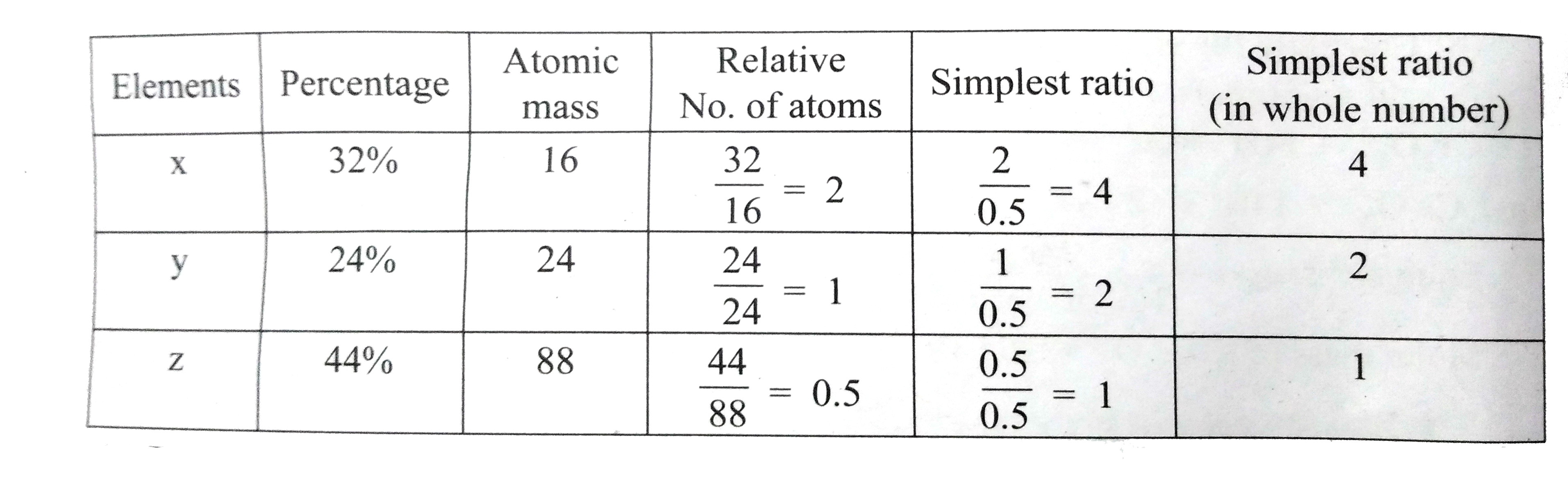
|
|
| 2. |
Expansion of a gas in vacuum is called free expansion.Calculate the workdone and the change in internal energy when 1 litre of ideal gas expandsisothermally into vacuum until its total volume is 5 litre ? |
| Answer» Solution :`w= -P _("EXT") DELTAV`. As`P_(ext) = 0` , therefore, `w=0` . ltbrlt As internal energyof an idealgas DEPENDS only on temperature, therefore,for isothermal expansion of an ideal gas , internalenergy remains constant, i.e., `DELTAU =0`. [ Also,remember that as`H= U +PV, DeltaH = Delta ( U+PV)= DeltaU +P DeltaV = DeltaU _nR ( DeltaT)`. For isothermal process, `DeltaT = 0`, and also `DeltaU =0` as stated above, therefore, `DeltaH =0 ]` | |
| 3. |
Expansion of a gas in vacuum is called free expansion. Calculate the work done and the change in internal energy when 1 litre of ideal gas expands isothermally into vacuum until its total volume is 5 litre ? |
|
Answer» Solution :Work DONE of a gas in vacuum, `W=-p_("ext") (V_(2) - V_(1) )` As `P_("ext" ) = 0` so, `W= -0(5-1) =0` As internal energy of an ideal gas depends only on temperature, therefore, for isothermal expansion of an ideal gas, internal energy remains constant, i.e., `Delta U=0` As `H= U + PV, Delta H = Delta U (U+ pV)= Delta U + pDelta V = Delta U + n R (Delta T)`. For isothermal process, `Delta T = 0 and` also `Delta U = 0`, as STATED above, therefore, `Delta H=0`. |
|
| 4. |
Expand each of the following condensed formulas into their complete structural formulas. (a) CH_(3)CH_(2)COCH_(2)CH_(3) (b) CH_(3)CH = CH(CH_(2))_(3) CH_(3) |
|
Answer» Solution :(a) `H- underset(underset(H)(|))OVERSET(overset(H)(|))(C )- underset(underset(H)(|))overset(overset(H)(|))(C )- overset(overset(O)(||))(C )- underset(underset(H)(|))overset(overset(H)(|))(C )- underset(underset(H)(|))overset(overset(H)(|))(C )- H` (b) `H - underset(underset(H)(|))overset(overset(H)(|))(C )- overset(overset(H)(|))(C )= overset(overset(H)(|))(C )- underset(underset(H)(|))overset(overset(H)(|))(C )- underset(underset(H)(|))overset(overset(H)(|))(C )- underset(underset(H)(|))overset(overset(H)(|))(C )- underset(underset(H)(|))overset(overset(H)(|))(C )- H` |
|
| 5. |
Expand each of the following condensed formulae into their complete structural formulae (a) CH_(3)CH_(2)COCH_(2)CH_(3)(b) CH_(3)CH = CH(CH_(2))_(3)CH_(3) |
| Answer» SOLUTION :(a) `H-underset(H)underset(|)overset(H)overset(|)(C)-underset(H)underset(|)overset(H)overset(|)(C)-overset(O)overset(||)(C)-underset(H)underset(|)overset(H)overset(|)(C)-underset(H)underset(|)overset(H)overset(|)(C)-H`(b) `H-underset(H)underset(|)overset(H)overset(|)(C)-overset(H)overset(|)(C)=overset(H)overset(|)(C)-underset(H)underset(|)overset(H)overset(|)(C)-underset(H)underset(|)overset(H)overset(|)(C)-underset(H)underset(|)overset(H)overset(|)(C)-underset(H)underset(|)overset(H)overset(|)(C)-H` | |
| 6. |
Expand each of the following bond0line formulas to show all the atoms including carbon and ydrogen |
Answer» SOLUTION : (B) `H- underset(underset(H)(|))overset(overset(H)(|))(C )- underset(underset(H)(|))overset(overset(H)(|))(C )- underset(underset(H)(|))overset(overset(H)(|))(C )- underset(underset(H)(|))overset(overset(H)(|))(C )- underset(underset(H)(|))overset(overset(H)(|))(C )-underset(underset(H)(|))overset(overset(H)(|))(C )-underset(underset(H)(|))overset(overset(H)(|))(C )-underset(underset(H)(|))overset(overset(H)(|))(C )-H` (c ) `H- C = - underset(underset(H)(|))overset(overset(H)(|))(C )-underset(underset(H)(|))overset(overset(OH)(|))(C )- underset(underset(H)(|))overset(overset(H)(|))(C )-H` 
|
|
| 7. |
Expalinthe ozonolysis of (a)Ethene and (b) propene |
|
Answer» Solution :OZONOLYSIS ismethodof oxidativecleavage of ALKENES usingdzone and it formform twocatrbonylcompoundAlkenesreactwith ozoneto formozonideand it iscleavedby `Zn//H_(2)O` to formsmallermolecules. This reactionis OFTEN to identifythe STRUCTUREOF unknowsalkenesby detectingthepositionofdoubletriplebond. 
|
|
| 8. |
Expain the reaction of aluminium towards acid. |
|
Answer» Solution :Aluminium reacts with dil. HCI liberating hydrogen. `2AI_((s)) + 6HCI _(AQ) to 2AICI_(3(aq)) + 3H_(2(g)).` Aluminium becomes passive when TREATED with conc. `HNO_(3)` due to the FORMATION of a thin PROTECTIVE layer of oxide `(AI_(2)O_(3))` on its SURFACE. |
|
| 9. |
Expain the formation of methane molecule on the basis of hybridization. |
Answer» Solution :The electronic configuration of the CENTRAL carbon atom `(x=6)` is methane is 2,4. Each of the four electrons present in the valence shell forms SHARED pairs with the electrons of the hydrogen atoms as shown below: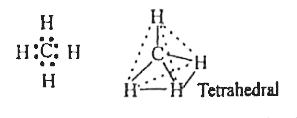 Methane has a tetrahedral structure which is multiplanar, in which carbon atom lies at the CENTRE and the four hydrogen atoms lie at the four comers of REGULAR tetrahedran. All H-C-H bodn angles are `109.5^(@)`. |
|
| 11. |
Exothermic formation represented by equation Cl_(2(g)) + 3F_(2(g)) hArr 2ClF_(3) (g) . DeltaH= - 339 KJ . Which of the following will increase the quantity of CIF_(3) in equilibrium mixture ? |
|
Answer» INCREASE in temperature |
|
| 12. |
Exothermic process is - |
|
Answer» `Na to Na^(-)+E` |
|
| 13. |
Exhausted permutit does not contain the following cation |
|
Answer» `Na^+` |
|
| 14. |
Exhibition of various oxidation states by transition elements is due to |
|
Answer» Less ENERGY difference between ns and (n-1)d sub-shells |
|
| 15. |
Exhausted cation exchange resin is regenerated by using solution of moderately concentrated. |
| Answer» Answer :C | |
| 16. |
Exhausted cation exchange resin is regenerated by using solution of moderately concentrated |
| Answer» Solution :Cation exchange `H_(2)SO_(4)` | |
| 17. |
Exhausted anion exchange resin is revived by using solution of |
| Answer» Answer :D | |
| 18. |
Exept LiF, other halides of Li are soluble in water |
| Answer» Solution :FALSE statement (Other halides of Li are soluble in ethanol, ACETONE, ETHYL acetate and pyridine) | |
| 19. |
Excluding hydrogen and helium , the smallest element in the periodic table is _______ |
|
Answer» Lithium |
|
| 20. |
Excluded volume for free random motion of gas molecules is how many times the actual volume of gas molecules |
| Answer» SOLUTION :Excluded volume, `B= 4V_("MOLECULES")` | |
| 21. |
Excited atoms emit radiations consisting of only certain discrete frequencies or wavelengths. In spectroscopy it is often more convenient to use frequencies or wave numbers than wavelength because frequencies and wave numbers are proportional to energy and spectroscopy involves transitions between different energy levels. The line spectrum shown by a mono electronic excited atom (a finger print of an atom) is called atomic spectrum. 1/(lambda) = Z^2 R [1/(n_1^2 - 1/(n_2^2)] The given diagram indicates the energy levels of certain atom. When an electron moves from 2E level to E level, a photon of wavelength lambda is emitted. The wavelength of photon emitted during its transition from (4E)/(3)level to E level is |
|
Answer» `lambda/3` `(hc)/(lambda) = E implieslambda = (hc)/(E) ` ALSO, `(hc)/(lambda_1) = (4E)/(3) - E = E/3` `E= 3 lambda` |
|
| 22. |
Excited atoms emit radiations consisting of only certain discrete frequencies or wavelengths. In spectroscopy it is often more convenient to use frequencies or wave numbers than wavelength because frequencies and wave numbers are proportional to energy and spectroscopy involves transitions between different energy levels. The line spectrum shown by a mono electronic excited atom (a finger print of an atom) is called atomic spectrum. 1/(lambda) = Z^2 R [1/(n_1^2 - 1/(n_2^2)] The ratio of wavelength for II line of Balmer series and I line of Lyman series is |
|
Answer» Solution :For II line of Balmer : `n_1 = 2 , n_2= 4` , `1/(lambda_B) = R_H XX [1/(2^2) - 1/(4^2) ] = R_H xx 3/(16)` For I line of Balmer : `n_1= 1 , n_2 = 2 `, `1/(lambda_L) = R_H xx [1/(1^2) - 1/(2^2)] = R_H xx 3/4 therefore (lambda_B)/(lambda_L) = 4` |
|
| 23. |
Excessive release of CO_2 into the atomosphere results in : |
|
Answer» POLAR vortex |
|
| 24. |
Excess of PCl_(5) reacts with conc. H_(2)SO_(4) giving |
|
Answer» sulphuryl chloride |
|
| 25. |
Excess of ozone is passed through 100 ml of 44.8 "vol" of H_2O_2aqueous solution. The S.T.P. volume of oxygen liberated is |
|
Answer» 44.8L |
|
| 26. |
Excess of Kl and Dil H_(2) SO_(4) were mixed in 50 mL H_(2)O_(2)thus ,I_(@) liberated requirs 20mL of 0.1 N Na_(2)S_(2)O_(3) ,the incrrect statemen among the following |
|
Answer» STRENGTH of HYROGEN peroxide is 100V \ |
|
| 27. |
Excess of KI reacts with CuSO_(4) solution if Na_(2)S_(2)O_(3) solution is added in it. Which of the statements is incorrect for the reaction ? |
|
Answer» EVOLVED `I_(2)` is reduced |
|
| 28. |
Excess of KI reacts with CuSO_(4) solution and then Na_2S_2O_3 solution is added to it. Which of the statements is incorrect for this reaction? |
|
Answer» `Na_(2)S_(2)O_(3)` is oxidised |
|
| 29. |
Excess of Kl and dil. H_2SO_4 were mixed in 50 mL H_2O_2. The liberated l_2 required 20 mL 0.1 N Na_2S_2O_3. Find out the strength of H_2O_2 in g "litre"^(-1). |
|
Answer» `2Kl + underset("one mole" 34.016 g)(H_(2)SO_(4)) + H_(2)O_(2) to K_(2)SO_(4) + 2H_(2)O + underset("one mole")(I_(2))` `underset("two moles" 2 xx 158.1 g)(2Na_(2)S_(2)O_(3)) + underset("one mole" 253.8 g)(I_(2)) to Na_(2)S_(4)O_(6) + 2NaI` WEIGHT of `Na_2S_2O_3` present in 20 mL 0.1 N solution can be obtained as follows : `therefore w =(NEV)/1000` `therefore w =(0.1 xx 158.1 xx 20)/1000 = 0.3162 g` `therefore` Amount of `H_(2)O_(2)` in one LITRE `=(0.03401)/50 xx 1000 = 0.6802g` Hence, the STRENGTH of given `H_(2)O_(2)` solution is `0.6802 g L^(-1)` |
|
| 30. |
Excess of KI and dil. H_(2)SO_(4) were mixed in 50 mL H_(2)O_(2). The liberated I_(2) required 20 mL of 0.1 N Na_(2)S_(2)O_(3). Find out the strength of H_(2)O_(2) in g per litre. |
|
Answer» |
|
| 31. |
Excess of calcium orthophosphate is reacted with magnesium to form calcium phosphide (Ca_(3)P_(2)) along with magnesium oxide. Calcium phosphide on reacting with excess of water liberate phosphine gas (PH_(3)) along with calcium hydroxide. Phosphine is burnt in excess of oxygen to form P_(2)O_(5) along with water. Oxides of magnesium and phosphorous react to give magnesium metaphophate. Calculate grams of magnesium metaphosphate obtained if 1.92 gm of magnesium is taken. [Round off your answer to nearest integer] |
|
Answer» |
|
| 32. |
Excess nitrate in drinking water can cause |
|
Answer» methemoglobinemia |
|
| 34. |
Exceptional elementsof group 13 in terms of atomic radius is ……… |
|
Answer» Gallium |
|
| 35. |
Except LiNO_(3), Nitrates of IA group on heating give |
|
Answer» `O_(2)` |
|
| 36. |
Except ____ halides, all the other halides of alkaline earth metals are ionic in nature. |
|
Answer» Sodium |
|
| 37. |
Except Cu, Ag and Au, most metals are black. Why? |
| Answer» Solution :Most metals are BLACK except copper, SILVER and GOLD. It is due to the absorption of light of all wavelengths. Absorption of light of all wavelengths is due to the ABSENCE of band GAP in metals. | |
| 38. |
Exaplain ionisation of acids and bases. |
|
Answer» Solution :(a) The complete dissociation of strong acids at MODERATE concentrations. EXAMPLE : HCL, HBr. (b) The complete dissociation of strong bases at moderate concentration. Example : NaOH, KOH. ( c) WEAK acids and weak bases undergo only partial dissociation at moderate concentrations. |
|
| 39. |
Example The measurement of heat change at constant pressure with a neat diagram. |
|
Answer» Solution :Heat change at constant PRESSURE ( at atmospheric pressure) can be measured using a coffee cup calorimeter. A SCHEMATIC REPRESENTATION of acoffee cup calorimeter is given in Figure. Instead of bomb, a Styrofoam cup is used in this calorimeter. It Acts as good adiabatic walland doesn't allow transfer of heat produced during the reaction to its surroundings. This entire heat ENERGY is ABSORBED by the water inside the cup. This method can be used for the reactions where there is no appreciable change in volume . The change in the temperature of water is measured and used to calculate the amount of heat that has been absorbed or evolved in the reaction using the following expression. `q=m_(w)C_(W)DeltaT` Where `m_(W)`is the molar mass of water and `C_(W)` is the molar heat capacity of water `(75.29 kJ K^(-1) mol^(-1))` 
|
|
| 41. |
Example of sp^2 hybridization is |
|
Answer» `CH_3^+` |
|
| 42. |
Example of intrinsic colloid is |
|
Answer» EGG -albumin |
|
| 43. |
Example of endothermic product is |
|
Answer» CARBON DIOXIDE |
|
| 46. |
Which of the following shows positive deviation from Raoult's law ? |
|
Answer» Solution :(i) LET us consider the positive deviation shown by a solution of ethyl alcohl and water. (ii) In this solution, the HYDROGEN bonding INTERACTION between ethnol and water is weaker than those hydrogen bonding interactions amongst themselves (ethyl alcohol-ethyl alcohol and water-water interaction). (iii) This results in the increased evaporation of both components from the aqueous solution of ethanol (iv) Here, the mixing process is endothermic i.e., `Delta H _("mixing") gt 0` and there will bge a slight increase in VOLUME `(Delta V_("mixing")gt 0)` 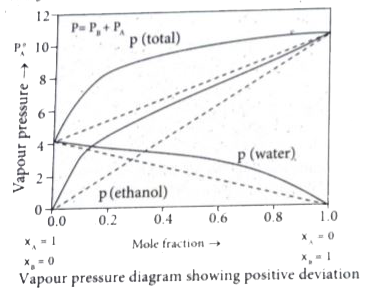 Vapout pressure diagram showing positive deviation |
|
| 47. |
Examine the structural formulas of following compounds and find how many compounds will produce. |
|
Answer» |
|
| 48. |
Examine the given defective crystal {:(X^+, Y^-, X^+, Y^-, X^+),(Y^+, Z^(2+), Y^- , X^+, Y^-),(X+ , Y^- , O, Y^- , X^+),(Y^-, X^+, Y^- , X^+, Y^-):} (i)Write the term used for this type of defect (ii)What is the result when XY crystal is doped with divalent (Z^(2+)) impurity? |
|
Answer» Solution :(i)The TERM used is 'doping' . It means adding impurity of `Z^(2+)` into the CRYSTAL of `X^+ Y^-` . (II)The result is creation of cation VACANCIES (as TWO `X^+` cations are replaced by one `Z^(2+)` cation). These vacancies result in higher electrical conductivity. |
|
| 49. |
Examine the given defective crystal {:(A^+, B^- , A^+ , B^- , A^+),(B^- , O, B^- , A^+ , B^-),(A^+, B^- , A^+ , O, A^+),(B^-, A^+, B^-, A^+, B^- ):} Answer the following questions : (i)What type of stoichiometric defect is shown by the crystal ? (ii)How is the density of the crystal affected by this defect ? (iii)What type of ionic substances show such defect ? |
| Answer» Solution :(i)Schottky defect ,(ii) Density of the crystal decreases, (iii)This type of defect is SHOWN by IONIC compounds in which the IONS have high coordination number and there is SMALL difference in the size of cations and ANIONS | |
| 50. |
Every amino acids has a carboxyl group and an amino and each group can exist ian acidic form or a basic form depending on the pH of the solution in which the amino acid is dissolved. The carboxyl groups of the amino acids have pka values of approximately 2, the protonated amino group have pka values neare 9. therefore, in a very acidic solutions (pH near zero), both the groups will be in their acidic forms. At a pH of 7 (which is greater than the pka of the protonated amino group), the carboxyl group will be in its basic form and the amino group will be in its acidic form. in a strongly basic solution (say pH=11) both the groups will be in the basic form. underset("(neutral not isolated)")(R-underset(NH_(2))underset(|)(CH_(2))-overset(O)overset(||)(C)-OH)overset(H^(+))(hArr) underset("(A)")(R-underset(NH_(3))underset(|+)(CH)-OH) hArrunderset("(B)")(R-underset(NH_(3))underset(+|)(C)-overset(O)overset(||)(C)-O^(-))+H^(+) hArr underset("(C)")(R-underset(NH_(2))underset(|)(CH)-overset(O)overset(||)(C)-O) For B is called |
| Answer» Answer :D | |