Saved Bookmarks
This section includes 7 InterviewSolutions, each offering curated multiple-choice questions to sharpen your Current Affairs knowledge and support exam preparation. Choose a topic below to get started.
| 1. |
Ferric oxide can be obtained by oxidation of FeO: 4FeO + O_(2) rightarrow 2Fe_(2)O_(3) The O_(2) gas required can be prepared by the following reaction. 2SO_(3) rightarrow 2SO_(2) + O_(2)(g) What is the maximum amount of Fe_(2)O_(3) that can be produced by 144 g FeO and 160g of SO_(3)? [Atomic mass of Fe = 56] |
|
Answer» 320g |
|
| 2. |
Ferric chloride solution on standing gives a brown precipitate. Why? |
|
Answer» Solution :Ferric ion undergoes HYDROLYSIS in water to form ferric hydroxide, `Fe^(3+) + 3H_2 Oto Fe(OH)_3+3H^(+)` Ferric hydroxide FORMED as shown in the equation is LESS soluble in water. Ferric hydroxide will be in the form of a BROWN precipitate. |
|
| 3. |
Ferric chloride is reduced when zinc and hydrochloric acid are added to its solution and not by passing H_2 gas through its solution. Explain |
|
Answer» Solution :Ordinary `H_2` is LESS reactive and THEREFORE, it does not reduce acidified `FeCl_3` solution. However, when zinc is added to acidified `FeCl_3` solution, nascent hydrogen is produced which has ENORMOUS ENERGY. It is more reactive than ordinary `H_2` and reduces acidified `FeCl_3` solution. `FeCl_3 + H_2 to ` No reaction `ZN + H_2 SO_4 to ZnSO_4 + underset("nascent hydrogen")(H_2^**)` `2FeCl_3 + H_2^(**) to underset("Green")(2FeCl_3) + 2HCl` |
|
| 4. |
Freon-114 used in refrigerator and air conditioners is 1, 2-dichlorotetrafluoroethane. Its structural formula is |
|
Answer» `CL-underset(Cl)underset(|)OVERSET(F)overset(|)C-underset(F) underset(|)overset(F) overset(|)C-H` |
|
| 5. |
Fermentation reaction is .......... . |
|
Answer» Exothermic |
|
| 6. |
Fe(OH)_(3) can be separated from Al(OH)_(3) by the addition of : |
|
Answer» NaOH solution `Al (OH)_(3) + NaOH RARR underset("Soluble COMPLEX")( Na[Al(OH)_(4)])` |
|
| 7. |
FeO.Cr_(2)O_(3)+Na_(2)O_(2)rarr A +B +Na_(2)O A + H_(2)O rarr underset("Red-brown ppt")(NaOH)+(C) B +H_(2)O rarr underset("Yellow")((D)) +Na^(+) (D) +2H^(+) rarr underset("Orange")((E))+H_(2)O Find the sum of peroxy linkages in A,B,C,D and E. |
|
Answer» `underset((A))(2NaFeO_(2))+H_(2)O rarr NaOH + underset("Red BROWN PPT")underset((C))(Fe_(2)O_(3))` `underset((B))(Na_(2)CrO_(4))+H_(2)O rarr underset((D))(CrO_(4)^(-2)) +2Na^(+)` `underset((D))(CrO_(4)^(-2)) +2H^(+) rarr underset(("Orange"))underset((E))(Cr_(2)O_(7)^(2-))+H_(2)O` |
|
| 8. |
Fenton.s reagent is... |
|
Answer» `FeSO_4 + H_2O_2` |
|
| 9. |
Fenton's reagent of the following is |
|
Answer» AMMONICAL `AgNO_3` SOLUTION |
|
| 10. |
Fenton's reagent is : |
|
Answer» `FeSO_(4)+H_(2)O_(2)` |
|
| 11. |
Fehling's solution is reduced by: |
|
Answer» SODIUM formate |
|
| 12. |
[Fe(H_(2)O)_(6)]SO_(4).H_(2)O overset(Delta)rarr Residue (X) +Y uarr +Z uarr Residue (X) was treated with HCI followed by H_(2)S gas yielding yellowish white turbidity (A). When gas (Y) is passed through H_(2)S(aq), same yellowish white turbidity (A) is obtained. Find the atomic mass of (A). |
Answer» 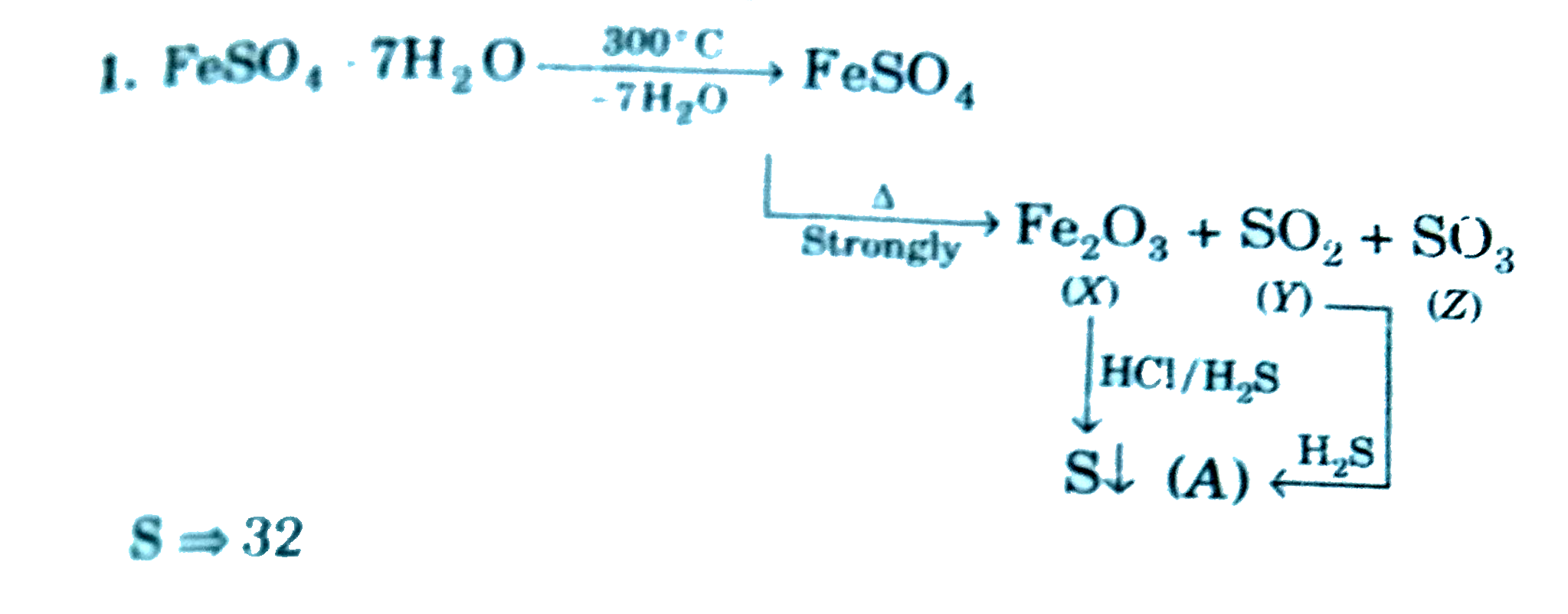
|
|
| 13. |
[Fe(H_(2)O_(3))_(5)NO]^(2+) is a complex formed during the brown ring test for NO_(3)(-) ion. In this complex, |
|
Answer» there are there unpaired ELECTRONS so that its MAGNETIC moment is 3.87 B.M. `Fe^(2+)e^(-)toFe^(+)`  `:.` Magnetic moment of `Fe^(+)=sqrt(n(n+2))BM` `=sqrt(3xx5)BM=3.87BM` All statements are correct. |
|
| 14. |
{:(FeCI_(3)"solution" +(NH_(4))_(2)S overset("Neutral medium")rarr,"Black ppt".(A)),(,""darrdil.H_(2)SO_(4)),(,"White ppt". (B) +Gas (C)):} while AICI_(3) solution +(NH_(4))_(2)S rarr White ppt.(D) White ppt. (B) and gas (C) are: |
|
Answer» S and `SO_(2)` |
|
| 15. |
{:(FeCI_(3)"solution" +(NH_(4))_(2)S overset("Neutral medium")rarr,"Black ppt".(A)),(,""darrdil.H_(2)SO_(4)),(,"White ppt". (B) +Gas (C)):} while AICI_(3) solution +(NH_(4))_(2)S rarr White ppt.(D) What is the formula of black ppt.(A)? |
|
Answer» `Fe_(2)S_(3)` |
|
| 16. |
{:(FeCI_(3)"solution" +(NH_(4))_(2)S overset("Neutral medium")rarr,"Black ppt".(A)),(,""darrdil.H_(2)SO_(4)),(,"White ppt". (B) +Gas (C)):} while AICI_(3) solution +(NH_(4))_(2)S rarr White ppt.(D) White ppt.(D) is : |
|
Answer» `AI_(2)S_(3)` |
|
| 17. |
Fe_((aq))^(+3)+SCN_((aq))^(-) harr [Fe(SCN)]_(aq)^(+2) is an example of |
|
Answer» HETEROGENEOUS equilibrium |
|
| 18. |
Fe^(3+) is reduced to Fe^(2+)by using |
|
Answer» `H_(2)O_(2)` in presence of NAOH |
|
| 19. |
Fe^(3+) has 3d^5 configuration |
|
Answer» |
|
| 20. |
Fe^(3+) can be used for coagulation of As_2S_3 sol. (R) Fe^(3+)reacts with As_2 s_3 to give Fe_2S_3. |
|
Answer» IF both (A) and (R) are correct and (r) is the correct explanation for (a). |
|
| 21. |
Fe_(2)(SO_(4))_(3)+NH_(3)+H_(2)O rarr Fe(OH)_(3)+(NH_(4))_(2)SO_(4).Give stoichiometric co-effcient of Fe(OH)_(3)and (NH_(4))_(2)SO_(4)respectively. |
|
Answer» 3, 2 |
|
| 22. |
Fe^(2) to Fe^(3+) +e^(-) is a __________reaction . |
|
Answer» REDOX |
|
| 24. |
Fe^(+3) ions in an aqueous solution gives deep red colouration with both sodium acetate (in excess) and ammonium thiocyanate(slightly acidic). The deep red colouration obtained with ammonium thiocyanate gets decolourised on addition of a solution containing F^(-) ions. What happens when deep red coloured solution of is diluted with water and then boiled? |
|
Answer» A deep red solution of ferric acetate is obtained `underset(("Red colouration"))([Fe_(3)(OH)_(2)(CH_(3)COO)_(6)]^(+))+4H_(2)O rarr underset(("Red ppt"))(3Fe(OH)_(2)CH_(3)COOdarr)+3CH_(3)COOH +H^(+)` |
|
| 25. |
Fe^(+3) ions in an aqueous solution gives deep red colouration with both sodium acetate (in excess) and ammonium thiocyanate(slightly acidic). The deep red colouration obtained with ammonium thiocyanate gets decolourised on addition of a solution containing F^(-) ions. Excess of sodium acetate is added in the reaction with Fe^(3+) ions because: |
|
Answer» it ACTS as a buffer to CONTROL pH of the reaction other wise reaction is made reversible `underset(("Red colouration"))([Fe_(3)(OH)_(2)(CH_(3)COO)_(6)]^(+))+4H_(2)O rarr underset(("Red ppt"))(3Fe(OH)_(2)CH_(3)COOdarr)+3CH_(3)COOH +H^(+)` |
|
| 26. |
Fe^(+3) ions in an aqueous solution gives deep red colouration with both sodium acetate (in excess) and ammonium thiocyanate(slightly acidic). The deep red colouration obtained with ammonium thiocyanate gets decolourised on addition of a solution containing F^(-) ions. Select the correct statement with respect to the compound formed as a result of the bleaching of deep red colouration of Fe(SCN)_(3) by a solution containing F^(-) ions. |
|
Answer» The net crysal field stabilisation energy is zero `underset(("Red colouration"))([Fe_(3)(OH)_(2)(CH_(3)COO)_(6)]^(+))+4H_(2)O rarr underset(("Red PPT"))(3Fe(OH)_(2)CH_(3)COOdarr)+3CH_(3)COOH +H^(+)` |
|
| 27. |
Fe^(+3) ions in an aqueous solution gives deep red colouration with both sodium acetate (in excess) and ammonium thiocyanate(slightly acidic). The deep red colouration obtained with ammonium thiocyanate gets decolourised on addition of a solution containing F^(-) ions. The deep red colouration is due to the formation of: |
|
Answer» `Fe(CH_(3)COO)_(2)` `underset(("Red COLOURATION"))([Fe_(3)(OH)_(2)(CH_(3)COO)_(6)]^(+))+4H_(2)O rarr underset(("Red ppt"))(3Fe(OH)_(2)CH_(3)COOdarr)+3CH_(3)COOH +H^(+)` |
|
| 28. |
Fe^(+3) ions in an aqueous solution gives deep red colouration with both sodium acetate (in excess) and ammonium thiocyanate(slightly acidic). The deep red colouration obtained with ammonium thiocyanate gets decolourised on addition of a solution containing F^(-) ions. Which one of the following statements is false with respect to deep red colouration produced with NH_(4)SCN? |
|
Answer» The DEEP red colour is bleached by `Hg(II)` ions. `underset(("Red colouration"))([Fe_(3)(OH)_(2)(CH_(3)COO)_(6)]^(+))+4H_(2)O rarr underset(("Red ppt"))(3Fe(OH)_(2)CH_(3)COOdarr)+3CH_(3)COOH +H^(+)` |
|
| 29. |
Fe^(+2) in acidic medium is convert Cr_(2)O_(7)^(-2) ion into Cr^(+3) ion by reduction Fe^(+3) is obtained balance these redox reaction with equation. |
|
Answer» Solution :Step-1 : Produce unbalanced equation for the reaction in ionic form : `Fe_((aq))^(+2)+Cr_(2)O_(7(aq))^(-2)toFe_((aq))^(+3)+Cr_((aq))^(+3)` Step-2 : Separate the equation into half reactions. Oxidation half : `Fe_((aq))^(+2)toFe_((aq))^(+3)` Reduction half : `Cr_(2)O_(7(aq))^(-2)toCr_((aq))^(+3)` Step-3 : Balance the atoms other than O and H in each half reaction individually. Here the oxidation half reaction is already balanced with respect to Fe atoms. For the reduction half reaction, we multiply the `CR^(3+)` by 2 to balance Cr atoms. `Cr_(2)O_(7(aq))^(-2)to2Cr_((aq))^(+3)` Step-4 : For reactions occurring in acidic medium, add `H_(2)O` to balance O atoms and `H^(+)` to balance H atoms. `Cr_(2)O_(7(aq))^(-2)+14H_((aq))^(+)to2Cr_((aq))^(+3)+7H_(2)O_((l))` Step-5 : Add electrons to one side of the half Oxidation half reaction to balance the CHARGES. If need be, make the NUMBER of electrons equal in the two half reactions by multiplying one or both half reactions by appropriate number. `OHR:Fe_((aq))^(+2)toFe_((aq))^(+3)+e^(-)` `RHR:Cr_(2)O_(7(aq))^(-2)+14H_((aq))^(+)+6^(-)to2Cr_((aq))^(+3)+7H_(2)O_((l))` To EQUALISE the number of electrons in both the half reaction, we add two WATER half reactions, we multiply the oxidation half reaction by 6 and write as : `6Fe_((aq))^(+2)to6Fe_((aq))^(+3)+6e^(-)` Step-6: We add the two half reactions to achieve the overall reaction and cancel the electrons on each side. `6Fe_((aq))^(+2)+Cr_(2)O_(7(aq))^(-2)+14H_((aq))^(+)to6Fe_((aq))^(+3)2Cr_((aq))^(+3)+7H_(2)O_((l))` |
|
| 30. |
Fatal dieses of respiratory system in children are caused due to NO_2 gas. |
| Answer» SOLUTION :TRUE STATEMENT | |
| 31. |
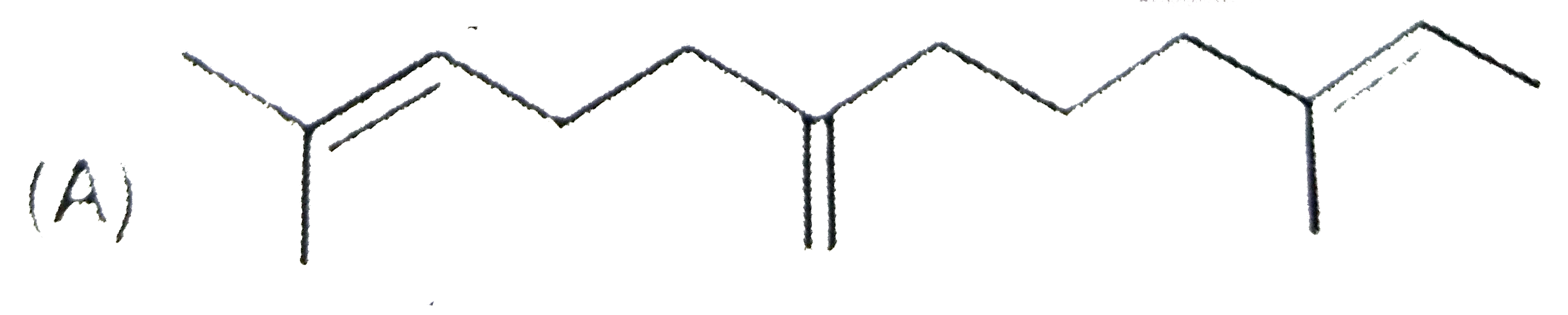
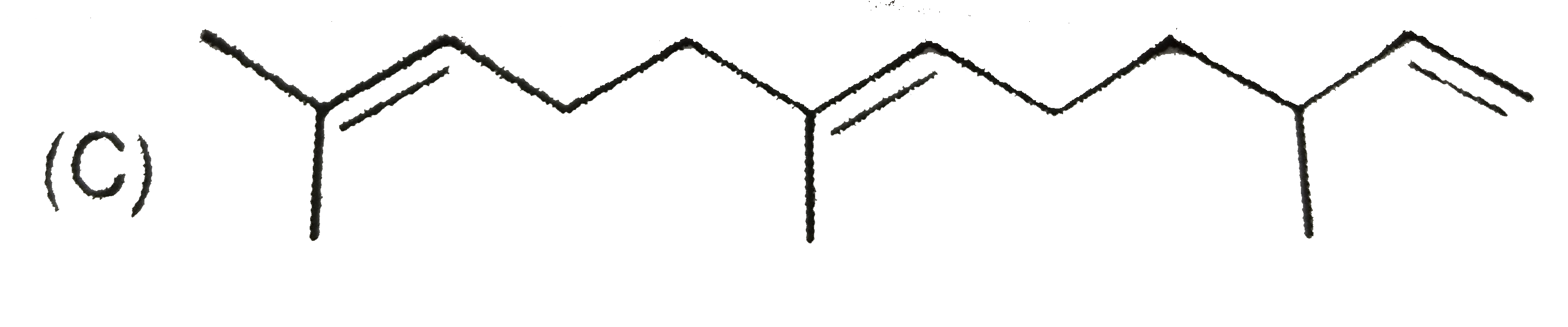
Farnesene is a compound found in the waxy coating of apples. On hydrogenation it gives 2,6,10-Trimethyl dodecane. On ozonolysis it givesone mole of 2-Methylpentanedial and one mole of 4-Oxopentanal. The structure proposed for Farnesene may be |
|
Answer»
 2-methylpentanedial +4-oxopentanal+formaldehyde+acetone 2-methylpentanedial +4-oxopentanal+formaldehyde+acetone
|
|
| 32. |
False statement regarding second law of thermodynamics is |
|
Answer» It is imposible to construct a mackine WORKING in cycles which transforms heat from a LOWER temperature region to higher temperature region without intervention of any ecternal agency. |
|
| 33. |
False among the following |
|
Answer» C forms MONOXIDE |
|
| 34. |
False statement among the following is: |
|
Answer» ANHYDROUS `AlCl_(3)` is covalent |
|
| 35. |
False statement about the de-Broglie.s wavelength of an electron in the Bohr.s orbit is |
|
Answer» equal to the circumference of the FIRST ORBIT |
|
| 36. |
Faecal matter polluting drinking water causes |
|
Answer» FLUOROSIS |
|
| 37. |
Face centered cubic lattice of NaCl may also smaller, tetragonal unit cell as shown below fig. (a,b) The number of formula units of NaCl present in smaller unit cell drawn in (b) are |
|
Answer» 1 Unit cell (b): the angle between the TWO edges on the front face (HEAVIER LINES) is `90^(@)` . This unit cell extends only `(l)/(2)` towards back, there fore the volume of unit cell `(l)/sqrt(2)xx(l)/sqrt(2)xx(l)/sqrt(2)=(l^(3))/(4)=(v)/(4)` |
|
| 38. |
Face centered cubic lattice of NaCl may also smaller, tetragonal unit cell as shown below fig. (a,b) The volume of the smaller unit cell in fig(a) , if the volume normal unit cell is V, is |
|
Answer» V Unit cell (b): the angle between the two edges on the front face (HEAVIER lines) is `90^(@)` . This unit cell extends only `(l)/(2)` towards back, there fore the VOLUME of unit cell `(l)/sqrt(2)XX(l)/sqrt(2)xx(l)/sqrt(2)=(l^(3))/(4)=(v)/(4)` |
|
| 39. |
Face centered cubic lattice of NaCl may also smaller, tetragonal unit cell as shown below fig. (a,b) The volume of the smaller unit cell in fig(b) . If the volume of the normal unit cell V, is |
|
Answer» Solution :C,Unit cell (a): the slating unit cell length is `(l)/sqrt(2)`, where l=length of fcc unit cell. Unit cell (b): the angle between the two edges on the front face (HEAVIER lines) is `90^(@)` . This unit cell extends only `(l)/(2)` towards back, there fore the VOLUME of unit cell `(l)/sqrt(2)xx(l)/sqrt(2)xx(l)/sqrt(2)=(l^(3))/(4)=(v)/(4)` |
|
| 40. |
Face centered cubic lattice of NaCl may also smaller, tetragonal unit cell as shown below fig. (a,b) The number of formula units of NaCl present in the smaller unit cell drawn in (a) are |
|
Answer» 1 Unit cell (b): the angle between the two edges on the front face (heavier lines) is `90^(@)` . This unit cell extends only `(l)/(2)` towards BACK, there fore the volume of unit cell `(l)/sqrt(2)xx(l)/sqrt(2)xx(l)/sqrt(2)=(l^(3))/(4)=(v)/(4)` |
|
| 41. |
F_2 is gas but I_2 is solid, because |
|
Answer» LARGER LONDON forces are PRESENT in `I_2` when compared to `F_2` |
|
| 42. |
F_2, is gas but I_2 is solid, because |
|
Answer» Larger LONDON forces are present in `I_2` when COMPARED with `F_2` |
|
| 43. |
Extraction of zinc blende is achieved by |
|
Answer» ELECTROLYTIC REDUCTION |
|
| 44. |
Extra pure N_(2) can be obtained by heating |
|
Answer» `BA(N_(3))_(2)` |
|
| 45. |
Extensive properties depend on the quantity of matter but intensive properties do not. Explain whether the following properties are extensive or intensive. Mass,internal energy , pressure , heat capacity , molar heat capacity , density, mole fraction, specific heat, temperature and molarity. |
|
Answer» Solution :Extensiveproperties . Mass , INTERNAL ENERGY , HEAT capacity. Intensive properties.Pressure, molar heatcapacity, density, mole fraction , specific heat, temperature and molarity. NOTE. Mole fraction or molarity of a solution is same whether we take a small amount of the soution or large amount of the solution . Otherwise too. ratio of two extensive properties is ALWAYS intensive, i.e., `("Extensive")/(Extensive")= ` Intensive e.g., Mole fraction `= ("Molarof the component") /( "Total no. of moles")=( "Extensive")/( "Extensive") ` and Molarity`= ( "Moles")/( "Volume") = ( "Extensive")/("Extensive")` |
|
| 46. |
Extensive property is a property whose value depends on the quantity of size of matter present in the system. Those properties which do not depend on the quantity of size of matter present are known as intensive properties. Find out the correct match |
|
Answer» INTERNAL energy `to` intensive PROPERTY |
|
| 47. |
Extensive properties depend on the quantity of matter but intensive properties do not. Explain whether the following properties are extensive or intensive. Mass, internal energy, pressure, heat capacity, molar heat capacity, density, mole fraction, specific heat, temperature and molarity. |
|
Answer» Solution :Extensive properties : Those properties whose value depends on the quantity or SIZE of matter present in the SYSTEM is known as extensive properties. e.g., mass, internal energy, heat capacity. Intensive properties : Those properties which do not depend on the quantity or size of matter present are known as intensive properties. e.g., pressure, molar heat capacity, density, mole fraction, specific heat, temperature and molarity. Mole fraction or molarity of a solution is same whether we take a small amount of the solution or large amount of the solution. Ratio of two extensive properties is always intensive. `("Extensive")/("Extensive") = "Intensive"` So, mole fraction and molarity are intensive properties. e.g., mole fraction `= ("MOLES of the COMPONENT")/("Total no. of moles") = ("Extensive")/( "Extensive")` and molarity `= ("mole")/( "VOLUME") = ("Extensive")/( "Extensive")` |
|
| 48. |
Expression for K_(p) " for the reaction " 3 Fe (s) + 4 H_(2)O (g) hArr Fe_(3) O_(4) + 4 H_(2) (g)" can be writtenas " K_(p) =…………. . |
|
Answer» <P> |
|
| 49. |
Express the results of the following calculations to the appropriate number of significant figures. (i) (3.24 xx 0.08666)/(5.006), (ii) 0.58 + 324.65 (iii) 943 xx 0.00345 + 101 |
|
Answer» Solution :(i) In this calculation, the least precise number, i.e., 3.24 has three significant figures. Therefore, the result should be reported UPTO three significant figures only. Hence, `(3.24 xx 0.08666)/(5.006) = 0.0560883 = 0.0561` (ii) In this calculation, both the numbers have two decimal PLACES. Hence, the result should be reported upto two decimal places only. Therefore, `0.58 + 324.65 = 325.23` Ans. (iii) In this calculation 943 and 101 are exact numbers. An exact number is SUPPOSED to have infinite number of significant figures. Therefore, the least precise number is 0.00345 which CONSISTS of three significant figures. Therefore, `943 xx 0.00345 + 101 = (3.25335) + 101 = 3.25 + 101 = 104.25` It is to be noted that the product of numbers 943 and 0.00345 comes out to be 3.25335. The result to be reported should contain three significant figures. Therefore, it should be written in the form 3.25. This number now contains two decimal places. Therefore, the result obtained after addition of 101 to it should ALSO have two decimal places. Therefore, the final answer is 104.25. |
|