

Saved Bookmarks
This section includes 7 InterviewSolutions, each offering curated multiple-choice questions to sharpen your Current Affairs knowledge and support exam preparation. Choose a topic below to get started.
| 1. |
How many electrons that can be accommodated in the subshells,p,d,f? |
Answer» SOLUTION :
|
|
| 2. |
How many electrons required to received by oxidising agent KMnO_(4) to converted into MnO_(4)^(-2),MnO_(2),Mn_(2)O_(3)andMn^(+2) ? |
|
Answer» 4, 3, 1, 5 `KMnO_(4)overset(+3E^(-))toMnO_(2)" "[Mn(+4)]` `KMnO_(4)overset(+4e^(-))to1/2Mn_(2)O_(3)" "[Mn(+3)]` `KMnO_(4)overset(+5e^(-))toMn^(+2)" "[Mn(+2)]` |
|
| 3. |
How many electrons maximum can have n + l = 4 in an atom. |
|
Answer» 8 |
|
| 4. |
How many electrons is an atom with atomic number 30 can have (n + l0 = 4) ? |
|
Answer» 5 |
|
| 5. |
How many electrons in sulphur (Z = 16) can have n + l = 3 ? |
|
Answer» Solution :Electronic CONFIGURATION of `._(16)S = 1s^(2) 2S^(2) 2p^(6) 3s^(2) 3p^(4)` For `1s^(2), N + l = 1 + 0 = 1`. For `2s^(2), n + l = 2 + 0 =2`. For `2p^(6), n + l = 2 + 1 = 3` For `3s^(2), n + l = 3 + 0 = 3` For `3p^(4), n + l = 3 + 1 = 4` Thus, `n + l = 3 " for " 2p^(6) and 3s^(2)` electrons, i.e., for 8 electrons |
|
| 6. |
How many electrons maximum can have n + 1 = 4 in an atom. |
|
Answer» 8 |
|
| 7. |
How many electrons in an atom with atomic number 50 can have (n + l) = 5 ? |
|
Answer» 10 
|
|
| 8. |
How many electrons in an atom with atomic number 105 can have (n+1)=8? |
|
Answer» 30 Electronic configuration of atom with atomic number 105 is` [RN]5f^(15)6D^(3)7s^(2)` 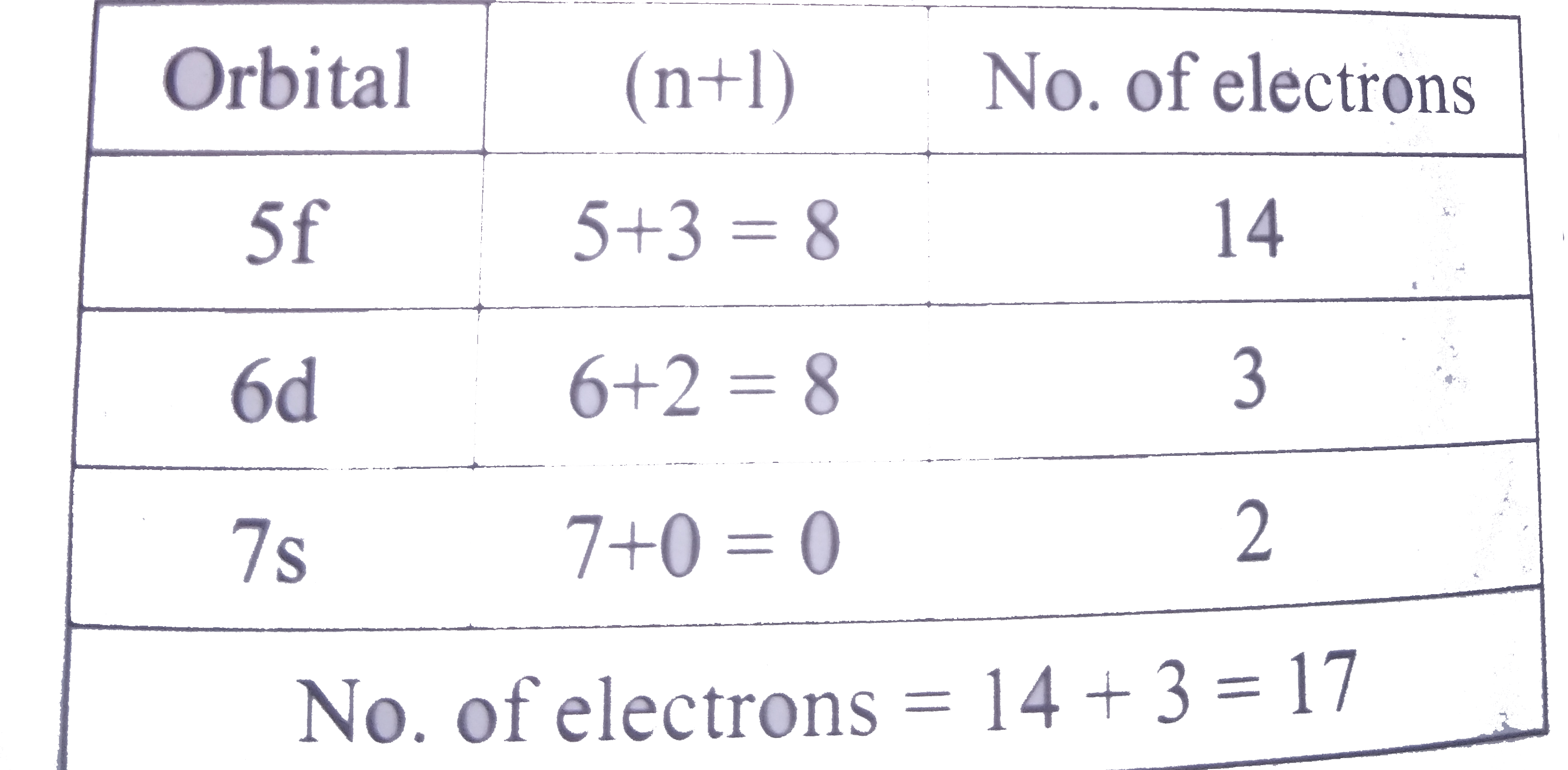
|
|
| 9. |
How many electrons in an atom with atomic number 105 can have (n+1)=8 ? |
|
Answer» 30 |
|
| 10. |
How many electrons in an atom with atomic number 105 can have (n + 1) = 8 ? |
|
Answer» 30 Electronic configuration of ATOM with atomic NUMBER 105 is `[RN] 5f^(14) 6d^3 7s^2` 
|
|
| 11. |
How many electrons in an atom may have the following quantum numbers? n=4,m_s=-1/2 |
| Answer» Solution :Total NUMBER of orbitals possible for 4 shell `=n^2=4^2=16` Each ORBITAL can contain one electron with `m_s=-1//2therefore` Number of ELECTRONS possible = 16 | |
| 12. |
How many electrons in an atom may have the following quantum numbers ? (a) n = 3, m_(s) = -1//2 (b) n = 4, l = 0 |
| Answer» SOLUTION :a) 9 ELECTRONS. B) 2 electrons.2 | |
| 13. |
How many electrons in an atom may have the following quantum numbers?N = 3, l = 0 |
| Answer» Solution :n = 3, L = 0 is3s orbital It can contain 2 electrons | |
| 14. |
How many electrons in an atom may have the folling quantum numbers?(a)n=4,m_s=-(1)/(2)(b)n=3,l=0 |
|
Answer» Solution :(a) For n=4 Total NUMBER of elctorns =`2n^(2)2xx16=32` Half out these will have`m_s=-(1)/(2)` `therefore`Total electrons with `m_s(-(1)/(2))=16` (b) For n=3 `l=0,m_l=0,m_s=+(1)/(2),-(1)/(2)("TWO "e^(-))` |
|
| 15. |
How many electrons in an atom have the following auantum numbers ? (i) n=4, m_(s)=-1/2 (ii) n=3, l=0. |
|
Answer» Solution :(i) TOTAL ELECTRONS in `n=4` are `2 n^(2)`, i.e., `2xx4^(2)=32`. Half of them, i.e., 16 electrons have `m_(s)=-1/2`. (II) `n=3, l=0` means 3s orbital which can have 2 electrons. |
|
| 16. |
How many electrons in atom can have n =4, =2, m=-2 and s = +(1)/(2) ? |
|
Answer» 1 |
|
| 17. |
How manyelectrons in 2porbitalhave spin quantumnumbers=(1)/(2) ? |
|
Answer» 6 |
|
| 18. |
How many electrons, electrical charge and hydrogen atom at left side balance half reduction reaction in following redox reaction respectively? Cr^(3+)+ClO_(3)^(-)toCr_(2)O_(7)^(2-)+ClO_(2)^(-) (Acidic) |
|
Answer» `6,+3,6` `3ClO_(3)^(-)+6H^(+)+6e^(-)to3ClO_(2)^(-)+3H_(2)O` |
|
| 19. |
How many electrons can have s+1//2in a d-sub-shell? |
| Answer» SOLUTION :d' SUB-shell has FIVE orientations. Each ORIENTATION can accommodate one electron with SPIN quantum number `+1//2` and another electron with `-1//2`. Hence number of electrons with `s+1//2` in 'd' sub shell is 5 | |
| 20. |
How many electrons can fit in the orbital for which n = 3 and Z = 1 ? |
|
Answer» 2 |
|
| 21. |
how many electrons can be accommodated in a sub-shell for which n=3, l=1 |
|
Answer» 8 |
|
| 22. |
How many electrons can fit in the orbital for which n = 3 and l = 1 ? |
|
Answer» 2 |
|
| 23. |
How many electrons can be accomdated in the shell l,m and n? |
Answer» SOLUTION :
|
|
| 24. |
How many electrons are transferred in the oxidation of nitrite by hydrogen peroxide? |
|
Answer» SOLUTION :The chemical equation is `NO_(2)^(-)+H_(2)O_(2) to NO_(3)^(-)+H_(2)O` The change in oxidation NUMBER of each reactant is 2 Number of electrons TRANSFERRED =2 |
|
| 25. |
How many electrons are transferred from reductant to oxidant is the following redox As_(2)S_(3) + HNO_3 rarr H_3ASO_(4) + H_2SO_4+NO |
|
Answer» 2 Reductant `overset(3+)(As_2)rarr2As^(5+)+4E^(-) S_3^(2-)rarr 3s^(6+)+24e^(-)` `(As_(2)S_3rarr2A_(s)^(5)+3s^(6+)+28)xx3` |
|
| 26. |
How many electrons are there in covalent oond ? |
| Answer» Solution :In each covalent bond TWO ELECTRONS are there each atom feature ONE `bar(E)` in bond. | |
| 28. |
How many electrons are required for the reduction of 1 mole of MnO_(4)^(-)" to "Mn^(2+) ? |
|
Answer» `3.011xx10^(24)`  `therefore` Reduction half reaction : `MnO_(4)^(-)+5bare+8H^(+)toMn^(2+)+4H_(2)O` Thus reduction of 1 mole of `MnO_(4)^(-)` requires 5 mole of electrons But 1 mole electron = `6.022xx10^(23)` electron `therefore5" mole electron"=(5xx6.022xx10^(23))/1` = `30.10xx10^(23)` = `3.011xx10^(24)` electrons |
|
| 29. |
How many electrons are present in the ion ._(26)^(56)Fe^(2+) ? |
| Answer» Solution :`._(26)FE` has 26 electrons. Hence, `Fe^(2+)` has `26 - 2 = 24` electrons. | |
| 30. |
How many electrons are present in all subshells (fully - filled) with n + l = 5 ? |
| Answer» SOLUTION :Subshells with `n + l = 5` are 5S, 4p, 3D. Hence, electrons present `= 2 + 6 + 10 = 18` | |
| 31. |
How manyelectrons are presentin n= 3 orbit ? |
| Answer» Solution :No OFELECTRONS`: 2N^(2)= 2(3) ^(2) =18` | |
| 32. |
How many electrons are involved during the oxidation reaction of KMnO_4 in acidic medium ? |
|
Answer» 1 |
|
| 33. |
How many electrons and protons are present in the balanced half equation? NO_(2)^(-)rarrNO |
|
Answer» SOLUTION :`overset(+3)(NO_(2)^(-)) to overset(+2)(NO)` `NO_(2)^(-)+2H^(+) to NO+H_(2)O` `NO_(2)^(-)+2H^(+)+E^(-) to NO+H_(2)O` NUMBER of ELECTRONS =1 Number of protons =2 |
|
| 34. |
Howmanyelectronin anatommay have thefollowingquantumnumber? (a ) n=4, m_(s )= - (1)/(2)( b) n=3, l =0 |
|
Answer» Solution :( a)n=-4` :. `Totalelectron`=2N^(2)` HALFOF the32- `m_(s ) `of 16electrons `=(1)/(2)` ( B)n=3 and l=0 3sorbital 3sorbitalhave only 2electrons Numberof electron=2heving n= 3and l=2 |
|
| 35. |
How many eclipsed and staggered ethanes is obtained if rotation of ethane of C-C of 0 to 360^(@) ? |
|
Answer» SOLUTION :THREE eclipsed and three STAGGERED ethane are obtained. From the initiation after rotation of `120^(@)` elipsed and after `240^(@)` two eclipsed conformaitons. From the initiation of staggered of C-C CARBON rotation after `120^(@)` and `240^(@)` ONE and two total three staggered conformations are obtained. |
|
| 36. |
How many different products (excluding stereoisomer) can be obtained by following reaction |
Answer» 
|
|
| 38. |
How many different isomeric alkynes on catalytic hydrogenation can give 2,3,4-trimethyl heptanes? |
Answer» 
|
|
| 39. |
How many different carboxylic acids are obtained when all the isomeric arenes having the molecular formula C_(8)H_(10) are oxidised with alkalise KMnO_(4) followed by acidification |
|
Answer» |
|
| 40. |
How many dichlorocyclohexane would be produced upon free radical chlorination of chlorocyclohexane? |
|
Answer» |
|
| 41. |
How many dichloro derivatives are possible for cyclopentane? |
|
Answer» |
|
| 42. |
Howmanydelocalisedpielectronsare present inbenzenemolecule ? |
Answer» Solution :Kekule.s STRUCTURE of `C_(6)H_(6)` is  THREE pi bonds are delocalised. HENCE number of delocalised ELECTRON in 6. |
|
| 43. |
How many dibromo dervatives are possible for n-butane? |
|
Answer» |
|
| 44. |
How many Debye is one coul-m? |
|
Answer» SOLUTION :Dipolemoment `mu=deltaxxl` Assuming L as `1A^(@),4.8D=1.6 xx10^(-29)` coul-m `=3XX10^(29)D`. |
|
| 45. |
How many structural cyclic isomers of C_(5)H_(10) are possible? |
Answer» SOLUTION :
|
|
| 46. |
How many cyclic and acyclic isomers (including tautomers) can be made by the formula C_(3)H_(6)O ? |
|
Answer» 4 |
|
| 47. |
No. of possible cyclic isomers (including with stereo isomer) for the molecular formulae C_(5)H_(10) |
Answer» 
|
|
| 48. |
How many cyclic and acyclic isomers are possible for the molecular formula C_(3)H_(6)O? |
|
Answer» 4 |
|
| 49. |
How many structural isomers are possible for the molecular formula C_(4)H_(8) which can undergo ozonolysis? |
|
Answer» 4 |
|