

Saved Bookmarks
This section includes 7 InterviewSolutions, each offering curated multiple-choice questions to sharpen your Current Affairs knowledge and support exam preparation. Choose a topic below to get started.
| 1. |
How many of the following oxides would liberate H_(2)O_(2) on treatment with dil. H_(2)SO_(4)? ltbr?PbO_(2),Na_(2)O_(2),MnO_(2),BaO_(2),TiO_(2),CO_(2),NO_(2),SnO_(2),Ag_(2)O. |
|
Answer» |
|
| 2. |
How many of the following oxides are acidic. PbO,SnO,CO,CO_(2),SiO_(2),PbO_(2),SnO_(2),GeO |
|
Answer» |
|
| 3. |
How many of the following on reductive ozonolysis will give only glyoxal ? 1,3-butadiene, ethylene, acetylene, o-xylene, m-xylene, p-xylene, benzene, cyclobutadiene, cyclooctateraene |
|
Answer» |
|
| 4. |
How many of the following molecule can give red precipitate when treated with ammnonical cuprouschloride. Propyne, Butyne-1, Butyne-2, Acetylene, pentyne-1, Pentyne-2 and Phenyl acetylene. |
|
Answer» |
|
| 5. |
How many of the following metals when heated in an atmosphere of N_(2)gas form nitrides ? Li , Na , K , Rb , Cs , Mg , Ca ,Sr , Ba |
|
Answer» |
|
| 6. |
How many of the following metals dissolve in boiling alkali to produce H_(2) gas ? Cu,Ni,Zn, Be,Ag,Fe,Mn,Sn,Al |
|
Answer» |
|
| 7. |
How many of the following metals can from peroxides Be, Mg, Ca, Sr, Ba |
|
Answer» |
|
| 8. |
How many of the following may produce salicylic acid on hydrolysis under appropriate conditions? |
|
Answer» |
|
| 9. |
How many of the following is reactive towards towards grigannard reagent ? |
|
Answer» |
|
| 10. |
How many of the following is correct statement(s) regarding 1,2-butadiene (I) and 1,3-butadiene is/are a) I has perpendicular pi planes while II has parallel pi planes b) Both gives the same products on adding 1.0 equivalent of HBr at -80^(@) . c) I gives 2,2-dibromobutane while II gives 2,3-dibromobutane, when reacted exces of HBr at very low temperature d) Both have same length of C=C double bonds |
|
Answer» |
|
| 11. |
How many of the following in drinking water below 30 ppm do not cause any effect on the body as per international standards of water? Pb^(2+),Hg^(2+),Mn^(2+),Cd^(2+),Cl^(-),NO_(3)^(-),SO_(4)^(2),Ca^(2+),Mg^(2+) |
|
Answer» 5 |
|
| 12. |
How many of the following in dinking water below 30 ppm do not cause any effect on the body as per international standards of water? Pb^(2+), Hg^(2+), Mn^(2+), Cd^(2+), Cl^(-), NO_(3)^(-), SO_(4)^(2), Ca^(2+), Mg^(2+) |
|
Answer» 5 |
|
| 13. |
How many of the following hydroxides is/are amphoteric in character? CsOH , LiOH , Ca(OH)_(2) , Be(OH)_(2) , Mg(OH)_(2) , Ba(OH)_(2) , Sr(OH)_(2) , Ba(OH)_(2) , KOH , NaOH. |
|
Answer» |
|
| 15. |
How many of the following groups cannot participate in resonance with other suitable group : {:("a) "-COOH, "b) "-COO^(rho), "c) "-COCl, "d) "overset(oplus)(-NH_(3))), ("e) "-overset(oplus)(C)H_(2),"f) "-overset(*)(C)H_(2), "g) "overset(overset(CH_(2)=overset(oplus)(N-))(|))(CH_(3)),""):} |
|
Answer» |
|
| 16. |
How many of the following gives green ppt.? (a) CrCI_(3)+NaOH rarr (b) CrCI_(3)+"excess" NaOH rarr (c) NiCI_(2)+"excess" NaOH rarr (d) NiCI_(2)+"excess" NH_(4)OH rarr (e) Hg_(2)^(2+) +KI rarr |
|
Answer» |
|
| 17. |
How many of the following gases are characterized by BOTH colour and a distinctive odour? CI_(2),CH_(4),NO_(2) |
|
Answer» |
|
| 18. |
How many of the following gaseous mixtures do not obey Dalton's law of partical pressures : H_2 + Cl_2 , NH_3 + HBr, N_2 + O_2, CO + Cl_2, NO + O_2, N_2 + Cl_2, Xe + O_2 |
|
Answer» `CO + Cl_2 to COCl_2, NO + O_2 to NO_2` |
|
| 19. |
How many of the following compounds will produce visible change when treated with I_(2)//NaOH |
|
Answer» |
|
| 21. |
How many of the following compounds react with NaHCO_(3) and liberate CO_(2)(g) 1. Salicylic acid2. Pthalic acid3. Picric acid4.Resorcinol 5. Carbolic acid6.Aspirin7.Anisol8.Tarteric acid |
|
Answer» |
|
| 23. |
How many of the following compounds give CO_(2) on reaction with NaHCO_(3) |
|
Answer» |
|
| 25. |
How many of the following compounds cleave diborane symmetrically? CH_(3)NH_(2), (CH_(3))_(2)NH, (CH_(3))_(3) N, CO(CH_(3))_(2)O, NH_(3) |
|
Answer» |
|
| 26. |
How many of the following compounds are aromatic ? |
Answer» 
|
|
| 28. |
How many of the following compound have less pKa then benzoic acid : |
|
Answer» |
|
| 29. |
How many of the following carbanions are more stable than mythyl carbanion? CH_(3)-bar(C)H_(2), Ph-bar(C)H-Ph, Ph-underset(underset(Ph)(|))(bar(C))-Ph, Ph-bar(C)H_(2), CH_(3)-bar(C)H-CH_(3), CH_(3)-underset(underset(CH_(3))(|))(bar(C))-CH_(3) |
|
Answer» |
|
| 31. |
How many of the following cannot show tautomerism ? acetophenone, acetaldehyde, cyclohexanone, acetylacetone, benzoquinone, acetone , benzaldehyde, butanone, ethyl acetoacetate. |
|
Answer» |
|
| 32. |
How many of the following can show both tautomerism, Hyper conjugation , & Aldol condensation |
|
Answer» |
|
| 33. |
How many of the following can produce hydrogen gas, when react with water Na,Cl_(2),CaF_(2),Mg_(3),N_(3),CaH_(2),CaC_(2) |
|
Answer» `2Cl_2 + 2H_2O to 2HCl + O_2` `Ca + 2H_2O to Ca(OH)_2 + H_2` `2F_2+ 2H_2O to 4HF + O_2` `Mg_3 N_2+ 6H_2O to 3Mg (OH)_2 + 2NH_3` `CaH_2 +2H_2O to Ca(OH)_2 + 2H_2` `CaC_2+2H_2O to Ca(OH)_2 + C_2H_2` |
|
| 34. |
How many of the following can act as negative healist for in the decomposion of H_(2)O_(2) urca, metals. sunlight, dust particles, glass, alkali, phosporic acid, acetanilide, sodium stannate, sandis Urea, Alkali. Phosporic acid, Acetanilide, Sodium stannate. |
|
Answer» |
|
| 35. |
How many of the following are tranquillizers ? Valium, seconal, diphenhydramine, primaquin, luminal, veronal, ranitidine, barbituric acid, mifepristone, equanil. |
|
Answer» |
|
| 36. |
How many of the following are the lyophilic sols? Gold sol, Silver sol, geltin,, starch,gum, Fe(OH)_(3),As_(2)S_(3) |
|
Answer» |
|
| 37. |
How many of the following are resolvable ? |
Answer» 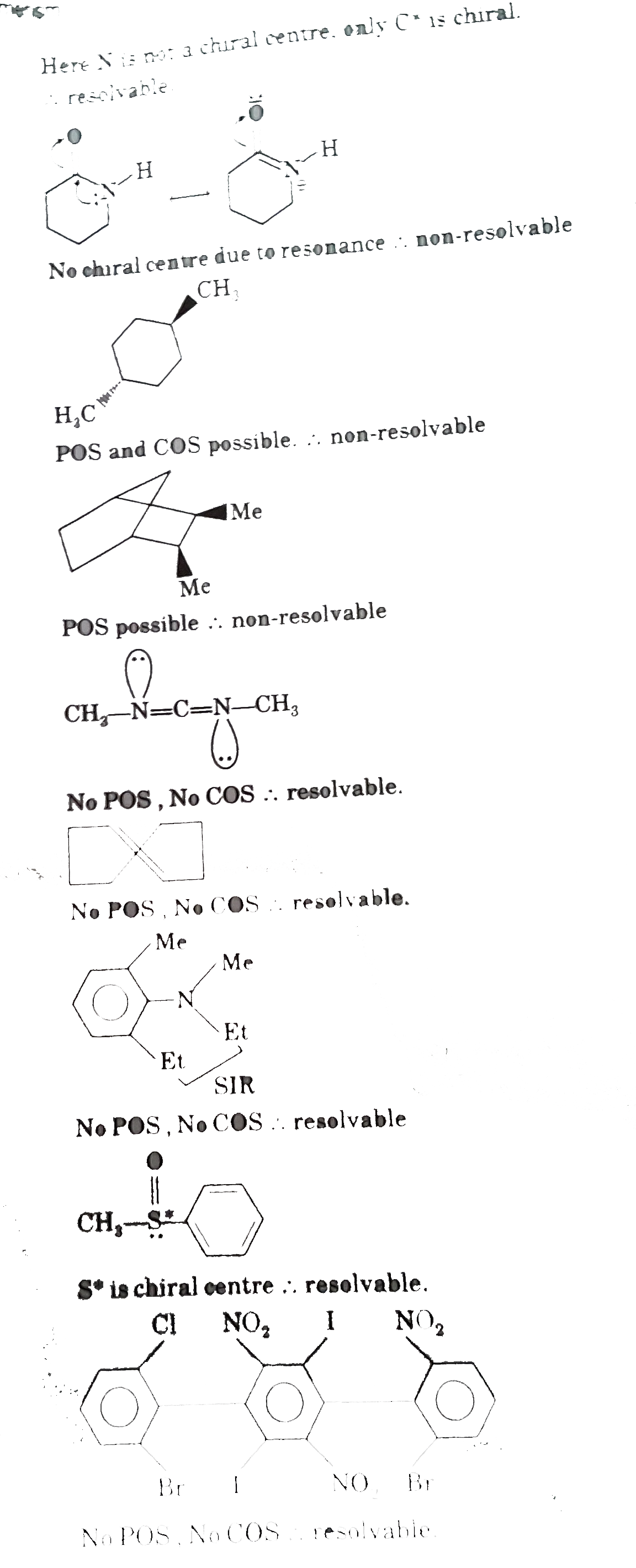 
|
|
| 38. |
How many of the following are non - metals B, Al, Ga, In, Tl, C, Si, Ge, Sn, Pb. |
|
Answer» |
|
| 40. |
How many of the following are macro molecular colloids? Proteins, starch, cellulose, gold sol, sulphur sol, sodium stearate. |
|
Answer» |
|
| 41. |
How many of the following are meta orienting ? -underset(O)underset(||)C-OCH_3, -underset(O)underset(||)C-OH, -underset(CH_3)underset(|)overset(CH_3)overset(|)C-CH_3, -N = O, -NO_2 |
|
Answer» |
|
| 42. |
How many of the following are Lewisacids ?[C Cl_4 , Si F_4 , BF_4^(-), NH_4^(+), overset(* * )(C Cl_2 ) , Mg^(+2), O, HCHO] |
|
Answer» |
|
| 43. |
How many of the following are Covalent network solids ? S_(8), Bronze, SiO_(2), Diamond, ZnSO_(4), Si, AlN, SiC, CO_(2) |
|
Answer» |
|
| 44. |
How many of the following are antihistamine drugs ? Salvarsen, streptomycin, promethazine, iproniazid, terfenadine, diclofenac sodium, bromopheniramine, lansoprazole, diphenyl hydramine. |
|
Answer» |
|
| 45. |
How many of the following are anomalous properties of lithium ? (i) Hydrated lithium ion is the largest among alkali metals . (ii) The melting and boiling points of lithium are comparatively high . (iii) Lithium directly reacts with atmospheric nitrogen on heating . (iv) Lithium chloride is the only hydrated salt , among all alkali chlorides . (v) Lithium salts shows crimson red colour in flame test . (vi) Lithium is softer than that of other alkali metals . (vii) Lithium reacts directly with carbon to form an ionic carbide . |
|
Answer» |
|
| 46. |
How many of the following are aromatic in nature. |
|
Answer» |
|
| 47. |
How many of the following are aerosols of liquid of gas ? Fog, clutch mist, insecticide sprays, smoke, dust. |
|
Answer» |
|
| 48. |
Howmany of the following alkynes on treatment with dilute H_2SO_4 in presence of Hg SO_4 give a methyl ketone ? HC -= CH, CH_3C -= CH, CH_3CH_2 C -= CH, CH_3C -= C CH_3 , C_6H_5C -= CH, C_6H_5C -= C CH_3. CH_3CH_2C -= C CH_2CH_3, CH_3CH_2CH_2C -= CH, C_6H_5CH(OH)C-=CH |
|
Answer» `C_6H_5 CH (OH)C -=CH` gives `C_6H_5CH = CH - CHO and C_6H_5C-= C CH_3` gives `C_6H_5COCH_2CH_3 ` |
|
| 49. |
How many of the following alkali metals are kept on kesosene oil Li, Na, K, Rb, Cs. |
|
Answer» |
|
| 50. |
How many of the followign are coloured or paramagnetic or coloured and paramagnetic both. NO_(2),Cu^(+1),O_(2),O_(3),Hg_(2)^(+2),Cd^(+2), Al,C("graphite"),Sc^(+3) |
|
Answer» `Cu^(+1)`Colourless `.^(**)O_(2)`Paramagnetic `O_(3)`Diagmagnetic `Hg_(2)^(+2)`Colourless `CD^(+2)`Coloureless `.^(**)Al`Paramagnetic `.^(**)C("GRAPHITE")`Paramagnetic `SC^(+3)`Colourless or diamagnetic |
|


