

Saved Bookmarks
This section includes 7 InterviewSolutions, each offering curated multiple-choice questions to sharpen your Current Affairs knowledge and support exam preparation. Choose a topic below to get started.
| 1. |
How many radial nodes for2_(s),4_(p), 5_(d) and 4f orbitals exhibit? How many angular nodes? |
Answer» SOLUTION :
|
|
| 2. |
How many radial nodes for 2s,4p,5d and4f orbitals exbitals ? How many angulars nodes ? |
|
Answer» SOLUTION :Formula for total number of NODES =n-1ltbrltgtFor 2s orbitals:Number of radial nodes=1. For 4p orbitals: Number of radial nodes=n-l-1. =4-1-1 =2 Number of angular nodes=l :.Number of radial nodes =n-l-1 =5-2-1 =2 radial nodes. Number of angular nodes=l =2 :.5d orbital have 2 radial nodes and 2 angular nodes. For 4F orbitals:Total number of nodes =n-1 =4-3-1 =0 node. Number of angular nodes=l =3 nodes ,gt4 f orbitals have 0 radial node and 3 angular nodes. |
|
| 3. |
How many radial and angular nodes are present in 2p orbital. |
|
Answer» |
|
| 4. |
How many protons and neutrons are there in one atom of ""_(6)^(13)C |
|
Answer» SOLUTION :Atomic number (Z) = 6 MASS number (A) = 13 Number of protons (Z) = 6 Number of neutrons `= A-Z = 13 - 6 = 7` |
|
| 5. |
How many properties of gases increases with increasing the temperature, Viscosity, mean free path, collision frequency, rate of diffusion, R.M.S velocity, density at constant pressure, molar volume at constant pressure, molar concentration at constant pressure, vander Waals parameter a. |
|
Answer» |
|
| 6. |
How many protons are present in 4 g NaOH ? |
|
Answer» `6.022xx10^(23)` `= 40 g*MOL^(-1)` (ii) Mole `= ("weight")/("molecular weight")` `= (4.0)/(40.0) = 0.1` mole NaOH (iii) NaOH =`(""_(11)Na + ""_(8)O +""_(1)H)`  TOTAL no. of proton `=20` in each molecule of NaOH (iv) Thus one mole of NaOH have `20 xx 6.022 xx 10^(23)` total protons. `:.0.1`one mole of NaOH have (?) protons `=0.1xx20xx6.022xx10^(23)` `= 12.044 xx10^(23)` protons |
|
| 7. |
How many products will be formed when methylene cyclohexane reacts with NBS? |
|
Answer» |
|
| 8. |
How many products (structural isomers only ) are formed by monochlorination of given compound. |
|
Answer» 4 |
|
| 9. |
How many products are possible theoretically in the reaction of cis-2-pentene with Cl_2 in H_2O |
Answer» 
|
|
| 10. |
How many products are formed on mono bromination of 1-methyl cyclohexene with NBS ?(Including stereo isomers) |
Answer» 
|
|
| 11. |
How many product will be formed in above reaction . |
|
Answer» |
|
| 13. |
How many products are expected from 1,2- or 1,4-addition of HBr to 1,3-pentadiene? |
|
Answer» 2 |
|
| 14. |
How many primary, secondary, tertiary and quaternary carbon atoms are present in the following compound? CH_(3)-underset(CH_(3))underset(|)(C)H-CH_(2)-underset(CH_(3))underset(|)overset(CH_(3))overset(|)(C)-CH_(3) |
|
Answer» ONE primary, two SECONDARY and one tertiary |
|
| 15. |
How many plance of symmetry (Z) present in the following compound? |
|
Answer» |
|
| 16. |
How many planes of symmetry (Z) present in carbon tetachloride? |
|
Answer» |
|
| 17. |
How many peroxy linkages are present in CrO_(5) ? |
|
Answer» 1 |
|
| 18. |
How many peaks and radial nodes are present in the radial probability curve of 3s-orbital ? |
|
Answer» SOLUTION :3s orbital CURVE has 3 peaks. Number of RADIAL NODES `= n-1 -1 = 2` |
|
| 19. |
How many para substituted benzenoid isomers of C_(8)H_(8)O_(2) gives 1,4-dihydroxy benzene on hydrolysis ? |
Answer» 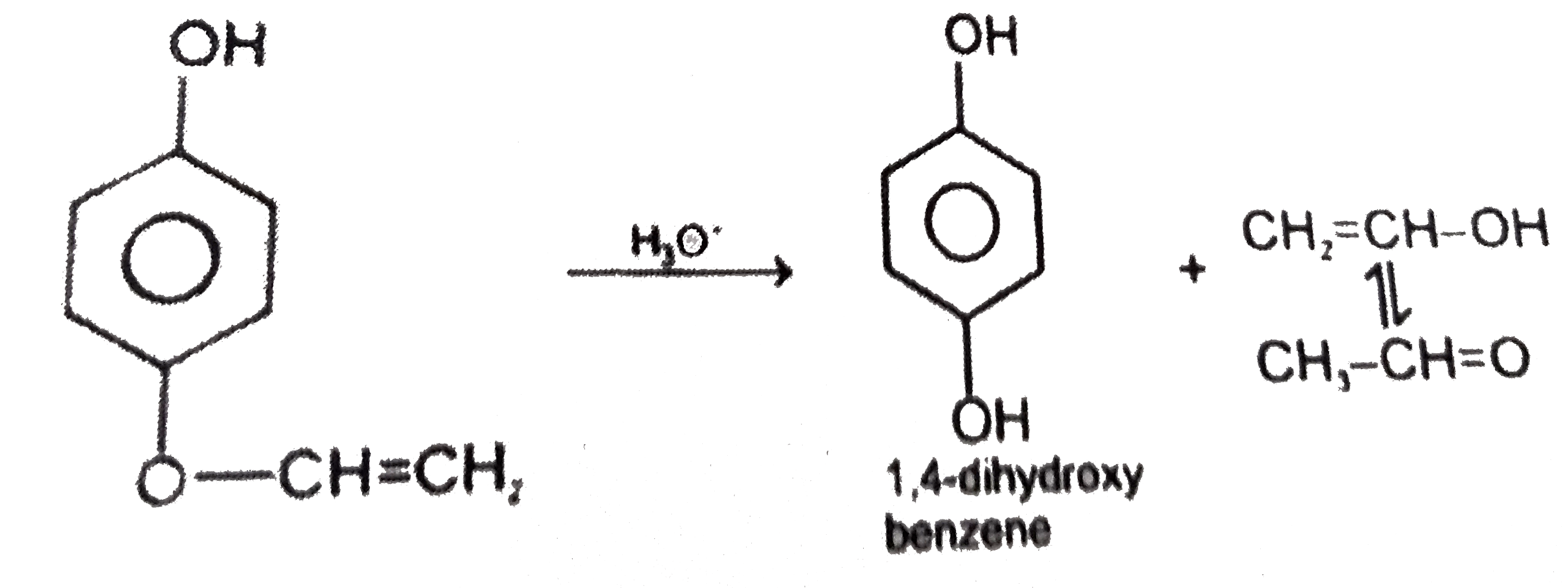
|
|
| 20. |
How many pairs of electrons are involved in bond formation in case ofnitrogen molecule. |
| Answer» SOLUTION :THREE PAIRS. | |
| 21. |
How many out of the following is/are intermediate(s) in the bromination reaction of toluene |
Answer» 
|
|
| 24. |
How manyorbitalsuptonn=4 ? |
|
Answer» Solution :`n=1 ,n^(2) =1 ` Orbital `n=2 , n^(2)=4`Orbital `n=3 ,n^(2) = 9`Orbital `n=4 ,n^(2) = 16` Orbital total30Orbital |
|
| 25. |
How many orbitals are present in the subshells with (a) n = 3, l = 2 (b) n = 4, l = 2 (c) n = 5, l = 2? |
|
Answer» |
|
| 26. |
How many orbitals are possible in the 4^(th) energy level?(n=4) |
|
Answer» Solution :n=4 NUMBER of orbitals in `4^(th)` energy level=l When n=4,l=0,1,2,3 if l=0orbital=4s=1 if l=1orbital=`4p_x,4p_y,4p_z`=3 If l=2orbital=`4d_(xy),4d_(YZ),4d_(zx)4d_(X^(2)-y^(2)),4d_(z^(2))=5` If l =2 orbital=`-3,-2,-1,0,+1,+2,+3=7` NUmber of orbitals in`4^(th)` energy level =16 |
|
| 27. |
How many orbitals are possible in the 3rd energy level ? |
|
Answer» SOLUTION :n=3,main SHELL is m Total NUMBER of orbitals in 3RD energy level=? 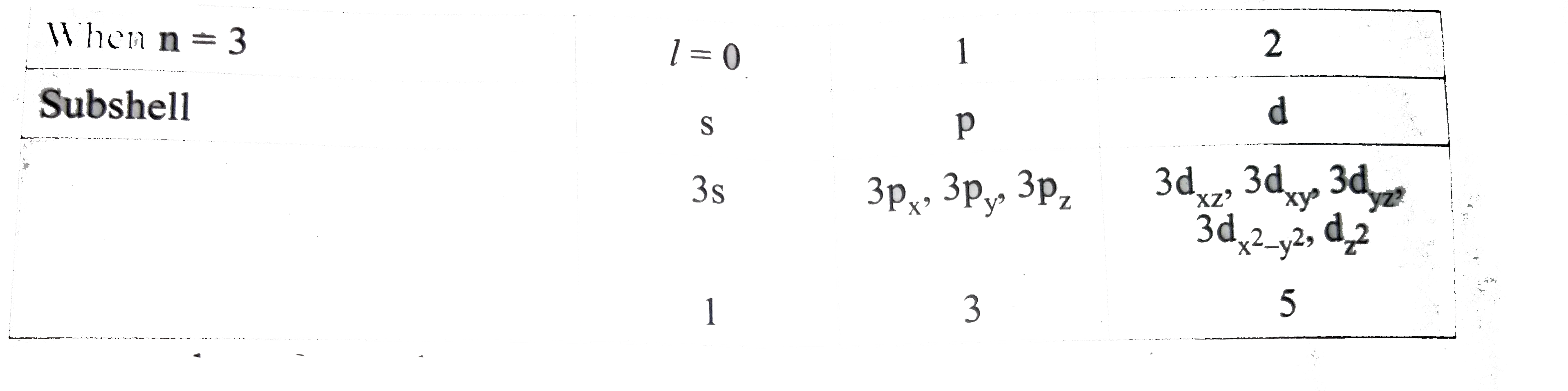
|
|
| 28. |
Howmanyorbitalsare thereif n= 3, l =2, m_(l) =+ 2? |
|
Answer» 1 |
|
| 29. |
How many optically stereoisomers are possible for butene-2,3-diol ? |
|
Answer» 1 `underset("Butane-2,3-diol")(CH_(3)-overset(OH)overset(|**)(CH)-overset(OH)overset(|**)(CH)-CH_(3))` Optically active stereoisomers are I and III `{:(""CH_(3) ""CH_(3)""CH_(3)),("|""|""|"),(" "OH-C-H""H-C-OH""H-C-OH), ("|""|""|"),(""H-C-OH""OH-C-H""H-C-OH),("|""|""|"),(""CH_(3)""CH_(3)""CH_(3) ),("(I)(II)(III)"):}` III is MESO form and is not optically active. |
|
| 30. |
How many orbitals are possible for n=4? |
|
Answer» Solution :If `n = 4`, the POSSIBLE NUMBER of orbitals are calculated as FOLLOWS. n = 4 main `""` main shell = N If `n = 4 "" `L values are 0,1, 2, 3 If `l = 0 ""` 4s orbital = 1 orbital If `l = 1 ""` 4s orbtial = 1 orbital If `l = 0 ""` 4s orbital = 1 orbital If `l = 0 "" m = -1, 0 , +1 = 3` orbitals. If `l = 2 "" m = -2, -1, 0, +1, + 2 = 5"` orbitals. If `l = 3"" m = -3, -2, -1, 0, +1, +2, +3 = 7` orbitals `:.` Total number of orbitals = 16 orbitals. |
|
| 31. |
How manyorbital a are therein sushell ? |
|
Answer» SOLUTION :No . Ofsubshell = (2L + 1) TOTALVALUE o = `m_(1)` wherel = subshellor angularquantumnumber . |
|
| 32. |
How many optically active stereoisomers are possible for butane-2, 3-diol ? |
|
Answer» 1 
|
|
| 33. |
How many of the substrates would produce H_(2)S when subjected to hydrolysis? Cr_(2)S_(3),AI_(2)S_(3),BaS,P_(4)S_(10),PSCI_(3),Na_(2)S |
|
Answer» |
|
| 34. |
How many of the following will turn moist red litmus blue and finally white ? Li_(2)O, KO_(3), RbO_(2), Cs_(2)O_(2), BeO, MgO, BaO_(2), SrO |
|
Answer» |
|
| 35. |
How many of the following substituents can cause aromatic electrophilic substitution faster than benzene ? (a)-NH_2 , (b)-NR_2 , ( C)-NO_2 , (d)-overset(+)NH_3 (e)-O-oversetoverset(O)(||)C-R , (f) -NH-oversetoverset(O)(||)C-R , (g)-oversetoverset(O)(||)C-Cl , (h)-oversetoverset(O)(||)C-H (i)-SO_3H , (j)-CH_3, (k)-CH-CR_2 |
|
Answer» |
|
| 36. |
How many of the following statements is (are) true about resonance. a) Resonance is an intramolecular process. b) Resonance involves delocalization both of s and p electrons. c) Resonance involves delocalization of pi electrons only. d) Resonance decreases potential energy of a molecule. e) Resonance has no effect on the potential energy of a molecule. f) Resonance is the only way to increase molecular stability. g) Resonance is not the only way to increase molecular stability. h) Any resonating molecule is always more stable than any nonresonating molecule. i) The canonical struture explains all features of a molecule. j) The resonance hybrid explains all features of a molecule. k) Resonating structures are real and resonance hybrid is imaginary. l) Resonance hybrid is real and resonating structures are imaginary. m) Resonance hybrid is always more stable than all canonical structures. |
|
Answer» |
|
| 37. |
How many of the following statements are correct for green vitriol? 1. it can be used for the preparation of Mohr's salt. ltbr 2. It is a hydrated salt and its anhydrous form is white in colour. 3. The decomposition reaction of its anhydrous form is redox in nature. 4. It is used for making fenton's reagent used as a catalyst in organic chemistry. 5. It can be used for the preparation of Potassium ferrocynide. 6. It has same number of molcules of water of crystallization as white vitriol or blue vitriol 7. It turns brownish-yellow on exposure to atmosphere. 8. Its aqueous solution is acidic in natrue due to hydrolysis. 9. Out of the decomposition products of its anhydrous form, only one can turn acidified K_(2)Cr_(2)O_(7) solution green. |
|
Answer» 2. Green vitriol is `FeSO_(4).7H_(2)O&` its anhydrous form `(FeSO_(4))` is white. 3. `overset(+2)(2FE)overset(+6)(SO_(4))overset(Delta)tooverset(+3)(Fe_(2))O_(3)+overset(+4)(SO_(4))+SO_(3)(REDOX)` 4. Fact (Fenton's reagent `=FeSO_(4)+H_(2)O_(2)`) 5. `UNDERSET(aq)(FeSO_(4))+underset(aq)(6KCN)toK_(4)[Fe(CN)_(6)]` 6. White vitriol is `ZnSO_(4).7H_(2)O&` blue vitriol is `CuSO_(4).5H_(2)O` 7. Due to its oxidation to `Fe^(3+)` 8. `Fe^(2+) +2H_(2)OhArrFe(OH)_(2)darr+2H^(+)` (acidic solution) 9. Only `SO_(2)` can TURN acidified `K_(2)Cr_(2)O_(7)` solution green. |
|
| 38. |
How many of the following statements are correct? 1) The most stable conformer of cis-1,3-cyclohexanediol is chair form. 2) Cis-1,3-cyclohexanediol is more stable than trans -1.3-cyclohexanediol. 3) iN Cis 1,3-cyclohexanediol both the OH groups occupy equitorial positions. 4)The most stable conformerf of trans -1,4-cyclohexanediol is chair form. 5) The most stable conformer of Cis-1,4-cyclohexanediol is boat conformer. |
|
Answer» |
|
| 39. |
How many of the following statements are correct? 1) The most stable conformer of cis-1, 3-cyclohexanediol is chair form. 2) Cis- 1, 3- cyclohexanediol is more stable than trans -1, 3-cyclohexanediol. 3) In Cis 1, 3-cyclohexanediol both the OH groups occupy equitorial positions. 4) The most stable conformer of trans -1, 4-cyclohexanediol is chair form. 5) The most stable conformer of cis-1, 4-cyclohexanediol is boat conformer. |
Answer» 
|
|
| 40. |
How many of the following species are more stable than (CH_(3))_(3)overset(*)(C) |
Answer» 
|
|
| 41. |
How many of the following species are aromatic in nature ? Cyclopentadienyl cation, cyclopentadienyl anion, tropylium cation , azulene, cyclopropenyl cation, tetrahydrofuran , cyclooctatetraene, furan , cycloheptatriene. |
|
Answer» |
|
| 42. |
How many of the following show borax bead test B, Be, Mg, Cu, Fe, Cr, Co, Mn, Ni |
|
Answer» |
|
| 43. |
How many of the following s-block elements do not give characteristic colours in the flame test ? Li, Be, Ca , Ba , Sr , Mg , Na , K , Cs |
|
Answer» |
|
| 44. |
How many of the following reagents on reacting with Acetylene. (I) Na , (II) ammoniacal AgNO_3, (III) HCI , (IV) NaOH |
|
Answer» `CH-= underset("(Ammonical)")(CH + AgNO_3)to underset ("White ppt.")(CH -= C^(-) Ag^(+))` `CH -= CH + NaOH to CH_3 = CH - CL` Usually occurs in the presence of `Hg^(2+)` `CH = CH + NaOH to `no reaction . Because of hard acid, hard based and SOFT acid , soft base (HASB) thepry. But is REACTS wiht `NaNH_2`. `CH -= CH + NaNH_2 to CH -= C^(-) Na^(+)` Feasible |
|
| 45. |
How many of the following reagents can be used to distinguish between SO_(2) and CO_(2)? Ca(OH)_(2), (strach +KIO_(3)),(K_(2)Cr_(2)O_(7)+H_(2)SO_(4)),(KMnO_(4)+H_(2)SO_(4)),Ba(OH)_(2),FeCI_(3),Zn[Fe(CN)_(5)(NO)] |
|
Answer» |
|
| 46. |
How many of the following reagents can give benzene from benzene diazonium salt? H_2O, CH_3CH_2OH, H_3PO_4 , H_3PO_2 , HCHO , CH_3COOH, RCHO |
|
Answer» |
|
| 47. |
How many of the following reactions are homogenous reversible reactions? (1) CH_(3)COOH(l)+C_(2)H_(5)OH(l)hArrCH_(3)COOC_(2)H_(5)(l)+H_(2)O(l) (2) C(s)+CO_(2)(g)hArrCO(g)+H_(2)O(g) (3) H_(2)(g)+CO_(2)(g)hArrCO(g)+H_(2)O(g) (4) CO(g)+CI_(2)(g)hArrCOCI_(2)(g) (5) NH_(4)HS_(s)hArrNH_(3)(g)+H_(2)S(g) (6) CaCO_(3)(s)hArrCaO(s)+CO_(2)(s) (7) N_(2)(g)O_(2)(g)hArr2NO(g) (8) CO_(2)(g)+C(s)hArr2CO(g) (9) SO_(2)+NO_(2)(g)hArrSO_(3)(g)+NO(g) (10) NO(g)+(1)/(2)Br_(2)(l)hArr2NOBr(g) |
|
Answer» |
|
| 48. |
Howmany of the following Reactions will give products that are diastereomers ? |
|
Answer» |
|
| 49. |
How many of the following processes have +ve sign for entropy change? (i) Cl_(2(g)) hArr 2Cl_((g)) (ii) S_(8)("rhombic") hArr 4S_(2(g)) (iii) 3O_(2(g)) hArr 2O_(3(g)) (iv) 60C (graphite ) hArr C_(60(s)) (v) Ag_((aq))^(+) + Br_((aq))^(-) hArr AgBr_((s)) + H_(2)O (vi) H_(2)O_((l)) hArr H_(2)O_((s)) (vii) 2NH_(3(g)) hArr N_(2(g)) + 3H_(2(g)) (viii) CuSO_(4(g)) + 5H_(2)O_((l)) hArr CuSO_(4) .5H_(2)O_((s)) (ix) Ba(OH)_(2).10H_(2)O_((s)) + 2NH_(40Cl_((s))) hArr BaCl_(2(s)) + 2NH_(3(g)) + 12H_(2)O_((l)) |
|
Answer» (ii) `S_(8)` (rhombic) `rarr 4S_(2(g))` (III) 60C (GRAPHITE) `rarr C_(60(s))` (vii) `2NH_(3(g)) rarr N_(2(g)) + 3H_(2(g))` (ix) `Ba(OH)_(2). 10H_(2)O_((s)) + 2NH_(4)Cl_((s)) rarr Bacl_(2(s)) + 2NH_(3(g)) + 12H_(2)O_((l))` |
|