

Saved Bookmarks
This section includes 7 InterviewSolutions, each offering curated multiple-choice questions to sharpen your Current Affairs knowledge and support exam preparation. Choose a topic below to get started.
| 1. |
Mention any two biological effects of D_2O |
|
Answer» Solution :(a) `D_2O` retards the growth of living organisms LIKE PLANTS and animals (B) Pure heavy water kills SMALL fishes, TADPOLES and mice when fed upon it |
|
| 2. |
Mention any two anomalous properties of second period elements. |
|
Answer» SOLUTION :(i) In the 1" GROUP, LITHIUM forms compounds with more COVALENT character while the other elements of this group form only ionic compounds. (ii) In the 2ND group, beryllium forms compounds with more covalent character while the other elements of this family form only ionic compounds. |
|
| 3. |
Write any three postulates of Bohr's model for hydrogen atom. |
|
Answer» Solution :Postulates of bohr's theory. Electron revolve ROUND the nucleus in CERTAIN orbits of definite ENERGY. The quantum mechanically allowed orbits are those for which the angular momentum of the morning electron is an INTEGRAL multiple of quantity `h/(2pi)` Energy is emitted of Absorbed only when an electron jumps from one orbit to another. When an electron jumps from HIGHER energy to loiner energy the energy difference is emitted in form Cf Radiation. `E_(2)-E_(1)=DeltaE=hv` |
|
| 4. |
Bonellia feeds with the help of |
| Answer» SOLUTION :INTERFERENCE, DIFFRACTION, POLARISATION. | |
| 5. |
Mention any three methods of preparation of haloalkanes from alcohols. |
|
Answer» SOLUTION :Haloalkanes are prepared from alcohols by treating with (i) HCl(ii) `PCl_5` (iii) `SO_2Cl_2` (i) Reaction of alcohol with hydrogen halide: `underset("Ethanol")(CH_3-CH_2OH + HCl) underset(ZnCl_2)OVERSET("ANHYDROUS")to underset("CHLORO ethane")(CH_3 - CH_2 Cl) + H_2O` (ii) Reaction of alcohol with phosphorous halide: `underset("Ethanol")(CH_3-CH_2OH)+underset("Pentachloride")underset("Phosphorus")(PCl_5) to underset("Chloro ethane")(CH_3 - CH_2Cl) + POCl_3 + HCl` (iii) Reaction of alcohol with thionyl chloride: `underset("Ethanol")(CH_3-CH_2OH) + SOCl_2 to underset("Chloroethane")(CH_3-CH_2Cl + SO_2uarr) + HCluarr` |
|
| 6. |
Mention any three applications of equilibrium constant. |
|
Answer» Solution :(a) Predicting the extent of a REACTION. (b) Predicting the direction of a reaction. ( C) Calculating the EQUILIBRIUM CONCENTRATIONS. |
|
| 7. |
Mention an example in which H_2O acts as reducing agent. |
|
Answer» |
|
| 8. |
Mention an industrial application of silicones. |
| Answer» SOLUTION :Siliconesare USED for makingwater-proof papers, wool, textiles, wood, etc. by coating them with a thin filmof SILICONS. | |
| 9. |
Mention any 4 redox reaction that takes place in our daily life. |
|
Answer» SOLUTION :(a) Burning of COOKING gas, wood (B) Rusting of iron articles (c) Electroplating (d) Galvanic and electrolytic cells |
|
| 10. |
Mention about the uses of barium. |
|
Answer» SOLUTION :In metallurgy, its compounds are used in pyrotechnics, petroleum mining and radiology. (ii) Deoxidizer in copper REFINING. Its alloys with nickel which readily emits electrons hence used in electron tubes and spark plug ELECTRODES. (iv) As a scavenger to remove last traces of oxygen and other gases in television and on ELECTRONIC tubes. (V) An isotope of `"barium"^(133)`Ba, used as a se isotope of barium "Ba, used as a source in the calibration of gamma ray detector nuclear chemistry. |
|
| 11. |
Mention about the purification of (a) aniline and (b) naphthalene |
|
Answer» Solution :(a) Aniline can be purified by steam distillationbecause It is immiscrible with water and steam volatile, (b) Napthalene can be purified by sublimation it change on heating directly to VAPOUR state and on COOLING, it changes back into SOLID FORM. |
|
| 12. |
Mendeleev's periodic table is based on atomic masses of elements. It was the first successful attempt to classify all the known elements (63) that time. One of the most important advantage of this classification was that mendeleev predicted the physical and chemical properties of three elements : Eka-boron, Eka-silicon and Eka-aluminium. These elements were discovered as: |
|
Answer» GERMANIUM, SCANDIUM, GALLIUM |
|
| 13. |
Melting point of covalent molecule is less because.... |
|
Answer» Molecules are attracted by VAN DER Waals FORCES in covalent molecule. |
|
| 14. |
Melting point of calcium halides decreases in the order |
|
Answer» `CaF_(2) gt CaCl_(2) gt CaBr_(2) gt CaI_(2)` |
|
| 15. |
Melting point is highest for |
|
Answer» B |
|
| 16. |
Melting point, enthalpy of vapourisation and viscosity data of H_(2)O and D_(2)O is given below:{:(,H_(2)O,D_(2)O),("Melting point/k",373.0,374.4),("Enthalpy of vapourisation at (373K)/KJ mol"^(-1),40.66,41.61),("Viscosity/centipoise",0.8903,1.107):} On the basis of this data explain in which of these liquids intermolecular forces are stronger? |
| Answer» Solution :The MELTING point, enthalpy of vaporization and viscosity values of all these items depend upon the intermolecular foreces of ATTRACTION . Since their values are highter for `D_(2)O` as compared to those of `H_(2)O`, THEREFORE, intermolecular forces of attraction are stronger in `D_(2)O` than in `H_(2)O`. | |
| 19. |
Melting and boiling points of alkynes are lower than those of the corresponding alkenes. |
|
Answer» |
|
| 20. |
Melting & boiling point of NaCl respectively are 1080 K & 1600K. Delta S for stage -I & II in NaCl_((s)) underset(Delta H_("fus") = 30kJ)overset(I)rarr NaCl_((l)) underset(Delta H_("vap") = 160kJ)overset(II)rarr are |
|
Answer» `{:(Delta S (I) (KJ//mol//K),Delta S (II) (KJ//mol//K)),(1//36,1//10):}` `Delta S_("fusion") = (Delta H_("fusion"))/(M.P) = (30 xx 10^(3))/(1080) = (1)/(36)` KJ State -II is vapouraization `Delta S_("vap") = (Delta H_("vap"))/(B.P) = (160 xx 10^(3))/(1600) = (1)/(10)KJ` |
|
| 21. |
Melting and boiling point of ionic compounds are higher then covalent compounds . |
| Answer» SOLUTION :Ionic COMPOUNDS possess strong ELECTROSTATIC force of attraction between the oppositely charged ions, hence their melting and boiling points are higher than covalent compounds. | |
| 22. |
{:("Medium","Equivalent weight of "KMnO_(4)),("A) Acidic","a) 158"),("B) Neutral","b) 79"),("C) Strongly basic","c) 52.6"),("D) Weakly basic","d) 31.6"):} The correct match is |
|
Answer» A - d, B - c, C - a, D - c |
|
| 23. |
Mechanism of reductive ozonolysis is given below for an alkene Which is correct for the above mechanism |
|
Answer» Ozone ACT as electrophile and as well as nucleophile in this reaction |
|
| 24. |
Meation the condition favouring ionic bond formation. |
|
Answer» Solution :(1) Lower IONISATION energy of METALS. (2) Higher ELECTRON affinity of non-metal (3) Higher magnitude of lattice energy of BOND (4) Higher electromagnativity difference between metal and non-metals. (5) Larger radius of cation of smaller radius of anion. |
|
| 25. |
Meaning of Alkali word is... |
|
Answer» ASH of Coal |
|
| 26. |
Me_3SiCl is used during polymerization of organosilicons because.... |
|
Answer» chain length of ORGANO silicon polymers can be controlled by adding `Me_3SiCl`. 
|
|
| 27. |
Mean free path decreases if |
|
Answer» `H_2` is REPLACED by He |
|
| 28. |
Me_(3)SiCl isused during polymerisation of organosilicones because |
|
Answer» the chain lengths of organosilicone polymers can be controlled by ADDING`Me_(3)SiCl` |
|
| 29. |
Me_(2)SiCl_(2) on hydrolysis will produce |
|
Answer» `Me_(2)SI(OH)_(2)` |
|
| 30. |
Me_(2)C=CH_(2)underset(Delta)overset(conc.H_(2)SO_(4))tounderset(("major"))(A)underset(Delta)overset(H^(+)//KMnO_(4))toBoverset(NaOI)toCunderset(CaO,Delta)overset(NaOH)to product. Incorrect about the product. |
|
Answer» It GIVES two MONOCHLORO products. 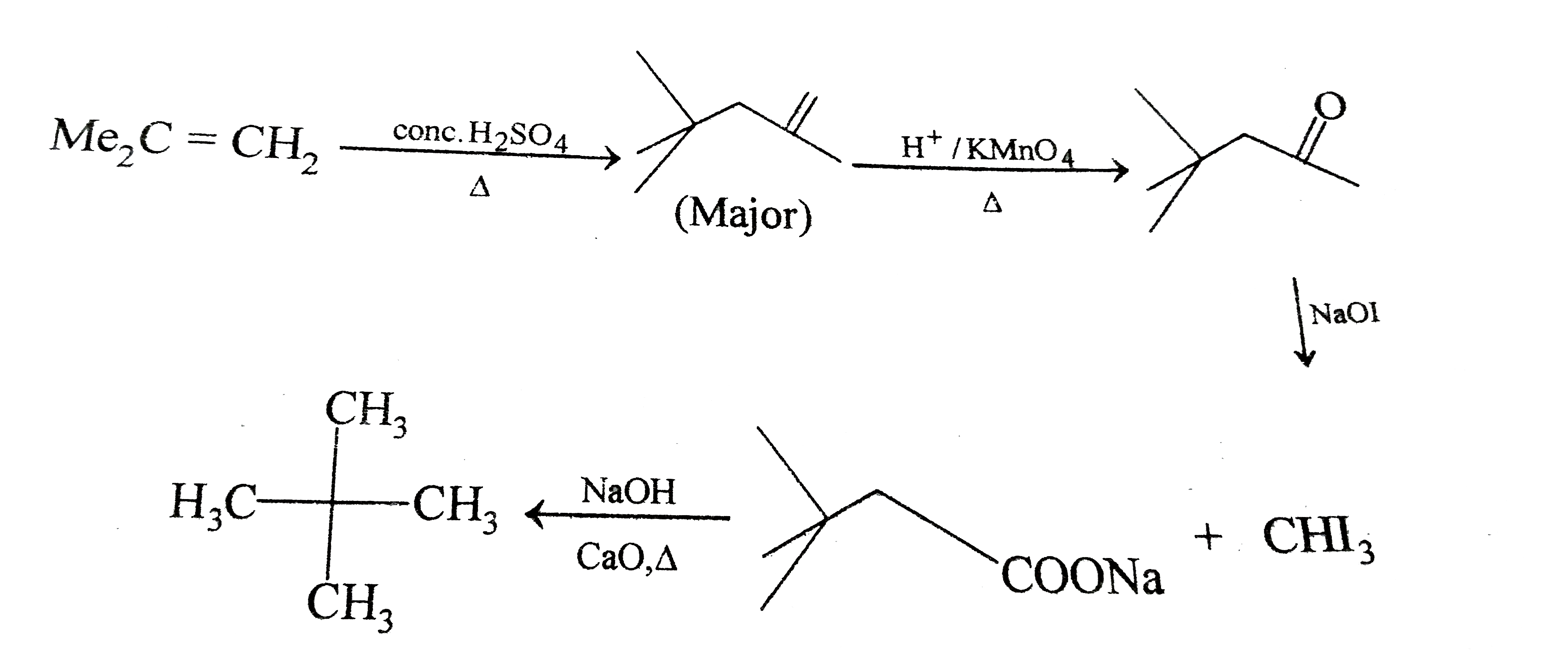
|
|
| 31. |
Maximum value (n+l+m) for unpaired electrons in second excited state of chlorine ._(17)Cl is: |
|
Answer» 28  CONFIGURATION in SECOND EXCITED STATE may be GIVEN as: |
|
| 32. |
Maximum racemization take place when |
|
Answer» `100% H_(2)O` |
|
| 33. |
Maximum probability of finding an electron along xy orbital is |
|
Answer» ALONG X-AXIS |
|
| 34. |
Maximum oxidation state is present in the central metal atom of which compound |
|
Answer» `CrO_2CI_(2)` |
|
| 36. |
Maximum number of sigma bonds that may be present in an isomer of C_(4)H_(8) are: |
|
Answer» 10 |
|
| 37. |
Maximum number of possible stereoisomers (configurational only) with the molecular formula C_(4)H_(10)O are |
|
Answer» 1 |
|
| 38. |
Maximum number of possible stereoisomers (configurational only) with the formula CH_(3)CH=CHCH(CH_(3))COOH |
|
Answer» 2 |
|
| 39. |
Maximum number of planar atoms in SF_(5) molecule |
|
Answer» 5 |
|
| 40. |
Maximum number of molecules are present in |
|
Answer» 15 L of `H_(2)` gas at S.T.P `= (15L)/((22.4L))xx6.022xx10^(23)=4.033xx10^(23)` (b) 5L of `N_(2)` gas at S.T.P. `= ((5L))/((22.4L))xx6.022xx10^(23)` `=1.344xx10^(23)` (C) 0.5 g of `H_(2)=((0.5g))/((2.0g))xx6.022 xx 10^(23)` `=1.505 xx 10^(23)` 10 g of `O_(2)=((10.0g))/((32.0g))xx6.022xx10^(23)` `=1.882xx10^(23)`. |
|
| 41. |
Maximum number of hydroge bonds that one water molecle is capable of forming is |
|
Answer» 1 |
|
| 42. |
Maximum number of electrons that can be present in M and N - shells respectively are |
|
Answer» 18, 32 |
|
| 43. |
Maximum number of electrons that can be present in any molecular orbital is |
|
Answer» 3 |
|
| 44. |
Maximum number of electrons present in 'N' shell is |
|
Answer» 18 |
|
| 45. |
Maximum number of electrons may be present in one 4f-orbital |
|
Answer» 2 |
|
| 46. |
Maximum number of electrons in a subshell with l = 3 and n = 4 is |
|
Answer» 10 |
|
| 47. |
Maximum number of electrons in a subshell wih l=3 and n=4 is |
|
Answer» 10 |
|
| 48. |
Maximum number of electrons in a shell with principal quantum number n is given by |
|
Answer» n |
|
| 49. |
Maximum number of electrons in a subshell of an atom is determined by the following |
|
Answer» `2L + 1` `:.` Maximum no. of ELECTRONS in a subshell `= 2 (2l + 1) = 4 L + 2` |
|