Saved Bookmarks
This section includes 7 InterviewSolutions, each offering curated multiple-choice questions to sharpen your Current Affairs knowledge and support exam preparation. Choose a topic below to get started.
| 1. |
The hydrolysis constant of CH_3 COONais given by |
|
Answer» ` (K_W)/(K_a) ` |
|
| 2. |
The hydrogen was warms up during the Joule -Thomson expansion The temperature at which the Joule Thomson coefficeint becomes negative is called Joule-Thomson inversion temperature . |
| Answer» Solution :The temperature at which the Joule-Thomson COEFFICEINT BECOMES ZERO is CALLED Joule-Thomson inversion temperature . | |
| 3. |
The hydrogen like species Li^(2+) is in a spherically symmetric state S_(1) with one radial node. Upon absorbing light, the ion undergoes transition to a state S_(2). The state S_(2) has one radial node and its energy is equal to the ground state energy of the hydrogen atom The orbital angular momentum quantum number of the state S_(2) is |
|
Answer» 0 ORBITAL ANGULAR MOMENTUM quantum NUMBER (l) for 3p = 1 |
|
| 4. |
The hydrogen like species Li^(2+) is in a spherically symmetric state S_(1) with one radial node. Upon absorbing light, the ion undergoes transition to a state S_(2). The state S_(2) has one radial node and its energy is equal to the ground state energy of the hydrogen atom Energy of the state S_(1) in units of the hydrogen atom ground state energy is |
|
Answer» 0.75 `= - (13.6 XX 3^(2))/(2^(2)) = - 13.6 xx 2.25 eV` = 2.25 times of `E_(H)` |
|
| 5. |
The hydrogen like species Li^(2+) is in a spherically symmetric state S_(1) with one radial node. Upon absorbinf light the ion undergoes transition to a state S_(2) The state S_(2) has one radial node and its energy is equal to the ground state energy of the hydrogen atom. Energy of the state S_(1) units of the hydrogen atom ground state energy is |
|
Answer» 0.75 |
|
| 6. |
The hydrogen-like species Li^"2+" is in a spherically symmetric state S_1 with one radial node. Upon absorbing light the ion undergoes transition to a state S_2. The state S_2 has one radial node and its energyis equal to the ground state energyof the hydrogen atom. The state S_1 is |
|
Answer» 2p No. of radial NODE = 1=n-l-1 PUT n=2 and l=0 (as HIGHER state `S_2` has n=3) So, it would be 2s (for `S_1` state) |
|
| 7. |
The hydrogen like species Li^(2+) is in a spherically symmetric state S_(1) with one radial node. Upon absorbing light, the ion undergoes transition to a state S_(2). The state S_(2) has one radial node and its energy is equal to the ground state energy of the hydrogen atom The state S_(1) is |
|
Answer» 1st and it must have jumped to 3P (which again has one radial node and energy equal to that of GROUND state H-atom as `E_(H (Is)) = - 13.6 eV` `E_(Li^(2+) (3p)) = (-13.6 Z^(2))/(n^(2)) = - (13.6 xx 3^(2))/(3^(2))` `= -13.6 eV` |
|
| 8. |
The hydrogen like species Li^(2+) is in a spherically symmetric state S_(1) with one radial node. Upon absorbinf light the ion undergoes transition to a state S_(2) The state S_(2) has one radial node and its energy is equal to the ground state energy of the hydrogen atom. The state S_(1) is |
|
Answer» 1s |
|
| 9. |
The hydrogen-like species Li^"2+" is in a spherically symmetric state S_1 with one radial node. Upon absorbing light the ion undergoes transition to a state S_2. The state S_2 has one radial node and its energyis equal to the ground state energyof the hydrogen atom. Energy of the state S_1 in units of the hydrogen atom ground state energy is |
|
Answer» `4.50` 2.25 (energy of H-atom in ground state ) |
|
| 10. |
The hydrogen-like species Li^(2+) is in a spherically symmetric state S_(1) with one radial node. Upon absorbing light the ion undergoes transition to a state S_(2). The state S_(2) has one radial node and its energy is equal to the ground state energy of the hydrogen atom. Q. The state S_(1) is: |
|
Answer» 1s |
|
| 11. |
The hydrogen ion concentration of a 10^(-8)MHCl aqueous solution at 298 K (K_(w) = 10^(-14)) is |
|
Answer» `9.525xx10^(-8)M` From `H_(2)O][H^(+)]=[OH^(-)]=x "mol" L^(-1)` (say) `([H^(+)] or [OH^(-)]!=10^(-7)` M in presence of acid ) Thus, in the solution, `[H^(+)]=(10^(-8)+x) M and [OH^(-)]=XM` But `[H^(+)] [OH^(-)]=K_(w)=10^(-14)` `:. (10^(-8)+x)(x)=10^(-14)` or `x^(2)+10^(-8)x-10^(-14)=0` `:. x=(-10^(-8)pm sqrt(10^(-16)+4xx10^(-14)))/(2)` `=9.51xx10^(-8), "i.e.," [OH^(-)]=9.51xx10^(-8)`. Hence, `[H^(+)]=(10^(-14))/((9.51xx10^(-8)))=1.05xx10^(-7)M` ALTERNATIVELY, directly, the only CONCENTRATION which will give pH close to 7 but less than7 is (d). |
|
| 12. |
The hydrogen ion concentration of 0.2 M CH_3 COOHwhich is 4% ionised is |
|
Answer» `0.008 N` |
|
| 13. |
The hydrogen electron de-exites from its 3rd excited state. W hich are tru e and false statem ents for it. Assign T for true and F for the false.(i) It emits the radiation giving the lines in the Lyman Balmer and Paschen series. (ii) It emits radiation of only UV and visible regions and not infrared region. (iii) It em its the ra d ia tio n of sm allest wavelength giving the line in Lyman series. (iv) It will emit the radiation of the highest frequency giving line in Pfund series |
|
Answer» TFTF |
|
| 14. |
The hydrogen bond is strongest in ...... . |
|
Answer» O - H----S |
|
| 15. |
The hydrogen bond is an electrostatic attractive force between covalently bonded hydrogen atom of one molecule and an electronegative atom like (F,O,N) of other molecule. Hydrogen bond is nearly an electrostatic attractive force and not a normal chemical bond. It is very weak (2-10 kcal/mol) as compared to a colvent bond (strength 50-100 kcal/mol). In intramolecular hydrogen bonding, the two or more than two molecules of the same or different substances are linked to form polymeric aggregate. Intermolecular hydrogen bonding increases the boiling point of the compound and also its solubility in water. Intramolecular hydrogen bonding occurs within two atoms of the same molecule. Intramolecular hydrogen bonding is also called chelation, since it involves ring formation. intramolecular hydrogen bonding decreases the boiling point of the compound and also its solubility in water. underset((A))underset(2,4-"pentadione")(CH_(3)-overset(O)overset(||)(C)-CH_(2)-overset(O)overset(||)(C)-)CH_(3)hArrunderset((B))underset(4-"hydroxypent-3-en-2-one")(CH_(3)-overset(OH)overset(|)(C)=CH-overset(O)overset(||)(C)-CH_(3)) Select the correct statement about above tautomers. |
|
Answer» FORM (A) is more STABLE due to FORMATION of intramolecular hydrogen bond |
|
| 16. |
The hydrogen bond is an electrostatic attractive force between covalently bonded hydrogen atom of one molecule and an electronegative atom like (F,O,N) of other molecule. Hydrogen bond is nearly an electrostatic attractive force and not a normal chemical bond. It is very weak (2-10 kcal/mol) as compared to a colvent bond (strength 50-100 kcal/mol). In intramolecular hydrogen bonding, the two or more than two molecules of the same or different substances are linked to form polymeric aggregate. Intermolecular hydrogen bonding increases the boiling point of the compound and also its solubility in water. Intramolecular hydrogen bonding occurs within two atoms of the same molecule. Intramolecular hydrogen bonding is also called chelation, since it involves ring formation. intramolecular hydrogen bonding decreases the boiling point of the compound and also its solubility in water. Which of the following molecules is dimerised when dissolved in non-polar or organic solvent? |
|
Answer» `R-COOH` |
|
| 17. |
The hydrogen bond is an electrostatic attractive force between covalently bonded hydrogen atom of one molecule and an electronegative atom like (F,O,N) of other molecule. Hydrogen bond is nearly an electrostatic attractive force and not a normal chemical bond. It is very weak (2-10 kcal/mol) as compared to a colvent bond (strength 50-100 kcal/mol). In intramolecular hydrogen bonding, the two or more than two molecules of the same or different substances are linked to form polymeric aggregate. Intermolecular hydrogen bonding increases the boiling point of the compound and also its solubility in water. Intramolecular hydrogen bonding occurs within two atoms of the same molecule. Intramolecular hydrogen bonding is also called chelation, since it involves ring formation. intramolecular hydrogen bonding decreases the boiling point of the compound and also its solubility in water. Select the compound which involves intramolecular hydrogen bonding. |
|
Answer» `HCOOH` |
|
| 18. |
The hydrogen bond is shortest in |
|
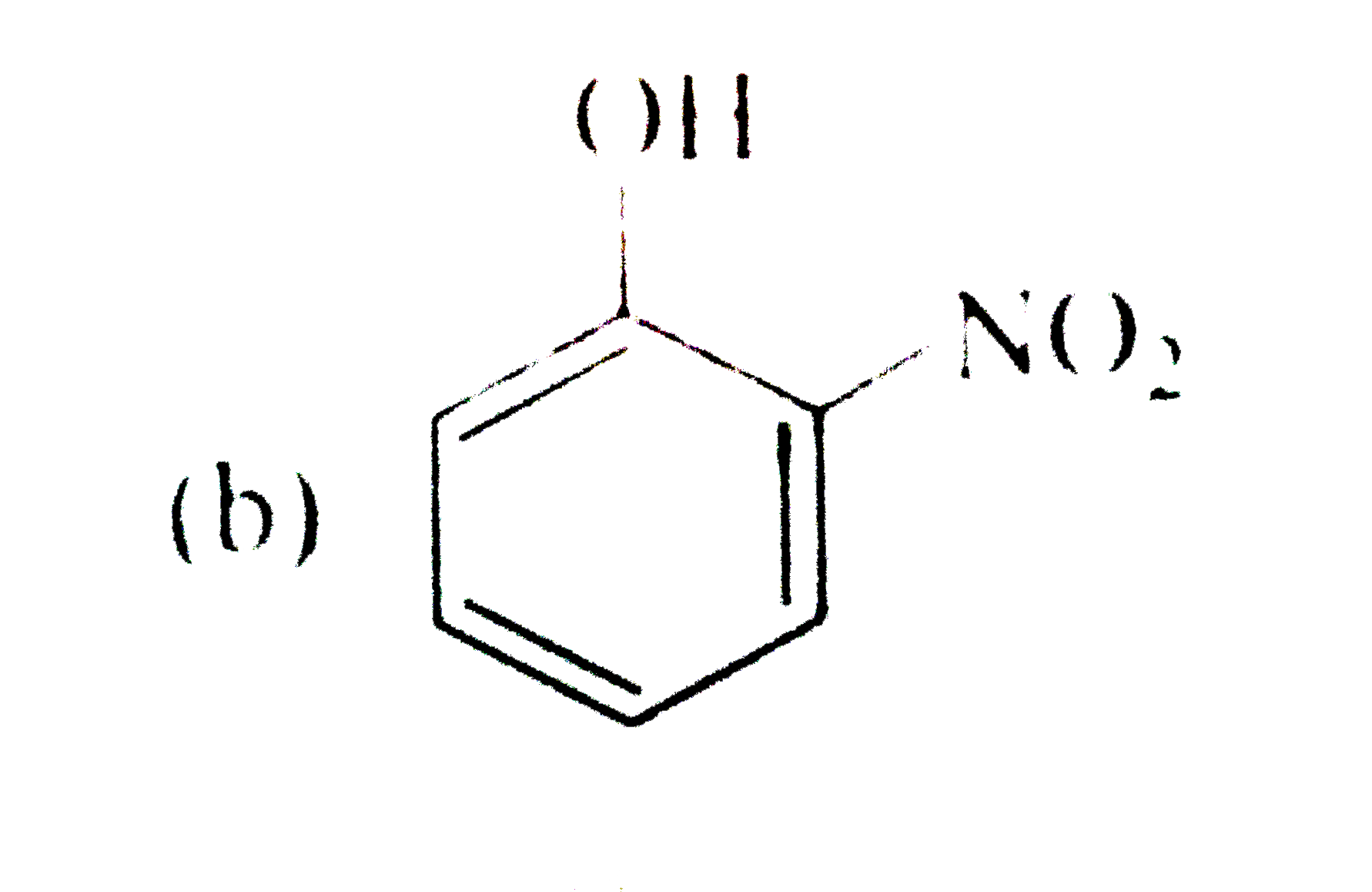
Answer» `S-H----S` m-nitrphenols because o-nitrphenol SHOWS intramolecular HYDROGEN BONDING . |
|
| 19. |
The hydrogen bond is an electrostatic attractive force between covalently bonded hydrogen atom of one molecule and an electronegative atom like (F,O,N) of other molecule. Hydrogen bond is nearly an electrostatic attractive force and not a normal chemical bond. It is very weak (2-10 kcal/mol) as compared to a colvent bond (strength 50-100 kcal/mol). In intramolecular hydrogen bonding, the two or more than two molecules of the same or different substances are linked to form polymeric aggregate. Intermolecular hydrogen bonding increases the boiling point of the compound and also its solubility in water. Intramolecular hydrogen bonding occurs within two atoms of the same molecule. Intramolecular hydrogen bonding is also called chelation, since it involves ring formation. intramolecular hydrogen bonding decreases the boiling point of the compound and also its solubility in water. Which of the following compounds is (are) stabilised by intramolecular hydrogen bonding? |
|
Answer» `Cl-OVERSET(CI)overset(|)underset(CI)underset(|)(C)-overset(" "OH)overset(|)underset(" "OH)underset(|)(C)-H` |
|
| 20. |
The hydrocarbon which does not decolourise alkaline KMnO_4 solution and also does not give any precipitate with ammoniacal silver nitrate is |
|
Answer» BENZENE |
|
| 21. |
The hydrocarbon which can react with sodium in liquid ammonia is :1.CH_3CH_2CH_2C -= "CCH"_2CH_2CH_32. CH_3CH_2C -=CH3.CH_3CH = CHCH_34.CH_3CH_2C -= "CCH"_2CH_3 |
|
Answer» `CH_3CH_2CH_2C -= "CCH"_2CH_2CH_3` |
|
| 22. |
The hydrocarbon which can react with sodium in liquid ammonia is |
|
Answer» `CH_(3)CH_(2)C-=C CH_(2)CH_(3)` |
|
| 23. |
The hydrocarbon which can react with sodium in liquid ammonia is : |
|
Answer» `CH_(3)CH_(2)C-=CH` |
|
| 25. |
The hydrides of the first elements in groups 15-17, namely NH_(3), H_(2)O and HF respectively show abnormally high values for melting and boiling points. This is due to |
|
Answer» SMALL SIZE of N,O,F |
|
| 26. |
The hydries of first elements in grounp 15 to 17 amely NH_(3) H_(2)Oand HF rectivelyshow abnormally high values for meltin and bolting points this is due to |
|
Answer» Small size of N, O and F |
|
| 27. |
The hydride ion H^(-) is a stronger base than hydroxide ion. Which of the following reactions will occur if sodium hydride (NaH) is dissolved in water ? |
|
Answer» `H^(-) (AQ) + H_(2)O(L) to H_(3)O^(+)(aq)` |
|
| 28. |
The hydride ion H^-is a stronger base than hydroxide ion. Which of the following reactions will occur if sodium hydride (NaH) is dissolved in water ? |
|
Answer» `H_((aq))^(-) + H_2O_((L)) to H_3O_((aq))^(+)` |
|
| 29. |
The hydride H^(-) stronger base than hydroxide ionWhich of the following reaction would occur if NaHdissolved in water |
|
Answer» `H_(aq)^(-)+H_(2)O_((l)) to H_(3)O_(aq)^(-)` |
|
| 30. |
The hydration enthalpies of alkali metal ions decreases in ________ order. |
|
Answer» `Li^+gtNa^+gtK^+gtRb^+gtCs^+` |
|
| 31. |
The hydration energy of Mg^(2+)is greater than that of..... |
|
Answer» `Al^(3+)` |
|
| 32. |
The hydration energy of Mg^(2+) is greater than that of |
|
Answer» `Al^(3+)` |
|
| 33. |
The hydration energy of Mg^(2+) is : |
|
Answer» more than that of `MG^(3+)` ion |
|
| 34. |
The hydrated salt Na_(2)CO_(3)x H_(2)O undergoes 63 % loss in mass on heating and becomes anhydrous. What is the value of x ? |
|
Answer» Loss in mass due to dehydration = 63 % `(18x xx 100)/(106+18x)=63or(18x)/((106+18x))=0.63` `18x=0.63(100+18x)=66.78+11.34x` `(18 x - 11.34 x)=6.66 x = 66.78` `x=(66.78)/(6.66)~~10`. |
|
| 35. |
The hybridizations of atomic orbitals of nitrogen in NO_(2)^(+), NO_(3)^(-) and NH_(4)^(+)respectively are |
|
Answer» `SP , sp^(2), sp^(3)` `{:(NO_(2)^(+)= sp , "LINEAR"),(NO_(3)^(+) = sp^(2)," Trigonal PLANAR"),(NH^(+) = sp^(3) , "Tetrahedral" ):}` |
|
| 36. |
The hybridization that is not present in 1,2-Butadiene is |
| Answer» SOLUTION :Hybridizaion | |
| 37. |
The hybridization of oxygen atom in H_(2)O_(2) is |
|
Answer» `sp^(3) d `  Each O-atom has two bond pairs and two lone pairs. HYBRIDISATION of each O-atom is `sp^(3)`. |
|
| 39. |
The hybridization of central carbon atom in trimethyl free radical is |
|
Answer» SP |
|
| 40. |
The hybridizationof C in diamond, graphite and ethyneis in the order |
|
Answer» `SP^(3), sp , sp^(2)` |
|
| 43. |
The hybridisations of atomic orbitals of nitrogen in NO_(2)^(+),NO_(3)^(-) and NH_(4)^(+) respectively are- |
|
Answer» `sp^(2),sp^(3) and sp` |
|
| 44. |
The hybridisation type of carbon respectively in methane, ethane, ethene and ethyne is ……,…., …., and …… |
| Answer» SOLUTION :`SP^(3), sp^(3), sp^(2) and sp` | |
| 46. |
The hybridisation of silicon in SiF_(6)^(2-) is |
|
Answer» `SP^(3)d^(2)` |
|
| 48. |
The hybridisation of oxygen atom is H,O and H, 0, are respectively.......... |
|
Answer» SP and `sp^3 ` |
|
| 49. |
The hybridisation of oxygen in OF_(2) molecule is |
|
Answer» Sodium CHLORIDE |
|