Saved Bookmarks
This section includes 7 InterviewSolutions, each offering curated multiple-choice questions to sharpen your Current Affairs knowledge and support exam preparation. Choose a topic below to get started.
| 1. |
Which of the following MO's have two nodal plane ? . |
|
Answer» `sigma2p_(z)` Note Only bonding `sigma MO s` have ZERO nodal plane . |
|
| 2. |
What are the types of bonds present in hydrogen cyanide molecule? |
|
Answer» Solution :Lewis dot structure of HCN is `H:Cvdots vdots N:` The BONDS in HCN molecule are one single BOND and one triple bond. Further HCN molecule has to `SIGMA` and two `pi` bonds. |
|
| 3. |
Which of the following has bond formed by overlap of sp^(3)-sp hybrid orbitals? |
|
Answer» `CH_(3)-C -= C-H` |
|
| 4. |
The standard electrode potential of the electrode Ag(s) , AgCl| KCl (1 M) is |
|
Answer» `+0.2225 V` |
|
| 5. |
Write the IUPAC names of the following compounds. (i) CH_(3)-CH_(2)-underset(CH_(3))underset(|)(CH)-CH_(2)-CH_(3) (ii) CH_(3)-underset(CH_(3))underset(|)overset(CH_(3))overset(|)C-CH_(2)-CH_(3)-underset(underset(CH_(3))underset(|)(CH_(2)))underset(|)(CH)-CH_(3) (iii) CH_(3)-underset(CH_(3))underset(|)(CH)-CH_(2)-CH_(3) |
|
Answer» SOLUTION :(i) 2-ethyl-but-4-ene-oic ACID (II) 2,2-dimethyl-hexanoic acid |
|
| 6. |
Which of the following salts show chromyl chloride test? |
|
Answer» `KCI` |
|
| 7. |
Write the unit of van der Waal constant which represent the magnitude of attractive forces between gas molecules. |
| Answer» SOLUTION :`L^2" ATM " MOL^(-2)` | |
| 8. |
Which one of the following has minimum gold number ? |
| Answer» Answer :D | |
| 9. |
Which of the following can act as Lowry -Bronsted acid as well as base? |
| Answer» Solution :`HPO_4^(2-) to H^(+) +PO_4^(3-) , HPO_4^(2-)+H^(+) to H_2 PO_4^(-) ` | |
| 10. |
Two elements A (At. wt. 75) and B (At. wt. 16) combine to yield a compound. The % by weight of A in the compound was found to be 75.08. The formula of the compound is: |
|
Answer» `A_(2)B` |
|
| 11. |
Write the IUPAC names of the following |
|
Answer» Solution :(a) The structure of the COMPOUND can be WRITTEN as : `CH_(3)-CH_(2)-UNDERSET(CH_(3))underset(|)underset(CH_(2))underset(|)OVERSET(CH_(3))overset(|)overset(CH_(2))overset(|)C-CH_(2)-CH_(3)` The IUPAC name is Diethlpentane. (There is no need of given NUMBERING). (b) The IUPAC name of the compound is 2-oxocyclohexane carboxylic acid. Carboxylic acid groupshould be given preference to keto group. |
|
| 12. |
Which one is the major reason for pollution in big cities ? |
|
Answer» Fossil FUEL |
|
| 13. |
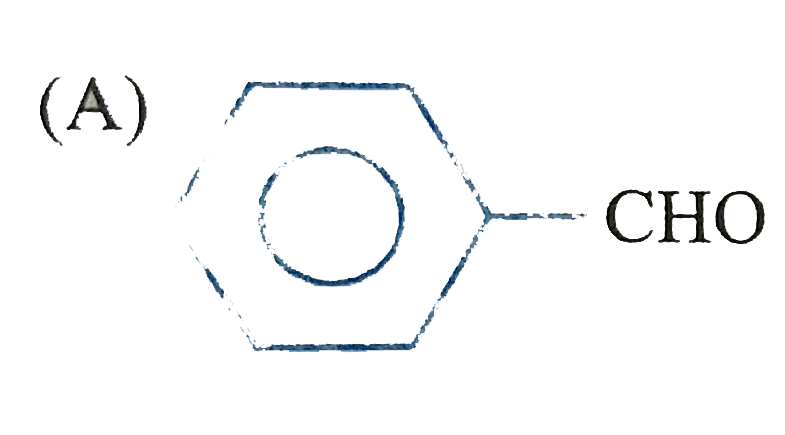
Which of the following aromatic acids has lowest K_(a) ? |
|
Answer» <P>`p-` Nitrobenzoic ACID 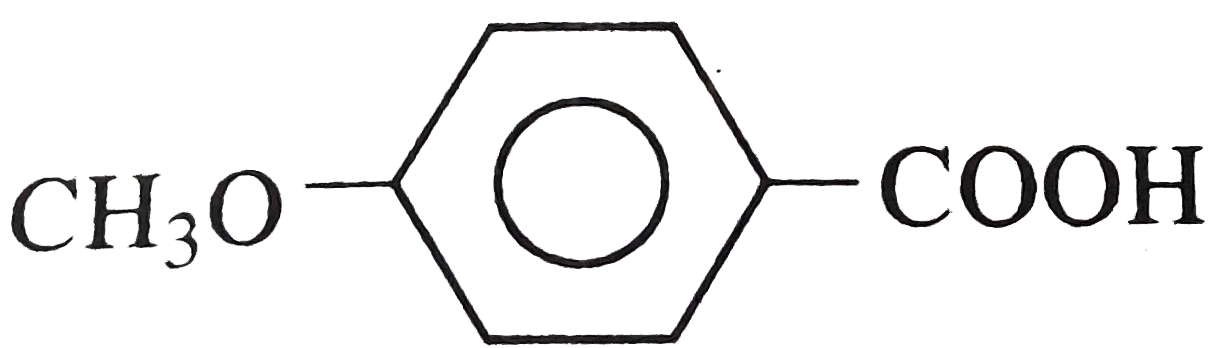 is the WEAKEST acid. So it haslowest `K_(a)` is the WEAKEST acid. So it haslowest `K_(a)`
|
|
| 14. |
Which oxide of nitrogen is not a common pollutant introduced into the atmosphere both due to natural and human activity ? |
|
Answer» NO |
|
| 15. |
Which of the following are not hydrolysed ? MgCl_2, CuCl_2 , HCl , C Cl_4 , AlCl_3 , PCl_5 |
| Answer» SOLUTION :`C Cl_4 , PCl_5` | |
| 16. |
What of the following sets of quantum numbers are not possible? (i)n = 3, l = 2,m = 0, s = -1//2 (ii) n = 3, l = 2, m = -2, s = -1//2 (iii) n = 3, l = 3, m = -3, s = +1//2 (iv) n = 3, l = 1, m = 0, s + 1//2 |
|
Answer» |
|
| 17. |
Which weighs the maximum ? |
|
Answer» 2.24 litres of `CO_(2)` at N.T.P |
|
| 18. |
Write equation for calculate of pH of weak acid and weak base salt solution. |
| Answer» SOLUTION :`pH=7+1/2(pK_a - pK_b)` | |
| 19. |
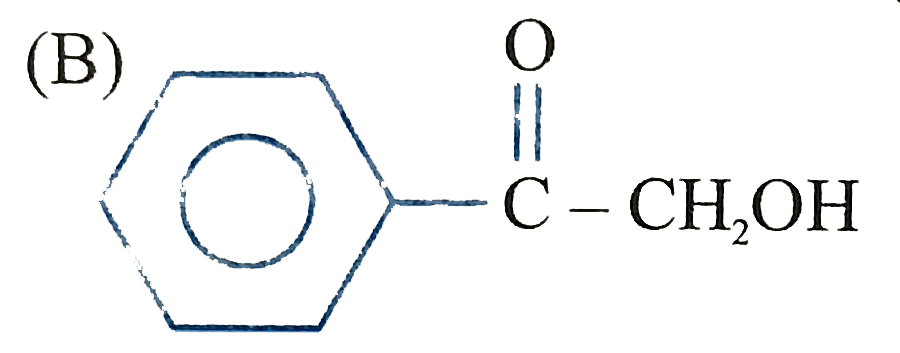
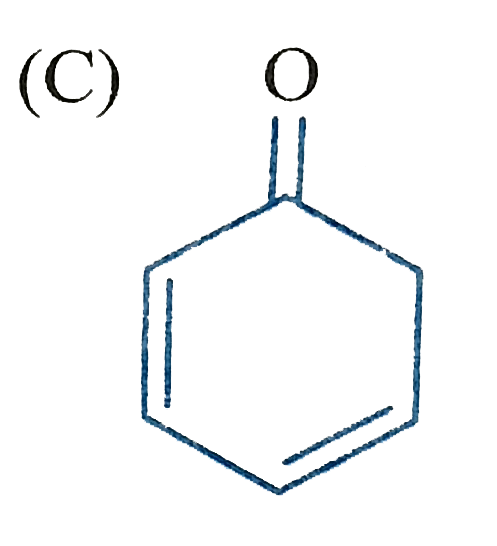
Which of the following compound(s) shows higher 'enol' content than 'keto' |
|
Answer»
|
|
| 20. |
Which of the following compound gives easily sulphonation reaction ? |
|
Answer» Benzene |
|
| 21. |
Write the molecular formula of the first six members of homologous series of nitro- alkanes |
|
Answer» SOLUTION :Nitroalkanes: 1.`CH_(2)NO_(2)` Nitromethane 2. `CH_(2)-CH_(2)NO_(2)` Nitroethane 3. `CH_(3)-CH_(2)-CH_(2)NO_(2)` 1-nitropropane 4. `CH_(3)-CH_(2)-CH_(2)-CH_(2)-NO_(2)` 1-nitrobutane 5. `CH_(3)-CH_(2)-CH_(2)-CH_(2)-CH_(2)-NO_(2)` 1-nitropentane 6. `CH_(2)-CH_(2)-CH_(2)-CH_(2)-CH_(2)-CH_(2)-CH_(2)-NO_(2)` 1-nitrohexane |
|
| 22. |
Which compounds are included in chemistry ? |
|
Answer» NATURAL |
|
| 23. |
What is the reactive intermediate in the reaction of 1,3-butadiene with HBr which results in1,2- and 1,4- addition? |
|
Answer» allylic radical |
|
| 24. |
The substances which contain species with unpaired electrons in their orbitals behave as paramagnetic substances. Such substances are weakly attracted by the magnetic field. The paramagnetism is expressed in terms of magnetic moment. The magnetic moment is related to the number of unpairedelectrons according to the following relation : Magnetic moment, mu = sqrt(n(n+2)) B.M. Where .n. = number of unpaired electrons. B.M. stands for Bohr magneton, a unit of magnetic moment. Which of the following is diamagnetic ? |
|
Answer» `He^(2+)` `Sc^(3+) (Z=21) [Ar] 3d^0 ,n=0` |
|
| 25. |
The structure of (S)-2-fluorobutane is best represented by : |
|
Answer»

|
|
| 26. |
When acetyl chloride reacts with sodium propionate, the product formed is |
|
Answer» ACETIC ANHYDRIDE |
|
| 27. |
The reagents used to prepare DDT are …………………… . |
| Answer» SOLUTION :CHLORAL and CHLOROBENZENE | |
| 28. |
Which of the following tests would help in the distinction of HCOOH and CH_(3)COOH ? |
|
Answer» TREATMENT with Tollen's reagent |
|
| 30. |
Which solutions, when mixed, forms acidic buffer ? |
|
Answer» `H_2SO_4` and `Na_2SO_4` |
|
| 31. |
What is the expression for the energy of a photon? |
| Answer» Solution :E = hn where, H = planks constant= `6.626xx10^(-34)` Js, `lamda`= frequency or RADIATION. | |
| 32. |
Which of the following pair of compounds cannot co-exist in aqueous solution? |
|
Answer» `Na_(2)CO_(3),K_(2)CO_(3)` |
|
| 33. |
Which of the following is not classified as a derivative of carboxylic acid ? |
|
Answer» alcohols |
|
| 34. |
Which of the following is heaviest? |
|
Answer» 50g of iron |
|
| 35. |
Which water pollutant produce from water used for cooling in industries? |
| Answer» Solution :Heat | |
| 36. |
Which of the following IUPAC names are incorrect |
|
Answer» 2-methyl-2-propylhexane |
|
| 37. |
When CO_(2) is bubbled in excess of water , the following equilibrium is established . CO_(2) + 2 H_(2)O hArr H_(3) O^(+) + HCO_(3)^(-) K_(c) = 3.8 xx 10^(-7) , pH = 6 What would be the [HCO_(3)^(-)] //[CO_(2)] ? |
|
Answer» 6 |
|
| 38. |
Write the half equations for each of the following redox reactions. NO_(3)^(-)+ZntoZn^(2+)+NH_(3)^(+) |
|
Answer» SOLUTION :`ZntoZn^(2+)` (OXIDATION HALF EQUATION) `NO_(3)^(-)toNH_(4)^(+)` (reduction half equation) |
|
| 39. |
When copper is treated with a certain concentration of nitric acid, nitric oxide and nitrogen dioxide are liberatel in equal volumes according to the equation, xCu+yHNO_(3)toCu(NO_(3))_(2)+NO+NO_(2)+H_(2)O The coefficients x and y are _______ |
|
Answer» 2 and 3 |
|
| 40. |
Write the chemical formulae of the following compounds: washing soda, baking soda, caustic soda. |
| Answer» SOLUTION :`Na_2CO_3, NaHCO_3,NAOH` | |
| 42. |
Which ion will be hydrolyse in NH_4Cl solution ? |
|
Answer» SOLUTION :`NH_4^+` is hydrolyse , `because` It is a ion of weak BASE `Cl^-` is not hydrolyse `because` It is ion of STRONG ACID. Hydrolysis : `NH_4^(+) + H_2O HARR NH_4OH+ H^+` |
|
| 43. |
The solubility product of BaSO_4 at 18^(@) C is 15 xx 10^(-9)Its solubility (mole"lit"^(-1)) at the same temperature is |
|
Answer» `1.5 XX 10^(-9) ` `S = sqrt( K_(sp) ) = sqrt( 1.5 xx 10 ^(-9) )= 3.9 xx 10 ^(-5) M` |
|
| 45. |
Which is the lightest among the following? |
|
Answer» An ATOM of HYDROGEN |
|
| 46. |
Which has no rotation of symmetry ? |
|
Answer» HEXAGONAL |
|
| 47. |
Which of the following is correct option for free expansion of an ideal gas under adiabatic condition? |
|
Answer» `q=0,DELTAT LT0,w cancel(=) 0` For free expansion, `P_(EXT) = 0`. Hence,`w-0` `DeltaU = q+w=0+0=0`. As U is a function of TEMPERATURE `( U = (3)/(2) nRT)` and as `DeltaU = 0,:.DeltaT =0` |
|
| 48. |
What will be the resultant products formed when the phosphorus hailde PBr_(5) splits up ? |
|
Answer» `[PBr_(4)]^(+)andBr^(-)` |
|
| 49. |
The temperature at which the vapour pressure of a liquid equals external pressure in called |
|
Answer» FREEZING POINT |
|
| 50. |
The statement that is not correct for periodic classification of elements is : |
|
Answer» The properties of elements are PERIODIC FUNCTION of their atomic numbers. . Therefore, 3d orbital is filled when 4s orbital gets fully field by electrons. |
|