

Saved Bookmarks
This section includes 7 InterviewSolutions, each offering curated multiple-choice questions to sharpen your Current Affairs knowledge and support exam preparation. Choose a topic below to get started.
| 1. |
Method of integration by parts : inte^(x)[tanx-log(cosx)]dx=..... |
|
Answer» `E^(x)LOG(secx)+c` |
|
| 2. |
If roots of the equation x^(2)+alpha^(2)=8x +6alpha are real, then which one is correct? |
|
Answer» `-2 LE alpha le 8` |
|
| 3. |
The solution of the differential equation (dy)/(dx) = (x-2y +1)/(2x-4y) |
|
Answer» `(x-2Y)^(2) + 2X = C` |
|
| 4. |
Letngt 1bean interger. Whichof thefollowingsetsof numbersnecessarily containsmultipleof 3? |
|
Answer» `N^(19)-1,n^(19)+1` 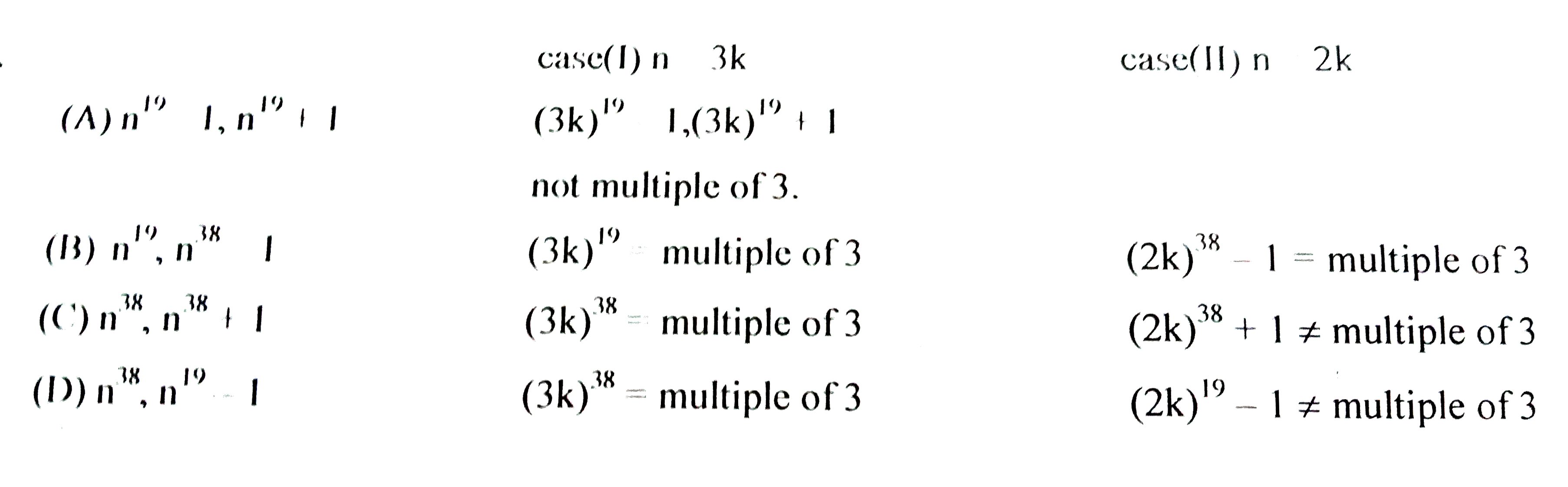
|
|
| 5. |
Find the mean deviation and the standard deviation of thefirst 2n+1 natural numbers . |
|
Answer» |
|
| 6. |
n aritmetic means are inserted between 7 and 49 and their sum is found to be 364, then n is : |
|
Answer» 11 |
|
| 7. |
Method of integration by parts : int tan^(-1)x dx=.... |
|
Answer» `x TAN^(-1)x+(1)/(2)log(1+x^(2))` |
|
| 8. |
Stacy has 30 meters of fencing that she wishes to use to enclose a rectangular garden. If all of the fencing is used, what is the maximum area of the garden, in square meters, that can be enclosed? |
|
Answer» `48.75` |
|
| 9. |
Which one is not a requirement of a binomial distribution ? |
|
Answer» There are 2 OUTCOMES for each trial |
|
| 10. |
Evalute the following integrals int e^(x) ((x + 2)/((x + 3)^(2)) )dx |
|
Answer» |
|
| 11. |
Let f _(a)(x) =In x andfor n ge 0 and x gt 0 Let f _(a)(x) = int _(0) ^(x)f _(a) (t) dt then: f _(a) (x ) equals : |
|
Answer» ` (x ^(3))/(3 ) (LN x - (5)/(6))` |
|
| 13. |
int (1)/(1 - sin x )dx = |
|
Answer» tan X + secx +c |
|
| 14. |
int " cosec"^(m) x cot x dx= |
|
Answer» `("cosec"^(m)X)/(m) +C ` |
|
| 15. |
Consider f(x)=Lim_(nto oo)((a^(n)+b^(n))^((1)/(n))sinx+{e^(x)}^(n))([(1)/(ncot^(-1)n)]+1),AAx inR where agtbgt0. [Note : {k} and [k] denotes fractinal part of k and greatest interger less than or equal to k respectively.] If H(x)=sgn (f(x)-3) has exactly one point of discontinuity AA x in[0,2pi], then number of integral value of a, is |
|
Answer» 1 `:.""f(x)=(asinx+0)(1+1)` `:.""f(x)=2asinx` (i) `H(x)=SGN (2asinx-3)` has exactly one POINT of discontinuty in `[0,2pi]`, then `2A sinx-3=0` must have one real root in `[0,2pi],sin(3)/(2a)` `:." "a=(3)/(2)` only `:.""` Number integral value of a is ZERO. `G(x)=|2asinx|+2asin|x|` (ii) 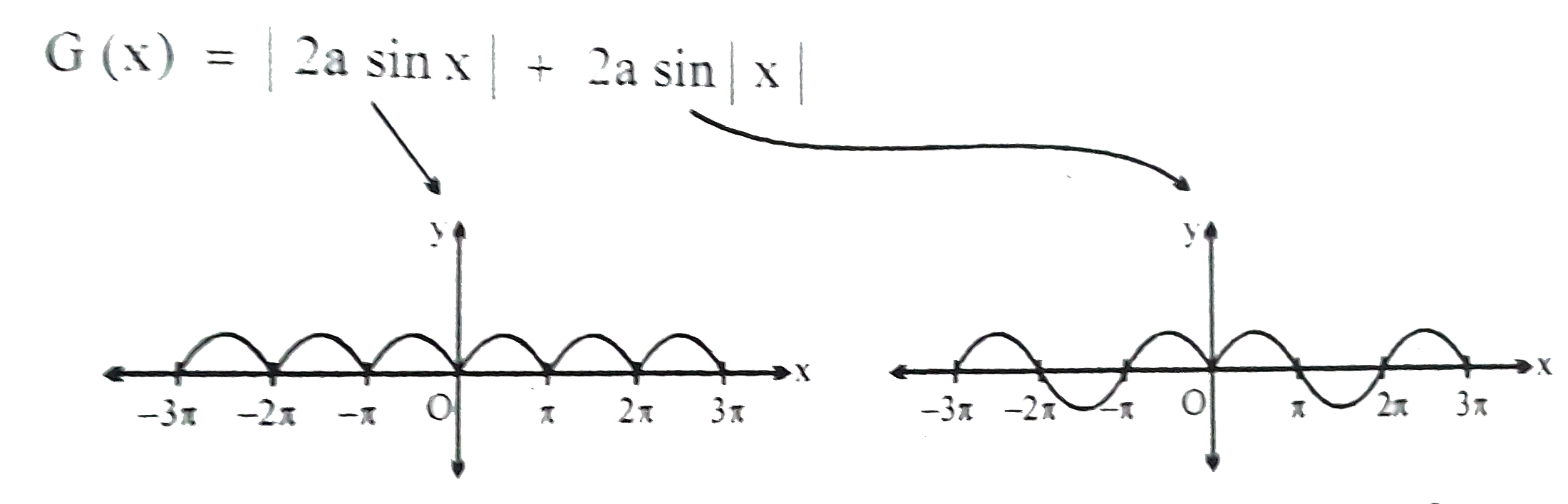 Number of non-differential point of G(x) is `x=-2pi,-pi,0,pi,2pi` separately we can prove that G(x) is non-differentiable at x=0. |
|
| 16. |
Prove that the function f : R to Rdefined byf(x)= 2x+ 7, is invertible. Hence findf^(-1) |
|
Answer» |
|
| 17. |
If |x| is so small that x^4 and higher powers of x many be neglected , then find an approximate value of root(4)(x^2 + 81) - root(4)(x^2 + 16) |
|
Answer» |
|
| 19. |
A: f(x)=x-[x] is discontinuous at x=2 R: underset(x to a)"Lt" f(x)=f(a) |
|
Answer» Both A and R are true and R is the correct explanation of A |
|
| 20. |
What is the total number of functions that can be defined from the set{1,2}" to the set" {1,2,3}? |
| Answer» SOLUTION :The TOTAL number of FUNCTIONS that can be defined from the set {1,2} to the set {1,2,3} is `3^2=9`. | |
| 21. |
If A and B are events such that P(A)=p_(1), P(B)=p_(2) and P(AnnB)=p_(3) then P(barAuuB)= |
|
Answer» `1-p_(1)+p_(2)` |
|
| 22. |
A : x^ 2 +x+1gt 0forallx in R R :if therootsof ax ^2+ bx+ c=0are imaginarythen forx inR , ax^2 + bx+ canda havethe samesign . |
|
Answer» BothA are RARE tureR ISTHE correctexplanationOf A |
|
| 23. |
Out of 100 bulbs in a box 10 bulbs are defective. Five bulbs are selected at random from it. Then find the probability of an event that selected bulb is of without defect. |
|
Answer» `((9)/(10))^(10)` |
|
| 24. |
Focii of the curve xy = -4 are |
|
Answer» ` (SQRT2, -sqrt2 ) (-sqrt2, - sqrt2) ` |
|
| 25. |
Let f: X rarrYbe a function. Define a relation R in X given by R = {(a, b): f(a) = f(b)}. Examine whether R is an equivalence relation or not. |
|
Answer» |
|
| 26. |
Show that number of equivalence relation in the set {1,2,3} containing (1,2) and (2,1) is two. |
|
Answer» |
|
| 27. |
Evaluate the following:""^(20)C_(4)= |
| Answer» | |
| 28. |
Evaluate : Lim_(x to 0)lim_(0)^(x^(2))(sinsqrt(t)tansqrt(t)dt)/(x^(4)) |
|
Answer» Solution :Applying L' hospital rule `UNDERSET(xrarr0')("LIM")'(2xsinxtanx)/(4x^(3))rArr underset(xrarr0)("Lim")'(1)/(2)((sinx)/(X))(tanx/x) = 1/2` |
|
| 29. |
Let f(x)={(0 , x "is irrational"),(2/(2q^(3)-q^(2)+q+sin^(2)q+5) , if x=p/q ("rational")):}(where HCF (p,q)=1,p,q,gt0) and f(x) is defined AAxgt0 then which of the following is/are incorrect? |
|
Answer» `f(x)` is continuous at each irrational in `(0,oo)` `f(sqrt(3))=0` `because sqrt(3)=1.732050807`………. As the decimal PART increase then in the expression `p/q, q` becomes very large So, `2/(2q^(3)-q^(2)+q+sin^(2)q+t)to0` Hence `lim_(xtosqrt(3))f(x)=0` THUS, `f(x)` is continuous at each irrational |
|
| 30. |
The circle on SS^' as diameter intersects the ellipse in real points then its eccentricity |
|
Answer» |
|
| 31. |
Let f(x)=x^(4)-4x^(3)+4x^(2)+c, c in R. Then |
|
Answer» f(x) has infinitely MANY zeros in (1, 2) for all C |
|
| 32. |
If intx.e^(2x)dx=e^(2x)f(x)+c where c is arbitary constant then f(x)=……. |
|
Answer» `(x-4)/(6)` |
|
| 33. |
If E and F are independent events such that 0 lt P(E) lt 1 and 0 lt P(F) lt 1, then |
|
Answer» E and `F^(C)` (the complement of the EVENT F) are INDEPENDENT |
|
| 34. |
If x_(1) and x_(2) are the real roots of the equation x^(2)-kx+c=0, then the distance between the points A(x_(1),0) and B(x_(2),0) is |
|
Answer» `SQRT(K^(2)+4c)` |
|
| 35. |
If three dice are rolled, the probability of getting sum 12 is |
|
Answer» `(15)/(216)` |
|
| 36. |
Let f : N to R be a function defined as f(x) = 4x ^(2) + 12x + 15. Show that f: N to S. where, S is the range of f, is invertible. Find the inverse of f. |
|
Answer» |
|
| 37. |
The value of sum_(n=1)^(13)(i^(n)+i^(n-1)),i=sqrt(-1), is |
|
Answer» i |
|
| 39. |
A function f(x) having the followingproperties, (i) f(x) iscontinuous except at x=3 (ii) f(x) isdifferentiable except at x=-2 and x=3 (iii) f(0) =0 lim_( x to 3) f(x) to - oo lim_( x to -oo) f(x) =3 , lim_(x to oo) f(x)=0 (iv) f'(x) gt 0 AA in (-oo, -2) uu (3,oo) " and " f'(x) le 0 AA x in (-2,3) (v) f''(x) gt 0 AA x in (-oo,-2)uu (-2,0)" and "f''(x) lt 0 AA x in (0,3) uu(3,oo) Then answer the followingquestions show that graph of fucntion y=f (-|x|) iscontinuous but notdifferentiable at two points if f(0)=0 |
| Answer» | |
| 40. |
Let x, y, z be three positive real numbers such that x+y+z=1 then the maximum value of the expression (1-x)(2-y)(3-z) is __________ |
|
Answer» |
|
| 41. |
If A+B+C=180^(@)C then (sin 2A+sin 2B+sin 2C)/(cos A +cos B +cos C-1)= |
|
Answer» `4cos A//2 COS B//2 cos C//2` |
|
| 42. |
A function f(x) having the followingproperties, (i) f(x) iscontinuous except at x=3 (ii) f(x) isdifferentiable except at x=-2 and x=3 (iii) f(0) =0 lim_( x to 3) f(x) to - oo lim_( x to -oo) f(x) =3 , lim_(x to oo ) f(x)=0 (iv) f'(x) gt 0 AA in (-oo, -2) uu (3,oo) " and " f'(x) le 0 AA x in (-2,3) (v) f''(x) gt 0 AA x in (-oo,-2)uu (-2,0)" and "f''(x) lt 0 AA x in (0,3) uu(3,oo) Then answer the followingquestions Show that f'(x) +3x=0 has five solutions if f'(0) gt -3 " and " f(-2) gt6 |
| Answer» | |
| 43. |
Consider the identity function I_(N):N to N defined as I _(N) (x)=x AA x in N. Show that although I _(N) is onto but I _(N) + I _(N) : N to Ndefined as (I _(N) + I _(N)) (x) = I _(N) (x) + I _(N) (x) x +x = 2xis not onto. |
|
Answer» |
|
| 44. |
Method of integration by parts : int(cos^(-1)x+cos^(-1)sqrt(1-x^(2)))dx=Ax+f(x)sin^(-1)x-2sqrt(1+x^(2))+c,AAx""in[-1,0) then .......... |
|
Answer» |
|
| 45. |
Find the coefficient of x^(10) in the expansion of (1+2x)/((1-2x)^(2)). |
|
Answer» |
|
| 46. |
Let A = Q xxQand **be a binary operation on A defined by (a, b) **(c,d) = (ad + b, ac). Prove that **is closed on A = QxxQ . Find (i) Identity element of (A, **) , (ii) The invertible element of (A,**). |
|
Answer» |
|
| 48. |
Find the direction cosines of the vector hati+2hatj+3hatk. |
|
Answer» |
|
| 49. |
Statement-1, For any two complex numbers z_(1) and z_(2) |z_(1)+sqrt(z_(1)^(2)-z_(2)^(2))|+|z_(1)-sqrt(z_(1)^(2)-z_(2)^(2))|=|z_(1)+z_(2)|+|z_(1)-z_(2)| Statement-2: For any two complex numbers z_(1) and z_(2) |z_(1)+z_(2)|^(2)+|z_(1)-z_(2)|^(2)=2(|z_(1)|^(2)+|z_(2)|^(2)) |
|
Answer» STATEMENT-1 is True, Statement-2 is True: Statement-2 is a correct EXP,anation for statement-1. |
|
| 50. |
What is the value of(sin34^(@)cos236^(@)-sin56^(@)sin124^(@))/(cos28^(@)cos88^(@)+cos178^(@)sin208^(@))? |
|
Answer» `-2` `=(sin34^(@)(-cos56^(@))-sin56^(@)cos34^(@))/(cos28^(@)SIN2^(@)+COS2^(@)sin28^(@))` `(-sin34^(@)cos56^(@)-sin56^(@)cos34^(@))/(SIN(28^(@)+2))` `=-(sin(34^(@)+56^(@)))/(sin30^(@))=(-SIN90^(@))/(sin30^(@))=(-1)/(1/(2))=-2` |
|