

Saved Bookmarks
This section includes 7 InterviewSolutions, each offering curated multiple-choice questions to sharpen your Current Affairs knowledge and support exam preparation. Choose a topic below to get started.
| 2. |
Let a, b, c be real numbers such that a+b+c lt 0 andthe quadratic equation ax^(2)+bx+c=0has imaginary roots. Then |
|
Answer» `a GT 0, C gt 0` |
|
| 3. |
A binary operation on aset has always the identity element. |
|
Answer» |
|
| 4. |
Choose the correct answer The anti derivative of (sqrtx+1/(sqrtx)) equals |
|
Answer» `1/3x^(1/3)+2X^(1/2)+C` |
|
| 5. |
Mean of 40 terms is 25 and S.D. is 4, then find the sum of the squares of all terms |
|
Answer» 25640 |
|
| 6. |
I : Ifalpha + beta = pi//2 and beta + gamma = alphathentan alpha = tan beta = 2 tan gamma II : In Delta ABCif C is an obtuseangle thentan A + tan B=1 |
|
Answer» only I is TRUE |
|
| 7. |
An integrating factor of the equation (1+y+x^(2)y)dx+(x+x^(3))dy=0 is |
| Answer» Answer :D | |
| 8. |
Find the integrals of the functions 1/(cos(x – a) cos (x – b)) |
|
Answer» |
|
| 9. |
Let a tangent drawn at any point on the ellipse (x^(2))/(25) + (y^(2))/(16) = 1 cut the X-axis at Q. Let R be the image of Q with respect to y = x. If S is a circle with QR as its diameter, then the fixed point through which the circle S passes is |
| Answer» ANSWER :C | |
| 10. |
Solve system of linear equations ,using matrix method5x+ 2y = 47x+3y =5 |
|
Answer» |
|
| 11. |
In the usual notation the value of DeltaV is equal to |
|
Answer» `DELTA-NABLA` `=Deltaf(x)-Deltaf(x-h)` `=Deltaf(x)-[f(x)-f(x-h)]` `=Deltaf(x)-nablaf(x)` `therefore Delta nabla=Delta -nabla` |
|
| 12. |
If the curve xy=R^(2)-16 represents a rectangular hyperbola whose branches lies only in the quadrant in which abscissa & ordinate are possite in sign but not equal in magnitude, then |
| Answer» Answer :A | |
| 13. |
A bag contains 4 red and 5 black balls, a second bag contain 3 red and 7 black balls. One ball is drawn at random from each bag, find the probability that the balls are of different colour. |
|
Answer» |
|
| 14. |
Consider point P(x, y) in first quadrant. Its reflection about x-axis is Q(x_(1), y_(1)). So, x_(1)=x and y(1)=-y. This may be written as : {(x_(1)=1. x+0.y),(y_(1)=0. x+(-1)y):} This system of equations can be put in the matrix as : [(x_(1)),(y_(1))]=[(1,0),(0,-1)][(x),(y)] Here, matrix [(1,0),(0,-1)] is the matrix of reflection about x-axis. Then find the matrix of (i) reflection about y-axis (ii) reflection about the line y=x (iii) reflection about origin (iv) reflection about line y=(tan theta)x |
|
Answer» Solution :(i) Reflection of (X, y) about y-axis is `(x_(1), y_(1)) equiv (-x, y)`. `:. x_(1)=(-1)x+0y` and `y_(1)=0x+y` `:. [(x_(1)),(y_(1))]=[(-1,0),(0,1)][(x),(y)]` (ii) Reflection of (x, y) about the line `y=x` is `(x_(1), y_(1)) equiv (y, x)`. `:. x_(1)=0x+y` `y_(1)=x+0y` `:. [(x_(1)),(y_(1))]=[(0,1),(1,0)][(x),(y)]` (III) Reflection of (x, y) about origin is `(x_(1), y_(1)) equiv (-x, -y)`. `:. x_(1)=-x+0y` `y_(1)=0x-y` `:. [(x_(1)),(y_(1))]=[(-1,0),(0,-1)][(x),(y)]` (iv) Reflecton in line `t=x tan theta` or `(SIN theta)x-(cos theta)y=0`: 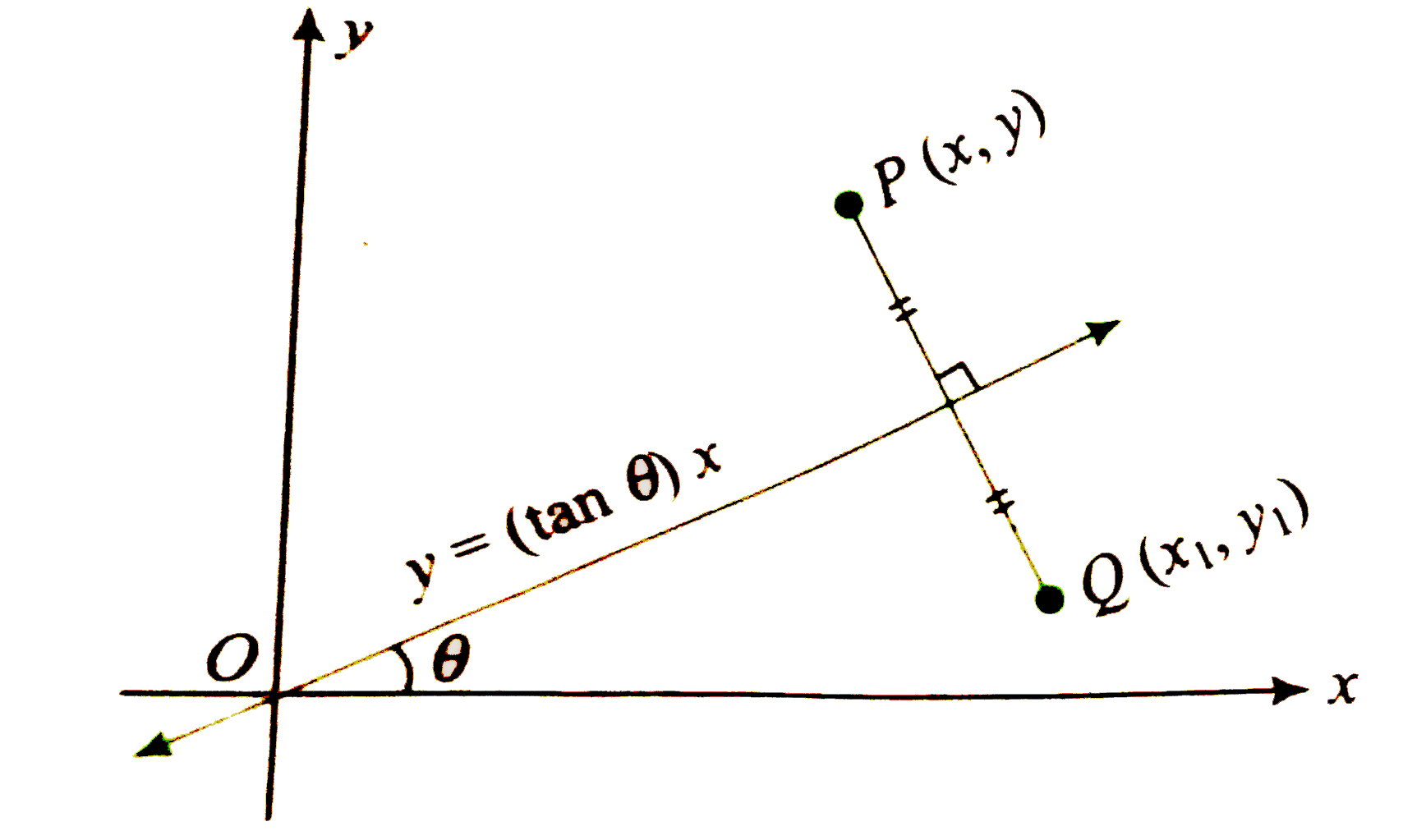 We kanow that `(x_(1)-x)/(sin theta)=(y_(1)-y)/(- cos theta)=(-2((sin theta)x-(cos theta)y))/(sin^(2) theta+cos^(2) theta)` `:. x_(1)=(1-2 sin^(2) theta)x+(2 sin theta cos theta)y` or `x_(1)=(cos 2 theta)x+(sin 2 theta) y` `y_(1)=(2 sin theta cos theta)x+ (1-2 cos^(2) theta)y` or `y_(1)=(sin 2 theta)x-(cos 2 theta)y` Thus, `[(x_(1)),(y_(1))]=[(cos 2 theta,sin 2 theta),(sin 2 theta,- cos 2 theta)][(x),(y)]` By putting `theta=0, pi//2, pi//4`, we can GET the reflection matrices x-axis, y-axis and the line y=x, respectively. |
|
| 15. |
A and B throw a pair of dice alternately. A wins the game if he gets a total of 6 and B wins if she gets a total of 7. It A starts the game, then find the probability of winning the game by A in third throw of the pair of dice. |
|
Answer» |
|
| 16. |
If the area bounded by the curves y = ax^(2) and x = ay^(2), (a gt 0) is 3 sq. units, then the value of a is |
| Answer» Answer :B | |
| 18. |
If polar of P w.r.t. S=0 touch the circle x^(2)+y^(2)=a^(2), the locus of P is |
|
Answer» `a^(2)[(X+g)^(2)+(y+f)^(2)]=C^(2)` |
|
| 19. |
Choose the correct answer If P(A)=(1)/(2), P(B) = 0, then P(A|B) is |
| Answer» Answer :C | |
| 20. |
Evaluate the following:lim_(xto0)(x^(1/2)+2x+3x^(3/2))/(2x^(1/2)-2x^(5/2)+4x^(7/2)) |
|
Answer» SOLUTION :`lim_(xtoinfty)(X^(1/2)+2X+3x^(3/2))/(2x^(1/2)-2x^(5/2)+4X^(7/2))` `=lim_(xto0)(1+2sqrtx+3x)/(2-2x^2+4x^3)=1/2` |
|
| 21. |
Find the sum of the squares of the roots of 3x^3-2x^2+4x+1=0 |
|
Answer» |
|
| 22. |
Determine if f defined by f(x) = {(x^(2)"sin" (1)/(x)",","if" x ne 0),(0",","if" x= 0):} is a continuous function? |
|
Answer» |
|
| 23. |
If 13^99-19^93is divided by 162, then the remainder is |
|
Answer» 3 |
|
| 24. |
int_(0)^(pi//2) x sin^(8) 2x dx= |
|
Answer» `(35pi^(2))/(1024)` |
|
| 25. |
If P(A) = 1/2, P(B) = 3/8 and P(A nn B) = 1/5· then P(A/B) is equal to : |
|
Answer» (2/5) |
|
| 26. |
Differentiate the functions with respect to x in sin (x^(2) + 5) |
|
Answer» |
|
| 28. |
Find the points on the curve x^2 + y^(2) - 2x - 3 = 0 at which the tangents are parallel to thex-axis. |
|
Answer» |
|
| 29. |
If the points in the complex plane satisfy the equations log_(5)(|z|+3)-log_(sqrt(5))(|z-1|)=1 and arg (z-1)=pi/4 are of the form A_(1)+iB_(1), then the value of A_(1)+B_(1), is |
| Answer» Answer :a | |
| 30. |
A number n is chosen at random from (1,2,3,4,…….1000). The probability that n is a number that leaves remainder 1 when divided by 7 is |
|
Answer» `(71)/(500)` |
|
| 31. |
sin^(-1)(4/5)+2tan^(-1)(1/3) is equal to |
|
Answer» `pi/3` |
|
| 32. |
Let a be a positivenumber such that the arithmetic mean of a and 2 exceeds their geometric mean by 1. Then the value of a |
|
Answer» 3 |
|
| 33. |
Solution of thedifferential equation (x+y-1)/(x+y-2)(dy)/(dx)=(x+y+1)/(x+y+2),x=1,y=1, is |
|
Answer» `2(x+y)+LOG|((x-y)^(2)+2)/(2)|=0` |
|
| 35. |
Which of the follwing statement is correct ? |
|
Answer» Every LPP ADMITS an optimal SOLUTION |
|
| 37. |
Find the derivative of the functions given by f(x)= (1+x)(1+x^(2))(1+x^(4))(1+x^(8)) and hence find f'(1). |
|
Answer» |
|
| 38. |
The number of ways of arranging 18 boys so that 3 particular boys are separated is : |
|
Answer» <P>`18!-16!.3!` `Sigma|vec(a)-vec(b)|^(2)=3[Sigma|vec(a)|^(2)]-2.Sigmavec(a).vec(b)le3(4)+4=16` |
|
| 39. |
The value of the intergal int_0^(pi//2) (phi(x))/(phi (x) + phi(pi/2 -x)) dx is |
|
Answer» `PI//4` |
|
| 40. |
Let f(x) =x^(3)-3(7-a)X^(2)-3(9-a^(2))x+2 The values of parameter a if f(x) has a positive point of local maxima are |
|
Answer» `PI` f(X)=`3x^(2)-6(7-a)x-3(9-a^(2))` for real root `Dge0` or `49+a^(2)-14a+9-a^(2)ge0 or ale58/14` when point of minma is negativepoint of maxima is also negative Hence equation f(x) =`3xA^(2)-6(7-a)x-3(9-a^(2))` =0 has both roots negative sum or roots =`2(7-a)lta or a gt 7 ` which is not possible as FORM (1) `ale58/14` When POINTOF maxima is positive point of minima is also positive ltrbgt Hence equation `f(x) =3x^(2)-6(7-a)x-3(9-a^(2))=0` has both roots positive sum roots =`2(7-a)GT0 or alt7` Also product of roots is positive or `-(9-a^(2))gt0 or a^(32)gt9 or a in (-oo,-3)CUP(3,oo)` From (1),(2) and (3) ain `(-oo,-3)cup(3,58//14)` For points of extrema of opposite sign equation (1) has roots of opposite sign Thus a in (-3,3). |
|
| 41. |
Three person A,B,C invite 2n guest to a party. All the people sit around a round table such A,B,C have their fixed seats (there is a least one seat between any two fixed seats)a and two particulars guests doesn't sit together. Find the number of ways is whcih they can be seated. |
|
Answer» |
|
| 42. |
Statement-1: If f:{a_(1),a_(2),a_(3),a_(4),a_(5)}to{a_(1),a_(2),a_(3),a_(4),a_(5)}, f is onto and f(x)nex for each xin {a_(1),a_(2),a_(3),a_(4),a_(5)}, is equal to 44. Statement-2: The number of derangement for n objects is n! sum_(r=0)^(n)((-1)^(r))/(r!). |
|
Answer» Statement-1 is true, statement-2 is true, statement-2 is a correct explanation for statement-1 `thereforeD_(5)=5!(1-(1)/(1!)+(1)/(2!)-(1)/(3!)+(1)/(4!)-(1)/(5!))` `=120((1)/(2)-(1)/(6)+(1)/(24)-(1)/(120))` `=6-20+5-1` `=65-21` =44 Hence, statement-1 is true, statement-2 is true and statement-2 is a correct explanation for statement-1. |
|
| 43. |
If [(3,5),(7,9)]is written as A + B, where A is the skew-symmetric matrix and B is thesymmetric matrix, then write the matrix A. |
|
Answer» |
|
| 44. |
Integrate the functions 1/(x^(1/2)+x^(1/3)) [Hint: 1/(x^(1/2)+x^(1/3))=1/(x^(1/3)(1+x^(1/6))), put x=t^(6)] |
|
Answer» |
|
| 45. |
If there are 5 alike pens, 6 alike pencils and 7 alike erasers, find the number of ways of selecting any number of (one or more) things out of them. |
|
Answer» |
|
| 46. |
The vector equation of the plane bar r=(3hati+hatj)+lambda(-hatj+hatk)+mu(hati+2hatj+3hatk) in scalar product form is |
|
Answer» `BARR.(-5hati+hatj+hatk)= -14` |
|
| 47. |
Determine w hether each of the following relations are reflexive, symmetric and transitive: (i) Relation R in the set A = {1,2,3,…,13,14} defined as R = {(x,y): 3x -y =0} (ii) Relation R in the set N of natural numbers defined as R = {(x,y): y = x +5 and x lt 4} (iii) Relation R in the setA ={1,2,3,4,5,6}as R = {(x,y):y is divisible by x} (iv) Relation R in the set Z of allintegers defined as R= {(x, y) : x -y is an integer} (v) Relation R in the set A of human beings in a town at a particular time given by (a)R = {(x,y) : x andy work at the same place} (b) R = {(x,y):x and y live in the same locality] (c ) R ={(x,y) :x is exactly 7 cm taller than y} (d)R = {(x,y) :x is wife of y} (e) R = {(x,y):xis father of y} |
|
Answer» (ii) Neither reflexive nor symmetric but transitive. (iii) Reflexive and transitive but not symmetric. (iv) Reflexive, symmetric and transitive. (v) (a) Reflexive, symmetric and transitive. (B) Reflexive, symmetric and transitive. (C ) Neither reflexive nor symmetric nor transitive. (d) Neither reflexive nor symmetric but transitive. (E) Neither reflexive nor symmetric nor transitive. |
|
| 48. |
Find the latus rectum of the parabola x=2y^2-4y+5 |
| Answer» | |
| 49. |
Find the values of the following integrals int((1)/(sqrt(1-x^(2)))+(2)/(sqrt(1+x^(2))))dx,|x|lt1 |
|
Answer» |
|