

Saved Bookmarks
This section includes 7 InterviewSolutions, each offering curated multiple-choice questions to sharpen your Current Affairs knowledge and support exam preparation. Choose a topic below to get started.
| 1. |
int (sin^(-1) sqrt(x))/(sqrt(1 -x)) dx = |
|
Answer» `2{ SQRT(X) - sqrt(1 - x) sin^(-1) sqrt(x) } + C` |
|
| 2. |
Find the integrals of the following functions : int(sin^(6)x+cos^(6)x)/(sin^(2)xcos^(2)x)dx |
|
Answer» |
|
| 3. |
A bag contains 3 maths book and 2 players book. A book is drawn at random if it is of math, 2 more book of maths together with this book put back in the bag and if it is of physics it is not replaced in the bag. This experiment is replaced 3 time. If third draw gives math book, what is the probability that first two drawn books were of physics. |
|
Answer» |
|
| 4. |
The vectors (x,x+1,x+2),(x+3,x+4,x+5) and (x+6,x+7,x+8) are coplanar for |
|
Answer» all VALUES of x |
|
| 5. |
Fundamental theorem of definite integral : f(x)=int_(2)^(x)(dt)/(sqrt(1+t^(4))) and g is a inverse function of f then g'(0) =…………. |
| Answer» ANSWER :C | |
| 6. |
Mr. john has x children by his first wife and Ms. Bashu has x+1 children by her first husband. They marry and have children of their own. The whole family has 10 children. Assuming that two children of the same parents do not fight, Find the maximum number of fight that can take place among children. |
|
Answer» |
|
| 7. |
If Sin^(-1)x+Sin^(-1)y+Sin^(-1)z=pi then prove that n xsqrt(1-x^(2))+ysqrt(1-y^(2))+zsqrt(1-z^(2))=2xyz |
|
Answer» 0 |
|
| 8. |
Solve the equation 3x^(4) -10x^(3) + 4x^(2) -x-6=0 one root being (1+sqrt(-3))/2. |
|
Answer» |
|
| 9. |
Find the area enclosed by the circle x^(2) + y^(2) = a^(2). |
|
Answer» |
|
| 10. |
Choose the correct answer: If A and B are any two events such that P(A) + P(B) - P(A and B) = P(A), then |
|
Answer» <P>`P(B|A)=1` |
|
| 11. |
Find underset(n to oo)lim x_(n) if (a) x_(n)=(sqrtn)/(sqrt(n+1)+sqrtn) (b) x_(n)=(sqrt(n^(2)+4n))/(root3(n^(3)-3n^(2)) (c) x_(n)=root3(1-n^(3))+n, (d) x_(n)=1/(2n)cos n^(3)-(3n)/(6n+1) (e) x_(n)=(2n)/(2n^(2)-1) cos ""(n+1)/(2n-1) -(n)/(1-2n) ""(n(-1)^(n))/(1-2n) (n^(2)+1) (f) x_(n)=(1+1/2+1/4+.....+(1)/2^(n))/(1+1/3+1/9+......+1/3^(n)) |
|
Answer» |
|
| 12. |
Find the area of the region BOB.RESB is enclosed by the ellipse and the lines x = 0 and x = ae. |
|
Answer» |
|
| 13. |
A galavanometer, whose resistance is 50 ohm has 25 divisions in it. When a current of 4xx10^(-4) A passes through it,its needle (pointer) deflects by one division. To use this galvanometer as a volmeter of range 2.5V, it is should be connected to a resistance of : |
|
Answer» 250 OHM |
|
| 14. |
Simplify costheta[(costheta,sin theta),(-sintheta,costheta)]+sin[(sintheta,-costheta),(costheta,sintheta)] |
|
Answer» |
|
| 15. |
Show that the number of binary opertions on {1,2} having 1 as identity and having 2 as the inverse of 2 is exactly one. |
|
Answer» |
|
| 17. |
A plane meets the co-ordinate axes at A,B,C such that the centroid of the triangle is (3,3,3). The eqation of the plane is |
|
Answer» `9x+9y+9z=1` |
|
| 18. |
Integrate the rational functions 1/(x(x^(4)-1)) |
|
Answer» |
|
| 19. |
If the letters of the word 'NORMAL' are arranged in all possible ways and the words thus formed are arranged as in dictionary. Then find the word the rank of which is 455. |
|
Answer» |
|
| 20. |
If one of the roots of |{:(3,5,x),(7,x,7),(x,5,3):}|=0 is -10, then the other roots are |
|
Answer» `3,7` |
|
| 21. |
(1-costheta+isintheta)^8= |
|
Answer» `256sin^8(theta//2)[cos4theta+isin4theta]` |
|
| 22. |
Using differentials, find the approzimate value of each of the following up to 3 places of decimal :(0.999)^((1)/(10)) |
|
Answer» |
|
| 23. |
Let L be the line x-4 =y-2 =(z-7)/(2) and Pbe the plane 2x - 4y +z =7 Statement 1: The line L lies in the plane P Statement 2: The direction ratios of the line L are l_1 =1, m_1 =1, n_1= 2and that of the normal to the plane P are l_2 =2, m_2 =-4, n_2 =1and l_1l_2 +m_1 m_2 +n_1 n_2 =0 holds |
|
Answer» Both the statement are TRUE and II is the CORRECT explanation of I |
|
| 24. |
Find the number of ways of arranging 15 students A_(1),A_(2),…….,A_(15) in a row such that A_(2) must be seated after A_(1)andA_(2) must come after A_(2) |
|
Answer» |
|
| 25. |
Letalpha(n)=1-(1)/(2)+(1)/(3)-(1)/(4)+.........+(-1)^(n-1)(1)/(n),ninN, then |
|
Answer» `(1)/(n+1)+(1)/(n+2)+.........+(1)/(2n)=ALPHA(2n)` |
|
| 26. |
Prove that the greatest integer function f : R rarrR given by f(x) =[x]is neither one-one nor onto, where [x] denotes the greatest integer less than or equal to x. |
|
Answer» Solution :We have `F(0.5) = [0.5] = 0` and f(0.75) = [0.75] = 0 THEREFORE` Both 0.5 and 0.75 are mapped to 0 `therefore` f is not one-one Since the value of f(X) are all INTEGERS, non-integer real numbers can.t have pre-images. `therefore` f is not onto. |
|
| 27. |
Evaluate the following: int_(0)^(pi)(1)/(3+2 sin x+cosx)dx |
|
Answer» Solution :LET `I=int_(0)^(pi)(1)/(3+2 sin x+cos x)dx` Put `TAN.(x)/(2)=t THEREFORE x =2 tan^(-1)t` `therefore dx=(2dt)/(1+t^(2))and sin x=(2t)/(1+t^(2)), cos x=(1-t^(2))/(1+t^(2))` When x = 0 , t = TNA 0 = 0 When `x=pi, t=tan.(pi)/(2)=oo` `therefore""I=int_(0)^(oo)(1)/(3+2((2)/(1+t^(2)))+((1-t^(2))/(1+t^(2)))).(2dt)/(1+t^(2))` `=int_(0)^(oo)(1+t^(2))/(3+3t^(2)+4t+1-t^(2)).(2dt)/(1+t^(2))` `=2int_(0)^(oo)(1)/(2t^(2)+4t+4)dt` `=(2)/(2)int_(0)^(oo)(1)/(t^(2)+2t+2)dt=int_(0)^(oo)(1)/((t^(2)+2t+1)+1)dt` `=int_(0)^(oo)(1)/((t+1)^(2)+(1)^(2))dt=(1)/(1)[tan^(-1)((t+1)/(1))]_(0)^(oo)` `=[tan^(-1)(t+1)]_(0)^(oo)` `=tan^(-1)oo-tan^(-1)1` `=(pi)/(2)-(pi)/(4)=(pi)/(4).` |
|
| 28. |
The range of the function f (x) =- sqrt( -x ^(2) -6x -5) is |
|
Answer» `[-2,0]` |
|
| 29. |
If the roots of x^(2)-ax+b=0 are two consecutive odd integers, then a^(2)-4b is |
| Answer» Answer :B | |
| 30. |
Let two circles S_1=0 and S_2=0 intersect at point A and B . L_1=0 is the line joining A and B where S_1=x^2+y^2+2ax+2by-5=0 and S_2=x^2+y^2+2x+4y-4=0 Let AB subtend and angle theta at (0,0) and angle subtended by S_1=0 and S_2=0at P(3,4) is alpha and beta respectively. If AB passes through (1,1) and parallel to a line which touches S_2=0 at (2,-2) ,then a+4b is equal to |
|
Answer» 4 |
|
| 31. |
Statemen-I The locus of a point which is equidistant from the point whose position vectors are 3hat(i)-2hat(j)+5hat(k) and (hat(i)+2hat(j)-hat(k) is r(hat(i)-2hat(j)+3hat(k))=8. Statement-II The locus of a point which is equidistant from the points whose position vectors are a and b is |r-(a+b)/(2)|*(a-b)=0. |
|
Answer» STATEMENT-I is true, Statement II is ALSO true, Statement-II is the correct EXPLANATION of Statement-I. |
|
| 32. |
Let two circles S_1=0 and S_2=0 intersect at point A and B . L_1=0 is the line joining A and B where S_1=x^2+y^2+2ax+2by-5=0 and S_2=x^2+y^2+2x+4y-4=0 Let AB subtend and angle theta at (0,0) and angle subtended by S_1=0 and S_2=0at P(3,4) is alpha and beta respectively. If equation of L_1=3x+4y=7, then the value of 4a-b is equal to |
|
Answer» |
|
| 33. |
.^(n)C_(0) + .^(m+1)C_(0) + .^(m+2)C_(2) "……." + .^(n)C_(m) is equal to : |
|
Answer» `.^(n+1)C_(n+1)` |
|
| 34. |
y = e^(2x)(a + bx), find dy/dx |
| Answer» | |
| 35. |
Find the value of the root(5)(242)correct to 4 decimal places |
|
Answer» |
|
| 36. |
If T_(r +1) is the first negative term in the expansion of (1+x)^(7//2) then r = |
|
Answer» 5 |
|
| 37. |
If P(A)=(7)/(13), P(B)=(9)/(13) andP(A cap B)=(4)/(13), evaluate P(A|B). |
|
Answer» |
|
| 38. |
If alpha and betaare the roots ofx^(2)-x+1=0then the valueof alpha^(2013) +beta^(2013) is equal to |
| Answer» Answer :B | |
| 39. |
Find the mid point of the chord intercepted by x^(2)+y^(2) -2x-10y +1=0"___(1)" on the line x - 2y +7 =- 0. "_____(2)" |
|
Answer» |
|
| 40. |
What happened with the last tiger? |
|
Answer» The tiger was still ALIVE because MAHARAJA missed his mark |
|
| 41. |
Prove the x^(2) - y^(2) = c (x^(2) + y^(2))^(2) is the general solution of differential equation (x^(3) - 3x y^(2))dx = (y^(3) - 3x^(2)y)dy, where c is a parameter. |
| Answer» | |
| 42. |
Differentiate sin^(n) (a x^(2) + bx + c) |
|
Answer» |
|
| 43. |
Let T be the line passing through the points P(-2, 7) and Q(2, -5). Let F_(1) be the set of all pairs of circles (S_(1),S_(2)) such that T is tangent to S_(1) at P and tangent to S_(2) at Q, and also such that S_(1) and S_(2) touch each other at a point , say M. Let E_(1) be the set representing the locus of M as the pair (S_(1),S_(2)) varies in F_(1). Let the set of all straight line segment joining a pair of disntinct point of E_(1) and passing through the point R(1, 1) be F_(2). Let E_(2) be the set of the mid-points of the line segments in the set F_(2). Then , which of the following statement (s) is (are) TRUE? |
|
Answer» The point (-2, 7) lies in `E_(1)` 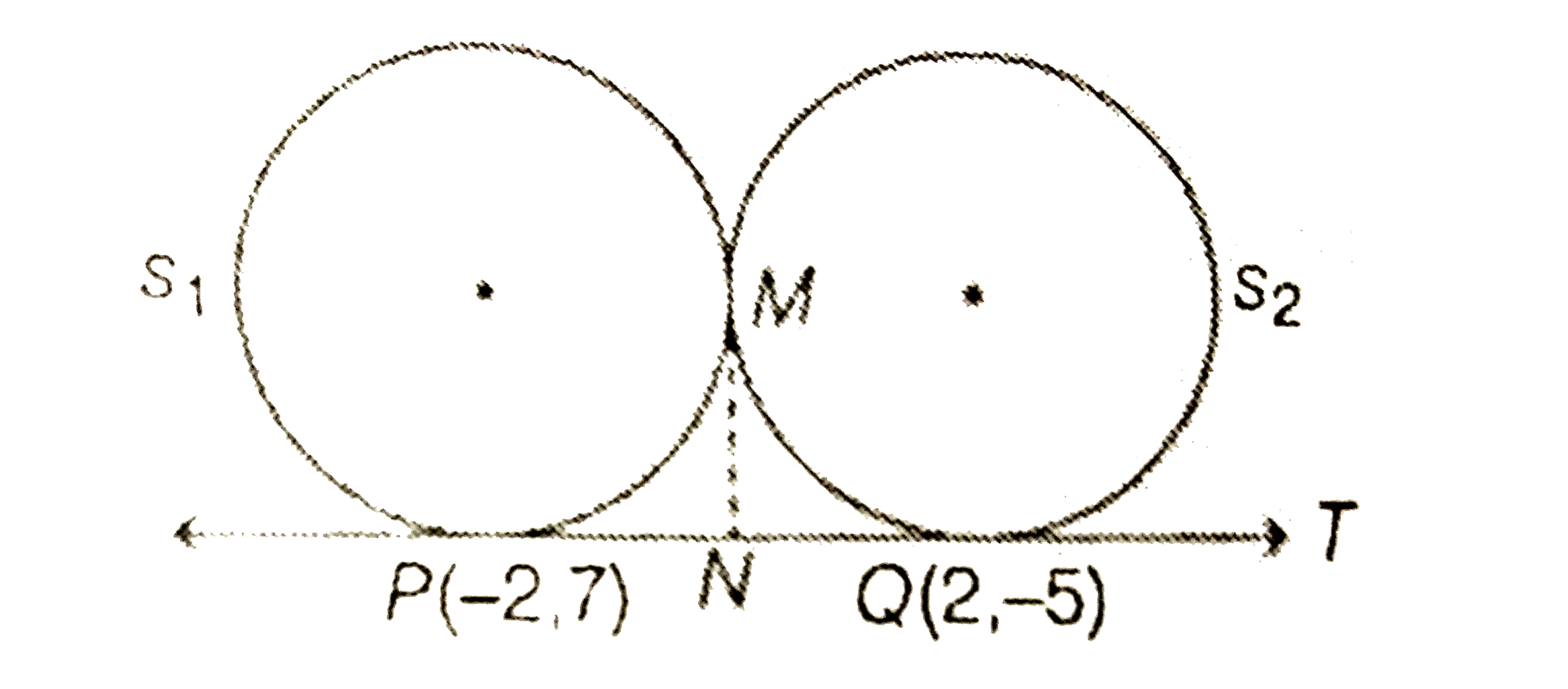 `THEREFORE MN=NP=NQ` `therefore` Locus ofM ISA CIRCLE having PQ as its diameter of circle. `therefore` Equation of circle `(X-2) (x+2)+(y+5)(y-7)=0` `rArrx^(2)+y^(2)-2y-39=0` Hence, `E_(1):x^(2)+y^(2)-2y-39=0,xnepm2` Locus of mid-point of chord (h,k) of the circle E_(1) is `xh+yk-(y+k)-39=h^(2)+k^(2)-2k-39` `rArrxh+yk-y-k=h^(2)+k^(2)-2k` since, chord is passing through (1, 1). lt brgt `therefore` Locus of mid-point of chord (h,k) is `h+k-1-k=h^(2)+k^(2)-2k` ` rArr h^(2) +k^(2) - 2k -h +1=0` Locus is `E_(2): x^(2)+y^(2)-x-2y +1 =0` Now, after checking options, (a) and (d) are correct. |
|
| 44. |
Six dice are rolled. Find the probability that all six faces show different shows different numbers |
|
Answer» `therefore|S|=6^6` LET A be the event that all six faces show different numbers. `therefore |S|=6!` `therefore P(A)=6!/6^6` |
|
| 45. |
If I = int(sqrt(cot)x-sqrt(tan)x)/(1+3sin2x)dx=Atan^(-1)((sqrt(tan)x+sqrt(cot)x)/(B))+C, then |A/B| is equal to |
|
Answer» |
|
| 46. |
The statement p rarr ( q rarr p )is equivalent to |
|
Answer» <P>p`rarr ` Q |
|
| 47. |
If y=x+c is a normal to the ellipse x^(2)/25+y^(2)/9=1, "then "c^(2)= |
|
Answer» A`128/17` |
|
| 48. |
Separate the intervals of monotonocity for the following function: (a) f(x) =-2x^(3)-9x^(2)-12x+1 (b) f(x)=x^(2)e^(-x) (c ) f(x) =sinx+cosx,x in (0,2pi) (d) f(x) =3cos^(4)x+cosx,x in (0,2 pi) (e ) f(x)=(log_(e)x)^(2)+(log_(e)x) |
|
Answer» `f(x)=-6X^(2)-18x-12` `=-6(x+2)(x+1)` or `f'(x)gt0 if x in (-2,-1)` and `f'(x)lt0, if x in (-oo.-2)cup(-1,oo)` Thus f(x) is increasing for x `in` (-2,1) and f(X)is decreasing for x `in (-oo,2)cup(-1,oo)` (b) Let y=f(x)=`x^(2)e^(-x)` `therefore (dy)/(dx)=2xe^(-x)-x^(2)e^(-x)` `=e^(-x)(2x-x^(2))` `=e^(-x)x(2-x)` f(x) is increasing if `f(x)gt0 or x (2-x)gt0 or x in (0,2)` f(x) is decreasing if `f'(x)lt0 or x(2-x)lt0` or `x in (-oo,0)cup(2,oo)` (c ) we have f'(x) =cosx -sin x  f(x) is increasing if `f'(x) gt0 or cos x gt sin x ` or `x in (0,pi//4)cup ((5pi)/(4),2PI)` , (see the graph) f(x) is decreasing if `f'(x) lt 0 or cos x lt sinx ` or`x in (pi//4,(5pi)/(4))` (d) Given f(x) =`3cos^(4)x+10 cos^(3)x+6cos^(2)x-3` `therefore f'(x) =12 cos^(3)x(-sin x)+30 cos^(2)x(-sin x) + 12 cosx-(-sinx)` `=-3 sin 2x(2 cos^(2) x+5 cos x +2)` `=-3 sin 2x(2 cos x+1)(cos x+2)` `f'(x) =0 rarrr sin 2x =0 rarr 0,(pi)/(2), pi` or `2cos x +1 =0 rarr x=(2pi)/(3)` as `cos x+ 2 ne 0` sign scheme of f'(x) is as follow So , f (x) DECREASE on `(0,(pi)/(2))cup((2pi)/(3),pi)` and incerase on `((pi)/(2),(2pi)/(3))` (e ) f(X) =`(log_(e)x)^(2)+(log_(e)x),xgt0` `therefore f'(x) =2(log_(e)x)/(x)+(1)/(x)=(2log_(e)x+1)/(x)` f(X) increasing when 2 `log_(e)x+1gt0` or `log_(e)xgt-(1)/(2)` or `xgte^(-1)/(2)` or f(x) increases when`x in ((1)/sqrt(e),oo)` or f(x) decreases when x `in (0,(1)/sqrt(e))` |
|
| 49. |
If the length of the latus rectum of an ellipse is 4 units and the distance between a focus and its nearest vertex on the major axis is (3)/(2) units, then its eccentricity is: |
| Answer» Answer :A | |