Saved Bookmarks
This section includes 7 InterviewSolutions, each offering curated multiple-choice questions to sharpen your Current Affairs knowledge and support exam preparation. Choose a topic below to get started.
| 1. |
If A=sin(2pi)/(7)+sin(4pi)/(7)+sin(8pi)/(7) and B=cos(2pi)/(7)+ cos(8pi)/(7 ) then sqrt(A^(2)+B^(2)) is equal to |
| Answer» ANSWER :D | |
| 2. |
Find the are length of the curve x= (1)/(4) y^(2)- (1)/(2) ln y between the points with the ordinates y= 1 and y=2 |
|
Answer» |
|
| 3. |
The value of a, for which the points A, B, C with position vectors 2hat(i)-hat(j)+hat(k),hat(i)-3hat(j)-5hat(k),ahat(i)-3hat(j)+hat(k) respectively are the vertices of a right angled triangle with C=(pi)/(2)are |
|
Answer» 1 |
|
| 4. |
If b gt a, then the equation (x-a)(x-b)-1=0 has (a) Both roots in (a, b) "" (b) Both roots in (-oo, a) (c) Both roots in (b, +oo) "" (d) One root in (-oo, a) and the other in (b, +oo) |
|
Answer» SOLUTION :Given equation is `(x-a)(x-b)-1=0` Let `""F(x)= (x-a)(x-b)-1` `""f(a)=-1` and `""f(b)=-1` GRAPH of `f(x)` is concave upwards, HENCE `a and b` lie between the roots. 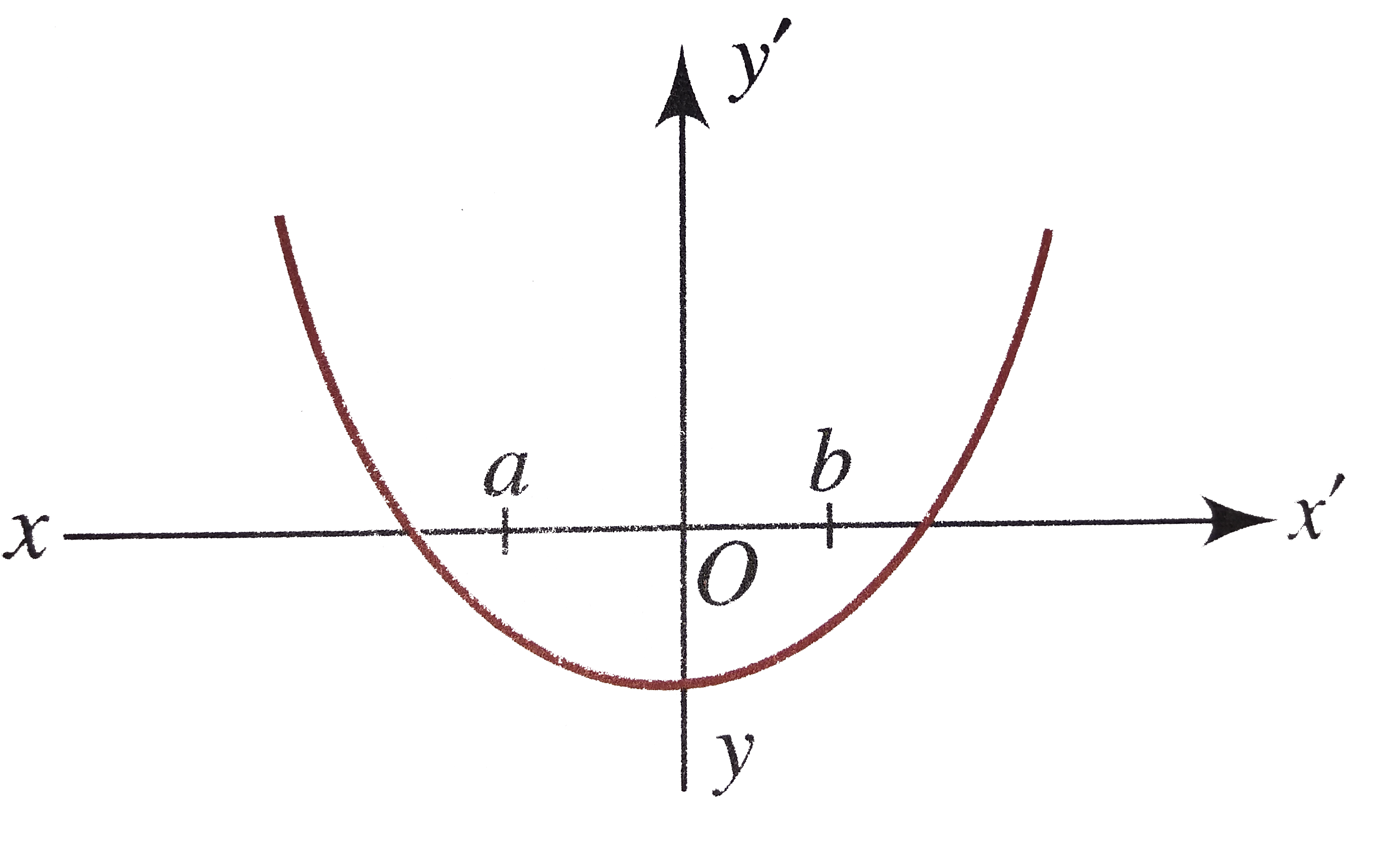 Also `b gt a`, then one root is in `(-OO, a)` and the other is in `(b, +oo)`. |
|
| 5. |
f: R^(+)cup{0} rarrR^(+)cup{0},f(x) = sqrtx. g : R rarr R , g(x)=x^2 -1 then find fog . |
|
Answer» |
|
| 6. |
The value of x that satisfies tan^(-1)(tan -3)=tan^(2)x is |
|
Answer» `(pi)/(3)` `tan^(-1)(tan-3)=tan^(-1)tan(3-pi))=3-pilt0` and `tan^(2)ge0` `THEREFORE tan^(-1)(tan3)=tan^(-1) x` has no solution |
|
| 7. |
Ifalpha, beta, gammaare therootsofx^3 +px^2 +qx +r=0then find sum(1)/( alpha ) |
|
Answer» |
|
| 8. |
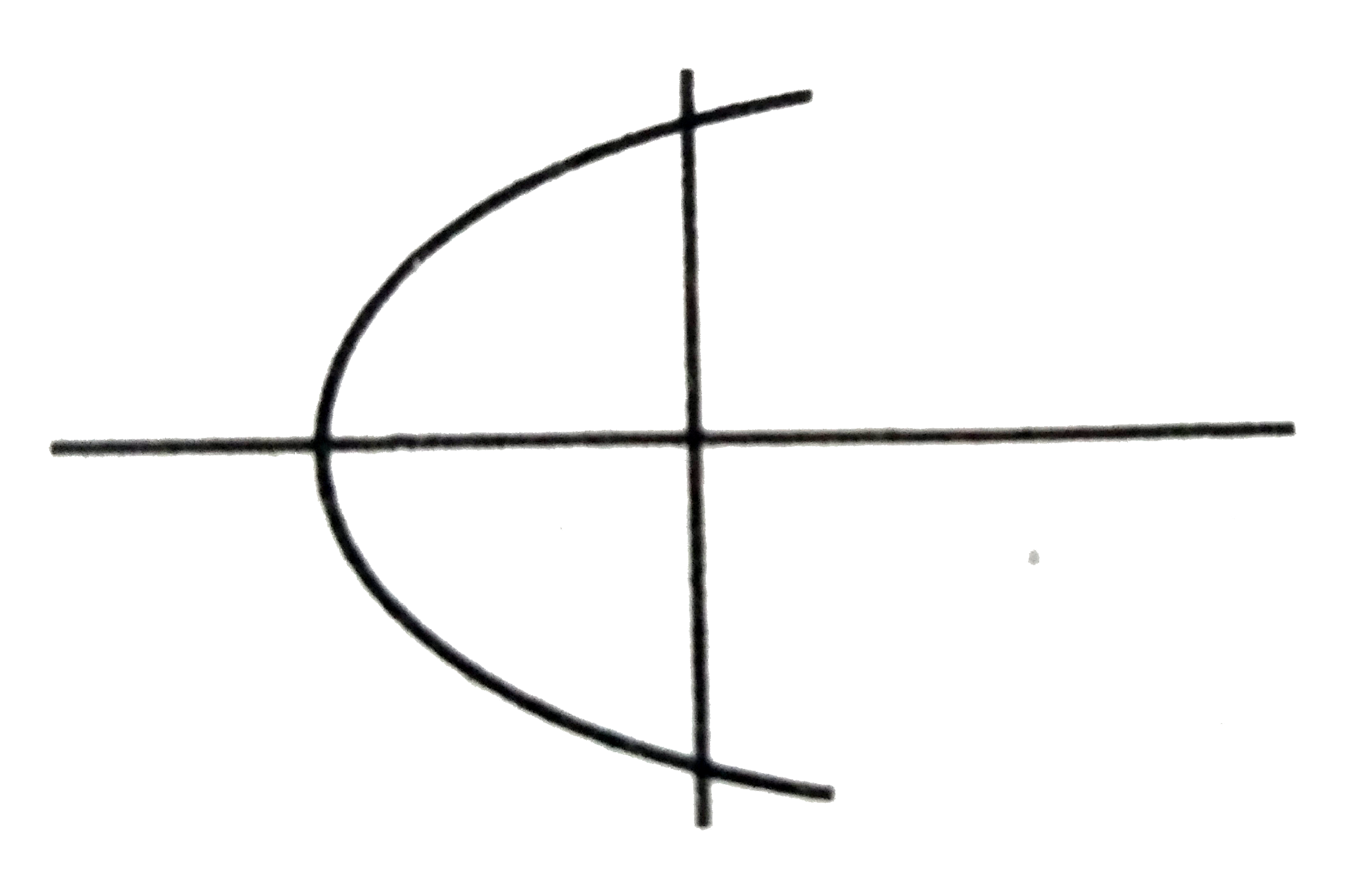
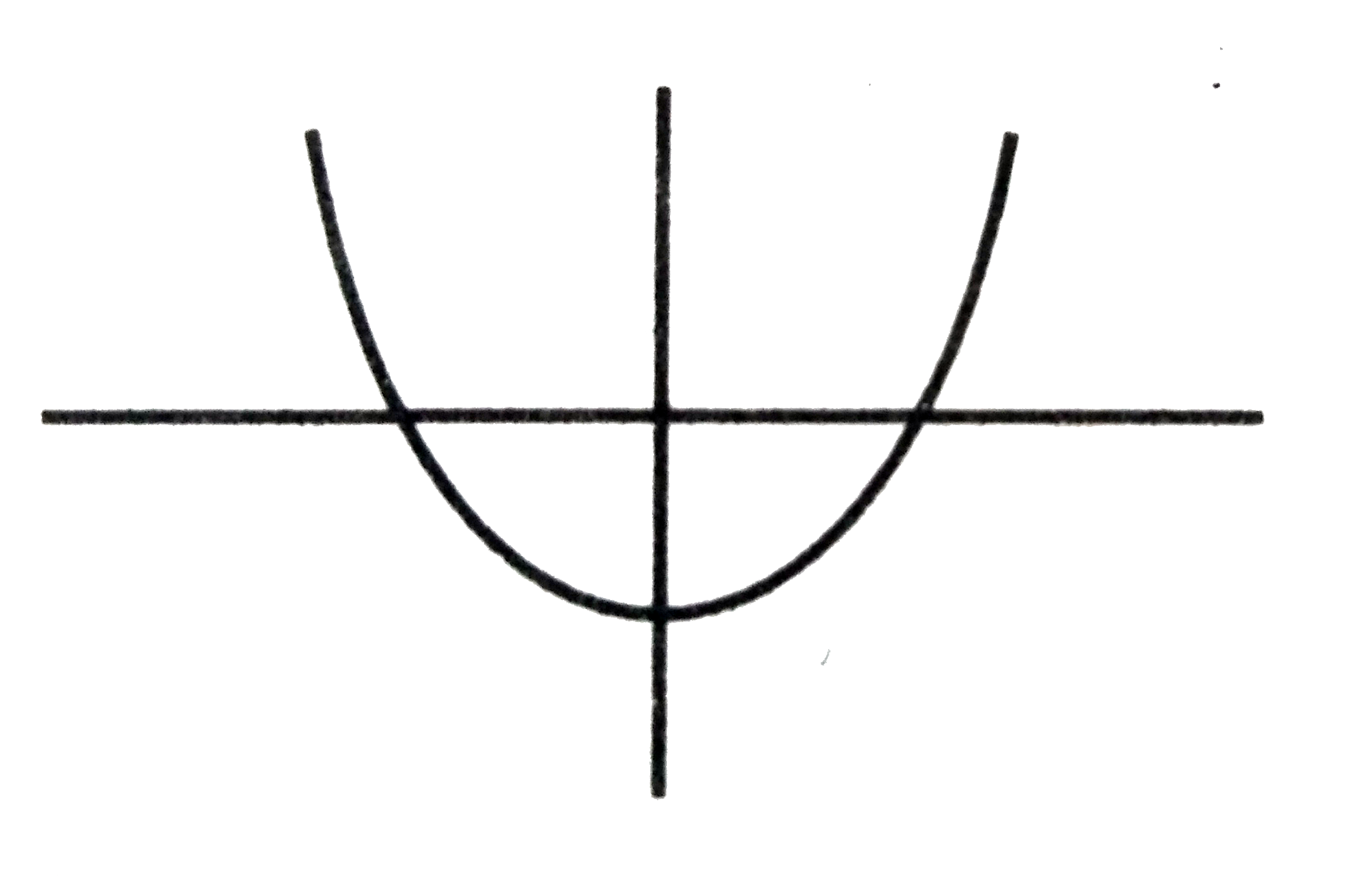
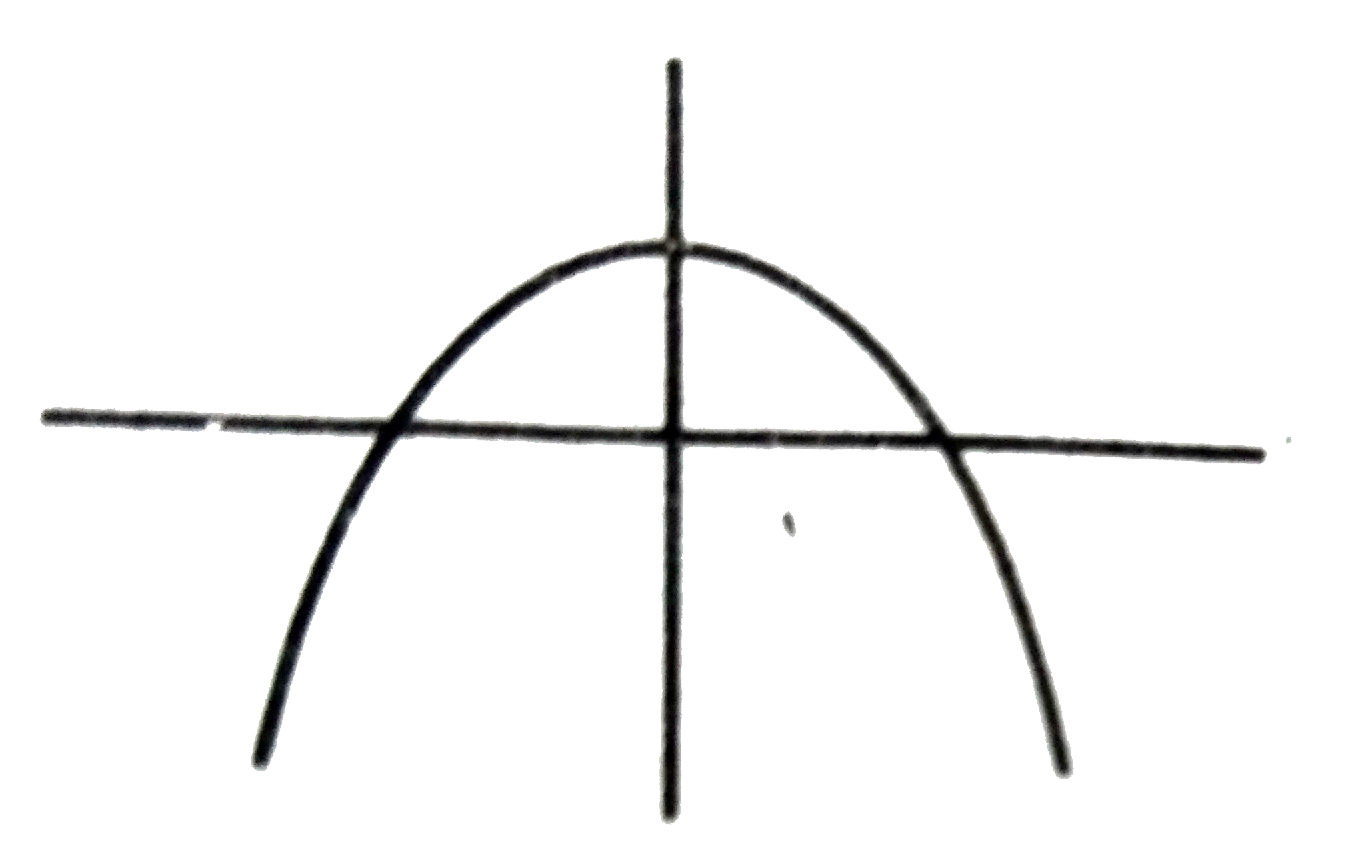
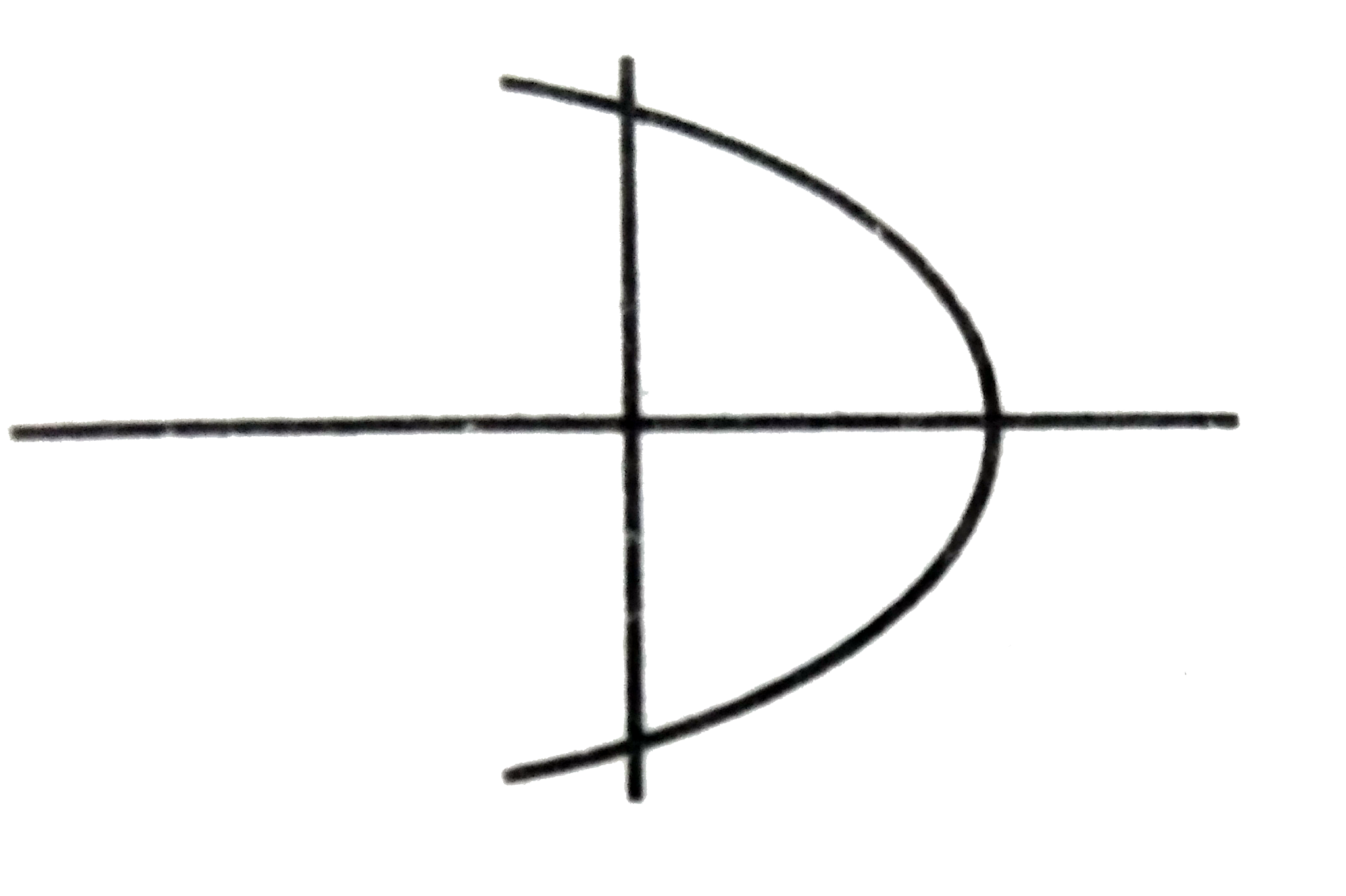
Which of the following curve is represented by y^(2)=1-x? |
|
Answer»
Since, the power of y is even, therefore, curve is symmetrical about x-aixs. Putting x = 0, `y=pm1` Putting y = 0, x = 1 Therefore, the curve passes through the points (1, 0), (0, 1) and (0, -1) Then CLEARLY, the equation `y^(2)=1-x` REPRESENTS the graph. |
|
| 9. |
Two persons A and B toss two coins one after another. The person who throws one head and one tail is the winner. If A starts the game the probability that B wins the game is |
| Answer» Answer :C | |
| 10. |
I : If (a + b) c = (a - b) c = 0 then (a xx b) xx c = 0 II : If a xx (b xx c) is a vector perpendicular to a,b,c |
|
Answer» only I is ture |
|
| 11. |
Let ABCDEF is a regular hexagon A(z_1),B(z_2),C(z_3),D(z_4),E(z_5), F(z_6) in argand plane where A,B,C,D,E and F are taken in anticlockwise manner. If z_1=-2, z_3=1-sqrt3i. |
|
Answer» |
|
| 12. |
Which of the following sentences are propositions and which are not ? Write with reason :Is 9 lt 3 ? |
| Answer» SOLUTION :Is `9 gt 3` ? Is not a PROPOSITION, as it is neither TRUE nor FALSE. | |
| 13. |
|{:(sqrt(14)+sqrt3,sqrt(20),sqrt5),(sqrt(15)+sqrt(28),sqrt(25),sqrt(10)),(3+sqrt(70),sqrt(15),sqrt(25)):}|=....... |
|
Answer» `25sqrt3-15sqrt2` |
|
| 14. |
Find the probability of getting two aces when two cards are drawn from pack of 52 cards. |
|
Answer» |
|
| 15. |
If int_(-20)^(-10)((x^(2)-x)/(x^(3)-3x+1))^(2)+dx+int_(1/21)^(1/11)((x^(2)-x)/(x^(3)-3x+1))^(2)dx + int_(21/20)^(11/10)((x^(2)-x)/(x^(3)-3x+1))^(2)dx=l then l+420/7939 is equal to |
|
Answer» `110/939` We get `L=int_(-20)^(-10) ((x^(2)-x)/(x^(3)-3x+1))(1+1/(x^(2))+1/(1-x)^(2))dx` Let `U=(x^(3)-3x+1)/(x(x-1))` then `l= int(du)/(u^(2))` |
|
| 16. |
Determine the binomial distributionwhose mean is 9 and whose standard deviation is(3)/(2) |
|
Answer» |
|
| 17. |
Prove that tan^(-1)(2/11) + tan^(-1)(7/24) = tan^(-1)(1/2) |
Answer» Solution : L.H.S =`TAN(-1)((2/11 +7/11)/(1-2/11xx7/24)) = tan^(-1)(((48 + 77)/264)/((264-14)/264))` `tan^(-1)(125/250) = tan^(-1)(1/2)` = R.H.S |
|
| 18. |
If harmonic mean of three numbers 2,4, and x is 3, then x is equal to ____________ |
|
Answer» |
|
| 19. |
The order and degree of the differential equation y = ([5+((dy)/(dx))^(2)]^(4//3))/((d^(2)y)/(dx^(2))) is |
|
Answer» (2,1) |
|
| 20. |
Let f(x) lt 0 AA x in (-=oo, 0) and f (x) gt 0 AA x in (0,oo)also f (0)=o, Again f'(x) lt 0 AA x in (-oo, -1) and f '(x) gt AA x in (-1,oo) also f '(-1)=0 given lim _(x to oo) f (x)=0 and lim _(x to oo) f (x)=oo and function is twice differentiable. If f'(x) lt 0 AA x in (0,oo)and f'(0)=1 then number of solutions of equatin f (x)=x ^(2) is : |
|
Answer» 2 |
|
| 21. |
Integrate the functions 2xsqrt(x^(2)+1) |
| Answer» | |
| 22. |
A committee of 4 persons is to be formed from 2 ladies 2 old man and 4 youngmen suchthat it includes at least 1 lady, at least one old man and at most 2 youngmen. Then the total number of ways in whichthiscommitteecan be formed is |
|
Answer» 40 |
|
| 23. |
Let F (x) = (f (x ))^(2) + (f' (x ))^(2), F (0) =6, whtere f (x) is a thrice differentiable function such that|f (x) || le 1 AA x in [-1, 1],then choose the correct statement (s) |
|
Answer» there is ATLEAST ONE point in each of the intervals `(-1,0) and (0,1) ` where `|f' (X) le 2` |
|
| 24. |
Let I_(n) = int _(0)^(pi) (sin (n + (1)/(2))x )/(sin ((x)/(2)))dx wheren in W. If l _(1)^(2)+l _(2)^(2) +l_(3)^(2)+ ……. + l _(20)^(2) =mpi^(2), then find the largest prime factor of m. |
|
Answer» |
|
| 25. |
Given that the event A and B aresuch that P(A) = 1//2, P (Acup B) = 3 //5 and P(B) = P . Find p, if they aremutually exclusive |
|
Answer» |
|
| 26. |
Find the slope of the lines whose inclinations are given.30^@ . |
|
Answer» Solution :SLOPE of the LINE WHOSE inclination is `30^@` `tan30^@=1/sqrt3` |
|
| 27. |
Which of the following statement is//arecorrect? |
|
Answer» `H_(2)S_(3)O_(6)` has TWO S-S linkage |
|
| 28. |
Simplify ((cos alpha + i sin alpha)^(4))/(sin beta + i cos beta)^(8) |
|
Answer» |
|
| 29. |
Statement-I: int_(-4)^(-5)sin(x^(2)-3)dx+int_(-2)^(-1)sin(x^(2)+12x+33)dx=0 Statement-II: int_(0)^(2a)f(x)dx=int_(0)^(a)f(x)dx+int_(0)^(a)f(2a-x)dx |
|
Answer» |
|
| 30. |
int (x^(2))/(x^(4)-x^(2)-12)dx |
|
Answer» |
|
| 31. |
x^(2)+6x+y^(2)-8y=56 If the above equation is written in the form (x-h)^(2)+(y-k)^(2)=r^(2), what is the value of r? |
| Answer» ANSWER :A | |
| 32. |
Point of intersection of tangents to the paraholu (y-2)^(2) = 4(x-1) at the ends of lutus rectum Is |
| Answer» ANSWER :D | |
| 33. |
If y= A sin x+ B cos x, then prove that (d^(2)y)/(dx^(2))+y=0. |
|
Answer» |
|
| 35. |
Number of 3 xx 3 non symmeteric matrix A such that A^(T)=A^(2)-I and |A| ne, 0 equal to |
|
Answer» 0 |
|
| 36. |
(p^(1/4)q^(-3))/(p^(-2)q^(1/2)) Which of the following is equivalent to the expression above, where p gt 1 andq gt 1? |
|
Answer» `(p^2root4p)/(q^3sqrtq)` |
|
| 37. |
f(x)= {((1)/(2)-x ",",0 le x lt (1)/(2)),(1",",x= (1)/(2)),((3)/(2)-x",",(1)/(2) lt x le 1):} Discuss the continuity of f(x) |
|
Answer» |
|
| 38. |
Evaluate int x sqrt(4x + 3)dx. |
|
Answer» |
|
| 39. |
Given f(x) is a periodic function with period 2 and it is defined as ""f(x) = {{:([cos""(pix)/(2)]+1",",,0lt x lt 1), (2-x",",,1 le x lt 2):} Here [*] represents the greatest integer le x. If f(0)=1, then draw the graph of the function for x in [-2, 2]. |
|
Answer» Solution :`f(x)= {{:([cos""(pix)/(2)]+1",",, 0 lt x lt 1), (2-x",",, 1 LE x lt 2):}` `""= {{:(1",",, 0lt x lt 1), (2-x",",,1le x lt 2):}` 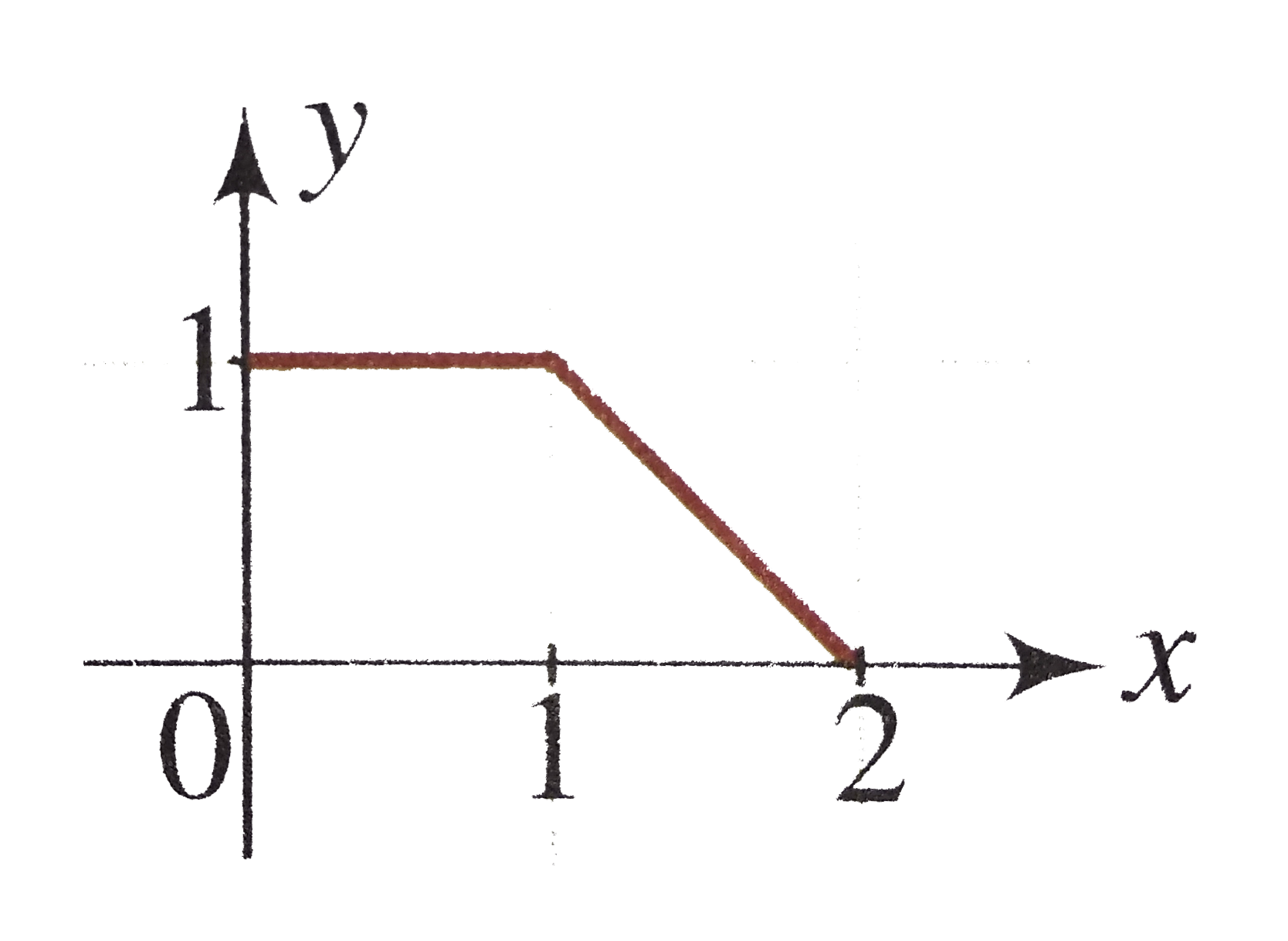 Since the function if periodic with period '2', the REQUIRED graph for `x in [-2, 1]` is as follows. 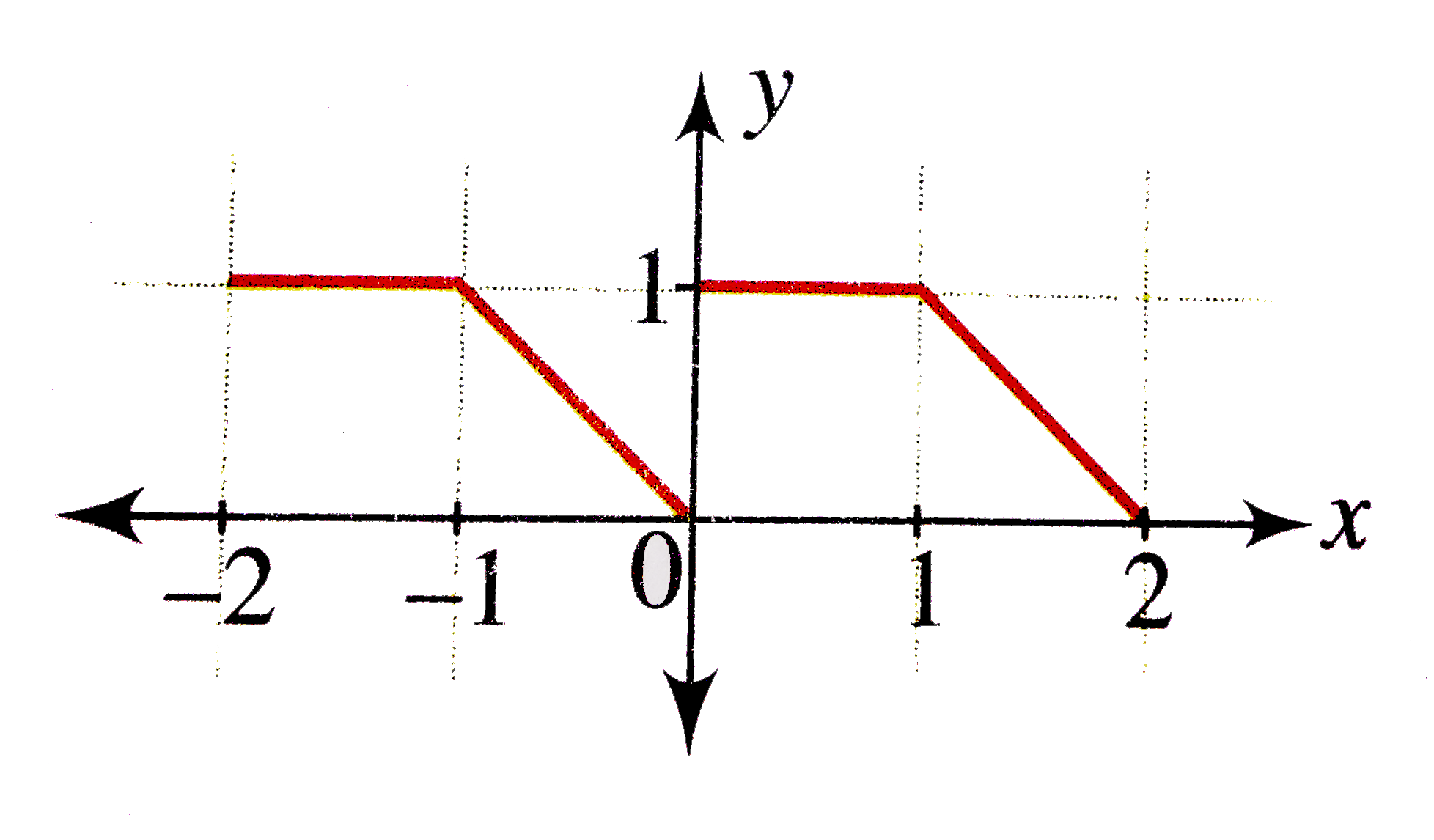
|
|
| 40. |
Show that the height of a cone of maximum volume inscribed in a sphare has the ration with the radius of sphere as 4 : 3. |
| Answer» | |
| 41. |
Integrate the function is exercise. sqrt(1-4x-x^(2)) |
|
Answer» |
|
| 42. |
The system of circle orthogonal tox^(2) + y^(2) + 2gx + 10 = 0is |
|
Answer» `X^(2) + y^(2) - 2GX - 10 = 0` |
|
| 43. |
If possible , using elementary row transformations , find the inverse of the following matrices : (i) [{:(2,-1,3),(-5,3,1),(-3,2,3):}] (ii) [{:(2,3,-3),(-1,-2,2),(1,1,1):}] (iii)[{:(2,0,-1),(5,1,0),(0,1,3):}] |
|
Answer» (ii) `=[{:(1,0,-2),(2,1,-2),(0,0,1):}].A` (III) `A^(-1)=[{:(3,-1,1),(-15,6,-5),(4,-2,2):}]` |
|
| 44. |
Evaluate the following integrals: int(x^3 +5x^2 -4)/x^2 dx |
| Answer» SOLUTION :`INT(x^3+5X^2-4)/x^2 DX = int(x+5 - 4/x^2)dx = x^2/2 +5x-4(-1/x)+C = x^2/2 +5x +4/x +c` | |
| 45. |
Find the unit vectors perpendicular to the vectors. hati+hatj, hati-hatk |
|
Answer» SOLUTION :`(hatixxhatj)xx(hati-hatk)` = `hatixxhati-hatixxhatk+hatjxxhati-hatjxxhatk` = `hatj-hatk-hati` =`-hati+hatj-hatk` THEREFORE `hatn` = `+-((-hati+hatj-hatk)/SQRT3)` |
|
| 46. |
If x is real then the range of (x^(2)-2x+9)/(x^(2)+2x+9) is |
|
Answer» `(-OO, 0] UU (1, oo)` |
|
| 47. |
If the plane passing through the points hati+hatj+hatk,2hati-hatk and the origin meets the line passing through the points hati+3hatj-2hatkandhati-hatj+3hatk at the points A, then A= |
|
Answer» `(1)/(9)(9hati-8hatj+7hatk)` |
|
| 49. |
Leta _(l) = (7)/(4) ((2)/(3)) ^( l -1), j in N.lf b _(1) = a _(j) ^(2) + a _(j),sum of the infinite sereies formed by b _(j) 's is (10 + alpha ) where [ (1)/( alpha ) ] is equal to ([] represent greatest integer function) |
|
Answer» |
|