Saved Bookmarks
This section includes 7 InterviewSolutions, each offering curated multiple-choice questions to sharpen your Current Affairs knowledge and support exam preparation. Choose a topic below to get started.
| 1. |
Differentiate w.r.t.x the function in Exercises 1 to 11. (cos^(-1)""(x)/(2))/(sqrt(2x+7)), -7 lt x lt2. |
|
Answer» |
|
| 2. |
Consider the equation x^(5) + 5lambdax^(4) -x^(2) + (lambdaalpha-4)x^(2) - (8lambda +3) x +(lambdaalpha-2)=0, where lambda, alpha in R (i) Determine a such that the given equation has exactly one root independent of lambda. (ii) Determine a such that the given equation has exactly two roots independent of lambda . |
|
Answer» |
|
| 3. |
If therootsof 54x^3 -39x^2 - 26 x^2- 26 x+16 =0are in G.Pthenonerootis |
|
Answer» `-2/3` |
|
| 5. |
Evaluation of definite integrals by subsitiution and properties of its : int_(1)^(2)e^(-(1)/(x))(dx)/(x^(2))=............ |
|
Answer» `(1)/(e)+(1)/(e^(2))` |
|
| 6. |
The solution of (dy)/(dx) = tan^(2) (x+y) is |
|
Answer» `SIN (2X + 2Y) = 2x + 2y + C` |
|
| 7. |
Evaluation of definite integrals by subsitiution and properties of its : int_(0)^(pi)sin2x.cos^(2)3xdx=............ |
| Answer» Answer :D | |
| 8. |
I: The equation whose roots are the squares of the roots of x^(3) - x^(2) + 8x - 6 = 0is x^(3) + 15x^(2) + 52x + 36 = 0. II: The equation whose roots are the cubes of the roots of x^(3) + 3x^(2) + 2 = 0is x^(3) + 33x^(2) + 12x + 8 = 0 . |
|
Answer» only I is TRUE |
|
| 9. |
If for any real x,(11x^(2)+12x+6)/(x^(2)+4x+2)= y is such that ylt a or y ge b, then a, b are |
| Answer» ANSWER :B | |
| 10. |
If f(x)={:{((|x|)/(x)", for " x!=0),(1", for " x=0):}, then |
|
Answer» `underset(x rarr 1^(-))LIM F(x)=1` |
|
| 11. |
Findthe areaof theregionenclosedby {(x,y):0 le y le x^2 +1,0 le y lex+1 ,0 le x le 2}. |
|
Answer» |
|
| 12. |
Let f (x) be a polynomial satisfying lim _(x to oo) (x ^(4) f (x))/( x ^(8) +1)=3 f (2) =5, f(3) =10, f (-1)=2, f (-6)=37The number of points of discontinuity of discontinuity of f (x)= (1)/(x ^(2)+1 -f (x))in [(-15)/(2), (5)/(2)] equals: |
|
Answer» 4 |
|
| 13. |
If (""^(n)P_(r)-1)/(a)=(""^(n)P_(r))/(b)=(""^(n)P_(r)+1)/(c) ,then which of the following hold good? |
|
Answer» `C^(2)`=a(B+c) |
|
| 14. |
{:abs((1,bc+ad,b^(2)c^(2)+a^(2)d^(2)),(1,ca+bd,c^(2)a^(2)+b^(2)d^(2)),(1,ab+cd,a^(2)b^(2)+c^(2)d^(2))):}= |
|
Answer» (a - B)(b - C) (c - d) (a - d) (a - c) (d - b) |
|
| 15. |
Let f: {2, 3, 4, 5} rarr{3, 4, 5, 9} and g : {3, 4, 5, 9} rarr {7, 11, 15}be functions defined as f (2) = 3, f(3) = 4, f(4) = f(5) = 5 and g(3) = g(4) = 7 and g(5) = g(9) = 11. Find gof. |
|
Answer» |
|
| 16. |
Let the vectors vec(PQ),vec(QR),vec(RS),vec(ST),vec(TU) and vec(UP) represent the sides of a regular hexagon. Statement 1: vec(PQ)xx(vec(RS)+vec(ST))!=vec0 Statement 2: vec(PQ)xxvec(RS)=vec0 and vec(PQ)xxvec(ST)!=vec0 |
|
Answer» 1 `:.vec(PQ)XX(vec(RS)+vec(ST))!=vec0` So STATEMENT-1 is TRUE. Also, `vec(PQ)` is not parallel to `vec(RS)`  `:.PQxxvec(RS)!=vec0` So, statement -2 is not true. |
|
| 17. |
Equation of pair of lines passing through (2, 1) and perpendicular to the lines 16x^(2) + 17 xy + 12 y^(2) = 0 is |
|
Answer» `12X^(2) - 17 xy + 6 y^(2) - 31x - 22y + 64 = 0` |
|
| 18. |
There are 21 points in a plane no three of which are collinear. The number of triangles formed by joining them is |
|
Answer» 1330 |
|
| 19. |
OABC is a tetrahedron in which O is the origin and position vector ot points A, B, C are hati+2hatj+3hatk,2hati+alpha hatj+hatk and hati+3hatj+2hatk respectively. An integral value of alpha for which shortest distance between OA and BC is sqrt((3)/(2)). |
|
Answer» |
|
| 20. |
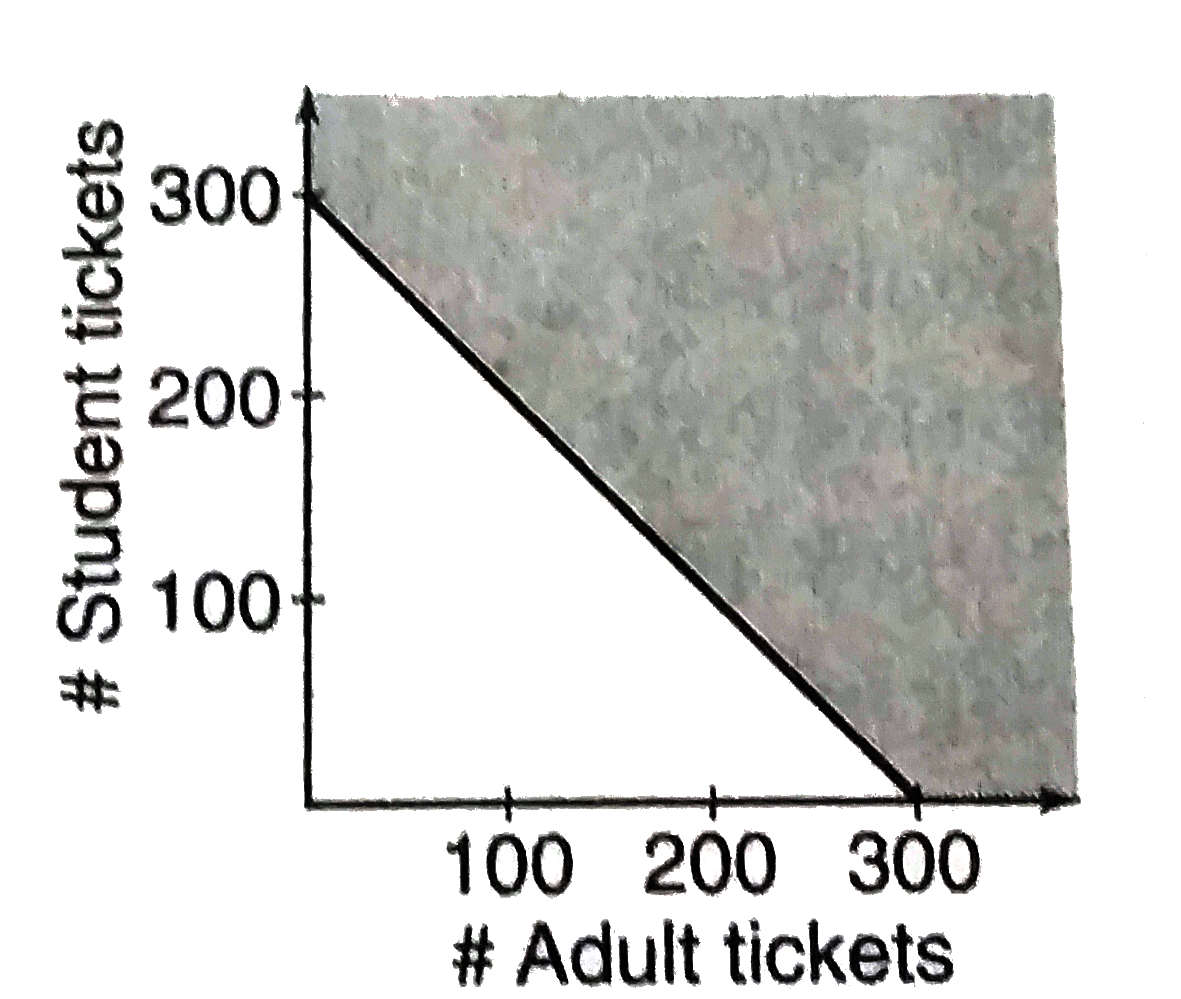
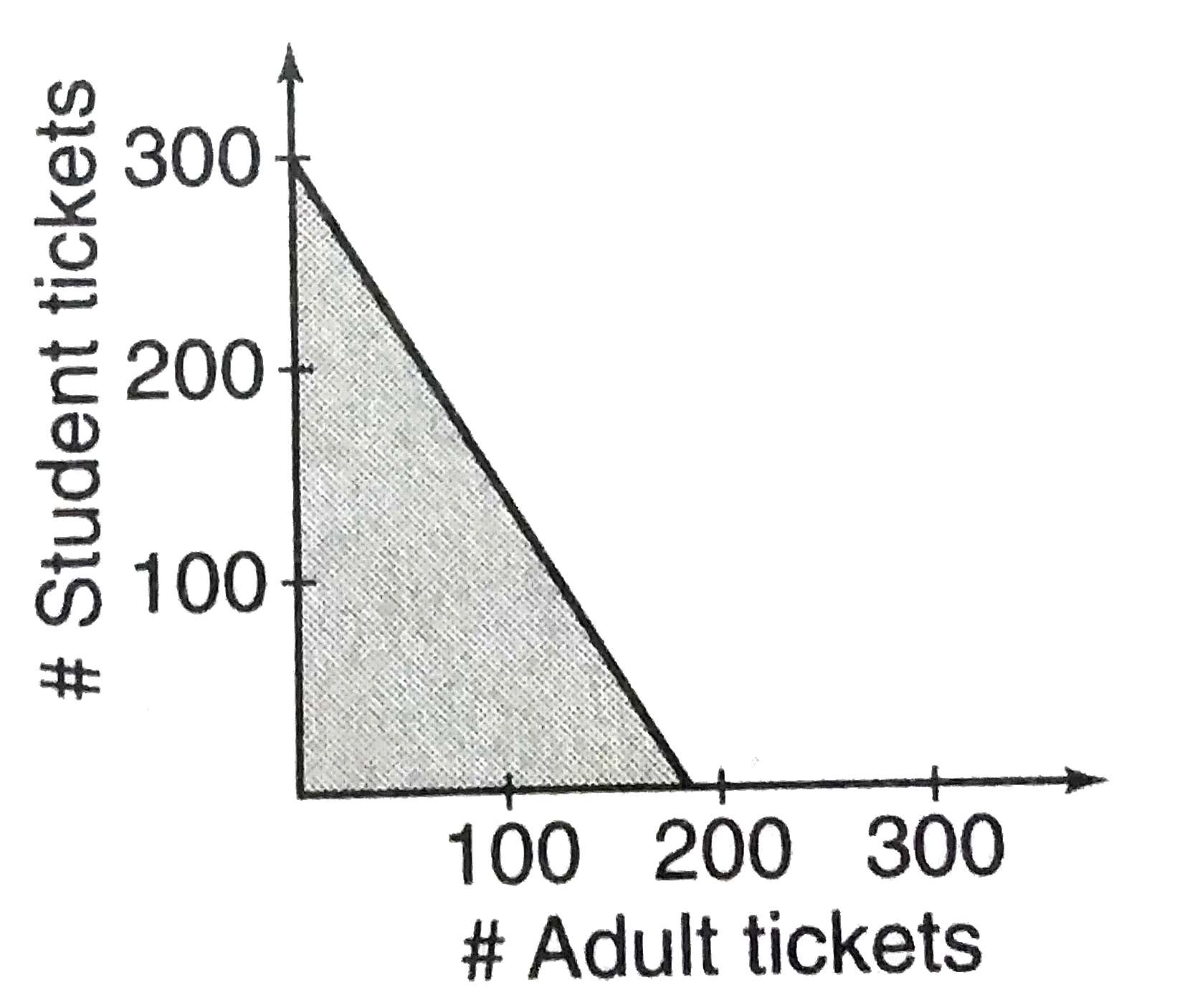
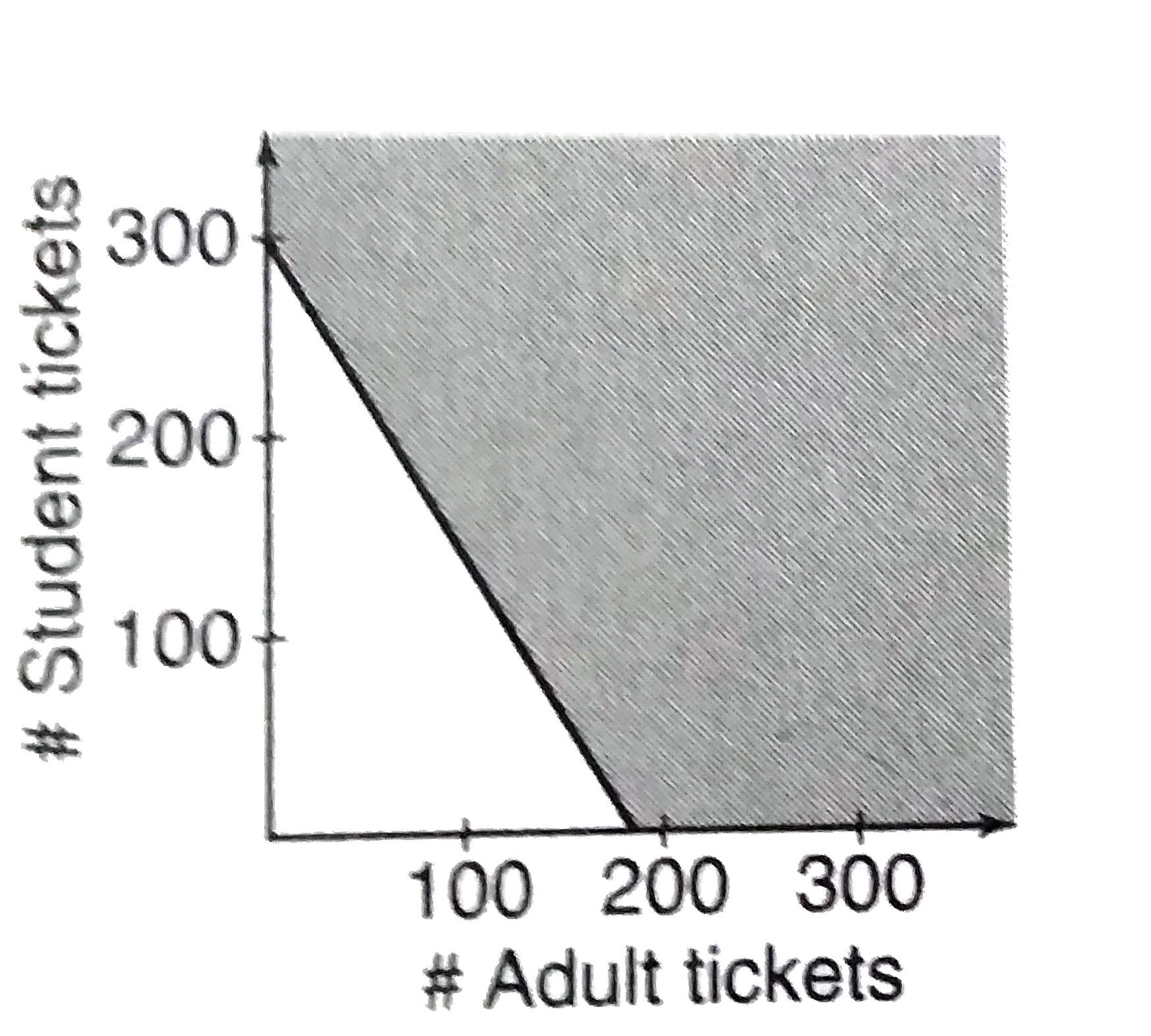
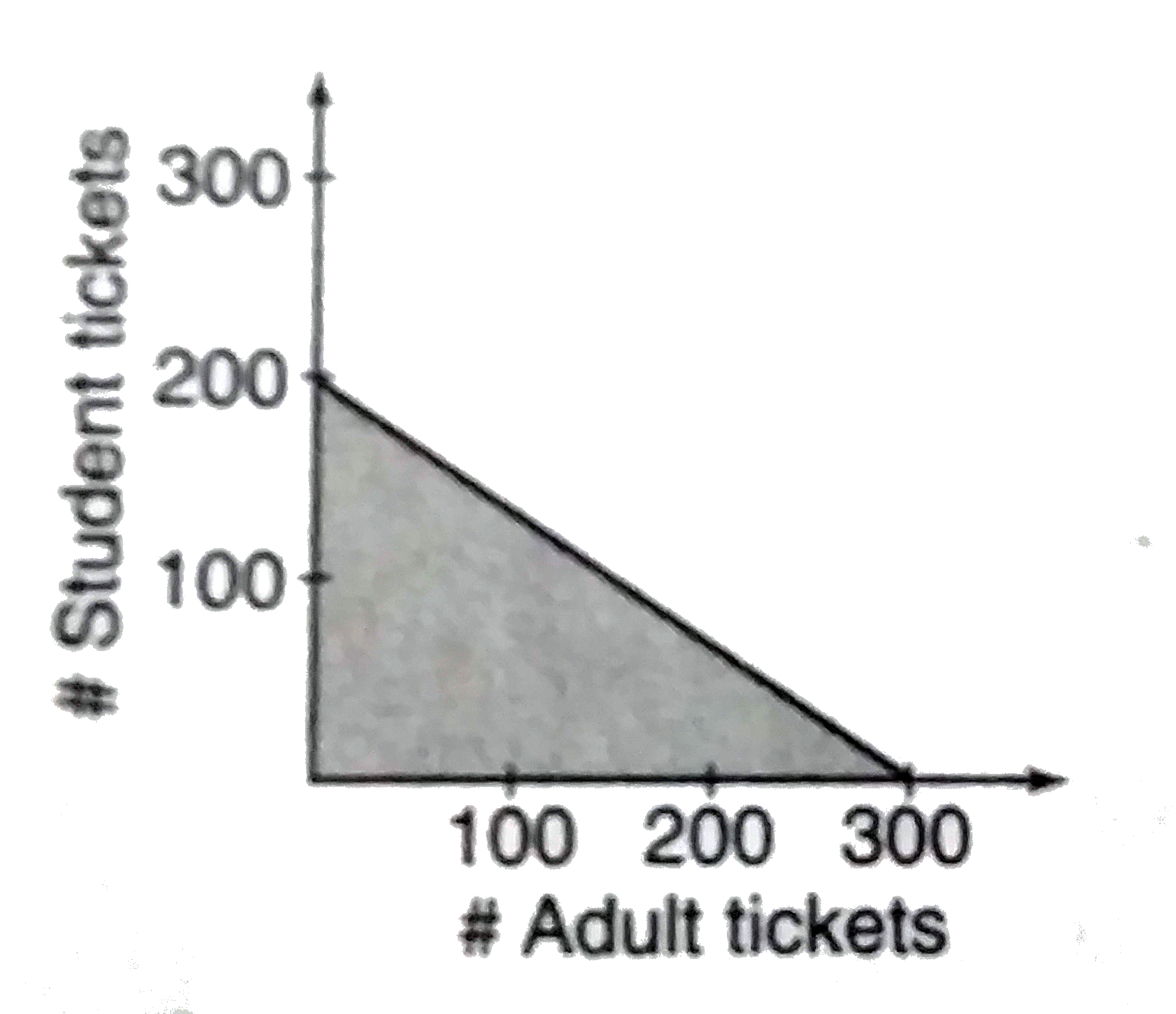
Tickets to the annual Follies Show at Littleton High School are $4 for adults and $2.50 for students. There is a cost of $750 to produce the show. If the x-axis represents the number of adult tickets sold and the y-axis represents the number of student tickets sold, which graph represents all the possible combinations of ticket sales that allow the junior class to at least cover the cost of the show ? |
|
Answer»
|
|
| 22. |
A tennis ball receives a top spin when struck by a racket and describes a curved trajectory. The top spin implies that the rotatory motion of the top surface of tha ball is in the direction of the translatory motion of the ball. Which one of the following statement is the best description of the trajectory ? |
|
Answer» PRESSURE on the top surface is LOWER, trajectory RISES In ball's frame `v_("air")=v+wr` `v_("air")=v-wr` APPLYING Benoulli's `P_("above") GT P_("below")` `:.` trajectory dipes 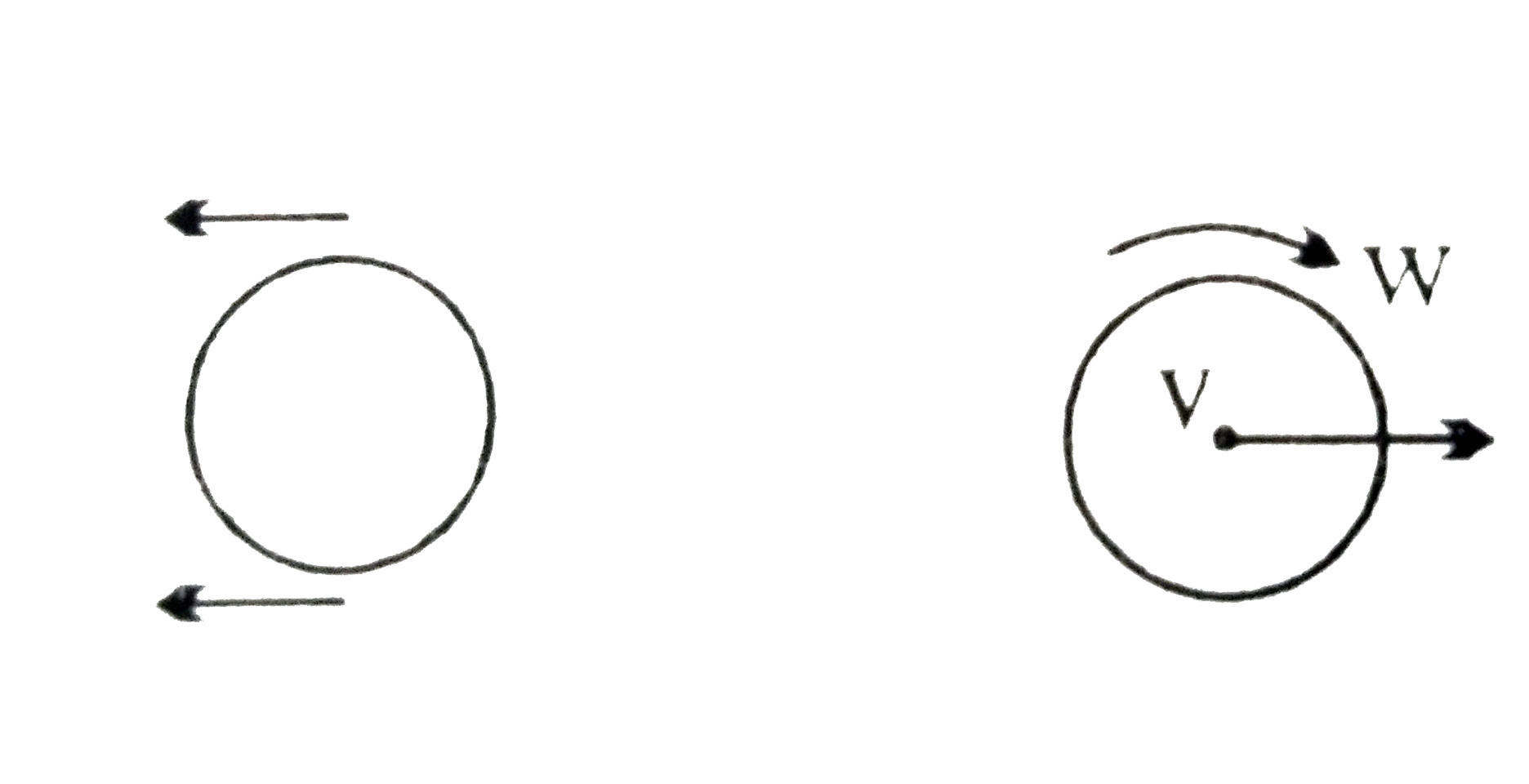
|
|
| 23. |
Find graphically the minimum value of Z = 100x + 50y, subject to the constraints x + y le 300, 3x + y le 600, y le x + 200, x ge 0, y ge 0. |
|
Answer» |
|
| 24. |
If y =tan^(-1)((5x)/(1-6x^(2))),where (-1)/(sqrt6)ltxlt(1)/(sqrt6)"then prove that"(dy)/(dx)=((2)/((1+4x^(2)))+(3)/((1+9x^(2)))). |
| Answer» | |
| 25. |
Evalute the following integrals int (1)/(3x^(2) + x + 1) dx |
|
Answer» |
|
| 26. |
If p=cos2 alpha+isin2 alpha,q=cos2beta+isin2beta then sqrt(p//q)-sqrt(q//p)= |
|
Answer» `2isin(alpha+beta)` |
|
| 27. |
If g(x) = lim_( n to oo)(x^(m)f(x) + h(x)+1)/(2x^(m) + 3x +3) is continuousat x =1 and g(1) = lim_(x to 1) (log{e^(x)})^(2/(log_(e)x)) ,such thatA g(1) + B f(1) + C h(1)= 1, and(A + B + C)^(n) = 243then n is |
|
Answer» |
|
| 28. |
Differentiate cos^(-1) ((sin x + cos x)/(sqrt2)), - (pi)/(4) lt x lt (pi)/(4) |
|
Answer» |
|
| 29. |
Resolve (1)/((x+1)^(6)(x+2)) into partial fractions. |
|
Answer» |
|
| 30. |
{:(" "Lt),(n rarr oo):}1/n { f(1/n)+f(2/n)+...+f(2)}= |
|
Answer» `int_(0)^(1) F(1/X)dx` |
|
| 32. |
An ellipse drawn by taking a diameter of the circle (x-1)^(2)+y^(2)=1 as its semiminor axis and a diameter of the circle x^(2)+(y-2)^(2)=4 as its semi-major axis. If the centre of the ellipse is at the origin and its axes are the coordinate axes, then the equation of the ellipse is |
|
Answer» `4x^(2) +y^(2) =4` |
|
| 33. |
If A and B are any two events such that P(overset(_)A)=0.4, P(overset(_)B)=0.9 then what is the value of P(overset(_)A cup overset(_)B) equal to |
|
Answer» 0.2 `P(overset(_)A )=P(overset(_)B)-P(overset(_)A cup overset(_)B)"By(De-Morgan's LAW")` `P(overset(_)A )=P(overset(_)B)-(1-P(overset(_)A cup overset(_)B))=4+3-(1-9)=6` |
|
| 34. |
Discuss the monotonicity and local extrema of the function f(x)=log (1+x)-(x)/(1+x), x gt -1 and hence find the domain where, log (1+x) gt (x)/(1+x) |
|
Answer» |
|
| 35. |
What do the{z:|z-a|-|z+a|=c} represent? |
|
Answer» SOLUTION :Here`{Z:|z-a|-|z+a|=c}` implies that , the difference of the DISTANCES of the point (x,y) from TWO fixed points'-a'and'a" is a CONSTANT i.e.c. So the locus is a hyperbola. |
|
| 36. |
Write the vector equation of a line through the point (1,2,3) and parallel to the vector 3overset^i+2overset^j-2overset^k |
| Answer» Solution :The parameric EQUATION of the LINE through `(1,-1,2) and parallel to the VECTOR `(3overset^i+overset^j-overset^k)` are x=1+3lambda,y=-1+lambda,z=2-lambda` | |
| 37. |
If n positive integers are taken at random and multiplied together, the probability that the last digit of the product is 2,4,6, or 8 is |
|
Answer» `(5^n -3^n)/(5^n)` |
|
| 38. |
Consider a curved mirror y = f(x) passing through (8, 6) having the property that all light rays emerging from origin, after reflected from the mirror becomes parallel to x-axis. The equation of the mirror is y^(a) = b(c-x^(d)) where a, b, c, d are constants, then |
| Answer» Answer :B::C | |
| 39. |
"Sec" (tan sqrt(x)). |
|
Answer» |
|
| 40. |
Prove that sin15^@ = (sqrt3-1)/(2sqrt2) |
| Answer» Solution :`sin15^@=sin(45^@-30^@)=SIN45^@cos30^@-COS45^@SIN30^@=1/(sqrt2).sqrt3/2-1/sqrt2.(1)/2=(sqrt3-1)/(2sqrt2)` | |
| 41. |
LetA={:[( 1,sin theta , 1),( -sin theta , 1, sin theta ),( -1 ,-sin theta , 1 )]:} ,"where" 0 letheta le 2pi ,Then |
|
Answer» `DET(A) =0` |
|
| 42. |
Find the range of the following functions f(x) = log_e (2 sin x + tan x -3x +1) where pi/6 lt x lt pi/3 |
|
Answer» |
|
| 43. |
{:(,"Column - I", "Column - II"),("(A)" ,"The area bounded by curve","(P)"2 ),(, x = 3y^(2) – 9" and the", ),(,"lines x = 0, y = 0 and y = 1 ",),(,"in square units is equal to",),("(B)", "If a curve "f(x) = a sqrt(x) + bx, (Q)4 ),(,(f(x)ge0AAx in [0,9]),),(,"passes through the point",),(,"(1, 2) and the area bounded ",),(,"by the curve, line x = 4 ",),(,"and x-axis is 8 square unit,",),(,"then 2a + b is equal to",),("(C)", "The area enclosed between", (R)8 ),(,"the curves " y = sin^(2)x and,),(,y = cos^(2)x" in the interval",),(,0 le x le pi " in square units is",),(,"equal to ",),("(D)","The area bounded by the", (S)5 ),(,"curve " y^(2) = 16 x" and line",),(,y=mx " is " 2/3 "square units, ",),(,"then m is equal to",):} |
|
Answer» |
|
| 44. |
The roots of the equation x^(3)-3x-2=0 are |
|
Answer» `-1, -1,2` |
|
| 45. |
Consider ax ^(4) +(7a -2b) x ^(3) + (12a-14b-c ) x^(2) - (2ab +7c) x+1-12c =0, has no real roots and f _(1)(x)=sqrt(log _((pi+e))(ax ^(4) + (7a-2b) x ^(3) + (12a-14b-c) x ^(2) -(24 b +7c) x+1 -12c))/(sqrta sqrt(- sgn (1+ ac+ b^(2)))) f _(2) (x) = -2+ 2log _(sqrt2) cos (tan ^(-1) (sin (pi(cos (pi ( x+ (7 )/(2))))))).Then match the following : |
|
Answer» <P> |
|
| 46. |
Find which of the operations given above has identity. a"*"b=ab^2 |
|
Answer» |
|
| 47. |
Differentiate the functions with respect to x in cos (sqrtx) |
|
Answer» |
|
| 48. |
4^(n+1) + 15n + 14 is divisible by 9 for every natural number n ge 0. |
|
Answer» Solution :Let`P_n = 4^(n+1) + 15n + 14` When n = 1, `4^2 + 15 + 14 = 45` is divisible by 9. `therefore P_1` is true. Let `P_k` be true. i.e , `4^(k+1) + 15k + 14` is divisible by 9. Now `4^(k+1+1) + 15(k+1) + 14` = `4^(k+2) + 15k + 29` `4(k+1).4 + 60k + 56 - 45k - 27` = `4(4^(k+1) + 15k + 14) - 9(5k+3)` Which is divisible by 9. `therefore P_(k+1)` is true. `therefore P_n` is true for all VALUES of `n ge 0`. |
|
| 49. |
If I_n = int_(pi//2)^(oo) e^(-x) x dx], then(I_(2018) )/(I_(2016)) = |
|
Answer» `(2018 XX 2019)/((2017)^2 + 1)` |
|