

Saved Bookmarks
This section includes 7 InterviewSolutions, each offering curated multiple-choice questions to sharpen your Current Affairs knowledge and support exam preparation. Choose a topic below to get started.
| 1. |
Show that the line 5x + 12y - 4 = 0 touches the circle x^(2)+ y^(2) -6x + 4y + 12 = 0 |
|
Answer» |
|
| 2. |
If l and m are the degree and the order respectively of the differential equation of the family of all circles in the XY plane with radius 5 units. Then 2l + 3m = |
|
Answer» 5 |
|
| 3. |
If the coefficient of (3r)^(th) and (r + 2)^(th) terms in the expansion of (1 + x)^(2n) areequal then n = |
| Answer» ANSWER :A | |
| 4. |
Find the relationship between a and b so that the function f defind by f(x)= {(ax+1, if x le 3),(bx+3, if x gt 3):} is continuous at x=3 |
|
Answer» |
|
| 5. |
Find the point on the curve y=x^(3)-11x+5 at which the tangent is y=x-11. |
|
Answer» |
|
| 6. |
On C, the set of complex number, define a relation R as follows: R ={(z_(1), z_(2)) : z_(1) , z_(2) in C, |z_(1) + z_(2)| = |z_(1)| + |z_(2)|} |
|
Answer» R is antisymmetric |
|
| 7. |
Consider f(x) =x^(2)+ax+3 and g(x)=x+bandF(x) = lim_( n to oo)(f(x)+x^(2n)g(x))/(1+x^(2n)) if F(x)is continuous at x=+-1, thenf(X)=2g(X)has |
|
Answer» IMAGINARY roots |
|
| 8. |
Let f : N to R be a function defined as f'(x) = 4x ^(2) + 12x + 15. Show that f: N to S. where, S is the range of f, is invertible. Find the inverse of f. |
|
Answer» |
|
| 9. |
There are 10 points in a plane of which no three points are collinear except 4. Then, the number of distinct triangles that can be formed by joining these points such that atlest one of the vertices of every triangle formed is formed the given 4 collinear points is |
|
Answer» 116 |
|
| 10. |
PA and PB are tangents drawn from a point P to the ellipse (x^2)/(a^2)+(y^2)/(b^2)=1. The area of the triangle formed by the chord of contact AB and axes of co-ordinates is constant. Then locus of P is: |
|
Answer» ellipse |
|
| 11. |
Let H be the orthocenter of an acute - angled triangle ABC and O be itscircumcenter. Then vec(HA)+vec(HB)+vec(HC) |
|
Answer» is equal to `vec(HO)` `G=(A+B+C)/(3)` `G=(20+H)/(3)` `2O+H=3G` `vec(HA)+vec(HB)+vec(HC)=vec(A)-vec(H)-vec(B)+vec(C)-vec(H)` `=vec(A)+vec(B)+vec(C)-3vec(H)` `=3vec(G)-3vec(H)` `=2vec(O)+vecH-3vec(H)` `=2vec(O)-2vec(H)` `=2vec(HO)` |
|
| 14. |
Obtain the following integrals : int (1)/(x sqrt(x^(4)-1))dx |
|
Answer» |
|
| 15. |
If the distance between the palens 2x- y + 2z = 1 and 4x-2y + 4z = k is 1/6 then k = ............... |
| Answer» ANSWER :B | |
| 16. |
If alpha, beta are the roots of 3x^(2) + 5x - 7 = 0 then (1)/(3alpha+5)^(2)+ (1)/(3beta+5)^(2)= |
|
Answer» `-(17)/(21)` |
|
| 17. |
If (vec(a)-vec(b)).(vec(a)+vec(b))=27 and |vec(a)|=2|vec(b)| the find |vec(a)| and |vec(b)|. |
|
Answer» |
|
| 18. |
If 'k' isa parameter then the equation of family of lines through the intersetion of the lines x+2y=5 and x-3y =7 is : |
|
Answer» (1+k)X-(2-3k)y-(5+7k)=0 |
|
| 19. |
If omega is cube root of unity, then tan{(omega^(200)+1/(omega^(200)))pi+pi/4} equals |
| Answer» Answer :A | |
| 20. |
Find the number of ways to arrange 8 persons around circular table id two specified persons wish to sit together |
|
Answer» |
|
| 21. |
The sum of the first 2n terms of an A.P. is x and the sum of the nextn terms is y, its common difference is : |
|
Answer» `(X- 2y)/(3N ^(2))` |
|
| 22. |
Assume that the chances of a patient having a heart attack is 40%. It is also assumed that a meditation and yoga course reduce the risk of heart attack by 30% and prescription of certain drug reduces its chance by 25%. At a time a patient can choose any one of the two options with equal probabilities. It is given that after going through one of the two options the patient selected at random suffers a heart attack. Find the probability that the patient followed a course of meditation and yoga? |
|
Answer» |
|
| 23. |
Find the equation of the ellipse whose length of major axis is 4 and length of latus rectum is 2. |
| Answer» | |
| 24. |
Find derivatives of the following functions.sin^(-1)2x |
|
Answer» Solution :`y=sin^(-1)2X` Then `dy/dx=1/sqrt(1-(2x)^2).d/dx(2x)`[`becaused/dx(sin^(-1)U) |
|
| 25. |
Match the following {:("I. The line passing through (5, 4) with slope "-7//2 "is", (a) 2x-y+5=0), ("II. The altitude through A of triangle ABC where",(b) 5x-9y+4=0), ("A(1, 1), B(-3, 4), C(2, -5) is",),("III. The perpendicular bisector of the line segment joining" , (c) 7x+2y-27=0),("(1,2), (-3, 4) is",) , ("IV. The line perpendicular to " 2x+3y-4=0 " and passing ", (d) 3x-2y=0) , ("through origin is", ):} |
|
Answer» d, B, a, E |
|
| 26. |
Differentiate the functions (x + (1)/(x))^(x) + x^((1 + (1)/(x))) |
|
Answer» |
|
| 27. |
Find the order and degree of the differential equation (d^(2)y)/(dx^(2))=cos3x+sin3x |
|
Answer» |
|
| 28. |
If 0 lt x lt 1 and y = x - x^(2) + x^(3) - x^(4) + ....... infty then y + y^(2) + y^(3) + ......... infty is equal to |
|
Answer» `X` |
|
| 29. |
int_(0)^(pi) (x)/(1+cos^(2)x)dx= |
|
Answer» `(1)/(2sqrt(2))` |
|
| 30. |
Find the equation of the circle with centre (-2, 3) cutting a chord length 2 units on3x + 4y + 4 = 0 |
|
Answer» |
|
| 31. |
The radical centre of the circles x^(2) + y^(2) = 1, x^(2) + y^(2) - 2x - 3 = 0 and x^(2) + y^(2) - 2y - 3 = 0 is |
|
Answer» (1,1) |
|
| 33. |
Let A (2,3,5) , B ( -1,3,2)and C( lambda ,5, mu )be the vertices ofa Delta ABC ,If the median through A is equally inclined to the coodinate axes, then |
|
Answer» `5 LAMBDA -8mu =0` |
|
| 34. |
Let alpha + beta = 1, 2 alpha^(2) + 2beta^(2) = 1 and f(x) be a continuous function such that f(2 + x) + f(x) = 2 for all x in [0, 2] and p = int_(0)^(4) f(x) dx - 4, q = (alpha)/(beta). Then, find the least positive integral value of 'a' for which the equation ax^(2) - bx + c = 0 has both roots lying between p and q, where a, b, c in N. |
|
Answer» |
|
| 35. |
lim_(xto-2)[x] |
|
Answer» SOLUTION :L.H.L.`=lim_(xto-2-)(x-2)/|x-2|` `=lim_(hto0)[-2-h]=-3` R.H.L.`=lim_(xto-2+)[x]=lim_(hto0)[-2+h]=-2` Thus `L.H.L.neR.H.L.` So the limit does not exist. |
|
| 36. |
The mean of two samples of sizes 200 and 300 were found to be 25, 10 respectively. Their standard deviations were3 and 4 respectively. The variance of combined sample of size 500 is |
|
Answer» 64 |
|
| 37. |
If O=(0,0),A=(1,0) and B=(1/2,(sqrt(3))/2) then centre of circle for which the lines OA, OB and AB are tangents is |
|
Answer» `(1/2), 1/(2sqrt(3))` |
|
| 38. |
Equation of normal to 9x^(2)-25y^(2)=225 at theta=pi//4 is |
|
Answer» `5x+3 sqrt2y=34sqrt2` |
|
| 39. |
If alphaandbeta are the roots of x^(2)-2x+4=0" then "alpha^(n)+beta^(n) |
|
Answer» `2^ncos(npi//2)` |
|
| 40. |
Let A = {a,b,c,d} and R = {(a,b),(a,c),(a,d), (b,c), (b,d), (c,d)} then R =R is equal to |
|
Answer» {(a,B),(a,C),(b,d),(c,d)} |
|
| 41. |
Evaluate lim _( n to oo) 1/n [ (1)/( n + 1)+ (2)/(n + 2)+...+ (3n )/(4n)] |
|
Answer» |
|
| 42. |
The shadow of tower standing on a level plane is found to be 60 metres longer when the altitude of be san is 30∘ than when it is 45∘.Then the height of the tower (in metres) is: |
|
Answer» `20 ( SQRT 3 +1)` |
|
| 44. |
Let f(x)=ln(2+x)-(2x+2)/(x+3). Statement I The function f(x) = has a unique solution in the domain of f(x). Statement II f(x) is continuous in [a, b] and is strictly monotonic in (a, b), then f has a unique root in (a, b). |
|
Answer» |
|
| 45. |
What value of x makes the proportion below true? (10)/(10+x) = 35/42 |
|
Answer» 2 |
|
| 46. |
Let ABCD be a square. An arc of a circle with A as centre and AB as radius is drawn inside the square joining the points B and D. Points P on AB, S on AD,Q and R on are taken such that PQRS is a square. Further suppose that PQ and RS are parallel to AC. "Then"("areaPQRS")/("areaABCD") is |
|
Answer» `1/8` 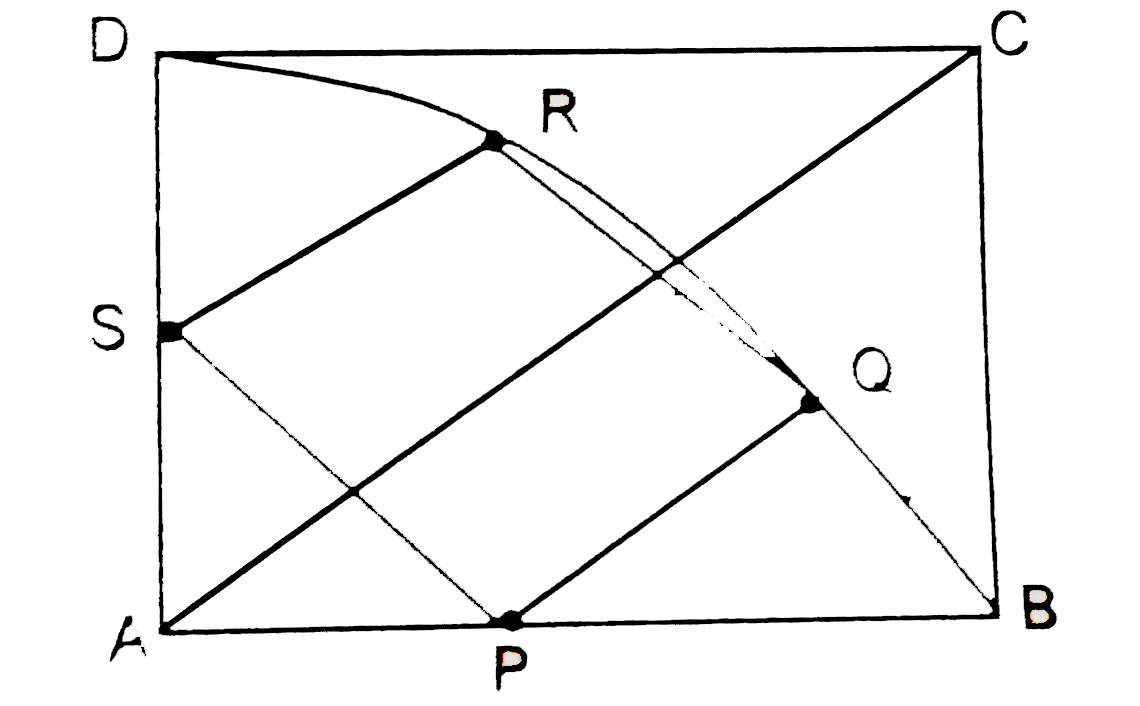 Let `A(0,0), B(1,0), C(1,1), D(0,1)rArr" Area ABCD = 1"` Again let `Q (cosalpha,sinalpha)" & "R(cosbeta,sinbeta)` `rArr " COORDINATE of " P (cosalpha,sinalpha)" & "S(cosbeta,sinbeta)` PQRS is a square `rArrPQ_|_QRrArr" slope of "QR=-1=" slope of SP"` `rArr(sinbeta-sinalpha)/(cosbeta-cosalpha)=-1=(sinbeta-cosbeta)/(sinalpha-cosalpha)` `rArrsinbeta-sinalpha=-sinalpha+cosalpha` `rArrsinbeta-cosbeta=sinalpha+cosalpha.........(i)` and `sinalpha+sinbeta=cosalpha+cosbeta...........(ii)` `rArrcosalpha=sinbeta` `rArrcosalpha=cos(90-beta)` `rArralpha+beta=90^(@)` Also PQ QR `rArrtanalpha=1/2` Area of `PQRS=2sin^(2)alpha=2(1/5)` `("Area of PQRS")/("Area of ABCD")=("2/5")/1=2/5` |
|
| 47. |
Find the shortest distance between the lines (x-1)/2=(y-2)/3=(z-3)/4a n d(x-2)/3=(y-4)/4=(z-5)/5. |
|
Answer» `(1)/(6)` |
|
| 49. |
Calculate the entropy change in system if 2 mole of methane undergoes complete combustion at 300 K from the following data. Given data :DeltaH_("cumbustion")^(@) CH_(4)(g)=-900kJ,DeltaG_(f)^(@)CH_(4)(g)=-40,DeltaG_(f)^(@)(H_(2)O)(l)=-120, DeltaG_(f)^(@)CO_(2)(g)=-400kJ//mol Instruction:- If your answer is -ve, then wire double the magnitude as your final answer For example : If DeltaS_("surr")=+20J/K then write your answer as 20 but if DeltaS_("surr")=-20 then write your answer as 40 Express your answer in J/K. |
|
Answer» Solution :[4000] `2CH_(4) to 4O_(2) to 2CO_(2)++4H_(2)O` `DELTAH^(@)=-900xx2=-1800kJ` `DeltaG^(@)=DeltaG_("f Products")^(@)-DeltaG_("f REACTANT")^(@)` `=(-400)xx2+4(-120)-[2xx(-40)+0]` =-800-480+80 =-1200kJ/mol `DeltaG^(@)=DeltH^(@)-TDeltaS^(@)` `DeltaS_("system")^(@)=(DeltaH^(@)-DeltaG^(@))/(T)` `((-1800)-(-1200)kJ)/(300)=(-600)/(300)kJ` `-2kJ=-2000J//K` Final answer4000 |
|