Saved Bookmarks
This section includes 7 InterviewSolutions, each offering curated multiple-choice questions to sharpen your Current Affairs knowledge and support exam preparation. Choose a topic below to get started.
| 1. |
Find (dy)/(dx), " if "y=12 (1-cos t), x= 10(t-sin t), -(pi)/(2) lt t lt (pi)/(2). |
|
Answer» |
|
| 3. |
If sin^(-1)(x)+sin^(-1)(1-x)=cos^(-1)(x), then x belong to |
|
Answer» `{1,0}` |
|
| 4. |
A : If |a| = 13, |b| = 19, |a + b| = 24 then |a -b| = 20 R: for any vectors a,b, |a + b|^(2) + |a - b|^(2) = 2 (|a|^(7) + |b|^(2)) |
|
Answer» both A and R are true and R is the correct EXPLANATION of A |
|
| 5. |
Given that , tan^(-1) ((2x)/(1-x^(2))) = {{:(2 tan^(-1) x"," |x| le 1),(-pi +2 tan^(-1)x","x gt 1),(pi+2 tan^(-1)x"," x lt -1):} sin^(-1)((2x)/(1+x^(2))) ={{:(2 tan^(-1)x","|x|le1),(pi -2 tan^(-1)x","x gt 1 and ),(-(pi+2tan^(-1))","x lt -1):} sin^(-1) x + cos^(-1) x = pi//2 " for " - 1 le x le 1 sin^(-1) ((4x)/(x^(2)+4)) + 2 tan^(-1)( - x/2)is independent of x, then |
|
Answer» `X in [-3,4]` |
|
| 6. |
int((lnx-1)/((lnx)^(2)+1))dx is equal to |
|
Answer» `(X)/(x^(2)+1)+C` |
|
| 7. |
Given that , tan^(-1) ((2x)/(1-x^(2))) = {{:(2 tan^(-1) x"," |x| le 1),(-pi +2 tan^(-1)x","x gt 1),(pi+2 tan^(-1)x"," x lt -1):} sin^(-1)((2x)/(1+x^(2))) ={{:(2 tan^(-1)x","|x|le1),(pi -2 tan^(-1)x","x gt 1 and ),(-(pi+2tan^(-1))","x lt -1):} sin^(-1) x + cos^(-1) x = pi//2 " for " - 1 le x le 1 If (x -1)(x^(2) +1) gt 0", then " sin(1/2 tan^(-1) .(2x)/(1-x^(2)) tan^(-1) x) isequal to |
| Answer» Answer :C | |
| 8. |
The solution of cos y log (sec x + tan x)dx = cos x log (sec y + tan y) dy is |
|
Answer» `[log (SEC x + TAN x)]^(2) - [log (sec y + Tany)^(2)] = c` |
|
| 9. |
Consider the system of linear equation ax+by=0, cx+dy=0, a, b, c, d in {0, 1} Statement-1 : The probability that the system of equations has a unique solution is 3/8. Statement-2 : The probability that the system has a solution is 1. |
|
Answer» Statement-1 is true, Statement-2 is true, Statement-2 is a correct explanation for statement -4 |
|
| 10. |
LetP (h,K) be anypointon curve y=f(x). Lettangentdrawnat point P meets x-axis at T & normal atpoint P meets x-axis at N(as shown in figure) and m =(dy)/(dx)]_()(h,k)) = shope of tangent. (i)Length of tangent =PT =|K| sqrt(1+(1)/(m^(2))) (ii) Length of Normal =PN +|K| sqrt(1+m^(2)) (iii) Length subtangent = Projection of segment PT on x-axis =TM =|(k)/(m)| (iv) Length of subnormal=Projection of line segment PN on x-axis =MN =|Km| Find theproduct of length of tangentand length of normal for thecurve y=x^(3)+3x^(2)+4x-1 at pointx=0 |
|
Answer» `(17)/(4)` |
|
| 11. |
LetP (h,K) be anypointon curve y=f(x). Lettangentdrawnat point P meets x-axis at T & normal atpoint P meets x-axis at N(as shown in figure) and m =(dy)/(dx)]_()(h,k)) = shope of tangent. (i)Length of tangent =PT =|K| sqrt(1+(1)/(m^(2))) (ii) Length of Normal =PN +|K| sqrt(1+m^(2)) (iii) Length subtangent = Projection of segment PT on x-axis =TM =|(k)/(m)| (iv) Length of subnormal=Projection of line segment PN on x-axis =MN =|Km| Determine 'p' such thatthe length of thesubtangent nad subnormalis equalfor thecurvey=e^(px) +px at thepoint (0,1) |
|
Answer» `+- 1` |
|
| 12. |
LetP (h,K) be anypointon curve y=f(x). Lettangentdrawnat point P meets x-axis at T & normal atpoint P meets x-axis at N(as shown in figure) and m =(dy)/(dx)]_()(h,k)) = shope of tangent. (i)Length of tangent =PT =|K| sqrt(1+(1)/(m^(2))) (ii) Length of Normal =PN +|K| sqrt(1+m^(2)) (iii) Length subtangent = Projection of segment PT on x-axis =TM =|(k)/(m)| (iv) Length of subnormal=Projection of line segment PN on x-axis =MN =|Km| Findlengthof subnormalto x=sqrt(2) cos t,y =- 3sin t " at " t= (-pi)/(4). |
|
Answer» `(2)/(9)` |
|
| 13. |
Construct a 3xx2 matrix whose elements are given by a_(ij)=e^(i.x)-sinjx. |
|
Answer» Solution : Since, `A=[ a_(ij)]_(MXX) 1leilem` and `1lejlen,i,jepsilonN` `therefore A=[E^(1.x)Sinjx]_(3xx2):1leile3,1lejle 2` `rArr a_(11)=e^(1.x),sin1.x=e^(x)sinx` `a_(12)=e^(1X),sin2,x=e^(x)SIN2X` `a_(21)=e^(2.x),sin1.x=e^(2x)sinx` `a_(22)=e^(2.x),sin2,x=e^(2x)sin2x` `a_(31)=e^(3.x),sin1.x=e^(3x)sinx` ` a_(32)=e^(3x),sin2.x=e^(3x)sin2x` `therefore A=[{:(e^(x)sinx,e^(x)sin2x),(e^(2x)sinx,e^(2x)sin2x),(e^(3x)sinx,e^(3x)sin2x):}]` |
|
| 14. |
Consider the parabola (x-1)^(2)+(y-2)^(2)=((12x-5y+3)^(2))/(169) and match the following lists : |
|
Answer» The locus of the point of intersection of perpendicular tangent is directrix, which is 12x-5y+3=0. The parabola is symmetrical about its axis, which is a LINE passing through the focus (1,2) and perpendicular to the directrix. So, it has equation 5x+12y-29=0. The minimum length of FOCAL chord occurs along the latus rectum line, which is a line passing through the focus and parallel to the directrix, i.e., 12x-5y-2=0. The locus of the foot of perpendicular from the focus upon any tangent is tangent at the vertex, which is parallel to directrix and equidistant from the directrix and latus rectum line. Let the equation of tangent at vertex be `12x-5y+lamda=0` where `(|lamda-3|)/(sqrt(12^(2)+5^(2)))=(|lamda+2|)/(sqrt(12^(2)+5^(2)))orlamda=(1)/(2)` Hence, the equation of tangent at vertex is 24x-10y+1=0. |
|
| 15. |
Form the differential equation representing the family of curves y= asin(x+b) where a,b are arbitrary constant. |
|
Answer» |
|
| 16. |
How many numbers can be formed using all the digits 1,2,3,4,3,2,1 such that even digits always occupy even places ? |
|
Answer» |
|
| 17. |
If the median of a Delta ABC through A is perpendicular to AC, then (tan A)/(tan C)= |
|
Answer» `1+SQRT(2)` |
|
| 18. |
int_(0)^(pi) [cot x] dx, where [*] denotes the greatest integer function, is equal to |
|
Answer» 1 |
|
| 19. |
A is a set containing n elements. A subset P of A is chosen. The set A is reconstructed by replacing the elements of P. A subset of A is again chosen. Number of ways of choosing P and Q so that PcapQ contains exactly one element is |
|
Answer» `3^(N)` |
|
| 20. |
A is a set containing n elements. A subset P of A is chosen. The set A is reconstructed by replacing the elements of P. A subset of A is again chosen. i) The number of ways of choosing P and Q so that PcapQ=phi is |
| Answer» Answer :C | |
| 21. |
Integrate the following functions 1/(x-sqrtx) |
|
Answer» SOLUTION :`1/(x-SQRTX) = 1/(sqrtx(sqrtx-1))` Put `sqrtx-1 = t` Then `dt = 1/(2sqrtx) dx gt 1/sqrtx dx = 2 dt` therefore `int 1/(x-sqrtx) dx = int 1/(sqrtx(sqrtx-1)) dx` =`int 2 (dt)/t = 2 log|t|+c` `2 log|sqrtx-1|+c` |
|
| 22. |
A is a set containing n elements. A subset P of A is chosen. The set A is reconstructed by replacing the elements of P. A subset of A is again chosen. P and have equal number of elements is |
|
Answer» `""^(2N)C_(N)` |
|
| 23. |
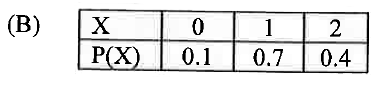
Which of the following distribution of probabilities of a random variable X is the probability distribution ? |
|
Answer»
|
|
| 24. |
If the square of 8xx8 chess board are painted either white or black at random then Statement-1 : The probability that not all squares are in any coloumn, are alternating in colour is (1-1/2^7)^8. Statement-3 : The probability that the chess board contains equal number of white and black squares is (64!)/(2^(64).32!). |
|
Answer» TFT |
|
| 25. |
A bag contains 'a' white and 'b' black balls. Two players A and B alternately draw a ball from the bag, replacing the ball each time after the draw till one of them drawn a white ball and wins the game. If the probability of A winning the game is three times that of B, then find the ratio a : b. |
|
Answer» |
|
| 26. |
Prove that (""^(2n)C_(0))^(2)-(""^(2n)C_(1))^(2)+(""^(2n)C_(2))-(""^(2n)C_(3))^(2)+......+(""^(2n)C_(2n))^(2)=(-1)^(n)""^(2n)C_(n). |
|
Answer» `(-1)^(N). ""^(2N)C_n` |
|
| 27. |
cot^(2)x-(1)/(2)cot^(4)x+(1)/(3)cot^(6)x -(1)/(4)cot^(8)x+…oo= |
|
Answer» LOG tanx |
|
| 28. |
(##CHY_SND_MAT_XII_U03_C17_E07_001_Q01.png" width="80%"> |
|
Answer» |
|
| 29. |
Find the vector equation of the plane passing through the points bar(i)-2bar(j)+5bar(k), -5bar(j)-bar(k), -3bar(i)+5bar(j). |
|
Answer» |
|
| 30. |
Find the area enclosed by y^2=x, x=0,y=1 |
| Answer» SOLUTION :AREA = `int_0^1xdy=int_0^1y^2dy=[y^3/3]_0^1=1/3` | |
| 31. |
The volume of the tetrahedron having the edges hati+2hatj-hatk, hati+hatj+hatk, hati-hatj+lambdahatk as coterminous, is (2)/(3) cu unit. Then, lambda equals |
|
Answer» 1 Since , volume of TETRAHEDRON `=(1)/(6)[abc]` `rArr(2)/(3)=(1)/(6)|{:(1,2,-1),(1,1,1),(1,-1,lambda):}|` `rArr (2)/(3)=(1)/(6)[ 1(lambda+1)-2(lambda-1)-1(-1-1)]` `rArr 4=[-lambda+5]` `rArr lambda=1` |
|
| 32. |
If h denotes the arithmetic mean and k denotes the geometric mean of the intercepts made on the coordinate axes by the lines passing through the point (1, 1), then the point (h, k) lies on |
|
Answer» a CIRCLE |
|
| 33. |
Aline makes acute angle of alpha, beta and gamma with the coordinate axes such that cos alpha cos beta cos gamma = (2)/(9) and cos gammacos alpha = (4)/(9), then cos alpha + cos beta + cos gamma is equal to |
|
Answer» `(25)/(9)` `cos alpha cos beta = cos beta cos gamma = (2)/(6)` and `cos gamma cos alpha = (4)/(9)` Then, `cos alpha = (2)/(3), ` `cos beta = (1)/(3)` and `cos gamma = (2)/(3)` `therefore cos alpha + cos beta + cos gamma = (2)/(3) + (1)/(3) + (2)/(3)` `= (5)/(3)` |
|
| 35. |
If y = a^((1)/(2) log_(a) cos x), find (dy)/( dx) |
|
Answer» |
|
| 36. |
Match the column |
|
Answer» <P> ` sin^(3)x` hasperiod `2pi` and `cos^(4)x` has period `PI`, and L.C.M.of `pi` and `2pi` is `2pi`. Hence, period is `2pi`. (q)` f(x)=sin^(4)x+cos^(4)x,` Both `sin^(4)x` and ` cos^(4)x` have the same period `pi`, and L.C.M. of `pi` and `pi` is `pi`. But `f(x+pi//2)=f(x)`. Then period is `pi//2`. (R) Both `sin^(3)x`and `cos^(3)x` have the same period `2pi,` and L.C.M. of `2pi` and `2pi` is `2 pi`. Hence, period is `2pi, [(f(x+pi) ne f(x)].` (s)`f(x)=cos^(4)x -sin^(4)x` Both `sin^(4)x` and `cos^(4)x` have the same period `pi,` andL.C.M. of `pi` and `pi` is `pi`. Hence, periodis `pi,[f(x+pi//2) ne f(x)].` |
|
| 37. |
Prove that the inverse of the discontinuous function y= (1+ x^2) sing x is a continuous function. |
|
Answer» |
|
| 38. |
The vertices of a hyperbola are(2,0 ) ,( -2,0) and the foci are (3,0) ,(-3,0) .The equation of the hyperbola is |
|
Answer» `X^(2)/5-y^(2)/4=1` |
|
| 39. |
if f(x)={((log_(e)x)/(x-1),,,x!=1),(k,,, x=1):} is continuous at x=1, then the value of k is |
|
Answer» 1)e |
|
| 40. |
Examine if Rolle's theorem is applicable to the following functions : f(x) = |x| on [-1,1] |
|
Answer» Solution :`f(x) = |x| on [-1,1] As f(x) = |x|` is not DIFFERENTIABLE at x = 0 `in (-1,1)` We have Rolle.s THEOREM is not APPLICABLE. |
|
| 41. |
Examine if Rolle's theorem is applicable to the following functions : f(x) = [x] on [-1,1] |
|
Answer» SOLUTION :`f(X) = [x] on [-1,1] f(x) = [x]` is not continous at `0 in [-1,1]1. Rolle.s THEOREM is not applicable. |
|
| 42. |
If the normal subtends a right angle at the focus of the parabola y^(2)=4ax then its length is |
|
Answer» `SQRT(5)a` |
|
| 43. |
If |{:(x,e^(x-1),(x-1)^(3)),(x-lx,cos(x-1),(x-1)^(2)),(tanx,sin^(2)x,cos^(2)x):}|=a_(0)+a_(1)(x-1)+a_(2)(x-1)^(2)cdots The value of lim_(xto 0) (sin x)^(x) is |
|
Answer» 1 |
|
| 44. |
Define an objective function. |
|
Answer» |
|
| 45. |
Using integration, find the area of the quadant of the circle x ^(2) + y ^(2) =4. |
|
Answer» |
|
| 46. |
If overline(a), overline(b), overline(c) are non-coplanar vectors, then the vectors given by overline(p)=2overline(a)-2overline(c), overline(q)= 3overline(a)+overline(b)+5overline(c) andoverline(r)= 2overline(a)-4overline(b)+3overline(c)are |
|
Answer» collinear |
|
| 47. |
Find the equation of all common tangents of the circles (i) x^(2)+y^(2)=9 and x^(2)+y(2)-16x+2y+49=0 (ii) x^(2)+y^(2)+4x+2y-4=0 and x^(2)+y^(2)-4x-2y+4=0 |
|
Answer» `16x+63y+195=0` (II) `y-2=0,4x-3y-10=0,x-1=0,3x+4y-5=0` |
|
| 48. |
Find the number of ways to arrange 8 persons around a circle by taking 4 at a time. |
|
Answer» |
|
| 49. |
Equation of the curve passing through the point (a,1) and has length of subtangent = a is |
|
Answer» `y = E^(X)` |
|
| 50. |
int_(0)^(pi//2)(sin^(3//2)x)/(sin^(3//2)x+cos^(3//2)x)dx= |
|
Answer» |
|