

Saved Bookmarks
This section includes 7 InterviewSolutions, each offering curated multiple-choice questions to sharpen your Current Affairs knowledge and support exam preparation. Choose a topic below to get started.
| 1. |
The value of (d)/( dx) int_(x^2)^(x) sqrt( cos t) dt at x= 0 is |
|
Answer» |
|
| 2. |
From a bag containing 4 red and 2 white balls two balls are drawn. The probability that both the balls are red is: |
|
Answer» `1/5` |
|
| 4. |
C_0 -C_2 + C_4 - C_6 +…..... |
|
Answer» `2^(n-1)` |
|
| 5. |
The solution of xdx + ydy = x^(2) y dy - xy^(2) dx is |
|
Answer» `X^(2) -1 = C (1 + y^(2))` |
|
| 6. |
15 coins are tossed. If the probability of getting at least 8 heads is equal to p, then (8)/(p) is equal to |
|
Answer» 2 |
|
| 7. |
If A,B ,C are the maximum velocities of the particles moving according to the law s=60t -5t^3,s=6t-1/2t^2,s=10t-7t^3 respectively then the ascending order of A,B,C is |
|
Answer» A,B,C |
|
| 8. |
{{:(hx +4y=-10),(kx +3y=-15):} If the graphs of the lines in the system of equations above intersect at (-3,1), what is the value of k /h ? |
|
Answer» `1/3` `(-3,1),` then the solution to the system is `x =-3and y =1.` Substitute these values into both equations and go from there : `HX -4y=-10""kx + 3y=-15` `H (-3) -4 (1) =-10"" k (-3)+3 (1) =-15` `-3h -4 =-10 "" -3k +3 =-15` `-3h=-6 ""-3k=-18` `h=2""k=6` So, `k/h=6/2=3,` making (C ) correct. |
|
| 9. |
If 0lexle1/2, then Sin^(-1)x+Sin^(-1)(x/2-sqrt(3-3x^(2))/2)= |
|
Answer» `PI` |
|
| 10. |
The value of the integral, int_(3)^(6)(sqrtx)/(sqrt(9-x)+sqrtx)dx is |
|
Answer» `1//2` |
|
| 11. |
Find the value of x for which: |{:(3,x),(x,1):}| = |{:(3,2),(4,1):}| |
|
Answer» |
|
| 12. |
The numberofways in which4 letters canbe putin 4addressedenvelopesso that I :Atlestone lettergoesintowrongenevelope is 23.II: nolettergoesintothe envelopementfor it is 9 . |
|
Answer» Only1 is ture |
|
| 13. |
Numbers are selected at random one ata time from the two digit numbers 00, 01, 02, 03 ….99 with replacement . An event E occurs if the product of the 2 digits of a selected number is 18. If four numbers are selected, the probability that the event E occurs atleast 3 times is |
|
Answer» |
|
| 14. |
Evaluation of definite integrals by subsitiution and properties of its : int_(1)^(e)(1+xlogx)(e^(x))/(x)dx=........... |
| Answer» ANSWER :C | |
| 15. |
If f(x)=1/x and g(x) = 0 then fog is |
|
Answer» Not defined |
|
| 16. |
Find the magnitude of the vector vec(PQ), its scalar components and the component vectors along the co-ordinate axes, if P and Q have the co-ordinates P(-1,30, Q(1,2) |
|
Answer» SOLUTION :`vec(PQ) = (1+1)hati+(2-3)HATJ = 2hati-hatj` SCALAR components of `vec(PQ)` are `2hati, -hatj`. MAGNITUDE of `vec(PQ) = |vec(PQ)| = sqrt5`. |
|
| 17. |
Find the volumes of the solids enclosed by the surfaces generated by revolving the lines y=e^(-x),x=0,y=0(0lexlt+oo): (a) about the x-axis (b) about the y-axis. |
|
Answer» (B) `2 pi` |
|
| 18. |
Find the magnitude of the vector vec(PQ), its scalar components and the component vectors along the co-ordinate axes, if P and Q have the co-ordinates P(-1,-2), Q(-5,-6) |
|
Answer» Solution :`vec(PQ) = (-5+1)HATI+(-6+2)HATJ = -4hati-4hatj` THEREFORE `|vec(PQ)| = SQRT((4)^2+(4)^2 = 4sqrt2 Scalar components are -4, -4, and vector components are -4, -4 and vector components are -4i, -4J. |
|
| 19. |
If A+B=[{:(4,3,2),(4,1,7),(3,2,0):}]andA-B=[{:(6,1,4),(-4,3,9),(5,8,2):}]Then find A and B. |
|
Answer» |
|
| 21. |
Evaluate the following integrals intsinsqrt(x)dx |
|
Answer» |
|
| 22. |
Let the tangent at a point P on the ellipse meet the major axis at B and the ordinate from it meet the major axis at A. If Q is a point on the AP such that AQ=AB, prove that the locus of Q is a hyperbola. Find the asymptotes of this hyperbola. |
|
Answer» |
|
| 23. |
Thevalue of int(1+sinx)/(1-sinx)dx |
|
Answer» `2 TAN ((x)/(2) + (pi)/(4)) + C` |
|
| 24. |
For every real number x. let f(x) = (x)/(1!)+(3)/(2!)x^(2)+(7)/(3!)x^(3)+(15)/(4!)x^(4)+cdots Then the equation f(x) = 0 has |
|
Answer» no REAL solution |
|
| 25. |
If f(x)=(x-[x])sin""1/x, then at x=0, f(x) is |
|
Answer» continuous |
|
| 26. |
If the circles of the maximum area inscriabed in the region bounded by the curves y=x^(2)-2x-3 and y=3+2x-x^(2) , then the area of region y-x^(2)+2x+3le0,y+x^(2)-2x-3le0 and sle0. |
|
Answer» |
|
| 27. |
As shown in the figure below, Tony has determined that he must ride his skateboard down a long ramp to be able to jump a shorter ramp with enough time to complete a new trick. First, he needs to determine the dimensions of both the shorter and longer ramps. Tony is on his skateboard at point K, 20 feet above the ground . He then notes that the vertical height bar(HJ) of the shorter ramp is 6 feet above the ground, and the length of the shorter ramp bar(GJ) is 9 feet. Approximately how many feet long is the longer ramp ? |
|
Answer» 3 |
|
| 28. |
Draw the graph of y = log_(e) (sin x). |
|
Answer» Solution :We have `y = f(x) = log_(e) (sin x)` Clearly, y = f(x) is defined when `sin x gt 0`, i.e. x lies in the `1^(st)` and `2^(nd)` QUADRANTS only expect the quadrant ANGLE. ALSO we have `0 lt sin x le 1` `therefore` `-oo lt log_(e)(sin x) le 0` PERIOD of y = f(x) is `2pi`. However, the function is not defined in `(PI, 2pi)`. The graph is for `(0, pi)` only. Now when `x to 0^(+) or x to pi^(-), sin x to 0^(+)`, for which `log_(e)(sin x) to -oo` Also `f(pi//2) = log_(e)(1) = 0` `f'(x) = cot x,` `f''(x) - "cosec"^(2)x lt 0` Hence the graph is concave downwards. The graph of the function for `x in (0, pi)` is as shown in the following figure. 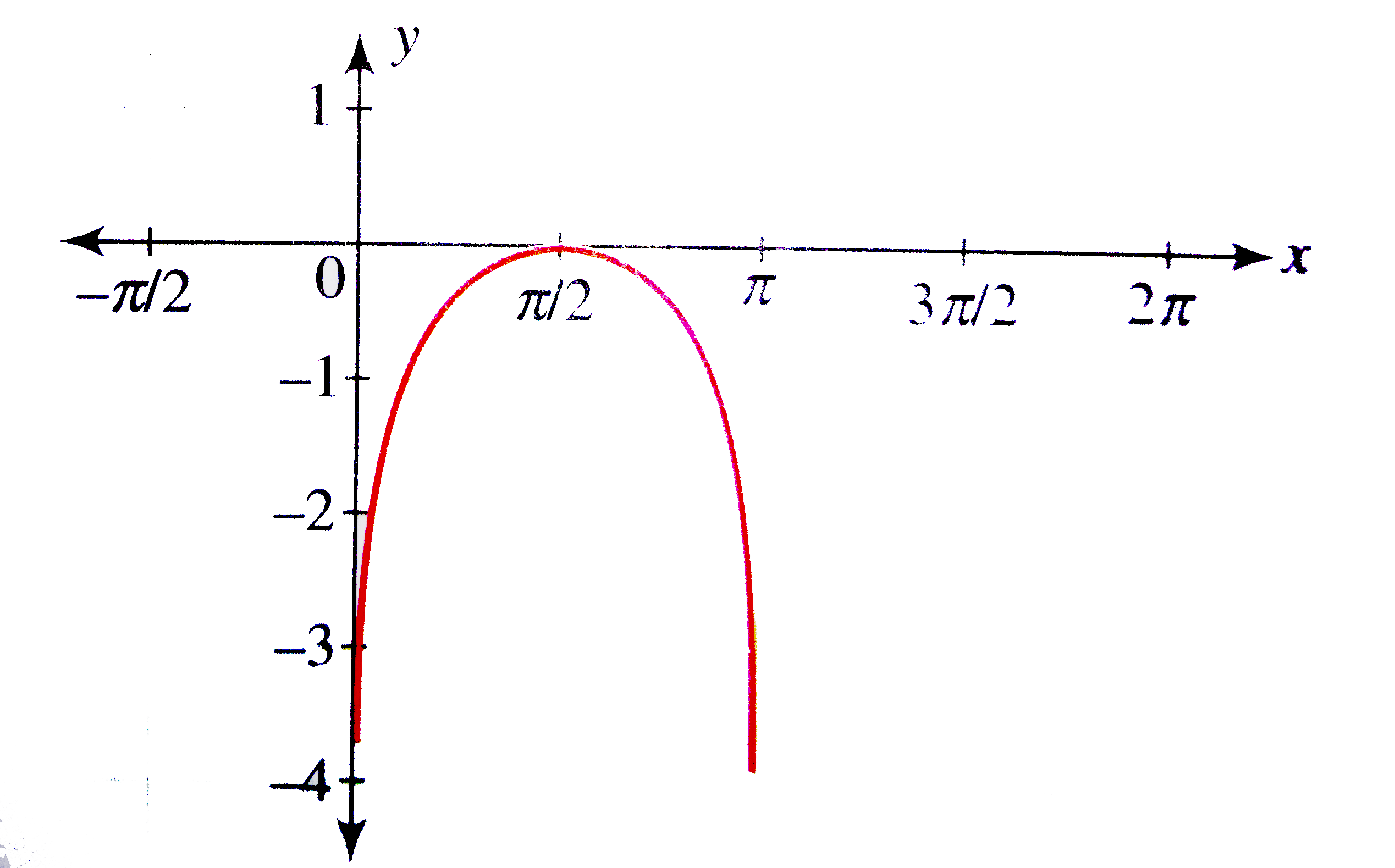 We have same graphs of intervals `... (-2pi, - pi), (2pi, 3pi), (4pi, 5pi)...` 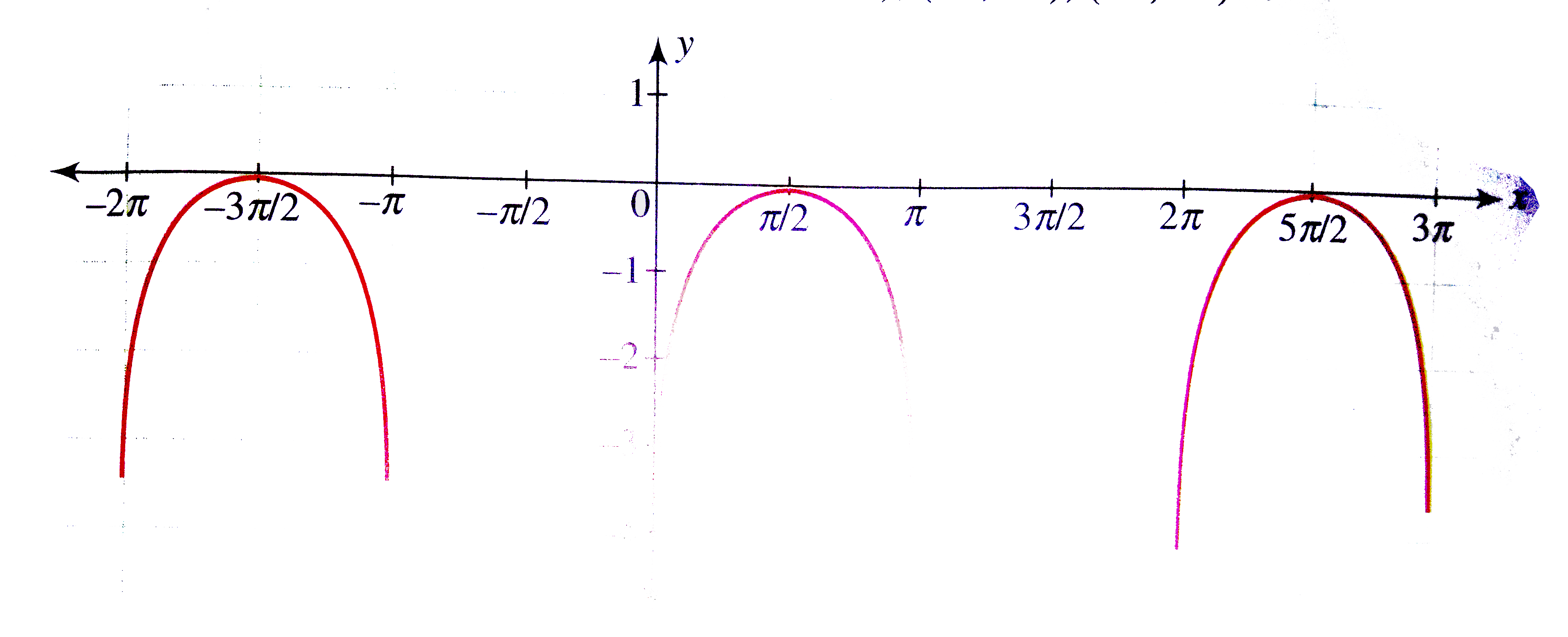
|
|
| 29. |
If A(x)=|(1,1,1),((e^(x)+e^(-x))^(2),(pi^(x)+pi^(-x))^(2),2),((e^(x)-e^(-x))^(2),(pi^(x)-pi^(-x))^(2),-2)| then A(x) = |
| Answer» Answer :D | |
| 30. |
Evaluate |[x^2-x+1,x-1],[x+1,x+1]| |
|
Answer» SOLUTION :`|[x^2-x+1,x-1], [x+1,x+1]| = (x^2-x+1)(x+1)-(x+1)(x-1) = x^3+1-(x^2-1) = x^3-x^2+2` |
|
| 31. |
Let Z=re^(itheta)(r gt 0 and pi lt theta lt 3pi) is a root of the equation Z^(8)-Z^(7)+Z^(6)-Z^(5)+Z^(4)-Z^(3)+Z^(2)-Z+1=0. the sum of all values of theta is kpi. Then k isequal to |
|
Answer» |
|
| 32. |
{:(I. |a xx b + b xx c + c xx a|, a. "Area of" Delta ABC),(II. |AB xx cd + BC xx AD + CA xx BD, b. 2 xx "Area of" Delta ABC),(III. |(a - c) xx (b - d)|, c. 4 xx "Area of" Delta ABC),(IV. (1)/(2) |(a - b) xx (b - c)|,d. 2 xx "Area of quandrilateral" ABCD),( , e. "none"):} |
|
Answer» a,C,c,b |
|
| 33. |
For the function f(x)=(x^(100))/(100)+(x^(99))/(99)+....x^(2)/2+x+1, f'(1)=mf ' (0), where m is equal to |
|
Answer» 50 |
|
| 34. |
Find the number of quintuples (x,y,z,u,v) of positive integers satisfying both equations x+y+z+u= 100 and x+y+z+v= 70 |
|
Answer» |
|
| 35. |
Consider the system of simultaneous linear equation 2x-3y+5z=12 3x+y+lambdaz=u x-7y+8z=17 {:(,"List-I",,"List-II",),((P),"for unique solution" ,(1),lambda=2.mu ne, 7),((Q),"For infinite solutions",(2),lambda ne 2. mu in R,),((R),"For no solution",(3),lambda = 2. mu = 7,):} |
|
Answer» `Delta_(3)[(2,-3,12),(3,1,mu),(1,-7,17)]=11mu-77=11(mu-7)` Now, verify it` |
|
| 36. |
int_(ln lambda)^(ln(1/lambda))(f(x^(2)/3)(f(x)+f(-x)))/(g(3x^(2))(g(x)-g(-x)))dx= |
|
Answer» 0 |
|
| 38. |
Sketch the graphs of the following functions. f(x) = (x-1)^2 |
Answer» SOLUTION :
|
|
| 39. |
If the 5th term is the term independent of x in the expansion of (x^(2//3) + 1/x)^n then n= |
|
Answer» 10 |
|
| 40. |
Assertion (A) : The number of real solutions of the equation sin x = x^(2) + 3x + 4 is zero Reason (R): -1 ge sin xle 1, AA x in R |
|
Answer» Both A, R are TRUE and R explain Assertion |
|
| 41. |
The range of f(x) is a subset of the given set |
| Answer» Answer :B | |
| 42. |
Integrate the following int(cosec^2x)/(1+cotx)dx |
|
Answer» SOLUTION :`INT((cosec^2x)/(1+cotx)DX [PUT 1+cotx=t then `-cosec^2xdx=dt` or `cosec^2xdx=-dt` `int(-dt/t)=-int(dt/t)=-inabst+C` |
|
| 43. |
Let A(x_1,y_1),x_1 ne 0, be a point of the curve y^2=x^3. Tangent at A meets the curve again at B(x_2,y_2). M and N are foot of perpendicular drawn to x-axis from point A and B respectively. T is the point where tangent at A meets x-axis, then : |
|
Answer» `y_1,y_2 GT0` |
|
| 44. |
If nobjectsare arrangedin arowthen the numberof waysof selectingthreeof theseobjectsso thatnotwoof themare nextto eachother is |
|
Answer» `""^((n-3))C_(3)` |
|
| 45. |
I: If a and b are positive real numbers then sqrt(-a) xx sqrt(-b) = -sqrt(ab) II : The Arg [(1 + isqrt3)/(1 - isqrt3)] is 240^(@) Which of the statements are true |
| Answer» Answer :A | |
| 46. |
If y= (sin^(-1) 2x)^(2) + (cos^(-1) 2x)^(2), then (1-4x^(2))y_(2) - 4xy_(1)= |
|
Answer» 0 |
|
| 47. |
Fundamental theorem of definite integral : I=int_(0)^(1)(sinx)/(sqrtx)dx and J=int_(0)^(1)(cosx)/(sqrtx)dx then which of the following statement is true ? |
|
Answer» `Igt(2)/(3) and Jgt2` |
|
| 49. |
Let A and B be events with P(A)= 3/8, P(B)= 1/2 and P(A cap B) = 1/4, Find P(A^c cap B) |
|
Answer» <P> `P(A^c CAP B)=P(B-A)` ` P(B)-P(AcapB)` `1/2-1/4=1/4` |
|