

Saved Bookmarks
This section includes 7 InterviewSolutions, each offering curated multiple-choice questions to sharpen your Current Affairs knowledge and support exam preparation. Choose a topic below to get started.
| 1. |
If f(x)=|{:(1,x,x+1),(2x,x(x-1),x(x+1)),(3x(x-1),x(x-1)(x-2),x(x^2-1)):}| then f(100)= ……… |
|
Answer» 0 |
|
| 2. |
If int _(0) ^(x) (x ^(3) cos ^(4) x sin ^(2)x)/(pi^(2) -3pix + 3x ^(2))dx = lamda int _( 0)^(pi//2)sin ^(2) x dx,then the value of lamda is: |
|
Answer» `(pi)/(12)` |
|
| 3. |
If int e^(x) cos 4 x dx = A e^( 5x) (sin 4x + (5)/(4) cos 4x) + C then A is equal to |
| Answer» Answer :A | |
| 4. |
STATEMENT -1 : for the function y= f(x), f(x) ,({1+((dy)/dx)^(2)}^(3/2))/((d^(2)y)/(dx^(2))) = - ({1+ (dx/dy)^(2)}^(3/2))/((d^(2)x)/(dy^(2))) STATEMENT -2 :(dy)/(dx) = (1/(dx))/dyand (d^(2)y)/(dx^(2)) = d/dx (dy/(dx)) |
|
Answer» |
|
| 5. |
If f(x) is differentiable function in the interval (0,oo) such that f(1) = 1 and lim_(trarrx) (t^(2)f(x)-x^(2)(t))/(t-x)=1 for each x gt 0, then f((3)/(2)) is equal tv |
|
Answer» `(13)/(6)` `underset(trarrx)(lim)(t^(2)f(x)-x^(2)(t))/(t-x)=1` `rArr""underset(trarrx)(lim)(t^(2){f(x)-f(t)}-(x^(2)-t^(2))f(t))/(t-x)=1` `rArr""underset(trarrx)(lim){(f(x)-f(t))/(t-x)}t^(2)+underset(trarrx)(lim)(x+t)f(t)=1` `rArr""-x^(2)f'(x)+2xf(x)=1""[{:(because" f is differentiable and"),("so continuous also"):}]` `rArr""f'(x)-(2)/(x)f(x)=(1)/(x^(2))"...(i)"` This is a linear differential equation with I.F. `e^(-int(2)/(x)DX)=(1)/(x^(2))` MULTIPLYING (i) by I.F.`=(1)/(x^(2))` integrating, we get `(f(x))/(x^(2))=(1)/(3x^(3))+C` It is given that f(1) = 1 Putting x = 1 in (ii), we get `=(1)/(3)+CrArr C=(2)/(3)` `therefore""(f(x))/(x^(2))=(1)/(3x^(3))+(2)/(3)` `rArr""f(x)=(1)/(3x)+(2x^(2))/(3)rArrf((3)/(2))=(2)/(9)+(3)/(2)=(31)/(18)` |
|
| 6. |
A cylindrical tank of radius 10 m is being filled with wheat at the rate of 314 cubic metre per hour. Then the depth of the wheat is increasing at the rate of ……….. |
|
Answer» 1 m/h |
|
| 7. |
The vertex of the parabola y^2 + 4x = 0 is |
|
Answer» `(4,0)` |
|
| 8. |
Sketch the origin in which the points satisfying the following inequalities lie. (i)|x+y| lt 2 "(ii) " |2x-y| gt 3 "(iii) "|x| gt|y| |
|
Answer» Solution :`(i) |x+y| lt 2` `therefore -2 lt x+y lt 2` `rArr x+y+2 gt 0 and x+y-2 lt 0` `L_(1)(x,y) = x+y+2 " and " L_(2)(x,y) = x+y-2` `L_(1)(0,0) = 2 gt 0 " and" L_(2)(0,0) = -2 lt 0` `" So ", x+y+2 gt 0` represents the region where origin lies and ` x+y-2 lt 0` also represents the region where origin lies. 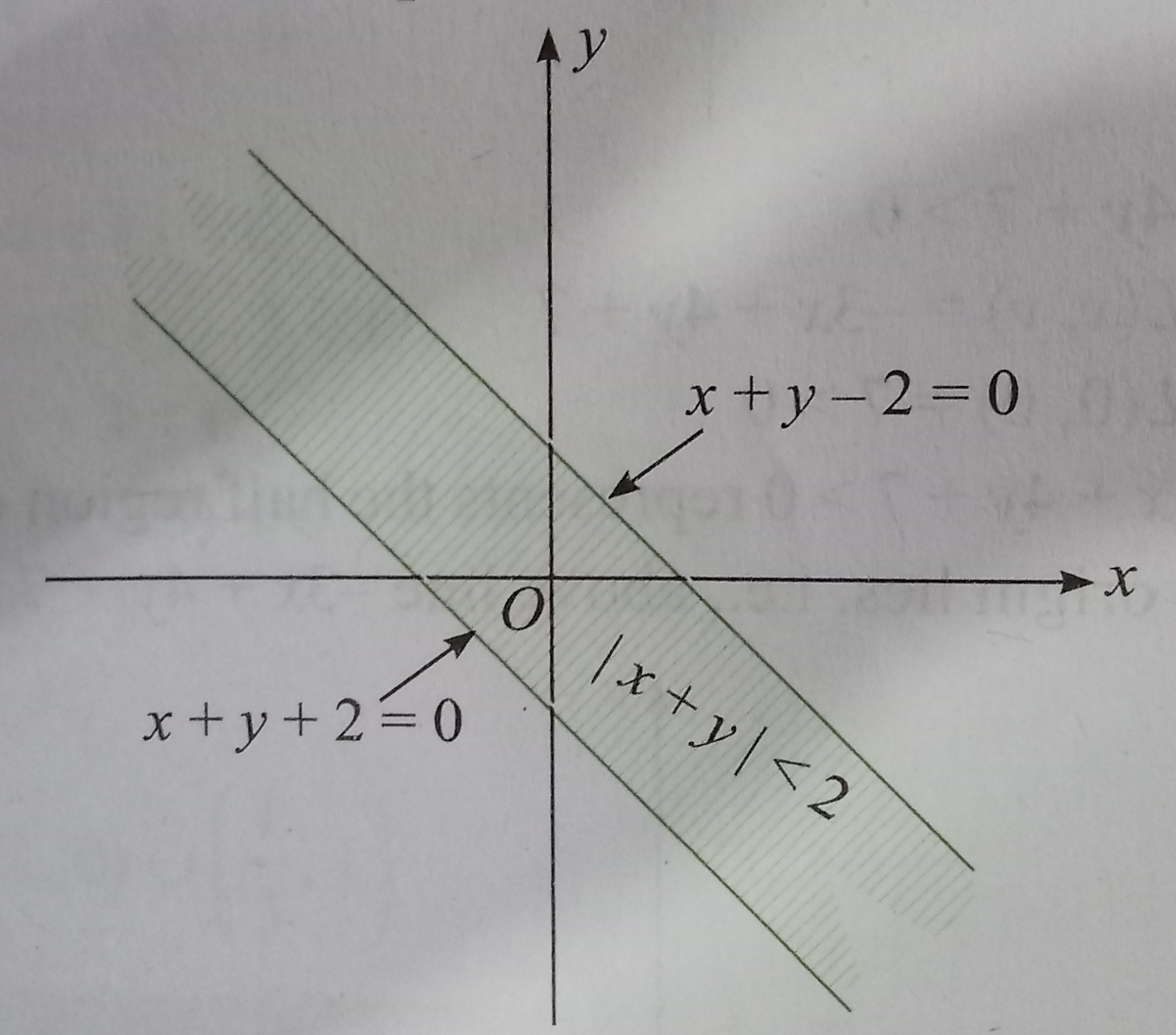 Thus, in general, `|ax + by +c| lt d` is the region of the points between the lines ax+by+c =d and ax+by+c = -d. `(ii) |2x-y| gt 3` `therefore 2x-y lt-3 " and " 2x-y gt 3` `rArr 2x-y+3 lt 0 " and " 2x-y-3 gt 0` `L_(1) (x,y) = 2x-y+3 " and " L_(2) (x,y) = 2x-y-3` `L_(1) (0,0) = 1 gt 0 " and " L_(2) (0,0) = -3 lt 0` `" So, " 2x-y+3 lt 0` represents where origin doest not lie and `2x-y-3 gt 0` also represents the region where origin does not lie. 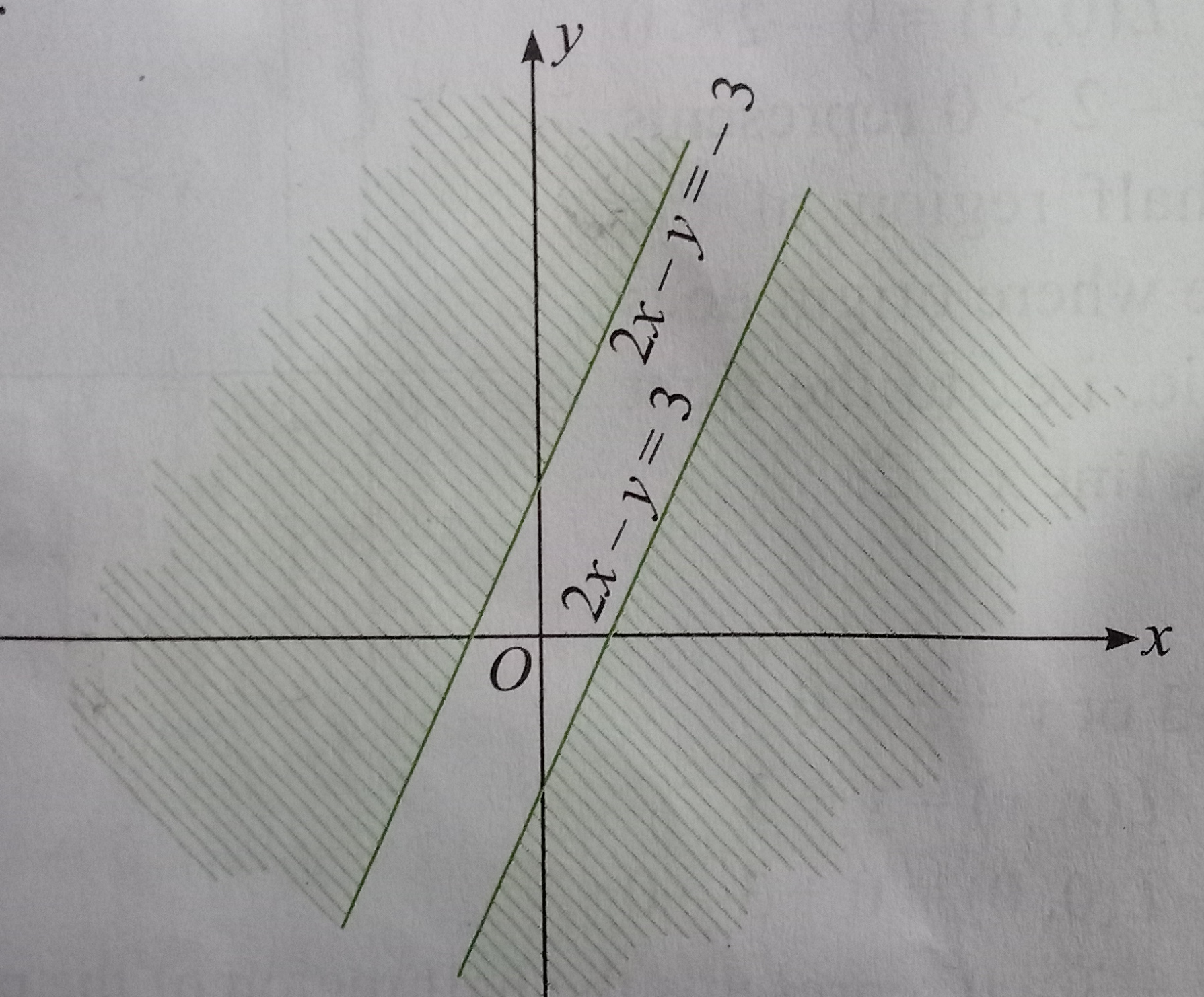 Thus, in general `|ax+by+c| gt d` is the region of the points which does not lie between the lines ax+by+c =d and ax+by+c=-d. `(iii) |x| gt |y|` ` " If " x,y gt 0`, then we have `x gt y " or" x-y gt 0`. Let L(x,y) = x-y. `therefore L(1,0) = 1-0 gt 0.` HENCE, points satisfying this INEQUALITY lie below the line x-y=0 in first QUADRANT. 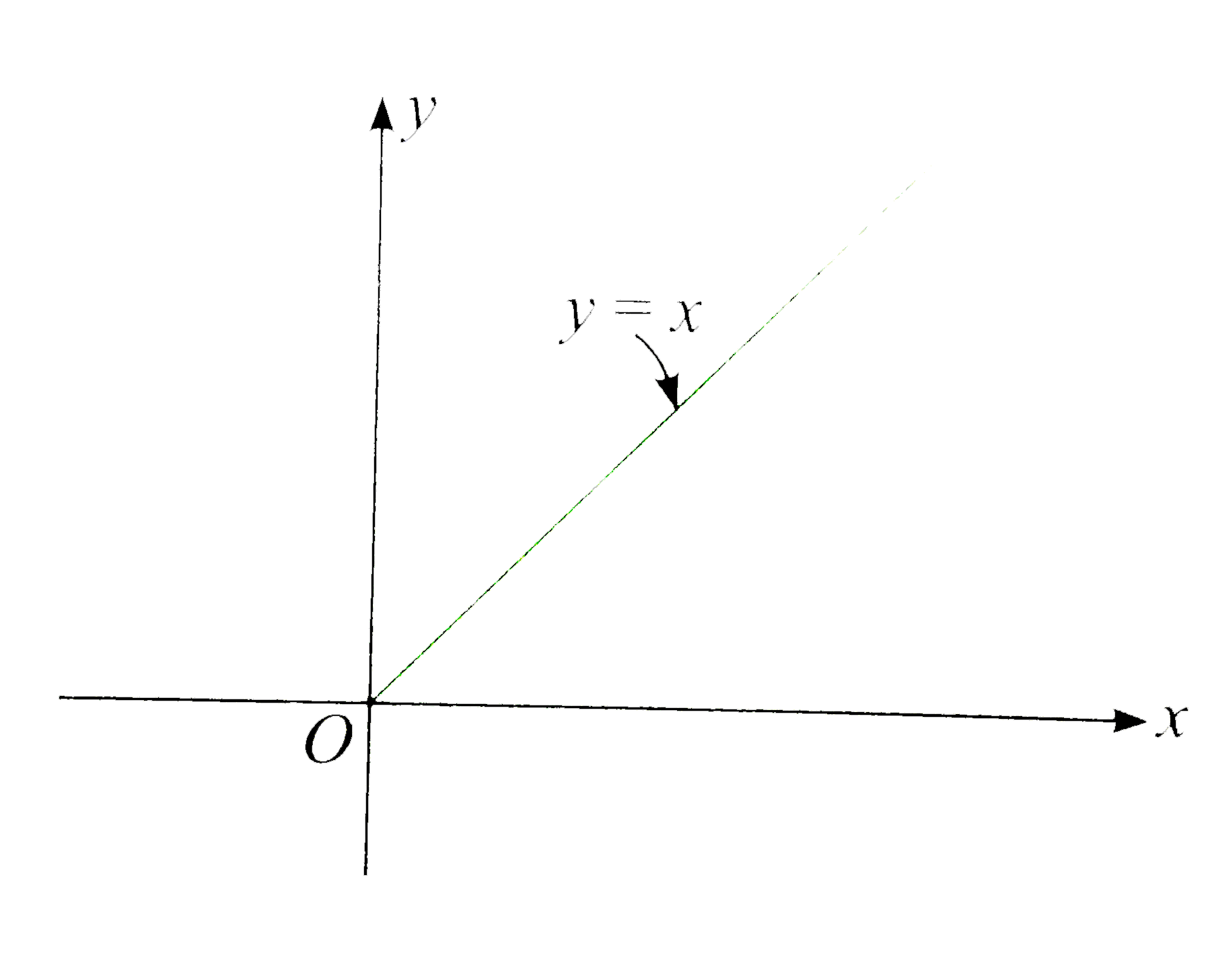 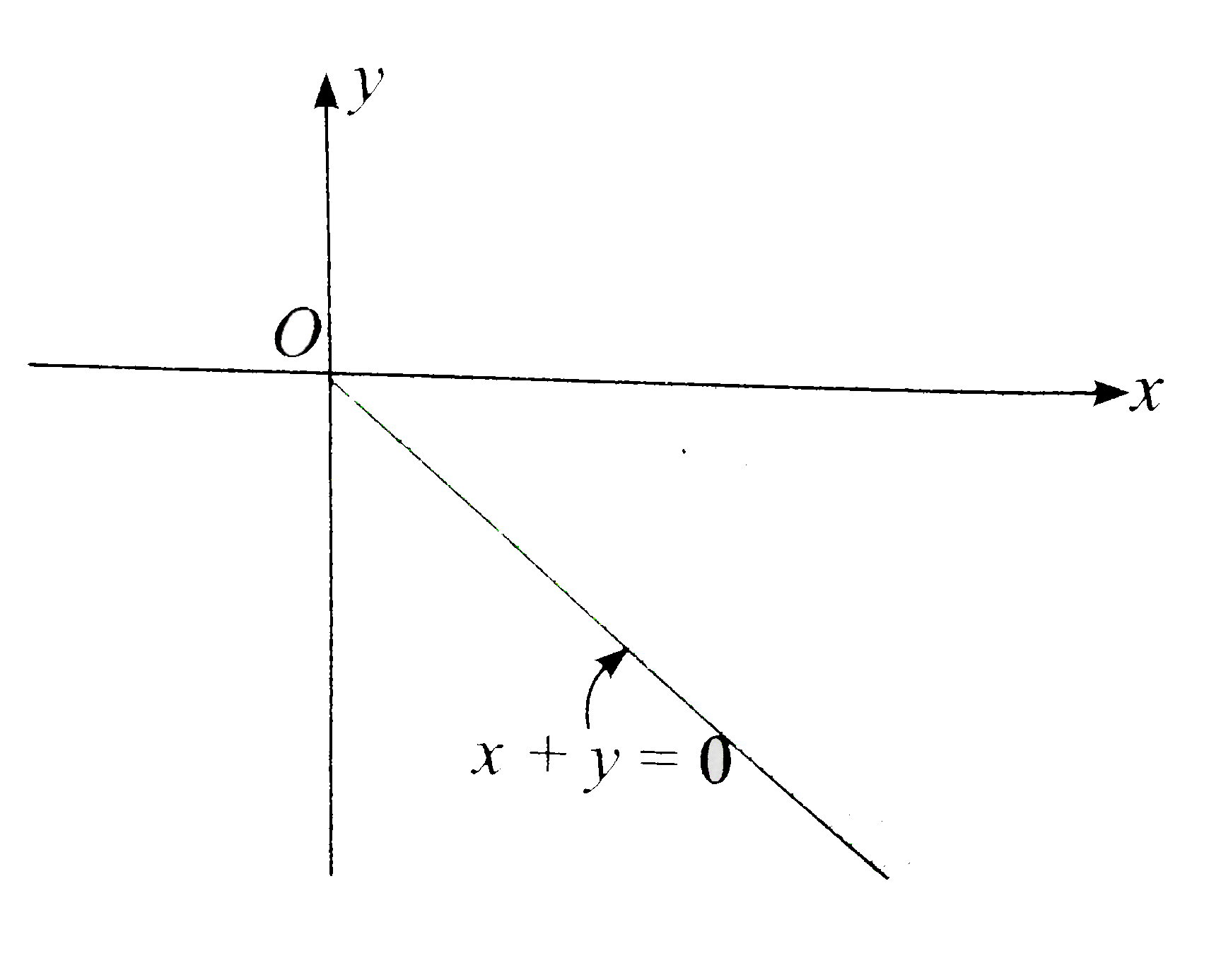 `" If" x gt 0, y gt 0`, then we have `x gt -y " or" x+y gt 0`. Let L(x,y) = x+y. `therefore L(1,0) = 1+0 gt 0` Points satisfying this inequality lie above the line x+y=0 in fourth quadrant. Similarly, we have one region in second quadrant and one in third quadant. Combining all the cases, we have FOLLOWING region. 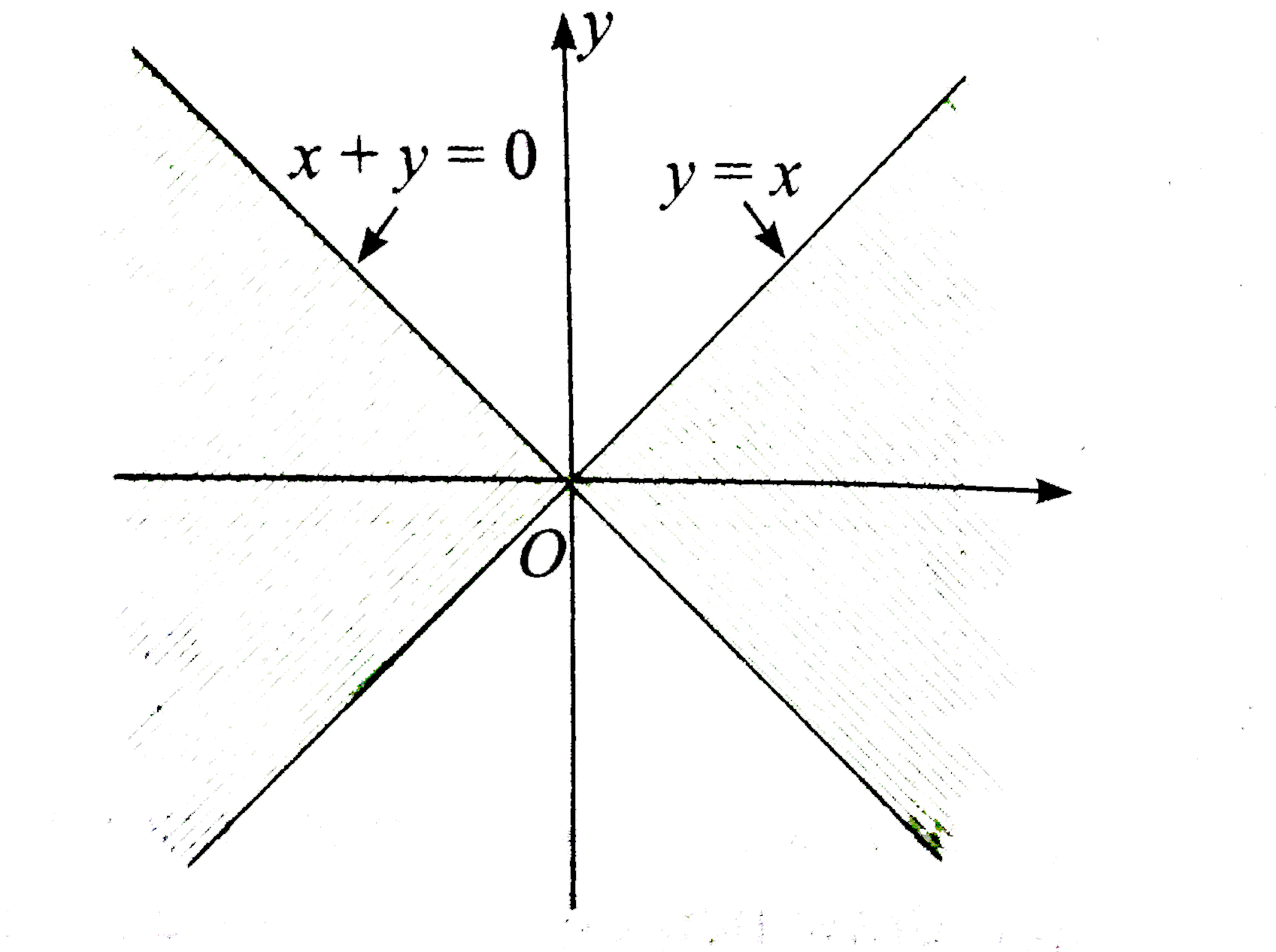
|
|
| 9. |
Equation of the tangent to the circle x^(2)+y^(2)=3, which is inclined at 60^(@) with the x-axis is |
|
Answer» `y=sqrt(3)x+2sqrt(3)` |
|
| 10. |
Find the equation of locus of a point, the sum of whose distances from (0 , 2) and (0 , -2) is 6 . |
|
Answer» |
|
| 11. |
How many different words can be formed by jumbling the letters in the word MISSISSIPPI in which no two S are adjacent? |
|
Answer» `7.""^(6)C_(4).""^(8)C_(4)` |
|
| 12. |
2sec^(2)theta - sec^(4)theta - 2cosec^(2)theta + cosec^(4)theta = 15/4 if tan theta is equal to , |
|
Answer» `1/2` |
|
| 13. |
Area of the triangle formed by the radical axis of the circles x^2+y^2=4, x^2+y^2+2x+4y-6=0 with co-ordinate axes is |
|
Answer» 1/4 SQ. UNITS |
|
| 14. |
arg(bar(z))+arg(-z)={{:(pi",","if arg (z) "lt 0),(-pi",", "if arg (z) "gt 0):},"where" -pi lt arg(z) le pi. Let z_(1) and z_(2) be two non-zero complex numbers, such that abs(z_(1))=abs(z_(2)) " and " arg(z_(1),z_(2))-pi," then " z_(1) is equal to |
|
Answer» `z_(2)` |
|
| 15. |
(dy)/(dx) + (sec x)y = tan x (0 le x lt (pi)/(2)) |
|
Answer» |
|
| 16. |
Let alpha and betabe the roots of the equation x^(2)+x+1=0.The equation whose roots are alpha^(19), beta^(7) is |
|
Answer» `X^(2)-x-1=0` |
|
| 17. |
The x-axis, y-axis and a line passing through the point A(6,0) form a triangle ABC. If /_A = 30^(@), then the area of the triangle in sq.units, is |
| Answer» Answer :A | |
| 18. |
f(x) = (x) /(1+("ln"x)("ln"x).. . oo)AAx in [1,3] is non-differentiableat x=K thenthe valueof [k^(2)] is ( where[.] representsthegreatest integer function )______. |
|
Answer» |
|
| 19. |
Consider the following linear equations ax+ by + cz=0, bx + cy + az =0, cx+ ay +bz=0 |
|
Answer» |
|
| 20. |
If alpha , beta , gammaare the rootsof theequationx^3 -6x^2 +11 x +6=0thensumalpha^2beta = |
|
Answer» 80 |
|
| 21. |
The sum of distance of any point on the ellipse 3x^2 + 4y^2 = 24 from its foci is |
|
Answer» `8sqrt(2)` |
|
| 22. |
If any two chords be drawn through two points on the major axis of the ellipse x^2/a^2+y^2/b^2=1 equidistant from the centre prove that tan""alpha/2 tan""beta/2 tan""gamma/2=1 where alpha,beta,gamma,delta are the eccentricity angles of the extremities of the chord. |
|
Answer» |
|
| 23. |
If z_(1) = 1 , z_(2) = i and A = Arg (z_(1) z_(2)) B = Arg ((z_(1))/(z_(2))) , C = Arg (z_(1) + z_(2)) , D = Arg (z_(1) - z_(2)) arrange A , B , C , D in ascending order |
|
Answer» A , C ,D , B |
|
| 24. |
A person wishes to make up as many different parties of 10 as he can out of 20 friends, each party consisting of the same number. The number of ways that the same man is found in different parties is |
|
Answer» 380 |
|
| 25. |
If x in (-3)/(sqrt(2)), thenint (x^(2))/(2x^(2) + 6 sqrt(2)x + 9) dx = |
|
Answer» `(1)/(2sqrt(2)) [ (sqrt(2)x + 3) - 6log | sqrt(2) x + 3 | - (9)/(sqrt(2) + 3)]` + C |
|
| 26. |
Find x and y, if 2[(1,3),(0,x)]+[(y,0),(1,2)]=[(5,6),(1,8)] |
|
Answer» X = 3, y = 3 |
|
| 28. |
If x =3 + (4)/(2!) + (8)/(3!) + (16)/(4!) + .....oothen 1/x = |
|
Answer» `1/E` |
|
| 30. |
A focal chordof y^(2)=4ax meets it in P and Q. If S is the focus, then (1)/(SP)+(1)/(SQ)= |
| Answer» Answer :A | |
| 31. |
If a_(n) = int_(0)^(pi//2) (sin^(2) nx)/( sin x) dx then a_(2) - a_(1) , a_(3)- a_(2), a_(4) - a_(3) are in |
|
Answer» A.P. |
|
| 32. |
Evaluate the following definite integrals: int_(-1)^(1//2)|xcos pi x|dx |
|
Answer» |
|
| 33. |
For each of the differential equations in find the particular solution satisfying the given condition : 2xy+y^(2)-2x^(2)(dy)/(dx)=0,y=2 when x=1 |
|
Answer» |
|
| 34. |
Find the area of the parallelogram whose diagonals are vectors 3hati+hatj-2hatk and hati-3hatj+4hatk. |
Answer» Solution :Given that the DIAGONAL of a PARALLELOGRAM are `veca = 3hati+hatj-2hatk, vecb = hati-3hatj+4hatk`  `|vecaxxvecb| = SQRT(4+196+100) = sqrt(300) = 10sqrt3` therefore AREA of the parallelogram = `1/2 xx10sqrt3 = 5SQRT3 sq. units. |
|
| 35. |
If 3f(cosx)+2f(sinx)=5x, then f^(')(cosx) is equal to (where f^(') denotes derivative with respect tox) |
|
Answer» `-5/(COSX)` `3f(sinx)+2f(cosx)=5(pi//2-x)`………..ii Solving EQUATION i and ii simultaneously we get `F(cosx)=5x-pi` `-sinx,f^(')(cosx)=5,f^(')(cosx)=-5//sinx` |
|
| 36. |
A bead is moving on a frictionless fixed circular wire of radius 0.8 m in horizontal plane with constant speed & there is no interaction force between bead & wire & it is also connected with string & spring . |
|
Answer» Speed of bead is 4m/sec |
|
| 37. |
Let OP = r and angle XOP = theta then the position of P in polar coordinate system is represented by (r,theta) OX and O are called the initial line and pole respectively. If p be the length of perpendicular from origin to line and if alpha is the angle which the perpendicular to the line makes with the initial line . The equation of line is given by r cos (theta - alpha) = p Perpendicular distance from pole to the line l/r = 4 cos theta +2 sin theta is |
|
Answer» `2SQRT5` |
|
| 38. |
If two circles touching both the axes are passing through (2,3) then length of their common chord is |
|
Answer» `SQRT(2)` |
|
| 39. |
If |bar(a)|=2,|bar(b)|=4,|bar( c )|=1 and bar(a)+bar(b)=-bar( c ) then bar(a).bar(b)+bar(b).bar( c )+bar( c ).bar(a)=…………… |
|
Answer» `-9.5` |
|
| 40. |
Let OP = r and angle XOP = theta then the position of P in polar coordinate system is represented by (r,theta) OX and O are called the initial line and pole respectively. If p be the length of perpendicular from origin to line and if alpha is the angle which the perpendicular to the line makes with the initial line . The equation of line is given by r cos (theta - alpha) = p The equation of straight line x+sqrt3y=1 in polar coordinate is |
|
Answer» `R=1/2COS(theta+pi/6)` |
|
| 41. |
inte^(2x)(log2x+(1)/(2x))dx=..........+c |
|
Answer» `(e^(2X))/(2)log2x` |
|
| 42. |
Differentiate (x^(2)-5x + 8) (x^(3) + 7x + 9)By using product rule |
|
Answer» |
|
| 43. |
Let OP = r and angle XOP = theta then the position of P in polar coordinate system is represented by (r,theta) OX and O are called the initial line and pole respectively. If p be the length of perpendicular from origin to line and if alpha is the angle which the perpendicular to the line makes with the initial line . The equation of line is given by r cos (theta - alpha) = p The polar coordinates of the foot of perpendicular from the pole on the line joining the two points (r_1,theta_1 ) and (r_2,theta_2) are |
|
Answer» `[(r_1r_2sin(theta_2-theta_1))/(SQRT(r_1^2+r_2^2-2r_1r_2cos(theta_1-theta_2))),TAN^(-1)((r_1costheta_1-r_2costheta_2)/(r_2sintheta_2-r_1sintheta_2))]` |
|
| 44. |
A circle of radius 2 units rolls inside the ring of the circle x^(2)+y^(2)+8x-2y-19=0 then the locus of its centre is |
|
Answer» `X^(2)+y^(2)+8x+2y-47=0` |
|
| 45. |
The sum sumsum_(0leilejle10) (""^(10)C_(j))(""^(j)C_(r-1))is equal to |
|
Answer» `2^(10)- 1` `= .^(10)C_(1)(.^(1)C_(0) + .^(1)C_(1))+.^(10)C_(2)(.^(2)C_(0)+.^(2)C_(1) + .^(2)C_(2))+"...."+.^(10)C_(10)(.^(10)C_(0) +.^(10)C_(1)+"..."+.^(10)C_(10))` `= .^(10)C_(1)(2) + .^(10)C_(2)(2^(2))+.^(10)C_(3)(2^(3))+"....."+.^(10)C_(10)(2^(10))` `= (2+1)^(10) - 1` `= 3^(10) - 1` |
|
| 46. |
If xy =e -e ^(y)then (d ^(2) y )/( dx ^(2)) at x =0 is |
|
Answer» `1/E` |
|
| 47. |
A die is thrown and a card is selected at random from a deck of 52 playing cards. The probability of getting an even number on the die and a spade card is ………… |
| Answer» Answer :C | |
| 48. |
Thetransformedequationx^3 -5/2 x^2 -(7)/(18 )x+(1)/( 108)=0byremovingfractionalcoefficientsis |
|
Answer» `x^3 -3x^2 -x+12=0` |
|