

Saved Bookmarks
This section includes 7 InterviewSolutions, each offering curated multiple-choice questions to sharpen your Current Affairs knowledge and support exam preparation. Choose a topic below to get started.
| 1. |
John, a United States resident, is on vacation in Spain and is trying to decide if the should use his own credit card from the U.S. or to purchase a prepaid credit card for 500 euros in Spain. |
|
Answer» |
|
| 2. |
If 2, -3 , 5 are the roots of ax^(3) + bx^(2) + cx + d = 0 then the roots of a(x - 1)^(3) + b (x -1)^(2) + c(x - 1) + d= 0 are |
| Answer» Answer :3 | |
| 3. |
Find the maximum value of the 8cosx-15sinx-2 |
|
Answer» SOLUTION :MAXIMUM VALUE of 8cosx-15sinx is`SQRT(8^2+(-15^2))=sqrt289=17` `THEREFORE` Maximum value of 8cosx-15sinx-2 is 17-2=15 |
|
| 4. |
Let the popultion of rabbits surviving at a time t be governed by the differential equation (dp(t))/(dt) = (1)/(2) p (t) - 200. If p(0) = 100, the p(t) equals |
|
Answer» `400-300e^(t//2)` |
|
| 5. |
r :Two chords of a circle are equidistant from the centre if and only if they are equal in length Statements r can be interpreted as |
|
Answer» If TWO polygons are congruent then they are EQUAL inshape and SIZE |
|
| 6. |
Given that the marginal cost MC and average cost AC for a product are equal. Then thetotal cost C is a(i) constant function(ii) linear function of number of units (x) produced(iii) quadratic function of number of units (x) produced(iv) None of these |
|
Answer» CONSTANT function |
|
| 7. |
Find the volume of the solid generated by revolving about the x-axis the figure enclosed by the astroid : x= a cos^(3)t , y= a sin^(3)t. |
|
Answer» |
|
| 8. |
If y=x^(x)+x^(a)+a^(x)+a^(a)," find "(dy)/(dx) |
|
Answer» |
|
| 9. |
Find an approximation of (0.99)^(5) using the first three terms of its expansion. |
|
Answer» |
|
| 10. |
Find the slope of the tangent to the curve. y=(x-1)/(x-2) x ne 2 at x=10 |
|
Answer» |
|
| 12. |
Let a=2hati+hat j and b=hat i+2hatj+hatk be two vectors. Consider a vector c=alphaa +betab,alpha,beta in R. If the projection of c on the vector (a+b) is 3sqrt(2), then the minimum value of (c-(axxb))).c equals........... |
|
Answer» and `b=hati+2hatj+hatk` so, `a+b=3hati+3hatjimplies|a+b|=3sqrt(2)` Since, it is given that projection of `C=alpha a+betab` on the vector `(a+b)` is `3sqrt(2)`, then `((a+b).c)/(|a+b|)=3sqrt(2)` `implies(a+b).(alpha a+betab)=18` `impliesalpha(a.a)+BETA(a.b)+alpha(b.a)+beta(a.b)=18` `implies6alpha+3beta+3alpha+6beta=18` `implies9alpha+9beta=18implies(alpha+beta)=2` . . (i) Now, for minimum value of `(c-(axxb)).c` `=(alpha a+betab-(axxb)).(alpha+betab)` `=alpha^(2)(a.a)+alphabeta(a.b)+alphabeta(a.b)+beta^(2)(b.b)""[because(axxb).a=0=(axxb).b]` `=6alpha^(2)+6alphabeta+6beta^(2)=6(alpha^(2)+beta^(2)+alphabeta)` `=6[(alpha+beta)^(2)-alphabeta]=6[4-alphabeta]=6[4-alpha(2-alpha)]` `=6[4-alpha+alpha^(2)]` the minimum value of `6(4-2alpha+alpha^(2))=6(3)=18` [As minimum value of `ax^(2)+bx+c=-(D)/(4a')`, if `a GT 0`] |
|
| 13. |
If A and B are two events such that P (barA)=0.3 P(B) =0.4 and P(A cap barB)=0.5 "then" P (B /A cup barB)= |
|
Answer» 0.3 |
|
| 14. |
A random variable X has the following probability distribution : P(X ge2) |
|
Answer» |
|
| 15. |
If A = [(5,-1,3),(0,1,2)] .B = [(0,2,3),(1,-1,4)], then (AB') ' equals : |
|
Answer» `[(-7,8),(0,7)] ` |
|
| 16. |
If n gt 3, then xyz^(n)C_(0)-(x-1)(y-1)(z-1)""^(n)C_(1)+(x-2)(y-2)(z-2)""^(n)C_(2)- (x-3)(y-3)(z-3)""^(n)C_(3)+…..+(-1)^(n)(x-n)(y-n)(z-n)""^(n)C_(n) equals : |
|
Answer» XYZ |
|
| 17. |
Find the value of k if x+ky-5=0 is a tangent to the ellipse 4x^2+9y^2=20 |
|
Answer» |
|
| 18. |
In a certain college 25% boys and 10% girls are studying mathematics the girls constitute 60% of the student body. What is the probability that mathematics is being studied ? |
|
Answer» |
|
| 19. |
If alpha-beta is constantprove that the chord joining the pointsalpha and beta on the ellipse (x^(2))/(a^(2))+(y^(2))/(b^(2))=1 touchesa fixed ellipse |
|
Answer» |
|
| 20. |
Evaluate the following determinants. [[1,1],[2,3]] |
| Answer» SOLUTION :`[[1,1],[2,3]]`=3-2=1 | |
| 21. |
Ifcos alpha + cos beta + cosgamma = 0 sin alpha + sin beta + sin gamma, Prove that cos^(2) alpha + cos^(2) beta + cos^(2) gamma = 3/2 = sin^(2) alpha + sin^(2) beta + sin^(2) gamma. |
| Answer» | |
| 22. |
If a=6hat(i)+7hat(j)+7hat(k), b=3hat(i)+2hat(j)-2hat(k), P(1, 2, 3) Q. If A is the point with position vector a then area of the triangle trianglePLA is sq. units is equal to |
|
Answer» `3sqrt(6)` |
|
| 23. |
Differentiate the following w.r.t. x : e^(x) + e^(x^3)+"……….."+e^(x^3). |
|
Answer» |
|
| 24. |
Show that +: R xx R to and x : R xx R to R are communtative binary opertions , but- : R xx R to R and div : R _(**) xx R _(**) are not commutative. |
|
Answer» |
|
| 25. |
Consider the probability distribution of a random variable X: Calculate (i) V((X)/(2)) (ii) Variance of X. |
|
Answer» |
|
| 26. |
If a,b,c are vectors of equal magnitude such that (a,b)= alpha, (b,c)= beta, (c,a)= gamma,then the minimum value of cos alpha +cos beta +cos gamma is |
|
Answer» A`(3)/(2)` |
|
| 27. |
If 8x+5y le 40, 5x+4y le 40, x ge 0 , y ge 0 then the maximum value of f=3x+2y is |
|
Answer» 11 |
|
| 28. |
Find the equation of the circle which cuts the following circles orthogonally. x^2 + y^2 + 2x + 4y + 1 =0, 2x^2 + 2y^2 + 6x + 8y - 3 = 0, x^2 + y^2 - 2x +6y - 3 = 0. |
|
Answer» |
|
| 29. |
Determine whether or not each of the definitions of ** given below gives a binary operation. In the event that ** is not a binary operation, give justification for this on R, define ** by a**b=ab^2 |
|
Answer» Solution :`a**b=ab^2, b**a=ba^2` `a**b NE b**a AA a, b in Q` `THEREFORE **` is not commutative `a**(b**C)=a**bc^2` `=a(bc^2)^2=ab^2c^4` `(a**b)**c=(ab^2)**c=ab^2c^2` `therefore a**(b**c)ne(a**b)**c AA a,b,c in Q` `therefore **` is not ASSOCIATIVE |
|
| 30. |
Oesophagous is a thin, long tube which extends ______ passing thought the Neck, Thorax and diaphragm. |
|
Answer» ANTERIORLY |
|
| 31. |
If x^3+12x^2+10ax+1999 definitely has positive zero , if and only if ............ |
|
Answer» `a GE 0` |
|
| 32. |
If a normal makes an angle theta with positive x-axis then the slop of the curve at the point where the normal is drawn is …………… |
|
Answer» `-COT THETA` |
|
| 33. |
A man observes that the angle of elevation of the top of a tower from a point P on the ground is theta. He moves a certain distance towards the foot of the tower and finds that the angle of elevation of the top has doubled. He further moves a distance 3/4 of the previous and finds that the angle of elevation is three times that at P. The angle theta is given by |
|
Answer» `SIN THETA = SQRT(5//12)` |
|
| 34. |
The sine of the angle between the straight line (x-2)/(3)=(y-3)/(4)=(z-4)/(5) and the plane 2x-2y+z=5 is …........ |
| Answer» Answer :D | |
| 35. |
Find the sum of the coefficients of integral powers of x in (1+3sqrtx)^20 |
|
Answer» |
|
| 36. |
vec(OA)andvec(BO) are two vectors of magnitudes 5 and 6 respectively. If angleBOA=60^(@),"then "vec(OA).vec(OB) is equal to |
|
Answer» 0 |
|
| 38. |
Solve in R and represent the solution on the number line. (x-1)/2 le (x+1)/3 lt (3x-1)/6 |
|
Answer» SOLUTION :`(x-1)/2 le (x+1)/3 lt (3x-1)/6` ` rArr 3x-3 le 2X+2 lt 3x-1` `rArr 3x-3 le 2x + 2` and 2x+2 le 3x-1` `rArr x le 5` and ` x GT 3` `rArr 3 lt x le 5` If x `in` R the solution set is S = {3,5} we can represent the solution on number line as : 
|
|
| 39. |
Draw the graph of y=cos^(-1){x}," where "{*}" represetns the fractional part function". |
|
Answer» Solution :We have `y=cos^(-1){x}` `{x}in[0,1)AAx in R` Hence the domain of the function is R. `0le{x}lt1` `:.""0ltcos^(-1){x}lepi//2` So the range of `y=f(x)is (0,pi//2]` Now y=f(x) is periodic and has PERIOD '1'. Also for `0lexlt1, {x}=x:.ycos^(-1){x}=cos^(-1)x` GRAPH of `y=|x|=x" and "cos^(-1){x}=cos^(-1)x` Graph of`y={x}=x" and "y=cos^(-1){x}=cos^(-1)"x for x"in[0,1)" is shwon in the following figure".` 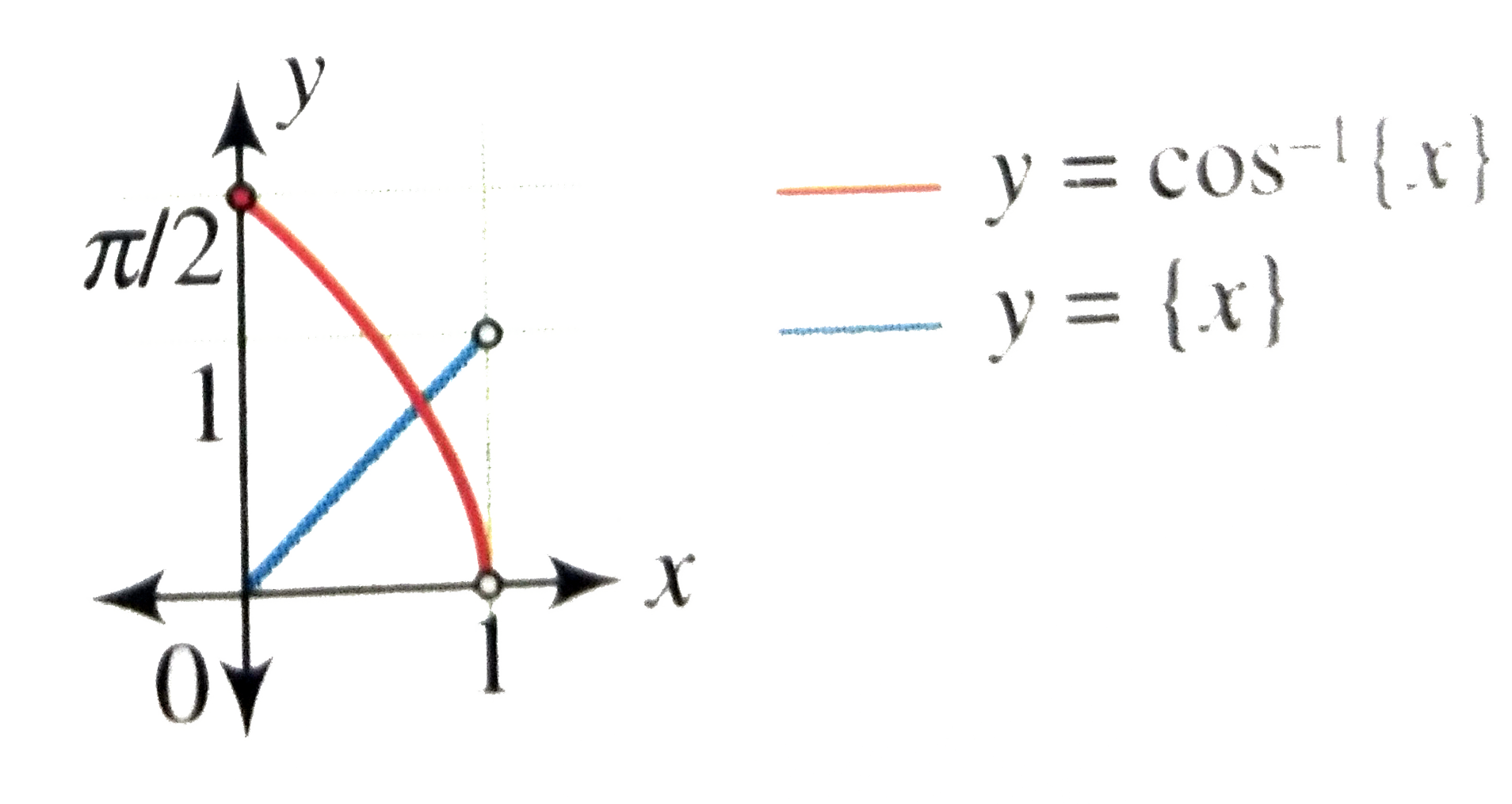 Since, the peirod of `y=f(x) is 'I'`, the graph of the function can be drawn by REPEATING the above for each interval `(n, n+1)n in Z`. 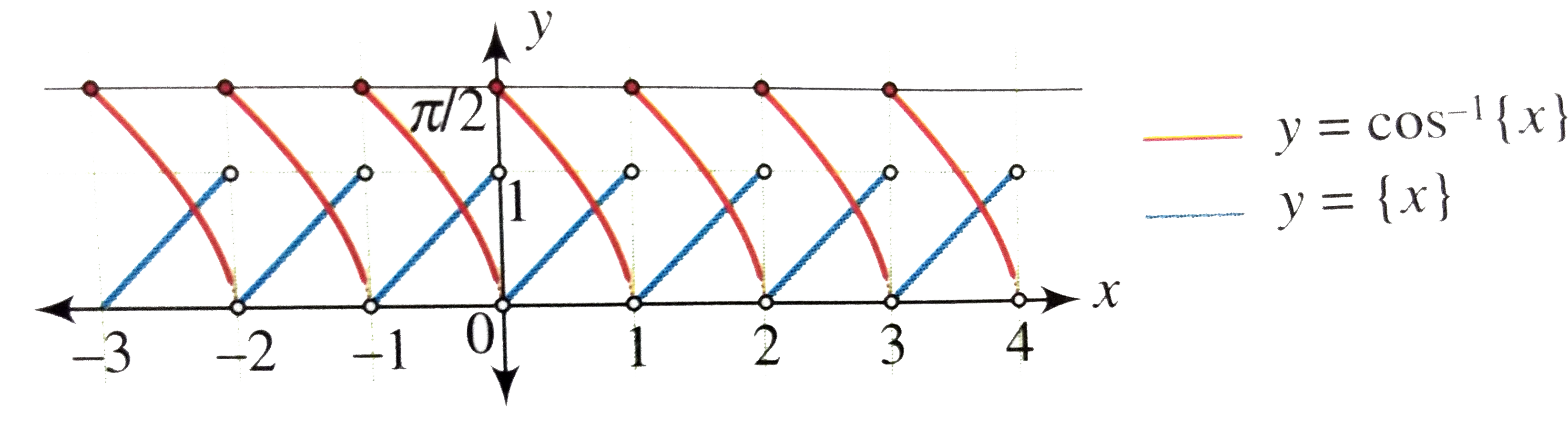
|
|
| 40. |
If m and M denotes the minimum and maximum value of |2z+1|, where |z-2i|le1 and i^(2)=-1, then the value of (M-n)^(2) is equal to |
|
Answer» 17 |
|
| 41. |
If sum _(r =1) ^(n ) T _(r) = (n +1) ( n +2) ( n +3) then findsum _( r =1) ^(n) = (1)/(T _(r)) |
|
Answer» |
|
| 42. |
Differentiate the following functions with respect to x. y= x^(x).sin x+ (sin x)^(x) |
|
Answer» |
|
| 43. |
Show that f(x)={(xsinfrac{1}{x},xne0),(0,x=0):} is not differentiable x=0 |
|
Answer» Solution :`L.H.D.=lim_(hto0)(f(-h)-f(0))/(-h)` `=lim_(hto0)((-h)sin(-1/h)-0)/(-h)=lim_(hto0)(-sinfrac{1}{h})` which does not EXIST. SIMILARLY R.H.D. does not exist. So f(X) is not differentiable at x=0 |
|
| 44. |
If1 , omega , omega^(2) are the cube roots of unity , then find the values of the following . (a + 2 b)^(2) + ( a omega^(2) + 2 b omega)^(2) + ( a omega + 2 b omega^(2))^(2) |
|
Answer» |
|
| 45. |
One of the closed points on the curve x^(2) - y^(2)=4 to the point (6,0) is……… |
| Answer» Answer :C | |
| 46. |
If cos alpha+cos beta+cos gamma=0 & sin alpha +sin beta +sin gamma=0. Then Prove thatsin2alpha+sin2beta+sin2gamma=0 |
| Answer» | |
| 47. |
Let f(x) ={{:(x^(2)+a, 0 le x lt1),( 2x+b, ale x le 2):} andg(x) ={{:(3x+b,0 le xlt1),( x^(3), 1le x le 2):} if (df)/(dg) exists at x=1, then |
|
Answer» a=-1 |
|
| 48. |
If |{:(a-b,b-c,c-a),(x-y,y-z,z-x),(p-q,q-r,r-p):}|=m|{:(c,a,b),(z,x,y),(r,p,q):}|," then m"= |
| Answer» Answer :C | |
| 49. |
If P(A) = 4//5, P(B) = 2//4, P(A nn B) = 3//5, then find P(bar(A uu B)). |
|
Answer» |
|
| 50. |
The perpendicular distance of the point P (6, 7, 8) from XY - plane is |
|
Answer» 1)8 |
|