

Saved Bookmarks
This section includes 7 InterviewSolutions, each offering curated multiple-choice questions to sharpen your Current Affairs knowledge and support exam preparation. Choose a topic below to get started.
| 1. |
The derivative of cos^(-1)(2x^(2) - 1) w.r.t cos^(-1) x is |
|
Answer» |
|
| 3. |
Sum of the first 20 terms of the series 1/((2)(4))+((1)(3))/((2)(4)(6))+((1)(3)(5))/((2)(4)(6)(8))+…. is |
|
Answer» `1/2-1/(2^(40))(""^(40)C_(20))` |
|
| 4. |
If int_(e)^(x) t f(t)dt= sin x - x cos x - (x^(2))/(2) for all x in R - {0} then the value of f(pi/6) is |
|
Answer» 0 |
|
| 5. |
If m is a positive integer then the solutions of x^((2)/(5))-5x^((1)/(m))+4=0 are |
|
Answer» 1, `2^(m)` |
|
| 6. |
Let O be the origin and A be a point on the curve y^(2)=4x. Then th locus of the mid point of OA is |
| Answer» Answer :D | |
| 7. |
Verify property 1 forDelta ={:|( 2,-3,5),(6,0,4) ,( 1,5,-7) |:} |
|
Answer» |
|
| 8. |
Prove that |{:(sqrt(13)+sqrt3,2sqrt5,sqrt5),(sqrt(15)+sqrt(26),5,sqrt(10)),(3+sqrt(65),sqrt(15),5):}|=5sqrt3(sqrt6-5) |
|
Answer» |
|
| 10. |
Ifalpha ,beta,gamma are the roots of x^3+px^2+qx+r=0 , then form the cubic equation whoseroots are alpha(beta+gamma),beta(gamma+alpha),gamma(alpha+beta) |
|
Answer» `x^(3) + 2qx^(2) + (q^(2) + pr) x - R (PQ - r) = 0` |
|
| 11. |
If A=[3""5],B=[7"" 3] , then find a non - zero matrix C such that AC=BC. |
|
Answer» |
|
| 12. |
Evaluate the following integrals int_(0)^(50)e^({x})dx where {x} denotes the fractional part of x |
|
Answer» |
|
| 13. |
A possible ordered pair (a, b) such that all the local extremum values of the function f(x) = x^(3) + ax^(2) - 9x + b are positive and the local minimum value occurs at point x = 1 is |
|
Answer» `(3,5)` |
|
| 14. |
Two dice are rolled and given that the sum is prime. The probability of getting sum more than 6 is |
|
Answer» `(7)/(15)` |
|
| 15. |
The plane region bounded by the curve y=sqrt(cosx), 0 le x le (pi)/(2) and the lines x=0,y=0 is rotated about x-axis. The volume of solid formed is : |
|
Answer» a)`pi` |
|
| 16. |
Which of the following pair of graphs intersect ? (i) y = x^(2) - xand y = 1 (ii) y = x^(2) - 2x+ 3 and y = sin x (iii) = x^(2) - x + 1 and y = x - 4 |
|
Answer» Solution :Graphs`y = X^(2) - x` and y = 1 intersect when `x^(2) `- x and y = 1 intersect when `x^(2)- x = 1 or x^(2) = x -1 = 0 ` CLEARLY, this EQUATION has real solution. So graphs intersect. Graphs `y = x^(2) - 2x + 3` and y = sin x intersect when `x^(2)-2x + 3 = sin x(x-1)^(2)+ 2 = sin` x, which is not possible as L.H.S. has least value 2, whereas R.H.S. has maximun value 1. So, Graphs do not intersect. (iii) Graphs `y = x^(2)-x + 1` and y = x -4` intersect if `x^(2)-x + 1 = x - 4 or x^(2) = 2x + 5 = 0 or (x -1)^(2)+ 4 = 0`. Clearly. this equation has non-real ROOTS . So, graphs do not intersect |
|
| 17. |
If omega=e^(i2pi//3), and a,b,c,x,y,z be non-zero complex numbers such that a+b+c=x, a+bomega+comega^(2)=y, a+bomega^(2)+comega=z Then, the value of (|x|^(2)+|y|^(2)+|z|^(2))/(|a|^(2)+|b|^(2)+|c|^(2)|, is |
|
Answer» 3 `x=a+b+c` `x=a+b+c` `RARR |x|^(2)-xbarx=(a+b+c)(bara+barb+barc)` `rArr |x|^(2)=abara+bbar+cbarc+(abarb+barab)+(barbc+barbc)+(cbara+barca)` and, `y=a+bomega+comega^(2)` `rArr |y^(2)|=ybary=(a+bomega+comega^(2))(bar(a+bomega+comega^(2)))=(a+bomega+comega^(2))(bara+barbomega^(2)+barcomega)` `rArr |y|^(2)=abara+barbb+cbarc+(abarbomega^(2)+barabomega)+(bbarcomega^(2)+barbcomega)+(barcaomega+cbaraomega^(2))` Similarly, `rArr |Z|^(2)=|a|^(2)+|b|^(2)+|c|^(2)+(abarbomega+barabomega^(2))+(bbarcomega+barbcomega^(2))+(barcaomega^(2)+cbaraomega)` `THEREFORE |x|^(2)+|y|^(2)+|z|^(2)=3{|a|^(2)+|b|^(2)+|c|^(2)}` `rArr (|x|^(2)+|y|^(2)+|z|^(2))/(|a|^(2)+|b|^(2)+|c|^(2))=3` |
|
| 18. |
The positive integer n for which lim_(x to 0)((cosx-1)(cosx-e^(x))/x^(n) exists and is finite, is |
|
Answer» 4 |
|
| 19. |
Is the function defined by f(x)= {(x+5",","if" x le 1),(x-5",","if" x gt 1):} a continuous function? |
|
Answer» |
|
| 20. |
Find the approximate value of (2.01), where f (x) = 4x^(2) + 5x + 2. |
|
Answer» |
|
| 21. |
If x = tan""(y)/(2) - log[((1 + tan""(y)/(2))^(2))/(tan""(y)/(2))], "then " dy/(dx)is equal to |
|
Answer» ` (1)/(2) "" SIN y (1 - sin y + cos y )` Put ` tan"" (y)/(2) = t rArr (y)/(2) = tan^(-1) t ` ` rArr (dy)/(DX) = (2)/(1 + t^(2)) = (2) /(1 + tan^(3) ((y)/(2)) = 2 cos^(2) ((y)/(2)) = 1 + cos ` ….(ii) From EQ . (i) , ` x = t = " In" [ ((1 + t)^(2))/(t)]` `(dy)/(dx) = 1 - (t)/((1 + t)^(2)) ((1)/(t^(2)) + 1) = (t^(2) +1)/( t^(2) +t)` `[ because (d)/(dt) ((1 + t)^(2))/(t) = d/dt ((1)/(t) + 2 + t) = - (1)/(t^(2)) + 1]` ` (dx)/(dt) = (1 + tan^(2)""(y)/(2))/(1 + tan^(2)"tan"(y)/(2))= (2)/(1 - cos y + siny) ` ...(iii) On dividing Eq. (ii) by .(iii) , we get `rArr (dy)/(dx) = ((1 + cos y) (1 - cos y + sin y))/(2)` ` dy/dx = 1/2"sin" y (1 + sin y + cos y)` . |
|
| 22. |
Evaluate the following definite integrals int_-1^1 dx/(x^2+2x+5) |
|
Answer» SOLUTION :`int_-1^1 DX/(x^2+2x+5) = int_-1^1 dx/((x+1)^2 +4)` =`[1/2 tan^-1((x+1)/2)]_-1^1` =`1/2[tan^-1 1- tan^-1 0]` =`1/2[tan^-1 1- tan^-1 -]` |
|
| 23. |
Find the second order derivatives of the functions given in Exercises 1 to 10. tan x. |
| Answer» | |
| 24. |
If z= sqrt(3)+i, then the argument of z^(2)e^(z-i) is equal to |
|
Answer» `(pi)/(2)` |
|
| 25. |
The statement, 'If it is raining then I will go to college' is equivalent to |
|
Answer» If it is not RAINING then I will not GO to COLLEGE |
|
| 26. |
If af(x) + bf(1/x) = x+1, x != 0, find f(x). |
|
Answer» Solution :Given AF(X) + BF(1/x) = x + 1 ...(i) `because x != 0` replacing x by `(1)/(x)` in (i), we get `af((1)/(x)) + bf (x) = (1)/(x) + 1` ....(ii) Eliminating `f((1)/(x))` from (i) and (ii), we get `(a^(2) - b^(2)) f(x) = a(x+1) - b((1)/(x) + 1) :. f(x) = (a(x+1)-b((1)/(x) + 1))/(a^(2)-b^(2))` |
|
| 27. |
If f_(n)(x) = log log…..log x(log is repeated n-times), then int (xf_(1)(x)f_(2)(x)…..f_(n)(x))^(-1) dx is equal to, |
|
Answer» `f_(N+1)(X)+c` |
|
| 28. |
Passage 1 The second section gives power to the President, "by and with the advice and consent of the Senate, to make treaties, provided two thirds of the Senators present concur…" Some are displleased with it, not on account of any errors or defects in it, but because they say the treaties will have the force of laws, and thus should be made only by the legislature. These gentlemen seem not to consider that the judgement of our courts, and the commissions constitutionally given by our governor, are as valid and as binding on all persons whom they concern as the laws passed by our legislature. All constitutional acts of power, whether in the executive or in the judicial department, have as much legal validity and obligation as if they proceeded from the legislature. it surely does not follow that because the people have given the power of makin laws to the legislature, they should therefore likewise give the legislature the power to do every other act of government by which the citizens are to the bound and affected. The President is to have power, "by and with the advice and consent of the Senate, to make treaties, provided two thirds of the senators present concur."... Though several writers o teh subject of government place the power of making treatis in the class of executive aunthorities, this is evidently an arbitrary classicication, for if we attend carefully to its operation, it will be found to partake more of the legislative than of the executive character, though it does not seem strictly to fall within the definition of either of them. The essence of teh legislative branch is to enact laws, or, in other words, to prescribe rules for the regulation of teh society, while the execution of the laws, and the employment of the common strength, either for this purpose of for the common defense, seem to comprise all the functions of the executive branch. The power of making treaties is, plainly, neither the one nor the other. It relates neither to the execution of the existing laws, nor to the creation of new ones, and still less to an exertion of the common strength. Its objects are CONTRACTS with foreign nations, which have the force of law, but derive it from the obligations of good faith. They are not rules prescribed by the government of the citizen, but agreements between two governments. The power in questin seems therefore to form a distinct department, and to belong, properly, neither to the legislative nor to the exective branch. The qualties elsewhere detailed as indispensable in the management of foreign negotiations point to the Exective as the best agent in those transactions, while the vast importance of the trust, and the operation of treaties as laws, plead strongly for the participation of the whole or a portion of the legislative body in the office of making them. What does Passage 1 suggest about Jay's opponents' opinion of the second section of Article Ii of the Consitution ? |
|
Answer» Jay's opponents' criticisms of the SECOND section would be legitimate if the second section contained errors and defects. |
|
| 29. |
Three vectors vec(a),vec(b) and vec( c ) satisfy the condition vec(a)+vec(b)+vec( c )=vec(0). Evaluate the quantity mu=vec(a).vec(b)+vec(b).vec( c )+vec( c ).vec(a), if |vec(a)|=1,|vec(b)|=4 and |vec( c )|=2. |
|
Answer» |
|
| 30. |
Passage 1 The second section gives power to the President, "by and with the advice and consent of the Senate, to make treaties, provided two thirds of the Senators present concur…" Some are displleased with it, not on account of any errors or defects in it, but because they say the treaties will have the force of laws, and thus should be made only by the legislature. These gentlemen seem not to consider that the judgement of our courts, and the commissions constitutionally given by our governor, are as valid and as binding on all persons whom they concern as the laws passed by our legislature. All constitutional acts of power, whether in the executive or in the judicial department, have as much legal validity and obligation as if they proceeded from the legislature. it surely does not follow that because the people have given the power of makin laws to the legislature, they should therefore likewise give the legislature the power to do every other act of government by which the citizens are to the bound and affected. The President is to have power, "by and with the advice and consent of the Senate, to make treaties, provided two thirds of the senators present concur."... Though several writers o teh subject of government place the power of making treatis in the class of executive aunthorities, this is evidently an arbitrary classicication, for if we attend carefully to its operation, it will be found to partake more of the legislative than of the executive character, though it does not seem strictly to fall within the definition of either of them. The essence of teh legislative branch is to enact laws, or, in other words, to prescribe rules for the regulation of teh society, while the execution of the laws, and the employment of the common strength, either for this purpose of for the common defense, seem to comprise all the functions of the executive branch. The power of making treaties is, plainly, neither the one nor the other. It relates neither to the execution of the existing laws, nor to the creation of new ones, and still less to an exertion of the common strength. Its objects are CONTRACTS with foreign nations, which have the force of law, but derive it from the obligations of good faith. They are not rules prescribed by the government of the citizen, but agreements between two governments. The power in questin seems therefore to form a distinct department, and to belong, properly, neither to the legislative nor to the exective branch. The qualties elsewhere detailed as indispensable in the management of foreign negotiations point to the Exective as the best agent in those transactions, while the vast importance of the trust, and the operation of treaties as laws, plead strongly for the participation of the whole or a portion of the legislative body in the office of making them. Jay includes the reasoning of those who are sipleased with the president's trety-making power (lines 5-9) in order to |
|
Answer» provide an OPPOSING conslusion that gives CONTEXT for his own argument. |
|
| 31. |
On which of the following intervals is the function f given by f(x)=x^(100)+sinx-1 strictly decreasing? |
| Answer» Answer :D | |
| 32. |
Find the angle between the circles x^2 + y^2 + 4x - 14y + 28 = 0 and x^2 + y^2 + 4x - 5 = 0 |
|
Answer» |
|
| 33. |
Foci of the rectangular hyperbola are (pm 7)the equation of the hyperbola is |
|
Answer» `X^(2)-y^(2)=49` |
|
| 35. |
if abs(veca) = 3, abs(vecb)=2 and veca . vecb = 3, then angle between veca and vecb is: |
|
Answer» `π/2` |
|
| 37. |
If A=[{:(1,0),(-1,7):}]andA^(2)=8A+KIthen find K. |
|
Answer» |
|
| 38. |
A man wants to invest at most 12000 in savings certificate and N.S.C. He has to invest at leat Rs. 2000 in saving certificate and at least Rs. 4000 inN.S.C. If the rate of interest on saving certificate is 8% per annum and rate of interest on N.S.C. is 10% per annum, how much money he should invest to earn maximum yearly income? Find also the maximum yearly income. |
|
Answer» Investment in N.S.C. = Rs. 10,000 Maximum INTEREST INCOME = Rs. 1,160 |
|
| 39. |
If int(x)/((x^(2)+1)(x-1))dx=A log|x^(2)+1|+B tan^(-1)x+C log|x-1|+d, then A+B+C= |
| Answer» Answer :C | |
| 40. |
If p,q,r and s are the probabilities of raining at four different places at some fixed moment , then find the maximum and minimum values of 3(p^2+q^2+r^2+s^2)-2(p+q+r+s)+4. |
|
Answer» |
|
| 41. |
If z,z+iz and iz are three complex nubers on a plane which forms a triangle of area 18 sq.Units, then the value of |
|
Answer» |
|
| 42. |
If (1+x+x^2)^n = sum_(r=0)^(2n) a_r x' then a_1-2a_2 + 3a_3-…..-2na_(2n)=….... |
|
Answer» 0 |
|
| 43. |
Evaluate the followingdeterminants |[3,-1,-2],[0,0,-1],[3,-5,0]| |
|
Answer» Solution :On expanding ALONG `R_2` we have |[3,-1,-2],[0,0,-1],[3,-5,0]| = -0|[-1,-2],[-5,0]|+ 0|[3,-2],[3,0]|-(-1)|[3,-1],[3,-5]| = 0+0+1(-15+3) = -12` |
|
| 44. |
The statement [ p ^^ ( p rarr q) ] rarr q is |
|
Answer» a FALLACY |
|
| 45. |
If coefficient of correlation is -0.6, standard deviation of x is 5 and variance of y is 16, then what is the co-variance of x and y? |
|
Answer» 0.75 |
|
| 46. |
Show that zero is the identity for addition on R and 1 is the identity for multiplication on R. But there is no identity element for the opertions -: R xxR to R and div : R _(**) xx R_(**) to R _(**). |
|
Answer» |
|
| 47. |
If the coordinates of any two points Q_1 and Q_2 are (x_1,y_1) and (x_2,y_2), respectively, then prove that OQ_1xxOQ_2cos(angleQ_1OQ_2)=x_1x-2+y-1y_2, whose O is the origin. |
Answer» Solution :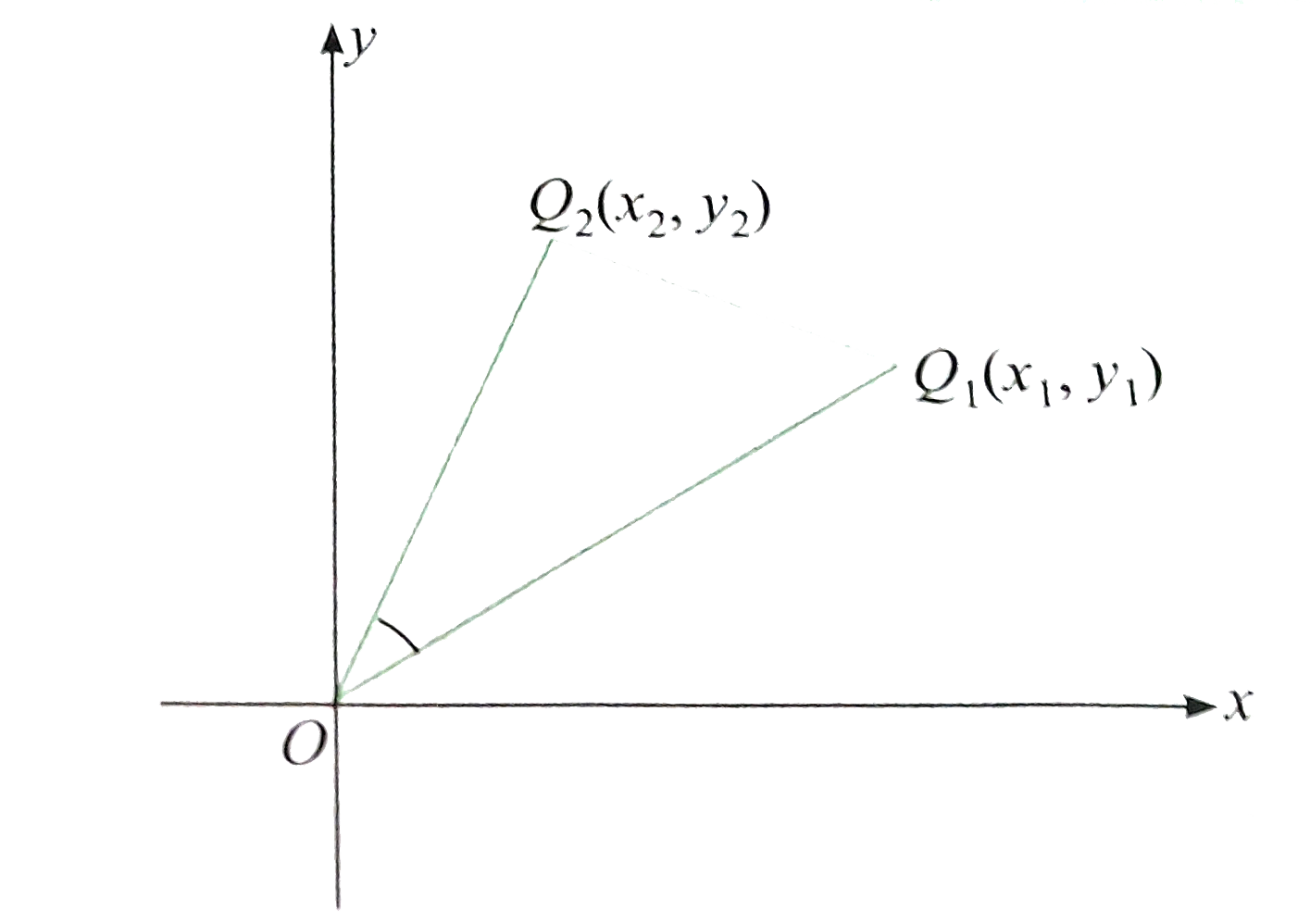 In `DeltaOQ_1Q_2`, using cosing rule, we get `(Q-1Q_2)^2=(OQ_1)^2+(OQ_2)^2-OQ_1.OQ_2.cos(angleQ_1OQ_2)` `therefore(x_2-x_1)^2+(y_2-y_1)^2` `=(x_(1)^2+y_1^2)+(x_2^2+y_2^2)-2OQ_1.OQ_2.cos(angleQ_1OQ_2)` `rArrOQ_1.OQ_2cos(angleQ_1OQ_2)=x_1x_2+y_1y_2`. |
|
| 48. |
For three vectors bar(a),bar(b) and bar( c ),bar(a)xx(bar(b)xx bar( c ))=(bar(a)xx bar(b))xx bar( c ) then |
|
Answer» `BAR(b)XX(bar(a)xx bar( C ))=0` |
|
| 50. |
Passage 1 The second section gives power to the President, "by and with the advice and consent of the Senate, to make treaties, provided two thirds of the Senators present concur…" Some are displleased with it, not on account of any errors or defects in it, but because they say the treaties will have the force of laws, and thus should be made only by the legislature. These gentlemen seem not to consider that the judgement of our courts, and the commissions constitutionally given by our governor, are as valid and as binding on all persons whom they concern as the laws passed by our legislature. All constitutional acts of power, whether in the executive or in the judicial department, have as much legal validity and obligation as if they proceeded from the legislature. it surely does not follow that because the people have given the power of makin laws to the legislature, they should therefore likewise give the legislature the power to do every other act of government by which the citizens are to the bound and affected. The President is to have power, "by and with the advice and consent of the Senate, to make treaties, provided two thirds of the senators present concur."... Though several writers o teh subject of government place the power of making treatis in the class of executive aunthorities, this is evidently an arbitrary classicication, for if we attend carefully to its operation, it will be found to partake more of the legislative than of the executive character, though it does not seem strictly to fall within the definition of either of them. The essence of teh legislative branch is to enact laws, or, in other words, to prescribe rules for the regulation of teh society, while the execution of the laws, and the employment of the common strength, either for this purpose of for the common defense, seem to comprise all the functions of the executive branch. The power of making treaties is, plainly, neither the one nor the other. It relates neither to the execution of the existing laws, nor to the creation of new ones, and still less to an exertion of the common strength. Its objects are CONTRACTS with foreign nations, which have the force of law, but derive it from the obligations of good faith. They are not rules prescribed by the government of the citizen, but agreements between two governments. The power in questin seems therefore to form a distinct department, and to belong, properly, neither to the legislative nor to the exective branch. The qualties elsewhere detailed as indispensable in the management of foreign negotiations point to the Exective as the best agent in those transactions, while the vast importance of the trust, and the operation of treaties as laws, plead strongly for the participation of the whole or a portion of the legislative body in the office of making them. Which choice provides the best evidence for the answer to the previous question ? |
|
Answer» LINES 5-6 ("Some are…legislature") |
|