

Saved Bookmarks
This section includes 7 InterviewSolutions, each offering curated multiple-choice questions to sharpen your Current Affairs knowledge and support exam preparation. Choose a topic below to get started.
| 2. |
If omega be the imaginary cube root of 1, the value of (7+11omega+3omega^(2))/(13+7omega+11omega^(2))+(7+11omega+13omega^(2))/(11+13omega+7omega^(2)) will be |
|
Answer» 2 |
|
| 4. |
Blocks A and B each have same mass m=1 kg determine the largest horizontal force P(in newton) which can be appied to B so that A wil not slip up on B . Neglect any friction. |
|
Answer» |
|
| 5. |
Let f(x)=f(x) f(y) for all x and y. If f(x) is continuous at x=1. then f(x) is continuous |
| Answer» ANSWER :B | |
| 6. |
Which statement is/are incorrect for given conplex ? Co(C_(2)O_(4))(en)Cl_(2)]^(-1) |
|
Answer» Oxidation state of central ATOM is + 3. Oxidation state of Co x-2+0-2=-1 x=+3 `C_(2)O_(4)^(-2)` and en = bidentate ligand `Cl^(-)` = monodentate] |
|
| 8. |
Each side of DeltaABC is the polarof the opposite vertex with respect to a circle with centre P. For the DeltaABC the point P is |
|
Answer» centroid |
|
| 9. |
Find the derivative of the following functions with respect to x sqrt((x+1)/(x-1)) |
|
Answer» |
|
| 10. |
If |{:(4-x,4+x,4+x),(4+x,4-x,4+x),(4+x,4+x,4-x):}|=0 then find values of x |
|
Answer» |
|
| 11. |
Differentiate the following w.r.t.x (cot^-1x)^2 |
| Answer» SOLUTION :`d/dx[(cot^-1x)^2]=2cot^-1xd/dx(cot^-1x)=2cot^-1"X"XX(-1)/(1+x^2)=(-2cot^-1x)/(1+x^2)` | |
| 12. |
The sum of the fourth and twelfth term of an arithmetic progression is 20. What is the sum of the first 15 terms of the arithmetic progression? |
|
Answer» |
|
| 13. |
An aqueous solution containing1 M NiSO_(4) & 1 M S_(2) O_(8)^(2-) is electrolysed using palladium electrode, at 25^(@)C {:(Ni^(+2)+2e^(-) rarrNi,,E^(@)=-0.25 V),(2H^(+)+2e^(-)rarrH_(2),,E^(@)=0.00 V ),(O_(2)+4H^(+)+4e^(-)rarr2H_(2)O,,E^(@)=1.23 V),(Pd^(+2)+2e^(-) rarrPd,,E^(@) = 0.92 V),(S_(2)O_(8)^(2-)+2e^(-) rarr 2SO_(4)^(2-),,E^(@)=2 V):} pH of solution is 7. Select the correct statementon the basis of above given information. (Ignore over voltage & neglect variation ofE_(Pd^(+2)//Pd)^(@) with concentration) |
|
Answer» REACTION at anode is `Pd rarr Pd^(+2)+2e^(-)` |
|
| 14. |
Prove that the chord joining pointsP(alpha) and Q (beta)on the ellipse subtends a right angle at the vertex A(a,0) then tan((alpha)/(2)) tan((beta)/(2))=(-b^(2))/(a^(2)) |
|
Answer» |
|
| 15. |
The pair of tangents from origin to x^(2)+y^(2)+4x+2y-3=0 is |
|
Answer» `(2x+y)^(2)=3(X^(2)+y^(2))` |
|
| 16. |
The curves y=x^3-3x^2-8x-4,y=3x^2+7x+4 touch at the point (-1, 0). The equation of the common tangent is |
|
Answer» A and R are TRUE and R is the CORRECT EXPLANATION of A |
|
| 17. |
Let f:[1,3]to[0,oo) be continuous and differentiabl function. If (f(3)-f(1))(f^(2)(3)+f^(2)(1)+f(3)f(1))=kf^(2)(c)f'(c) where c in (1,3), then the value of k is "_____" |
|
Answer» |
|
| 18. |
The minimum value of z = 2x + 4y subject to constraints x+2y ge 10, 3x+y ge 10, x ge 0, y ge 0 is ……….. |
|
Answer» 20 |
|
| 19. |
Let a, b, c be distinct non-negative numbers. If the vectors ahat(i)+ahat(j)+chat(k),hat(i)+hat(k),chat(i)+chat(j)+bhat(k) lie in a plane, then C is |
|
Answer» A.M. of a, B |
|
| 20. |
Find the number of ways of forming a committee of 5 persons from a group of 4 Indians and 3 Russians such that there are atleast 3 Indians in the committee. |
|
Answer» |
|
| 21. |
Discuss the continuity of the functionf(x) = |x -1|"at" x=1 |
|
Answer» Solution :By definition f(x) `{:{(x-1,XGE 1), (-(x-1), x lt1):}` CLEARLY, the function is DEFINED at 1 and f(1)=0 LEFT hand limit of at 1 is `underset(x to 1^(-))limf(x) = underset(x to1) LIM (-x+1)=0` Similarly the right hand limit of f at 1. is `underset(x to 1^(+))limf(x) = underset(x to 1^(+))lim ( x-1)=0 ` Thus, the left hand limit, right hand limit and the value of the function coincide at x =1 . Hence the function is continuous at x =1 . |
|
| 22. |
A 10 kW transmitter emits radio waves of 500 m wavelength. The number of photons emitted per second by the transmitter is of the order of :- |
|
Answer» `10^(25)` |
|
| 24. |
Find all the points of discontinuity of the function f defined by {{:(x+2," if "x lt 1),(0," if "x=1),(x-2," if "x gt 1):}. |
|
Answer» |
|
| 25. |
If alpha and beta are the roots of x^(2)+x+1=0, then alpha^(16)+beta^(16)= |
|
Answer» `(-1-isqrt3)/2` |
|
| 26. |
Let A and B be two sub-sets of C defined as follows: A = {z in C :(1+3i)z + (1-3i)barz=10} and B ={z in C : |z|=1}, then |
|
Answer» `A CAP B = phi` |
|
| 27. |
Let a=3^(1//224)+1 and for all n ge 3, let f(n)=""^(n)C_(0)a^(n-1)-""^(n)C_(1)a^(n-2)+""^(n)C_(2)a^(n-3)+...+(_1)^(n-1)*""^(n)C_(n-1)*a^(0). If the value of f(2016)+f(2017)=3^(k), the value of K is |
|
Answer» 6 |
|
| 28. |
There are 2 locks on the door and the door keys are among the 6 differentones you carry in your pocket . In a hurry one key is dropped somewhere by you. The probability that you can still open the door is |
|
Answer» `1//2` |
|
| 29. |
The point (2a, a) lies inside the region bounded by the parabola x^(2) = 4y and its latus rectum. Then, |
|
Answer» `0 LT=a lt=1` |
|
| 30. |
Observe the following statements: statement I: The radical centre of S-=x^2+y^2-1=0 S' -= x^2+y^2+6x-2y-1=0 S''-=x^2+y^2-12x+4y-1=0 does not exist. statement II : The radical centre of three circles whose centers are collinear does not exist because radical axes of each pair of circles are parallel. |
|
Answer» I is true, II is true, But II is not the CORRECT explaination for I |
|
| 31. |
Find the domain and range of the following function : f : R rarr R , f(x) = -|x| |
|
Answer» |
|
| 32. |
Find k if the following pairs of circles are orthogonal x^(2)+y^(2)-6x-8y+12=0,x^(2)+y^(2)-8x+6y+k=0 |
|
Answer» |
|
| 33. |
Refers to question 11. How many of circuit of type A and of type B, should be produced by the manufacture, so as to maximise hi profit? Determine the profit. |
|
Answer» Maximise Z=50x+60y, subject to `2x+y le 20, x+2y le 12, x+3y le 15 , x ge 0, y ge 0` From the shaded region it is CLEAR that feasible region determine by the system of constraints is OABCD and is bouned and the COORDINATES of corner points are (0,0) (10,0), `((28)/(3),(4)/(3))`,(6,3)and (0,5) respectively. `"since" x+2y=12 and 2x+y=20 Rightarrow x=(28)/(3),y=(4)/(3)and x+3y=15 and x+2y=12 Rightarrow y=3 and x=6] 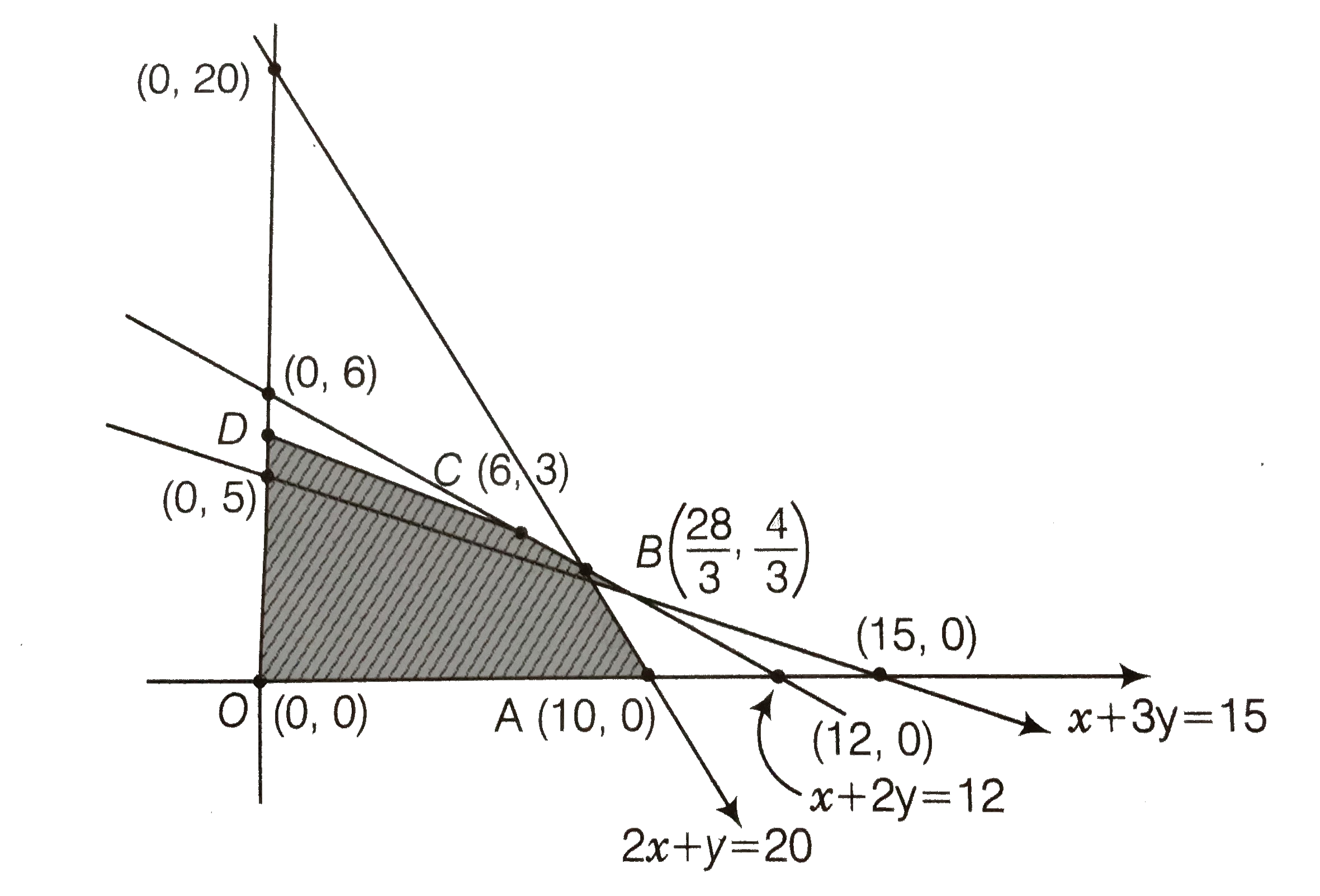 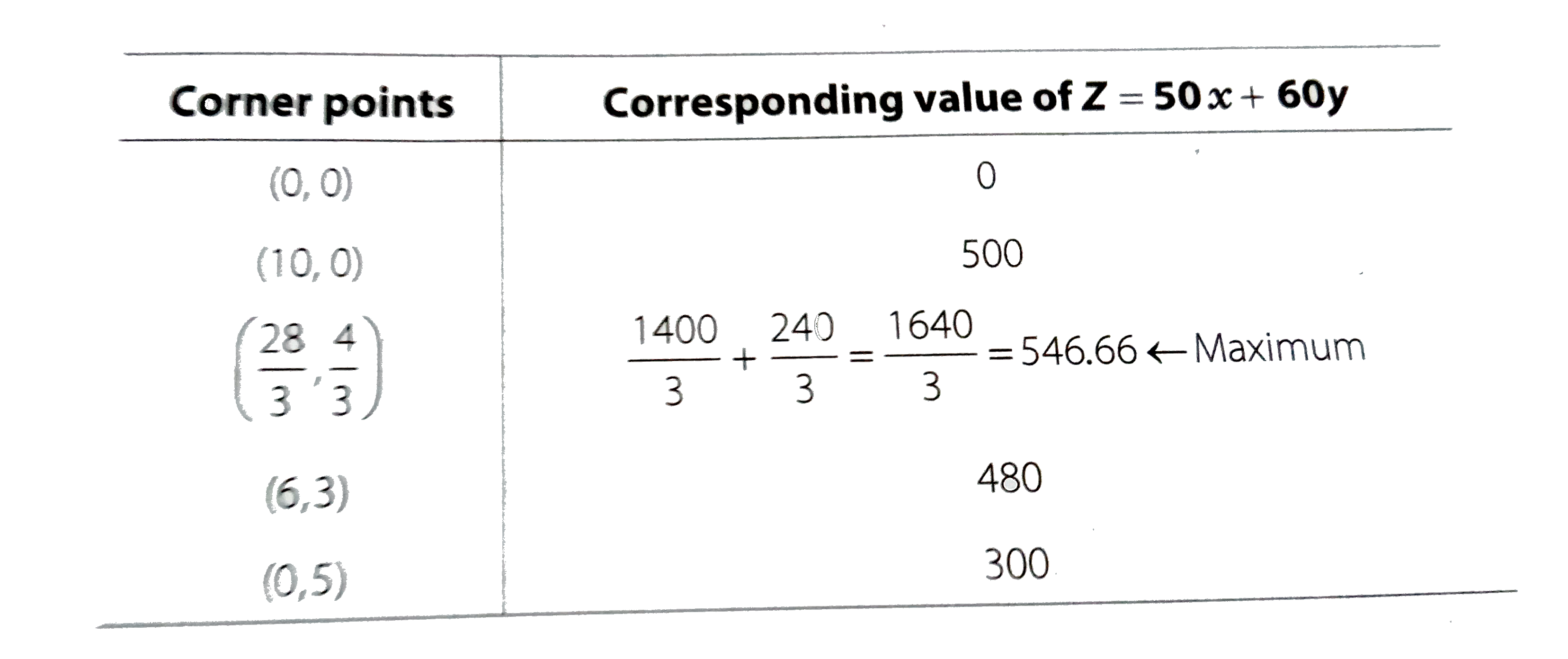 Since, the manufacture is required to produce two types of CIRCUITS A and B it is clear that parts of resistor, transistor and capacitor cannot be in friction, so the required MAXIMUM profit is 480 where circuits of types B is 3. |
|
| 34. |
An open top box of maximum possible volume from a square piece of tin of side 'a' is to be made by cutting equal squares out of the corners and then folding up the tin to form the sides.The length of a side of square cut out is |
|
Answer» `a//6` |
|
| 35. |
CaOCl_(2)overset(Delta)underset(CoCl_(2))rarrproduct, The product are |
|
Answer» `CaCl_(2)` |
|
| 36. |
Examine the existence of the following limits:lim_(xto0+) log_ax |
|
Answer» SOLUTION :`lim_(xto0+) log_ax` `lim_(hto0) log_ah=-infty` `THEREFORE` The LIMIT EXISTS. |
|
| 37. |
Evalute the following integrals int e^(2 log" cot x")dx = |
|
Answer» COT X - x + C |
|
| 38. |
If R and S are two symmetric relation then |
|
Answer» `R_(o)S` is SYMMETRIC RELATION |
|
| 39. |
The number of ways in which a 7 people can sit around a round table is |
|
Answer» `""^(16)C_(11)` |
|
| 40. |
The separate equations of the lines represented by the line equation (x+1)^(2)+(x+1)(y-2)-2(y-2)^(2)=0 are |
|
Answer» `2x+y-4=0 and 5x-3y+1=0` |
|
| 41. |
Integrate the functions sqrt((1-sqrtx)/(1+sqrtx)) |
|
Answer» |
|
| 42. |
Find the value of c for which the vectors vec(a)=(c log_(2)x)hati-6hatj+3hatk and vec(b)=(log_(2)x)hati+2hatj+(2c log_(2)x)hatk makes an obtuse angle for any (x in 0, oo). |
|
Answer» |
|
| 43. |
The sum of the first three terms of a G.P. is 16 and the sum of the next three terms is 128. (i) Determine the first term and common ratio. (ii) Find also the sum of n terms of the G.P. |
|
Answer» |
|
| 44. |
Let f :[1,oo] to[2,oo]differentiable function such that f (1) = 2 .If [1,oo] to[2,oo] |
|
Answer» `rArr6(x)*1-0=3f(x)+3xf'(x)-3x^(2)` `RARR 3xf' (x) -3 f(x) = 3x^(2) rArr f' (x) -(1)/(x)f(x)=x` `rArr (xf'(x)-f'(x))/(x^(2))=1rArr (d)/(dx){(x)/(x)}=1` On INTEGRATING both sides , we get `rArr (f(x))/(x')=x+c`"" [`:' f(1)=(1)/(3)]` `(1)/(3)=1+crArrc=(2)/(3)ANDF(x)=x^(2)-(2)/(3)x` `:. f(2)=4-(4)/(3)=(8)/(3)` NOTEHere , f (1) = 2 , does not satisfy given function. `:. f(1) = (1)/(3)` For that f (x)`=x^(2)-(2)/(3)x andf(2)=4-(4)/(3)=(8)/(3)` |
|
| 45. |
The normal at point P on a given parabola meet the axis of parabola at Q. Then prove that a line through Q and perpendicular to this normal always touches a fixed a parabola whose length of latusrectum is same as that of given parabola. |
|
Answer» |
|
| 46. |
Find the equation of circle passing through intersection points of line ax + by + c =0with coordinate axes and through origin. |
|
Answer» |
|
| 48. |
If the expansion in powers of x of the function (1)/((1-ax)(1-bx)) is a_(0)+a_(1)x+a_(2)x^(2)+a_(3)x^(3)+.....+a_(n) thencoefficient of x^(n) is |
|
Answer» `(a^(N+1)-B^(n+1))/(b-a)` |
|