

Saved Bookmarks
This section includes 7 InterviewSolutions, each offering curated multiple-choice questions to sharpen your Current Affairs knowledge and support exam preparation. Choose a topic below to get started.
| 1. |
If S = 0, S' =0 are touching circles, then the angle between the line of centres and radical axis of S = 0, S' =0 is |
| Answer» ANSWER :A | |
| 2. |
Find values of k if area of triangle is 4sq. units and vertices are (k,0)(4,0),(0,2) |
|
Answer» |
|
| 3. |
If Q is the set of rational numbers and a function f:Q to Qis defined as f(x)=5x-4, x in Q, then show that f is one-one and onto. Also define f^(-1). |
|
Answer» |
|
| 4. |
In a box containing 100 bulbs 10 are defective the probability that out of a sample of 5 bulbs none is defective is ? |
|
Answer» `10^(-1)` |
|
| 5. |
If intsqrt((x-5)/(x-7))dx=Asqrt(x^(2)-12x+35) +log|x-6+sqrt(x^(2)-12x+35)|+C, then A= |
|
Answer» `-1` `=intsqrt(((x-5)(x-5))/((x-7)(x-5)))dx` [rationalising] `=INT(x-5)/(sqrt(x^(2)-5x-7x+35))dx` `=int(x-5)/(sqrt(x^(2)-12x+25))dx` `=(1)/(2)int(2x-10)/(sqrt(x^(2)-12x+35))` `=(1)/(2)int(2x-12+2)/(sqrt(x^(2)_12x+35))dx` `=(1)/(2)int(2x-12)/(sqrt(x^(2)-12x+35))dx+int(1)/(sqrt(x^(2)-12x+35))dx` `=sqrt(x^(2)-12x+35)+int(1)/(sqrt(x^(2)-12x+36-1))dx+C` `[because" let "x^(2)-12x+35=timplies(2x-12)dx=dt]` `sqrt(x^(2)-12x+35)+int(1)/(sqrt((x-6)^(2)-1^(2)))dx+c` `l=sqrt(x^(2)-12x+35)log+|x-6+sqrt(x^(2)-12x+35)|+C` `thereforel=Asqrt(x^(2)-12x+35)+log|x-6+sqrt(x^(2)-12+35)+C` `=1*sqrt(x^(2)-12x+35)log|x-6+sqrt(x^(2)-12x+35)+C` On COMPARING both sides, we get A=1 |
|
| 6. |
int_(0)^(2) x (2-x ) ^(3/2)dx =…… |
|
Answer» `(32sqrt(2))/(35)` |
|
| 7. |
The probability that a student is not a swimmer is(1)/(5) Then the probability that out of five students, four are swimmers is |
|
Answer» `""^(5)C_(4)((4)/(5))^(4)(1)/(5)` |
|
| 8. |
A factor manufactures two types of screws, A and B. Each type of screw requires the use of two machines, an automatic and a hand operated. It takes 4 minutes on the automatic and 6 minutes on hand operated machines to maufacture a package of screw s A, while it take 6 minutes on automatic and 3 minutes on the hand operated machines to maufacture a package of screws B. Each machine is available for at the most 4 hours on any day. The manufacturer can sell a package of screws A at a profit of Rs. 7 and screws B at a profit of Rs 10. Assuming that he can sell all the screw he manufactures, how many packages of each type should the factory owner produced day in order to maximise his profit? Determine the maximum profit. |
|
Answer» THUS, the factory should PRODUCT 30 packages of screws A and 20 packages of screws B to get the maximum PROFIT of Rs 410 . |
|
| 9. |
The solution of y^(2) cos sqrt(x) dx-sqrt(x e)^((1)/(y)) dy = 0 is |
|
Answer» `2Cos SQRT(x) + E^((1)/(y)) = C` |
|
| 10. |
If the curves x^2/a^2+y^2/b^2=1 and x^2/25+y^2/16=1 cut each other orthogonally, then a^2-b^2 equals to |
|
Answer» 9 |
|
| 12. |
Prove that cot^(-1)(-x)=pi-cot^(-1)x,AAx inR. |
|
Answer» |
|
| 13. |
Let m = the number of values of a for which the system of equations x+2y+z=a 3x+4y+2z=a -3 4x+2y+z=4 has a solution . Let omega ne 1 be cube root of unity then |m+omega| = _____ . |
|
Answer» |
|
| 14. |
Proceeding from the definition, compute the following improper integrals (or prove their divergence): (a) int_(0)^(3a)(2xdx)/((x^(2)-a^(2))^(2//3)), (b) int_(0)^(2//pi)sin.(1)/(x)*(dx)/(x^(2)), (c ) int_(0)^(1)cos.(pi)/(1-x)*(dx)/((1-x)^(2)), (d) int_(2)^(6)(dx)/(sqrt((4-x)^(2))), (e ) int_(-1)^(-2)(dx)/(xsqrt(x^(2)-1)), (f) int_(1)^(2)(dx)/(x1n^(p)x) |
|
Answer» (b) it DIVERGES; (C ) diverges; (d) `6root3(2);` (e ) `(PI)/(3);` (F) converges for `plt1` and diverges for `pge1`. |
|
| 15. |
If veca*veca=0andveca*vecb=0 , then what can be concluded about the vectorvecb? |
|
Answer» |
|
| 16. |
The vector eqution of the plane passing through a point having position vector hati-hatj+hatk and parallel to the vectors 2hati+hatj+hatk" and " hatj+2hatk is |
|
Answer» `BARR.(hati-4hatj-2hatk)=7` |
|
| 17. |
intsqrt(x^2-6x+5)dx |
|
Answer» SOLUTION :`intsqrt(x^2-6x+5)DX=intsqrt((x-3)^2-2^2) dx` =`(x-3)/2sqrt((x-3)^2-2^2)-2^2/2In(x-3+SQRT((x-3)^2-2^2)+C)` =`[becauseintsqrt(x^2-a^2)dx =x/2sqrt(x^2-a^2)-a^2/2In(x+sqrt(x^2-a^2))]` =`1/2(x-3)sqrt(x^2-6x+5)-2In(x-3+sqrt(x^2-6x+5))+C` |
|
| 18. |
A box of oranges is inspected by examining three randomly selected oranges drawn without replacement. If all the three oranges are good, the box is approved for sale, otherwise, it is rejected. Find the probability that a box containing 15 oranges out of which 12 are good and 3 are bad ones will be approved for sale. |
|
Answer» |
|
| 19. |
A.(vec(B)+vec(C))xx(vec(A)+vec(B)+vec(C))= |
|
Answer» 0 |
|
| 20. |
Find (dy)/(dx) in the following y= cos^(-1) ((1-x^(2))/(1+ x^(2))), 0 lt x lt 1 |
|
Answer» |
|
| 21. |
If the vectors 3hati-2hatj-hatk,2hati-3hatj-4hatk,-hati+hatj+2hatk and 4hati+5hatj+lambda hatk are in the same plane then lambda = …………. |
|
Answer» `-(146)/(17)` |
|
| 22. |
Are the following sets relation ? phi xx phi from phi to phi.Determinethe domain range and inverse of each of the relations mentioned above. |
| Answer» SOLUTION :`PHI XX phi` from `phi` to `phi` is a RELATION | |
| 23. |
Evaluation of definite integrals by subsitiution and properties of its : If f(x)=f(2-x) then int_(0.5)^(1.5)xf(x)dx=........ |
|
Answer» `int_(0)^(1)F(x)DX` |
|
| 24. |
Let q be a positive with q le 50. If the sum ""^(98)C_(30)+2" "^(97)C_(30)+3." "^(96)C_(30)+ …… + 68." "^(31)C_(30)+69." "^(30)C_(30)=""^(100)C_(q) Find the sum of the digits of q. |
|
Answer» |
|
| 25. |
Find an anti derivative (or integral) of the following functions by the method of inspection. e^(2x) |
|
Answer» |
|
| 26. |
The set of all values of a for which the function f(x) =(sqrt(1+4)/(1-a)-1)x^5-3x+log 5 decreasesfor all real x is |
|
Answer» `(-OO,oo)` |
|
| 27. |
The Pace for Living' is written by : |
| Answer» Answer :C | |
| 28. |
int 3^(x)cos 5x dx = |
|
Answer» `(3^(x))/((log 3)^(2) + 25) `[ (log 3) .cos 5 x - 5 SIN 5 x ] + c |
|
| 29. |
The solution set of inequations 2x - 1 le 3 and 3x + 1 ge -5 is |
|
Answer» (-2,2) |
|
| 30. |
If 3A+4B'=[(7,-10,17),(0,6,31)]and 2B-3A'[(-1,18),(4,0),(-5,-7)]" then "B= |
|
Answer» `[(-1,-18),(4,-16),(-5,-7)]` |
|
| 31. |
Mean of 100 observations is 50 and S.D. is 10. If 5 subtracted from each observation and then it is divided by 4, then the new mean and S.D. are |
|
Answer» 11.25, 6.25 |
|
| 32. |
If a,b,c are in A.P., then prove that the following are also in A.P (i) a^(2)(b+c),b^(2)(c+a),c^(2)(a+b) ltbr gt(ii) 1/(sqrtb+sqrtc),1/(sqrtc+sqrta),1/(sqrta+sqrtb) (iii) a(1/b+1/c),b(1/c+1/a),c(1/a+1/b) |
|
Answer» SOLUTION :Let `a^(2)(b+C),b^(2)(c+a),c^(2)(a+b)` are in A.P. Then, `b^(2)(c+a)-a^(2)(b+c)=c^(2)(a+b)-b^(2)(c+a)` or `c(b^(2)-a^(2))+ab(b-a)=a(c^(2)-b^(2))+BC(c-b)` or `(b-a)(ab+bc+ca)=(c-b)(ab+bc+ca)` or b-a=c-b or 2b=a+c Thus, a,b,c are in A.P., which is given. (ii) Let `1/(sqrtb+sqrtc),1/(sqrtc+sqrta),1/(sqrta+sqrtb)` are in A.P.then, `1/(sqrtc+sqrta)-1/(sqrtb+sqrtc)=1/(sqrta+sqrtb)-1/(sqrtc+sqrta)` or `(sqrtb-sqrta)/((sqrtc+sqrta)(sqrtb+sqrtc))=((sqrtc-sqrtb))/((sqrta+sqrtb)(sqrtc+sqrta))` or `(sqrtb-sqrta)/((sqrtc+sqrta)(sqrtb+sqrtc))=((sqrtc-sqrtb))/((sqrta+sqrtb)(sqrtc+sqrta))` or `(sqrtb-sqrta)/(sqrtb+sqrtc)=(sqrtc-sqrtb)/(sqrta+sqrtb)` or b-a=c-b or 2b=a+c Thus, a,b,c are in A.P., which is given. Hence, `1/(sqrtb+sqrtc),1/(sqrtc+sqrta),1/(sqrta+sqrtb)` are in A.P. (iii) a,b,c are in A.P. Then, `a/(abc),b/(abc),c/(abc)` are in A.P. [On DIVIDING each term by abc] `rArr1/(bc),1/(ca),1/(ab)` are in A.P. `rArr(ab+bc+ca)/(bc),(ab+bc+ca)/(ca),(ab+bc+ca)/(ab)` are in A.P. [On multiplying each termby ab+bc+ca] `rArr(ab+bc+ca)/(bc)-1,(ab+bc+ca)/(ca)-1,(ab+bc+ca)/(ab)-1` are in A.P. [On adding -1 to each term] `rArr(ab+ac)/(bc),(ab+bc)/(ca),(bc+ca)/(ab)` are in A.P. `rArra(1/b+1/c),b(1/c+1/a),c(1/a+1/b)` are in A.P. |
|
| 33. |
10 persons are sitting in a row. Find the number of ways of selecting two persons out of them who are sitting adjacent to each other |
|
Answer» |
|
| 34. |
The sum of n terms of the series : 5 + 11 + 19+ 29+ 41 . . . is |
|
Answer» `(N(n-1)(n-+7))/(5)` |
|
| 35. |
Match the following lists: |
|
Answer» `"orIm"((x+iy)^(2))=3` `"or"2xy=3` which is a RECTANGULAR hyperbola having eccentricity `sqrt2`.  `TAN30^(@)=(b^(2)//a)/(2ae)` `"or"(2)/(sqrt3)e=e^(2)-1` `"or"sqrt3e^(2)-2e-sqrt3=0` LTBRGT `"or"e=(2pmsqrt(4+12))/(2sqrt3)=(2pm4)/(2sqrt3)` `"or"e=(3)/(sqrt3)=sqrt3` (c) Eccentricity of hyperbola`=(AB)/(PA-PB)=(6)/(4)=(3)/(2)` If the eccentricity of conjugate hyperbola is e', then `(1)/((3//2)^(2))+(1)/(e'^(2))=1` `"or"e'=(3)/(sqrt5)` (d) Angle between the asymptotes is `tan^(-1)|(2ab)/(a^(2)-b^(2))|=(pi)/(3)` `"or"|(2xxa//b)/((a^(2)//b^(2)))|=sqrt3` `"or"(2sqrt(e'^(2)-1))/(|e'^(2)-2|)=sqrt3` where e' is the eccentricity of conjugate hyperbola. THEREFORE, `e'=2.` |
|
| 36. |
The set of all points where at tunction f (x) = sqrt( 1 - e ^(-x)) is differentiable is |
|
Answer» ` (0,OO)` |
|
| 37. |
Match the following lists: |
Answer»  (a) OBVIOUSLY, all the points in List II are common to the hyperbola and circle. (b). The chord of contact of hyperbola w.r.t. (0, -9/4) is `0(x)-(-(9)/(4))y=9` `"or"y=4` Solving this with hyperbola, we have `x^(2)-16=9` `"or"x^(2)=25or x= pm5` Hence, the point of contact are `(pm 5, 4)`. (c) Obviously, the required point is `(-5, -4)`. (d) LET the point on the hyperbola be P(H,k) and `Q(-h,k)`. Then `"Area of TRIANGLE"=(1)/(2)|2h||-6-k|=10"(1)"` Also, points P and Q lie on the hyperbola. Hence, `h^(2)-k^(2)=9"(2)"` Clearly, point `(pm5,-4)` satisfy both (1) and (2). |
|
| 38. |
Using elementary row transformations , find the inverse of [{:(2,1),(7,4):}] |
|
Answer» |
|
| 39. |
Find the values of each of the following : If sin ("sin"^(-1)1/5+"cos"^(-1)x)=1 then find the value of x. |
|
Answer» |
|
| 40. |
The ratio of Jane's age to her daughter's age is 9:2. The sum of their ages is 44. How old is Jane? |
|
Answer» 22 |
|
| 41. |
A = (0,0 ) , B=( 4,0 ) ,C= ( 0,6)are the three centres of three circles of equal radii which do not touch externally pairwise. Then the radical centre of the circles is |
|
Answer» A) `(2,3) ` |
|
| 42. |
Match the following for coefficient of x^(n) in log_(e )(1+x+x^(2)) {:("List -I","List - II"),((1)n=6,(a)1),((2)n=3,(b) (1)/(2)),((3)n=2,(c )-(2)/(3)),((4)n=1,(d)-(1)/(3)):} |
|
Answer» `{:(1,2,3,4),(a,B,C,d):}` |
|
| 43. |
Sketch the region of relation [x] + [y] = 5, x, y ge 0, where [*] denots the greatest integer function. |
|
Answer» Solution :`[x]+[y]=5` For `0 le x lt1, 0 + [y]=5 or [y]=5 or 5 le x lt 6` Thus, the points lie in the region stisfying `0 le x lt 1 and 5 le x lt 6` as SHOWN in the FOLLOWING figure. 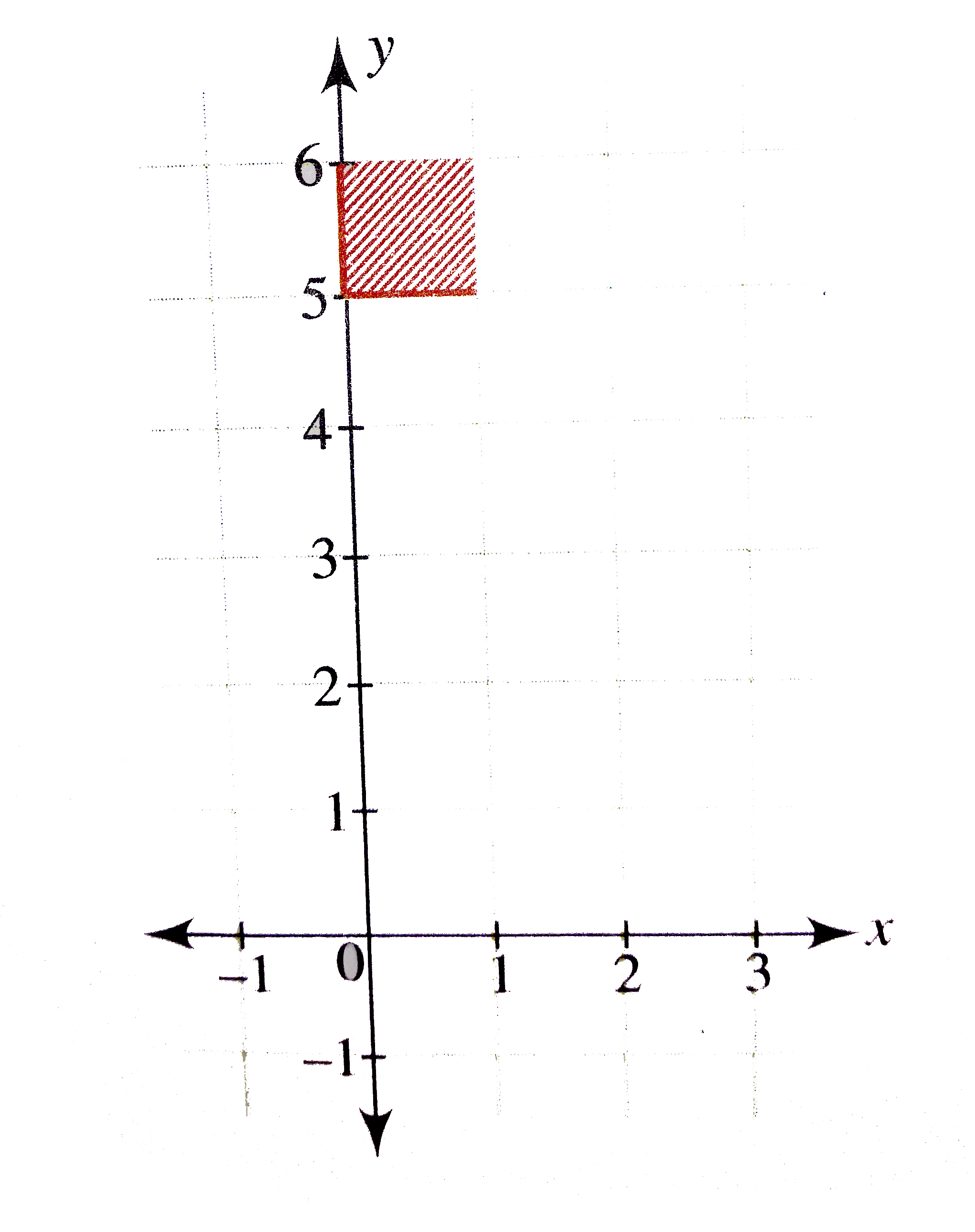 Thus, we have the following values of x and the corresponding values of y. 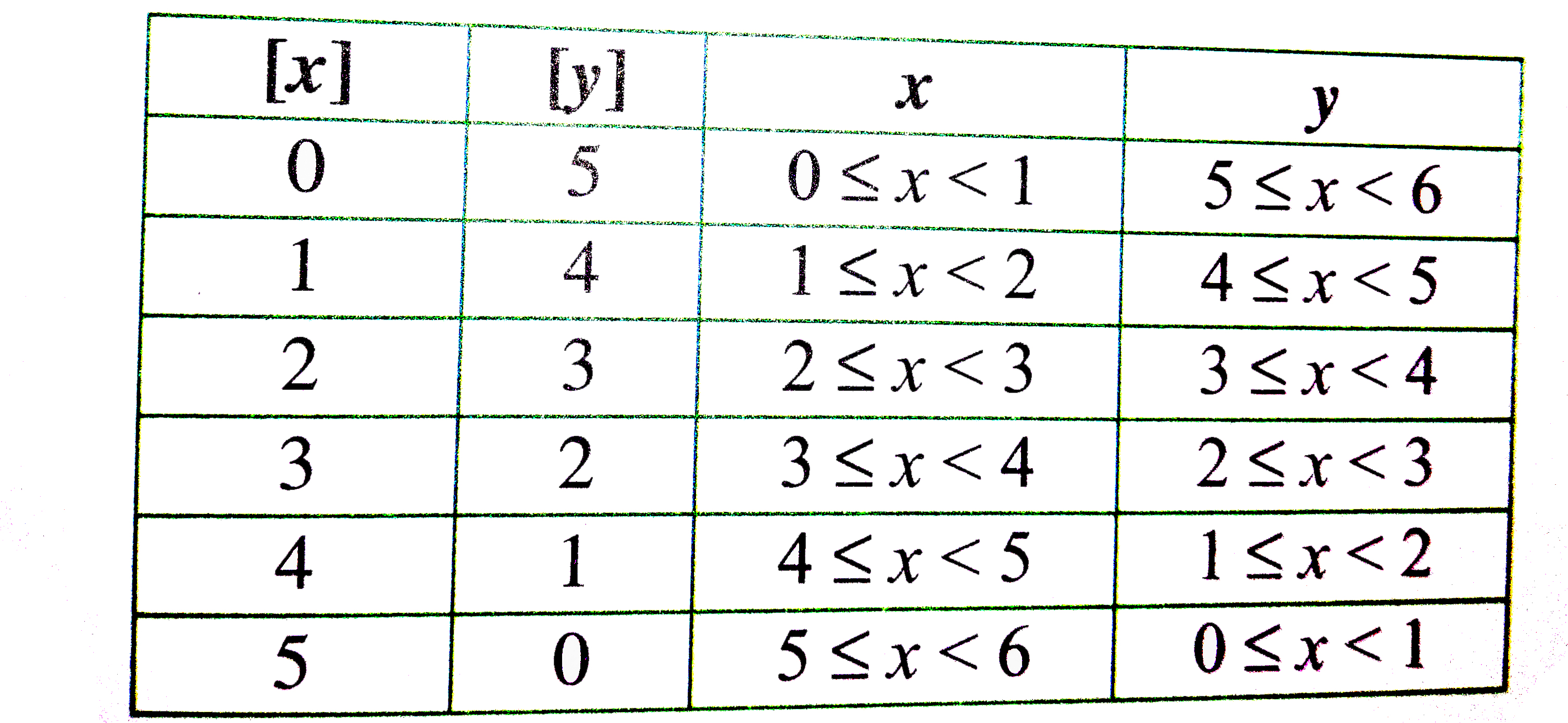 The region satisfying the above CONDITIONS is as shown in the following figure. 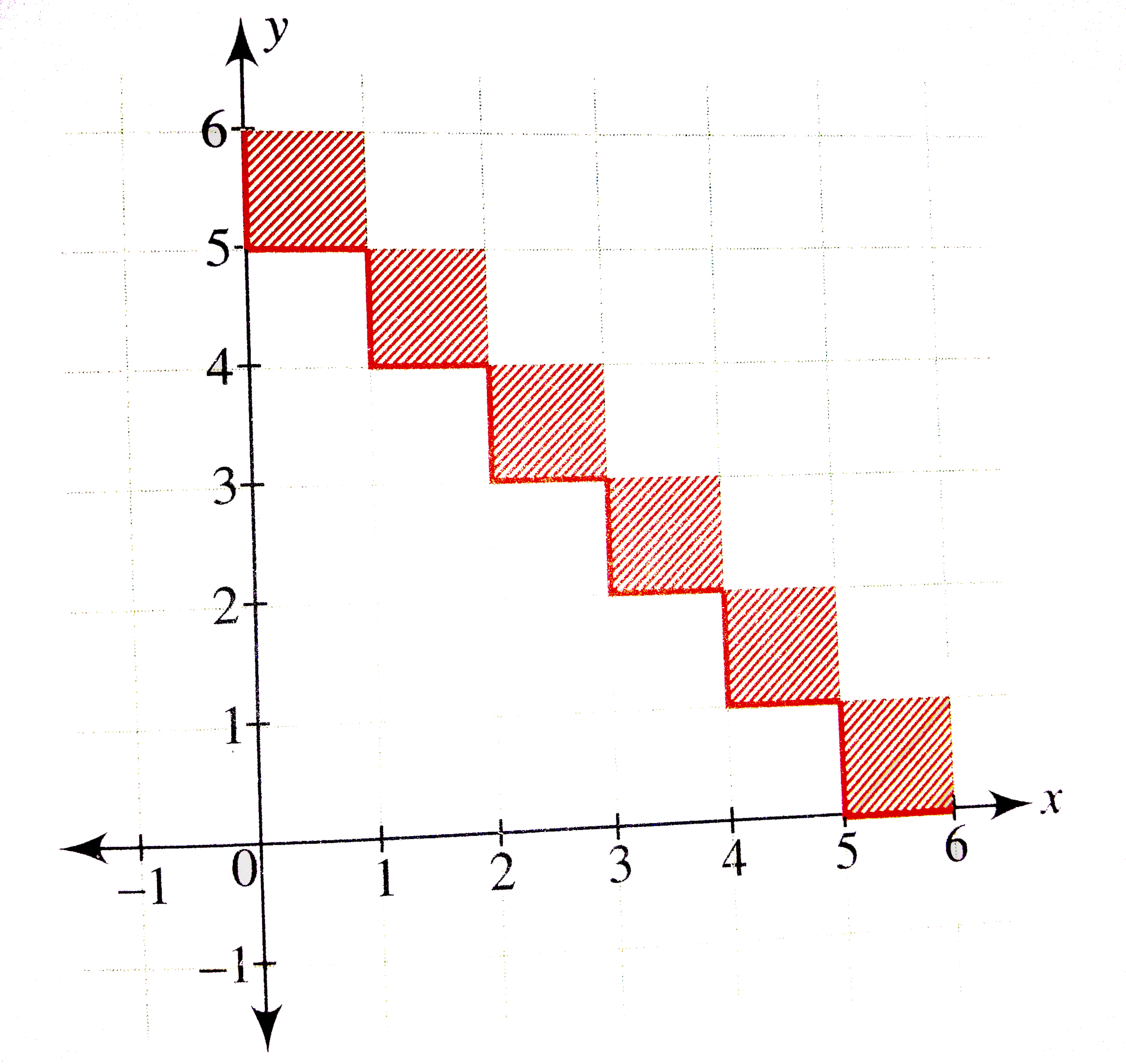
|
|
| 44. |
For allpositiveintegers n gt 1,{x(x^(n-1)- na^(n-1))+ a^(n) ( n-1)}is divisibleby |
|
Answer» (x-a) |
|
| 45. |
If I_(m,n)=int (x^(m))/((log x)^(n))dx then (m+1)I_(m,n)-n.I_(m,n+1)= |
|
Answer» `(X^(m))/((logx)^(N))+c` |
|
| 46. |
If veca = (1)/(sqrt10) (3 hati + hatk) and vecb =1/7 (2 hati + 3 hatj - 6 hatk), then the value of (2 veca - vecb). [ (veca xx vecb) xx (veca + 2 vecb] is : |
| Answer» ANSWER :A | |
| 47. |
An aeroplane flying at a constant speed, parallel to the horizontal ground, sqrt(3) km above it, is observed at an elevation of 60^(@) from a point on the ground. If, after five seconds, its elevation from the same point, is 30^(@), then the speed (in km/h) of the aeroplane, is |
|
Answer» 750 |
|
| 48. |
Find the projection of the vector hati+3hatj+7hatk on the vector 7hati-hatj+8hatk. |
|
Answer» |
|
| 49. |
In "The Pace for Living', the writer captures the agony of .... man. |
|
Answer» modern |
|
| 50. |
Let f(x)=x^(3)-9x^(2)+24x+c=0 have three real and distinct roots alpha, beta and lambda. (i) Find the possible values of c. (ii) If [alpha]+[beta]+[lambda]=8, then find the values of c, where [*] represents the greatestinteger function. (ii) If [alpha]+[beta]+[lambda]=7, then find the values of c, where [*] represents thegreatest integer function.s |
|
Answer» Solution :We have `y=f(x)=x^(3)-9x^(2)+24x+c` `f'(x)=3x^(2)-18x+24=3(x-2)(x-4)` Sign scheme of `f'(x)` is as follows. 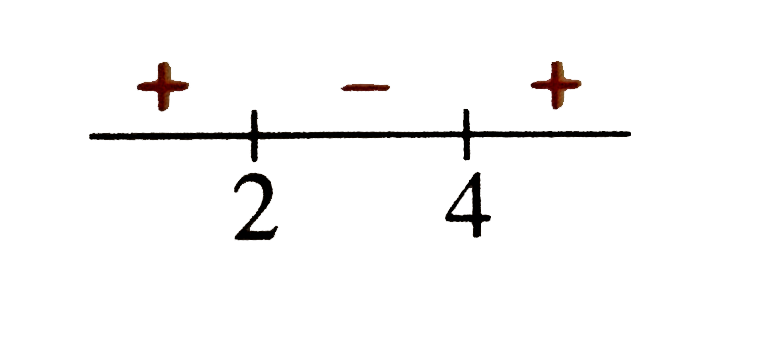 x=4 is the point of local minima and x = 2 is the point of local maxima. `f(2)=20, f(4)=16` `If c=0, " then " f(0)=0` So the graph of `y=f(x)` for `c=0` can be DRAWS as follows. 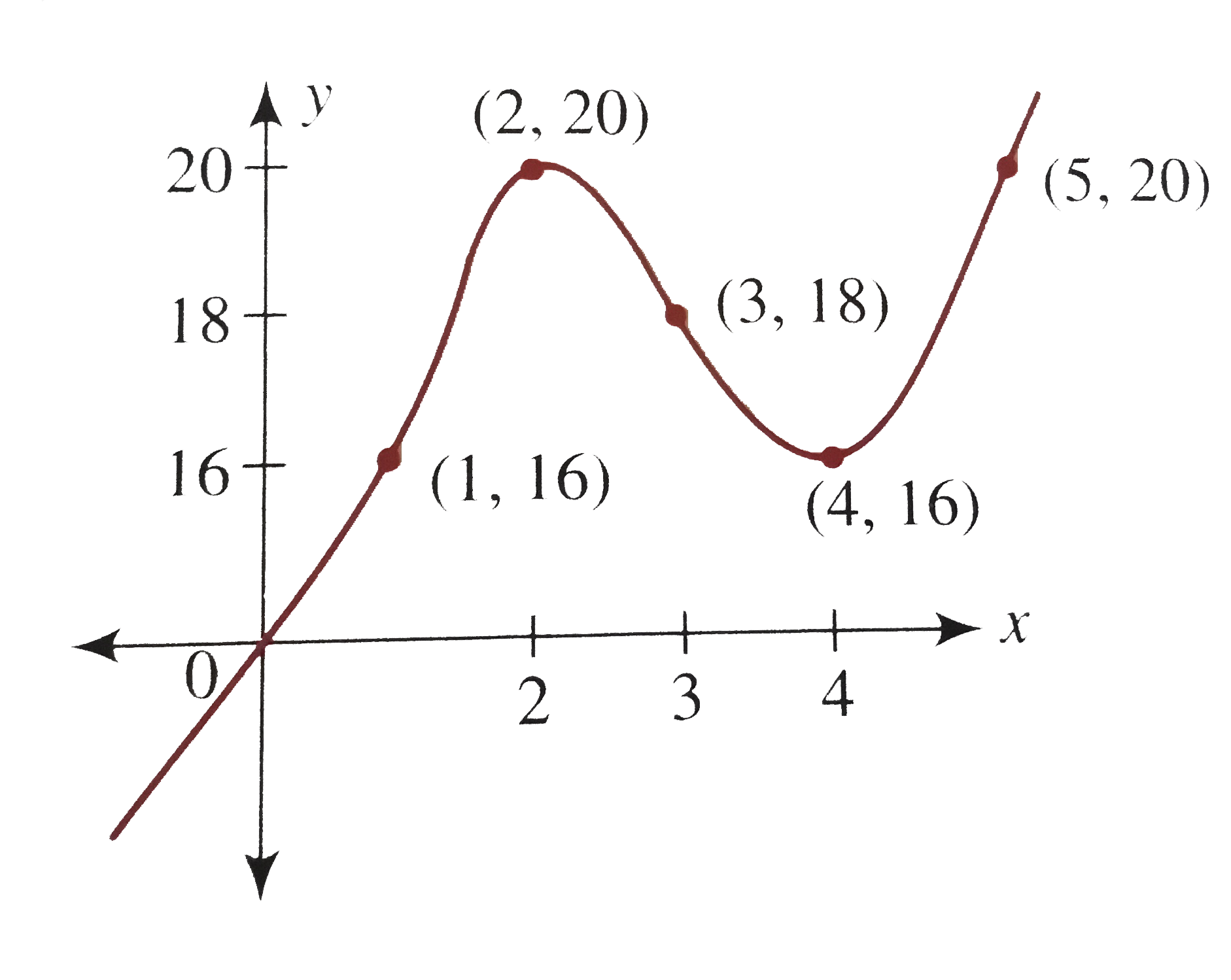 From the FIGURE, for three real roots of `f(x)=x^(3)-9x^(2)+24x+c=0`, c must lie in the interval `(-20, -16)`. `:. f(0)=c lt 0` `f(1)=1-9 +24+c=c+16 lt 0, AA c in (-20, -16)` `f(2)=8-36+48+c=c+20 gt 0, AA c in (-20, -16)` `:. alpha in (1,2) rArr [alpha]=1` `f(3)=27-81+72=18+c` `rArr f(3) gt 0 " if" c in (-20, -18) " or " f(3) lt 0 " if " c in (-18, -16)` or ` BETA in (2, 3) " if " c in (-18, -16)` and `beta in (3, 4) " if " c in (-20, -18)` Now `" " f(4)=64-144+96+c=16 +c lt0, AA c in (-20, -16)` `f(5) = 125 - 225 +120 +c = c+ 20 gt 0, AA c in (-20, -16)` ` :. LAMBDA in (4, 5) rArr [lambda] = 4` Thus `" " [alpha]+[beta]+[lambda]= {{:(1+3+4"," -20 lt c lt -18),(1+2+4"," -18 lt c lt -16):}` |
|