

Saved Bookmarks
This section includes 7 InterviewSolutions, each offering curated multiple-choice questions to sharpen your Current Affairs knowledge and support exam preparation. Choose a topic below to get started.
| 2. |
int(tan^(-1))/((1-x)^(2))dx |
|
Answer» |
|
| 4. |
int (dx)/(x(x^(2)+1))" equals" |
|
Answer» `log|x|+(1)/(2)log(x^(2)+1)+C` 1=A `(x^(2) +1) +(Bx+c)x` x=0 then 1=A (0+1) +0 `RARR ` A=1 Equatingthe COEFFICIENT of `x^(2)` `0= A+BrArrB=- A=-1` Equatingthe coefficeintsof `x,0 =C` ` :. (1)/(x(x^(2) +1)) =(1)/(x)+ (-x)/(x^(2) +1)` ` :. int(1)/(x(x^(2)+1))DX = int ((1)/(x)-(x)/(x^(2)-1))dx` `=log |x|-(1)/(2) log (x^(2)+1)+c` |
|
| 5. |
Find the coefficiant of x^(6) in the expansion of (1+x+x^(2)+x^(3) +x^(4))^(6) |
|
Answer» |
|
| 6. |
If R and R' are the circumradii of triangles ABC and OBC, where O is the orthocenter of triangle ABC, then : |
|
Answer» `R'=(R )/(2)` |
|
| 7. |
int(2)/( (e^(x) + e^(-x))^(2)) dx is equal to |
|
Answer» `INT(1)/( e^(X)+e^(-x))+C` |
|
| 8. |
If the roots of the equation x^(3) - 7x^(2) + 14x - 8 = 0are in geometric progression, then the difference between the largest and the smallest rootsis |
| Answer» ANSWER :C | |
| 9. |
If a, b are noncollinear vectors and A = (x + 4y) a + (2x + y + 1)b, B = (y - 2x +2) a + (2x - 3y - 1) b and 3A = 2B, then (x, y) = |
|
Answer» only I is TRUE |
|
| 10. |
Find the number of non-negative intergral solutions of x_(1)+x_(2)+x_(3)+x_(4)=20. |
|
Answer» Solution :We have `x_(1)+x_(2)+x_(3)+4x_(4)=20`, where `x_(1),x_(2),x_(3),x_(4) ge 0`. If we let `4x_(4)=y_(4)` we have `x_(1)+x_(2)+x_(3)+y_(4)=20, " where" y_(4)=0,4,8,12,16 " or " 20`. `therefore` Number of non-negative integral solutions of the above equation =coefficient of `p^(20) " in " underset("for" x_(1),x_(2) "and " x_(3))ubrace((p^(0)+p^(1)+p^(2)+p^(3)+..)^(3))xxunderset("for" y_(4))ubrace((p^(0)+p^(4)+p^(8)+p^(12)+p^(16)+p^(20)))` =coefficient of `p^(20) " in " ((1)/(1-p))^(3)((1)/(1-p^(4)))` =coefficient of `p^(20) " in " (1-p)^(-3)(1-p^(4))^(-1)` =coefficient of `p^(20) " in " (1+ ""^(3)C_(1)p+ ""^(4)C_(2)p^(2)+ ""^(5)C_(3)p^(3)+ ""^(6)C_(4)p^(4)+..) (1+p^(4)+p^(8)+..)` `=1+ ""^(6)C_(4)+""^(10)C_(8)+ ""^(14)C_(12)+ ""^(18)C_(16)+""^(22)C_(20)=536` |
|
| 11. |
Further ahead in the market, Mario finds a huge bag containing 171 mushrooms. He reads the label -“Weighing from 1 to 171 kgs, all varieties within”. Mario is puzzled as he does not know which mushrooms weighs what. He goes to a stone seller who had an offer of “Buy 1, Get 2 Identical Stones Free”. Mario asks him for the different kinds of stones and tells that he can use these to measure any of the mushroom accurately(using common balance). How many different kinds of stones does he buy? (Minimum ) |
|
Answer» Solution : “Buy 1, Get 2 Identical Stones FREE” means we can have 3 UNITS of every kind of stonewe buy. Answer is 3. We can measure weight of any randomly given mushroom using 3 stones ofweights 1 kg ,7 kg & 49 kg (`7^(0) ,7^(1) ,7^(2)`resp.)Suppose we could place stones only in the right PAN while a mushroom is in left pan of thebalance. Say we have stones of weight S1= 1kg ,S2= 2kg & S3= 4kg to balance a mushroom M ofweight 6,then only S2 & S3 are required to balance M.We can represent above statement using 0 & 1 as the coefficients of S1, S2 & S3.M (on left pan) = `1 x S3 + 1 x S2 + 0 x S1` (on right pan)Note that 110 is also the binary CONVERSION of 7 i.e. we represent 7 in terms of powers of 2: `1x2^(2) +1x2^(1) +0x2^(0) =7`.This way we can measure ANY weight from 1 to 7kg. For range of 171kg, we would require8 types of weights `(i.e. 1, 2,2^(2) ..."upto" 2^(7))`. But there is a shorter wayWe can instead represent the numbers in powers of 3. Here the coefficients will be 0, 1 or 2.This can do as we have 3 identical copies of each stone.for eg, 16 = 1x9 + 2x3 + 1x1. Giving 121 as the representation.For 171kg, this would require 5 types (1,3,9,27 & 81).If we increase to powers of 4, we require 1,4,16 & 64. (4 kinds)To reach lesser kinds, we’d use powers of 5, coefficients will be 0,1,2,3,4. But we don’t HAVE4 copies of the stones. But still we can overcome this problem Now, in the actual question, we can put stones on both sides of the balance.To represent this, we use ‘1’ to denote that a stone is in the left pan, ‘2’ to denote 2stones in left pan and so on. for eg, 16 = 1x9 + 2x3 + 1x1 = 1x9 + (31)x3 + 1x1 = 2x9 + (1)x3 + 1x1 In this way, we are putting 3kg on left pan making the weight 19kg on left. Also on rightside, weight is 2x9+1x1= 19kg. The advantage of using both sides is that we can do with only 3 identical copies of eachstone, rather than 6. Which means we can use powers of 7 to write the weights.For eg, writing 48 in powers of 7 is`48 = 6x7^(1)+ 6x7^(0)`(Whenever coefficient crosses 3, convert it to ve number.) `= (71)x7^(1)+ (71)x7^(0)` ` = 1x7^(2)+ (1)x7^(1)+1x7^(1) + (1)x7^(0)` ` =1x7^(2)+ 1 x 7^(0)` So weweigh 48kg by putting 1kg on left & 49 kg on right,Similarly, for 153kg 153 =3x49 + 0x7 + 6x1 = 3x49 + 1x7 1x1We can weigh 153 by putting 3 stones of 49kg & one 7kg stone on right and 1kg stone onleft with the mushroom.The range of this will be `6x7^(2) +6x7^(1) +6x7^(0) =171`.So, we can measure all weights till 171kg using only 3 kinds of stones : 1kg, 7kg & 49kg. |
|
| 12. |
Largange's Identify. Prove that (vec(a)xx vec(b))^(2)=|vec(a)|^(2)|vec(b)|^(2)-(vec(a).vec(b))^(2). |
|
Answer» |
|
| 13. |
vec(a)=2hati+lambda_(1)hatj+3hatk,vec(b)=4hati+(3-lambda_(2))hatj+6hatk and vec( c )=3hati+6hatj+(lambda_(3)-1)hatk are three vectors. Vector vec(b)=2vec(a) and vec(a) is perpendicular to vec(b) then the possible value of (lambda_(1),lambda_(2),lambda_(3)) is .............. |
| Answer» Answer :B | |
| 14. |
Evalute the following integrals int ((x^(3) -x)^(1//3))/(x^(4)) dx |
|
Answer» |
|
| 15. |
Let A be the event of having 53 sundays and B be the event of having 53 Mondays in a leap year. Decide whether A and B are independent or not. |
|
Answer» |
|
| 16. |
The solution of (dy)/(dx)+(1)/(x)=(e^(y))/(x^(2)) is |
|
Answer» `2X=(1+cx^(2))E^(y)` |
|
| 17. |
Solvethe equation 3x^3 -23x^2 + 72 x -70=0onerootbeing3 3+ sqrt(-5) |
|
Answer» |
|
| 18. |
x^(2) +4y^(2) +2x +16y +k=0represents an ellipse with ecentricity (sqrt3)/(2)for |
|
Answer» only one value of k |
|
| 19. |
Let g(x) = {{:(1,",",0 le x lt 1),(x^3, ",",1 le x lt 4),(sqrtx, ",",4 le x lt 9):} then int_(0)^(9) g (x) dx is |
|
Answer» `243//12` |
|
| 20. |
Using integration find the area of the region bounded by the triangle whose vertices are (1,0),(2,2) and (3,1). |
|
Answer» |
|
| 21. |
If f(x) is continuous at x=pi/4, where f(x)=(tan(pi/4 -x))/(cot 2x), for x != pi/4, then f(pi/4)= |
|
Answer» 2 |
|
| 22. |
A box contains 6 pens, 2 of which are defective, two pens are taken randomly from the box. If r.v.X: number of defective pens obtained, then standard deviation of X= |
|
Answer» `+-(4)/(3sqrt(5))` Two pens are taken randomly from the box. `THEREFORE`x and TAKE VALUES 0,1,2 `p(x=0)=(.^(4)C_(2))/(.^(6)C_(2))=(4xx3)/(6xx5)=(2)/(5)=(6)/(15)` `p(x=1)=(.^(2)C_(1)xx.^(4)C_(1))/(.^(6)C_(2))=(2x4xx2xx1)/(6xx5)=(8)/(15)` `p(x=2)=(.^(2)C_(2))/(.^(6)C_(2))=(1x2xx1)/(6xx5)=(1)/(15)` 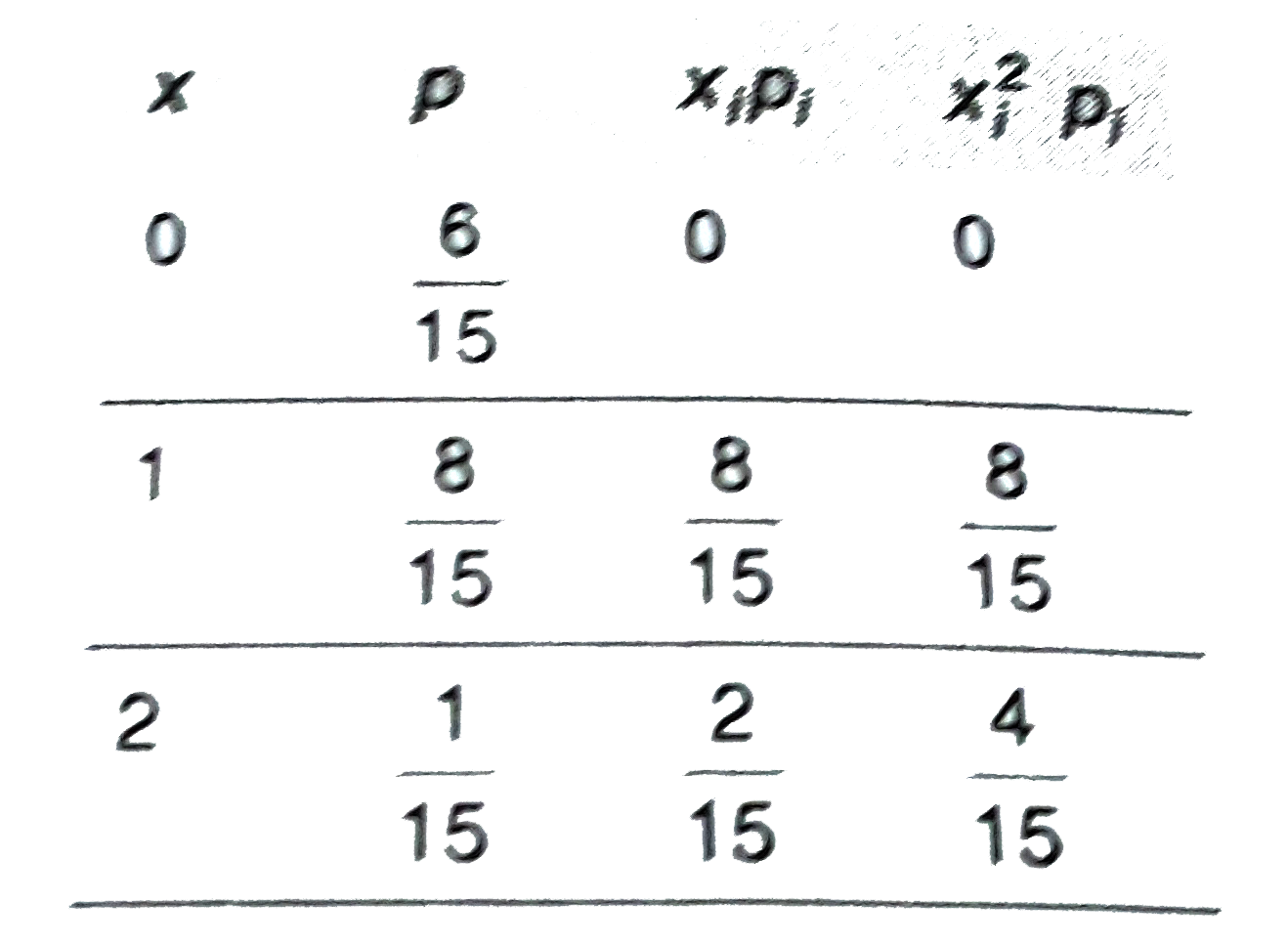 `E(x)=(10)/(15) and =(2)/(3)` `E(x^(2))=(12)/(15)=(4)/(5)` Standard deviation`=sqrt(E(x^(2))-[E(x)]^(2))` Standard deviation`=sqrt(((4)/(5))-((2)/(3))^(2))` `=sqrt((4)/(5)-(4)/(9))=sqrt((36-20)/(45))` `=sqrt((4xx4)/(45))=(4)/(3sqrt(5))` |
|
| 23. |
If A is the orthocentre of the triangle formed by 2x^(2)-y^(2)=0, x+y-1=0 and B is the centroid of the triangle formed by 2x^(2)-5xy+2y^(2)=0, 7x-2y-12=0, then the distance between A and B is |
| Answer» ANSWER :A | |
| 24. |
A fair coin is flipped 5 times. {:("Quantity A","Quantity B"),("The probability of getting",(1)/(2)),("more heads than tails",):} |
|
Answer» |
|
| 25. |
For any three propositions p, q and r, the proposition (p ^^ q) ^^ (q ^^ r) is true when |
|
Answer» <P>p, Q, R are all false |
|
| 26. |
7^(2n)+ 16 -1( nin N )isdivisibleby |
|
Answer» 65 |
|
| 27. |
A: The area of the triangle formed by x/4 + y/3 - z/2 = 1with x-axis and y-axis is 6. R: The area of the triangle formed by x/a + y/b + z/c = 1with x-axis and y-axis is1/2 | bc | |
|
Answer» both A and R are true and R is the correct EXPLANATION of A |
|
| 28. |
Consider the function f(theta)=int_(0)^(1)(|sqrt(1-x^(2))-sintheta|)/(sqrt(1-x^(2)))dx, where 0le theta le (pi)/2, then |
|
Answer» `f_("min")=sqrt(2)-1` Put `x=COS phi` `:.f(theta)=int_(0)^((pi)/2)|sinphi-sin theta|d phi` `=int_(0)^(theta)(sin theta-sin phi)d phi +int_(theta)^((pi)/2)(sin phi-sin theta)d phi` `=[phi sin theta+cos phi]_(0)^(theta)+[-cos phi-phi sin theta]_(theta)^(pi//2)` `=[theta sin theta+cos theta-0-1]-0-(pi)/2 sin theta +cos theta + theta sin theta` `=2(theta sin theta +cos theta)-(pi)/2 sin theta-1` `f'(theta)=2(theta cos theta+sin theta -sin theta)-(pi)/2 cos theta` `=2 (theta- (pi)/4) . cos theta` `f'(theta)=0` `:. theta =(pi)/4`, which is point of minima. `:. f((pi)/4)=2((pi)/4 1/(sqrt(2))+1/(sqrt(2)))-(pi)/2 1/(2sqrt(2))-1=sqrt(2)-1` `:. f(x)=1` and `f((pi)/2)=(pi)/2-1` So `f_("min")=sqrt(2)-1` and `f_("max")=1` |
|
| 29. |
Show that each of the relation R in the set A={x in Z: 0lt= xlt=12},given by R = {(a,b) : a=b} is an equivalence relation. Find the set of all elements related to 1 in each case. |
|
Answer» Solution :R={(1,1),(2,2),(3,3),(4,4),(5,5),(6,6),(7,7),(8,8),(9,9),(10,10),(11,11),(12,12)} R is reflexive, symmetric and transitive. `THEREFORE`R is equivalence relation. Set of all ELEMENTS related to 1 is {1}. |
|
| 30. |
IfA+B+C= pi and cos A+cos B+cos C=0=sin A+sin B+sin C ,then sin 3A+sin 3B+sin 3C = |
|
Answer» 0 |
|
| 31. |
The solution of the differential equation y^(-1)=(1)/(e^(-y)-x), is |
|
Answer» `x=e^(-y)(y+C)` |
|
| 33. |
Show that the straight lines whose direction cosines are given by 2l + 2m - n = 0 and mn + nl + Im = 0 are at right angles. |
|
Answer» |
|
| 34. |
Prove the existence of the limit of the sequence y_(n)=a^(1/2^(n)) (a gt 1) and calculate it. |
|
Answer» |
|
| 35. |
If a**b =a^(2) +b^(2) on Z , then ** is .......... |
|
Answer» COMMUTATIVE and associative. |
|
| 36. |
Construct a 3xx2 matrix A=[a_(ij)], whose elements are given by a_(ij)={{:(i-j",",iltj),(i+j",",i=j),(i*j",",igtj):}. |
|
Answer» |
|
| 37. |
Consider on equation with x as variable 7sin3x-2sin9x=sec^(2)theta+4cosec^(2)theta then the value of 15/(2pi)[minimum positive root-maximum negative root] is: |
|
Answer» |
|
| 38. |
If the vectors i-2xj-2yk and i+3xj+2yk are orthogonal to each other, then the locus of the point (x,y) is |
| Answer» Answer :A | |
| 39. |
Let A = {1,2,3}, B={a,b,c,d} and C={x,y,z,w}. Let R ={(1,a),(2,b),(1,c), (3,d)} S ={(a,x),(b,y),(c,y),(d,z)} Then S.R is equal to |
|
Answer» `{(1,X),(1,y),(3,z)}` |
|
| 40. |
Find dy/dx of y=cos^-1frac(1-x^2)((1+x^2)),0 |
| Answer» SOLUTION :`y=cos^-1((1-x^2)/(1+x^2))=2tan^-1xtherefore(DY)/(DX)=2XX1/(1+x^2)=2/(1+x^2)cos^-1((1-x^2)/(1+x^2))=2tan^-1x` | |
| 41. |
For function f(x)=(lnx)/(x), which of the following statements are true? |
|
Answer» f(X) has horizontal tangent at x = e |
|
| 42. |
Let M = {({:(a,b),(-b,a):}): a,b in R " and " a^(2) + b^(2) ne 0} Define a relation ~ on M as follows: A, B in M, A ~ B if AB A^(-1) = B |
|
Answer» R is an equivalence RELATION. |
|
| 43. |
The number of ways in which 6 gentlemen and 3 ladies be seated round a table so that every gentlemen may have a lady by his side is |
|
Answer» 1440 |
|
| 44. |
Find the number of triangles whose angular points are at the angular points of a polygon of 13 sides, but none of whose sides are the sides of the polygon. |
|
Answer» |
|
| 45. |
Find the value of {:(""SigmaSigma),(1 le i le j):}" "i xx (1/2)^j |
|
Answer» `=1xx[(1/2)^(2)+(1/2)^(3)+(1/2)^(4)+…]` `+2xx[(1/2)^(3)+(1/2)^(4)+(1/2)^(5)+..]` `+3xx[(1/2)^(4)+(1/2)^(5)+(1/2)^(6)+…]` ….. `=1xx((1/2)^(2))/(1-(1/2))+2xx((1/2)^(3))/(1-(1/2))+3xx((1/2)^(4))/(1-(1/2))+..` `thereforeS=1xx(1/2)+2xx(1/2)^(2)+3xx(1/2)^(3)+...` `therefore (1/2)S=1xx(1/2)^(2)+2xx(1/2)^(3)+3xx(1/2)^(4)...` Subtracting, we GET `(1/2)S=(1/2)+(1/2)^(2)+(1/2)^(3)+(1/2)^(4)+...=(1/2)/(1-1/2)=1` `therefore` S=2 |
|
| 46. |
Find the absolute maximum value and the absolute minimum value of the following functions in the given interval . (b) f(x) = sin x + cos x, x in [0, pi] |
|
Answer» |
|
| 47. |
Four circles each with radius 2 touch both axes then the radius of the largest circle touching all the four circles is |
|
Answer» `SQRT2 + 1 ` |
|
| 48. |
If A=sum_(r=7)^(2400)log_(7)((r+1)/(r)),""B=prod_(r=2)^(1023) log_(r)(t+1), ""C=sum_(r=2)^(2011) (1)/(log_(r)2+log_(r)3+.....+log_(r)2011) then which of the following statements is/are true ? |
|
Answer» `3A+C=B` `=log_(7)""8/7xx9/8xx..........xx(2401)/(2400)log_(7)""((2401)/(7))=log_(7)343=3` `B=underset(r=2)overset(1023)prodlog_(r)(r+1)=log_(2)3xxlog_(3)4xxlog_(4)5xx.....xxlog_(1023)1024=log_(2)1024=10` `C=underset(r=2)overset(2011)SUM(1)/(log_(r)2+log_(r)3+........+log_(r)2011)=underset(r=2)overset(2011)sum(1)/(log_(r)(2.3. .........2011))` `=underset(r=2)overset(2011)sumlog_(((2.3....,2011)))r=log_((2.3.....2011))(2.3......2011)=1.` |
|
| 49. |
Find the absolute maximum value and the absolute minimum value of the following functions in the given interval . (d) f(x) = (x -1)^(2) + 3x, x in [-3,1] |
|
Answer» |
|