

Saved Bookmarks
This section includes 7 InterviewSolutions, each offering curated multiple-choice questions to sharpen your Current Affairs knowledge and support exam preparation. Choose a topic below to get started.
| 1. |
If the lines (x-2)/(1)=(y-4)/(4)=(z-6)/(k)and (x+1)/(3)=(y+3)/(5)=(z+5)/(7) are coplanar, then the value of k is |
|
Answer» 7 |
|
| 2. |
An electronic assembly consists of two sub-systems, say, A and B. From previous -testing procedures, the following probabilities are assumed to be known. P(A fails)= 0.2 (B fails alone) = 0.15P(A and B fail)= 0.15 Evaluate the following probabilities i. P(A fails|B has failed) ii. P(A fails alone) |
|
Answer» |
|
| 3. |
Find the eqation of the plane passing through (a,b,c) and parallel to the plane vecr.(hati+hatj+hatk)=2 |
|
Answer» Hence, the required equation is 1(x-a)+1(y-b)+1(z-c)=0 x-a+y-b+z=0 i.e., x+y+z=a+b+c |
|
| 4. |
Evaluate int_(0)^(pi) sin^(3) theta(1+2 cos theta) (1+cos theta)^(2)d theta |
|
Answer» |
|
| 5. |
The vertex A of a triangle lies on the lines x+y=1 and 2x+3y=6 . If the orthocentre of the triangle is O ((3)/(7),(22)/(7)) then the equation of OA in the normal form is |
|
Answer» x cos`alpha+ysinalpha=7, alpha=tan^(-1)(1)/(7)` |
|
| 6. |
How many 5-digits numbers form from the digits { 0, 1 ,……..9 } have ? |
|
Answer» Strictly INCREASING digits |
|
| 7. |
A = {1,2,3,4} , B = {1,5,9,11,15,16} f = {(1,5),(2,9),(3,1),(4,5),(2,11)} Is f a function from A to B ? Give reason for your answer. |
|
Answer» |
|
| 9. |
For all x gt 0 |
|
Answer» `(2x)/(5) GT LOG (1+x)` |
|
| 10. |
Solve as directed : 2(3x-1) lt 7x + 1 lt 3 (2x +1) for real values. |
|
Answer» SOLUTION :2(3x-1) `lt` 7x + 1 `lt` 3 (2x +1) `6X-2 lt 7x +1 lt 6x + 3` ` -2 lt x+1 lt 3 `rArr -3 lt x lt 2` If x `in` R the solution set is S = { x:x `in` R and `-3 lt x lt 2`} {-3,2} |
|
| 11. |
If int (2^(x) 3^(x))/(5^(2x). 7^(x)) dx = (1)/(k) ((2^(x).3^(x))/(5^(2x).7^(x))) + cthen k = |
|
Answer» `log2 - LOG 3 + 2 log 5 - log 7` |
|
| 12. |
Find the angles between the lines (x-2)/2=(y-1)/5=(z+3)/-3and(x+2)/-1=(y-4)/8=(z-5)/4 |
|
Answer» `therefore costheta=(a_1a_2+b_1b_2+c_1c_2)/(sqrt(a_1^2+b_1^2+c_1^2)sqrt(a_2^2+b_2^2+c_2^2)) = (2xx(1)+5xx8+(-3)xx4)/(sqrt(4+25+9)sqrt(1+64+16)) = (-2+40-12)/(sqrt38sqrt81) = (26)/(9sqrt36)rArrtheta = cos^(-)(26/(9sqrt38))` |
|
| 13. |
If the vectors 2hati-3hatj+4hatk and hati+2hatj-hatk and m hati - hatj+2hatk are coplanar, then the value of m is |
|
Answer» `(5)/(8)` `implies 2(4-1)+3(2 +m) +4(-1-2m)=0` `implies m=8/5` |
|
| 14. |
Two circles intersect at the point P (2,3) and the line joining the other extermity of the two diameter through P makes an angle pi//6 with x-axis, then the equation of the common chord of the two circle is |
|
Answer» `X + sqrt3 y - (2 + 3 sqrt3)=0` |
|
| 15. |
Let pi_(1)and pi_(2) be two planes and angle be a line such thet pi_(1): x + 2y + 3z = 14 pi_(2) : 2x - y +3z = 27 angle : (x+1)/2=(y+1)/3=(z+1)/4 The line through P perpendicular to the plane pi_(1) passes through the point |
|
Answer» `(1, 1, 1)` |
|
| 16. |
The position vectors of two points A and B are respectively 6vec(a)+2vec(b) and vec(a)-3bar(b). If the point C divides AB internally in the ratio 3 : 2 then the position vector of C is …………… |
|
Answer» `3vec(a)-VEC(B)` |
|
| 17. |
e_(1),e_(2) arerespectively the eccentricites of the hfyperbola x^(2)-y^(2) cosec^(2) theta=5 and the ellipsex^(2) cosect^(2) theta+y^(2)=5 if 0lt thetalt pi//2 and e_(1)=sqrt(7) then theta is equal to |
|
Answer» `(pi)/(4)` |
|
| 18. |
A rectangular sheet of tin 45 cm by 24 cm is to made into a box without top, by cutting-off square from each other corner and folding up the flaps. What should be the side of the square to be cut-off so that the volume of the box is maximum? |
|
Answer» |
|
| 19. |
Evaluate the following integrals int_(0)^(pi/4) (sin x + cos x)/(9+ 16 sin 2x) dx |
|
Answer» |
|
| 20. |
If f (6-x ) =f (x), for all then 1/5 int _(2)^(3) x [f (x) + f (x+1)]dx is equal to : |
|
Answer» `INT _(3) ^(4) f (X+z) DX` `I =1/5 int _(2)^(3) ( 5-x) [f (5-x) + f (6-x)]dx` Adding (i) and (ii) `2I =5/5 int _(2)^(3) [f (x) + f(x+1) ]dx` `2I = int _(2)^(2) f (x) dx + int _(2) ^(3) f (x+1) dx` `2I = int _(2)^(3) f (x) dx + int _(2)^(3) f [6-x] dx` `2I = int _(2) ^(3) f (x) dx + int _(2)^(3) f (x) dx` `I = int _(2)^(3) f (x) dx implies I= int _(1) ^(2) f (x +1) dx` |
|
| 21. |
Computing area with parametrically represented boundaries If the boundary of a figure is represented by parametric equations x = x (t) , y = y(t) , then the area of the figure is evaluated by one of the three formulae S = -int_(alpha)^(beta) y(t) x'(t) dt , S = int_(alpha)^(beta) x (t) y' (t) dt S = (1)/(2) int_(alpha)^(beta) (xy'-yx') dt where alpha and beta are the values of the parameter t corresponding respectively to the beginning and the end of traversal of the contour . The area of the region bounded by the an arc of cycloid x = a (t - sin t) , y = a ( 1 - cost) and the x-axis |
|
Answer» `pi a^(2)` |
|
| 23. |
A determinant is chosen at random from the set of all 2 xx 2 determinants with elements -1, 0, 1 only. Find the probability that the determinant chosen is positive. |
|
Answer» |
|
| 24. |
Find the angle between the two planes 3x – 6y + 2z = 7 and 2x + 2y – 2z = 5. |
|
Answer» |
|
| 25. |
Let pi_(1)and pi_(2) be two planes and angle be a line such thet pi_(1): x + 2y + 3z = 14 pi_(2) : 2x - y +3z = 27 angle : (x+1)/2=(y+1)/3=(z+1)/4 If the line in the last question meets the plane pi_(2) in the point Q then the co-ordinates of mid-point of P and Q is |
|
Answer» `(1, 2, 3)` |
|
| 26. |
Evaluate the integrals by using substitution int_(0)^(2)(dx)/(x+4-x^(2)) |
|
Answer» |
|
| 27. |
Let z_k=cos((2kpi)/(10))+isin ((2kpi)/10),k=1,2,......9 {:("List I","List II"),((P) " For each " z_k"there exists a " z_j" such that " z_k.z_j=1,1."True"),((Q)"There exists a "k in{1,2,....9}"such that "z_1.z=z_k" has no solution z in the set of complex numbers.",2. False),((R)(|1-z_1||1-z_2|....|1-z_9|)/10 "equal ",3.1),((S)1-sum_(k=1)^9cos((2kpi)/(10))"equal" ,4.2):} |
|
Answer» <P>`{:(P,Q,R,S),(1,2,4,3):}` |
|
| 28. |
Show that the lines vecr=(4veci+5vecj+6veck)+t(2veci+3vecj+4veck) and vecr=(2veci+3vecj+4veck)+s(3veci+4vecj+5veck) are coplanar. Find the equation of the plane in which they lie. |
|
Answer» |
|
| 29. |
The value of a for which the equations x^(3)+ax+1=0 and x^(4)+ax^(2)+1=0 have a common root is |
|
Answer» -2 |
|
| 30. |
Find the derivative of sin^(-1) [(2^(x+1).3^(x))/(1+ (36)^(x))] with respect to x. |
|
Answer» |
|
| 31. |
The minimum value |x-6| + |x+3| + |x-8|+|x-4|+|x-3| is |
|
Answer» 11 |
|
| 32. |
An A.P. consists of 23 terms. If the sum of the three terms Is the middle is 141 and the sum of the last three terms is 261, then the first is |
|
Answer» 6 |
|
| 33. |
Integrate the following rational functions : int(1)/(sinx-sin2x)dx |
|
Answer» |
|
| 35. |
int cosh^(-1) ((x)/(3))dx = |
|
Answer» `x " cosh"^(-1) ""(x)/(3) + sqrt(x^(2) - 9) + C ` |
|
| 36. |
The order and degree of the differential equation y = x(dy)/(dx)-sqrt(1+((dy)/(dx))^(2)) |
|
Answer» (2,1) |
|
| 37. |
Find |veca-vecb|, if two vectors vecaandvecb are such that |veca|=2,|vecb|=3andveca*vecb=4. |
| Answer» ANSWER :D | |
| 38. |
Find (dy)/(dx) in the following sin^(2)y+ cos xy= k |
|
Answer» |
|
| 39. |
Examine the continuity of the following functions at indicated points.f(x)={((x^2-a^2)/(x-a),if xnea atx=a),(a, ifx=a):} |
|
Answer» Solution :`lim_(xtoa)f(X)=lim_(xtoa)(x^2-a^2)/(x-a)` `lim_(xtoa)((x-a)(x+a))/(x-a)` `lim_(xtoa)(x+a)=2a` Now f(a)=a Hence `lim_(xtoa)f(x)NEF(a)` So f(x)is not CONTINUOUS at x=a |
|
| 40. |
A company manufactures two types of screws A and B. all the screws have to pass through a threading machine and a slotting machine. A box of type A screw requires 2min on the threading machine and 3 min on the slotting machine. A box of type B screw requires 8 min on the threading machine and 2 min on the slotting machine. In a week each machine is availbale for 60h. On selling these screws, the company gets a profit of 100 box on type A screw and 170 per box on type B screws. Formulate this problem as a LPP given that the objective is to maximise profit. |
Answer» 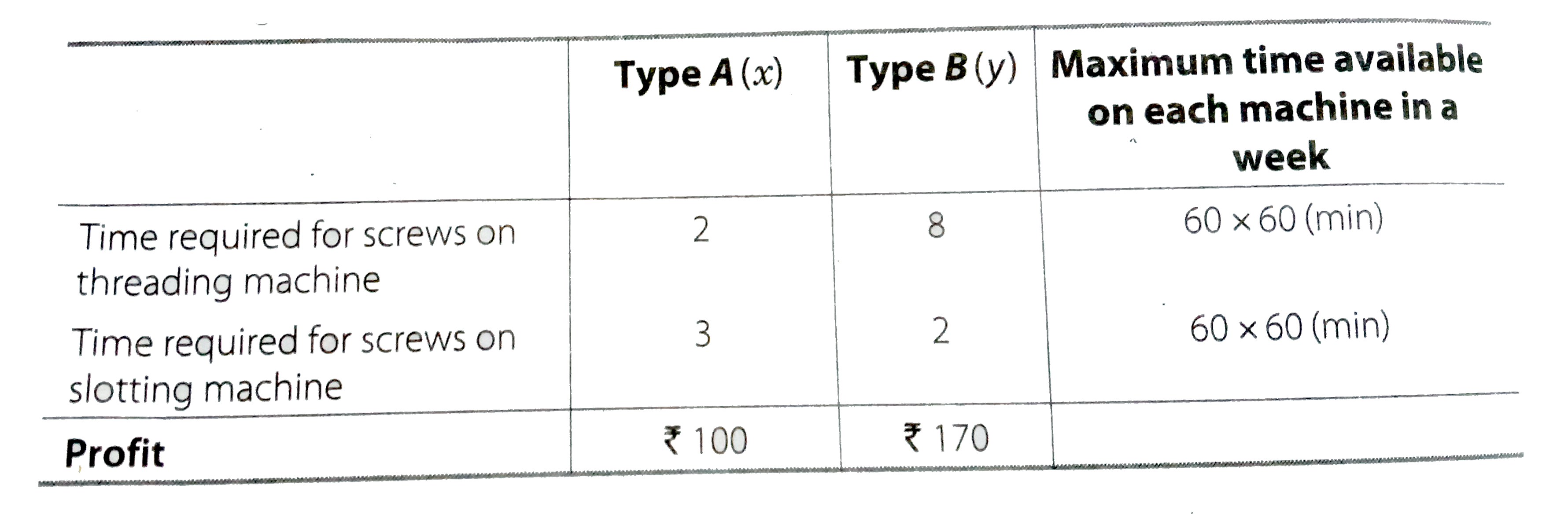 Thus, we see that objective function for maximum proft is Z=100x+170y Subject to constraints `2x+8y le 60 XX 60 ["time constraints for threading machine"]` `Rightarrow x+4y le 1800..(i) ` and `3x+2y le 60xx60["time constraint for slotting machine"]` `Rightarrow 3x+2y le 3600....(ii)` Also, `x ge 0, y ge 0 ["non negative contraints"] ...(iii)` `therefore "REQUIRED LPP is"` Maximise `Z=100x+170y` Subject to constraints `x+4y le 1800, 3x+2y le 3600, x ge 0, y le 0`, |
|
| 41. |
Evaluate the following integral int (1)/(sqrt(sin^(3) x sin( x + alpha)))dx |
|
Answer» |
|
| 42. |
If the eccentric angle of the point of contact of common tangent on the hyperbola is (3pi)/4 then the number of distinct normals that can be drawn to the curve (y + 4)^(2)= 2 sqrt2 (x + 2 sqrt 2) from the point of contact is |
|
Answer» 1 |
|
| 43. |
The value of .^(40)C_(0) xx .^(100)C_(40) - .^(40)C_(1) xx .^(99)C_(40) + .^(40)C_(2) xx .^(98)C_(40) "……." + .^(40)C_(40) xx .^(60)C_(40) is equal to "____". |
|
Answer» `=` Coefficient of `x^(40)` in `.^(40)C_(0)(1+x)^(100) - .^(40)C_(1)(1+x)^(99) + .^(40)C_(2)(1+x)^(96)+"….."+.^(40)C_(40)(1+x)^(60)` = Coefficient of `x^(40)` in `(1+x)^(60)(.^(40)C_(0)(1+x)^(40)-.^(40)C_(1)(1+x)^(39)+.^(40)C_(2)(1+x)^(38)+"....."+.^(40)C_(40))` `=` Coefficient of `x^(40)` in `(1+x)^(60)(1+x-1)^(40)` = Coefficient of `x^(40)` in `(1+x)^(60)x^(40)` `= 1` |
|
| 44. |
Let C be a circle whose centre is on te x-axis. Suppose C touches the line 3x + 4y =5 at (1,1). If (alpha, beta) lies on the circle C, then |3alpha + 4 beta-5| cannot exceed |
|
Answer» |
|
| 45. |
If 8 le E le 42 kJ/mol then which type of bond formation is possible (where E is bond energy ) ? |
| Answer» | |
| 46. |
There are two sets of parallel lines, their equations being x cos alpha+y sin alpha=p and x sin alpha- y cos alpha=p , p=1,2,3,….n and alpha in (0,pi//2). If the number of rectangles formed by these two sets of lines is 225, then the value of n is equals to |
| Answer» Solution :`(C )` `"^(N)C_(2)*^(n)C_(2)=225impliesn=6` | |
| 47. |
Solvethe equationfor x 3sin^(2)(x/(2))+cos^(2)(x/(2))+4sin(x/(2))cos(x/(2))-8sin(x/(2))=0 |
|
Answer» |
|
| 48. |
Area of the region bounded by two parabolas y=x^(2) and x=y^(2) is |
|
Answer» |
|
| 49. |
If f(x) is continuous such that abs(f(x)) le 1, forall x in R " and " g(x)=(e^(f(x))-e^(-abs(f(x))))/(e^(f(x))+e^(-abs(f(x)))), then range of g(x) is |
|
Answer» `[0,1]` |
|