

Saved Bookmarks
This section includes 7 InterviewSolutions, each offering curated multiple-choice questions to sharpen your Current Affairs knowledge and support exam preparation. Choose a topic below to get started.
| 1. |
This passage is adapted from a 2018 article summarizing two different proposals for solving problems with maintaining New York City's mass transit system. The history of the New York City subsaw system, quickly told: the first stations opened in 1904, and over the next century, it expended to 472 stations, more than any other subway system in the world, with 850 miles of track. Operating 24 hours a day seven days a week, with an average weekday ridership of approximately 5.7 million, it is the plant's 7th-busiest rapid transit system. While the system is, on many levels, an amazing chievement, it is also beset by a problem that harms both quality of life and economic activity. Such a large system must inevitably suffer from service interruptions and delays, normal wear and tear combined with the sheer age of the system necessitates regular maintanance. However, there is no consensus as to the best way to accomplish the required repairs. The current maintanance scheme is designed to minimize service interruptions. A subway line in need of repair will be taken out of sevice during a comaratively less busy time, such as nights or weekends, while another line is re-routed to cover as many as possible of the missing line's stops. The main advantage to this approach is that trains are not taken out of service during rush hour, when most subway trips occur, subway service generally remains predictable and commuters are, for the most part, able to use the system to get to their desinations on time. But critics are quick to point out the disadvantages to this approach. Perhaps most obvious is the confusion caused by trains swithing lines. The labyrinthine system is hard enough to navigate at the best of times. especially for tourists A subway rider on the A terain naturally expects the train to make stops on teh A line. If instead, it is diverted temporatily to the F line, the rader may find herself miles from her intended destination. While annoying, the confusion arising from route switching is hardly the most serious problem with the current approach to repairs. Because the system runs 24 hours a day, routine maintenance can generally be done only during the temporary closures on nights and weekends. This means that more serious repair and crucial preventative maintenance is often neglected. Problems that could have been fixed or prevented reasonably expeditiously given a slightly longer closure wind up leading to major breakdowns and service interruptions later on. On rare occasions, such breakdowns have resulted in entire subway lines being shut down for months or even a year. Beginning in 2019, for example the I. Train connecting lower Manhattan to parts of Brooklyn was scheduled to close for as much as 15 months for long overdue service and upgrades. In a city fewar than half of whose households own a car, this can have serious economic impacts Residents of the affected area may face a much longer commute via an alternate subway line if one is available, or, if there is no alternate subway service, they may need to take other, potentially more exppensive, modes of transportation, such as taxis or ferries. Morover, studies indicate that increased stress from the commute to work can lead to lower productivity, and that businesses near the impacted lines may see decreased revenue as potential customers have a harder time getting to them. One controversial proposal for reducing breakdowns and the resulting transit interruptions is to end the subway's 24-hour service and to shut down for several hours each night. Proponents of this plan argue that this would allow time, on a regular rather than sporadic basis, for more preventative maintanacnce. This, they claim, would ultimately lead to more consistent service, rrather than shutting down entire lines for long periods of a time, there would merely be shorter service outages overnight, when fewer people use the subway system. While this may seem a preferable outcome to the economic consequence of a total shutdown resulting from a breakdown, it has its liabilities as well. While most subway trips may occur during rush hour, not everyone works during the daytime. New yourk is famously known as the "the city that never sleeps." Doctors, nurses, bartenders, police officers, and firefighters are just a few examples of occupations whose workers need transportion at all hours of the day and night. Rather than be subjected to a relatively short period of inconvenience, these workers would find their commutes irrevocably altered. One thing, at least, is clear the city must carefully condider many economic and social factors in designing a subway maintenance plan. Which choice provides the best evidence for the answer to the previous question ? |
|
Answer» LINES 14-19 ("Such a…maintenance") |
|
| 2. |
This passage is adapted from a 2018 article summarizing two different proposals for solving problems with maintaining New York City's mass transit system. The history of the New York City subsaw system, quickly told: the first stations opened in 1904, and over the next century, it expended to 472 stations, more than any other subway system in the world, with 850 miles of track. Operating 24 hours a day seven days a week, with an average weekday ridership of approximately 5.7 million, it is the plant's 7th-busiest rapid transit system. While the system is, on many levels, an amazing chievement, it is also beset by a problem that harms both quality of life and economic activity. Such a large system must inevitably suffer from service interruptions and delays, normal wear and tear combined with the sheer age of the system necessitates regular maintanance. However, there is no consensus as to the best way to accomplish the required repairs. The current maintanance scheme is designed to minimize service interruptions. A subway line in need of repair will be taken out of sevice during a comaratively less busy time, such as nights or weekends, while another line is re-routed to cover as many as possible of the missing line's stops. The main advantage to this approach is that trains are not taken out of service during rush hour, when most subway trips occur, subway service generally remains predictable and commuters are, for the most part, able to use the system to get to their desinations on time. But critics are quick to point out the disadvantages to this approach. Perhaps most obvious is the confusion caused by trains swithing lines. The labyrinthine system is hard enough to navigate at the best of times. especially for tourists A subway rider on the A terain naturally expects the train to make stops on teh A line. If instead, it is diverted temporatily to the F line, the rader may find herself miles from her intended destination. While annoying, the confusion arising from route switching is hardly the most serious problem with the current approach to repairs. Because the system runs 24 hours a day, routine maintenance can generally be done only during the temporary closures on nights and weekends. This means that more serious repair and crucial preventative maintenance is often neglected. Problems that could have been fixed or prevented reasonably expeditiously given a slightly longer closure wind up leading to major breakdowns and service interruptions later on. On rare occasions, such breakdowns have resulted in entire subway lines being shut down for months or even a year. Beginning in 2019, for example the I. Train connecting lower Manhattan to parts of Brooklyn was scheduled to close for as much as 15 months for long overdue service and upgrades. In a city fewar than half of whose households own a car, this can have serious economic impacts Residents of the affected area may face a much longer commute via an alternate subway line if one is available, or, if there is no alternate subway service, they may need to take other, potentially more exppensive, modes of transportation, such as taxis or ferries. Morover, studies indicate that increased stress from the commute to work can lead to lower productivity, and that businesses near the impacted lines may see decreased revenue as potential customers have a harder time getting to them. One controversial proposal for reducing breakdowns and the resulting transit interruptions is to end the subway's 24-hour service and to shut down for several hours each night. Proponents of this plan argue that this would allow time, on a regular rather than sporadic basis, for more preventative maintanacnce. This, they claim, would ultimately lead to more consistent service, rrather than shutting down entire lines for long periods of a time, there would merely be shorter service outages overnight, when fewer people use the subway system. While this may seem a preferable outcome to the economic consequence of a total shutdown resulting from a breakdown, it has its liabilities as well. While most subway trips may occur during rush hour, not everyone works during the daytime. New yourk is famously known as the "the city that never sleeps." Doctors, nurses, bartenders, police officers, and firefighters are just a few examples of occupations whose workers need transportion at all hours of the day and night. Rather than be subjected to a relatively short period of inconvenience, these workers would find their commutes irrevocably altered. One thing, at least, is clear the city must carefully condider many economic and social factors in designing a subway maintenance plan. Based on the passage, advocates of the current Neq York City subway maintenance plan would most likely agree that |
|
Answer» given its size, the city's subway SYSTEM is ONE of the most well maintained in the world. |
|
| 3. |
This passage is adapted from a 2018 article summarizing two different proposals for solving problems with maintaining New York City's mass transit system. The history of the New York City subsaw system, quickly told: the first stations opened in 1904, and over the next century, it expended to 472 stations, more than any other subway system in the world, with 850 miles of track. Operating 24 hours a day seven days a week, with an average weekday ridership of approximately 5.7 million, it is the plant's 7th-busiest rapid transit system. While the system is, on many levels, an amazing chievement, it is also beset by a problem that harms both quality of life and economic activity. Such a large system must inevitably suffer from service interruptions and delays, normal wear and tear combined with the sheer age of the system necessitates regular maintanance. However, there is no consensus as to the best way to accomplish the required repairs. The current maintanance scheme is designed to minimize service interruptions. A subway line in need of repair will be taken out of sevice during a comaratively less busy time, such as nights or weekends, while another line is re-routed to cover as many as possible of the missing line's stops. The main advantage to this approach is that trains are not taken out of service during rush hour, when most subway trips occur, subway service generally remains predictable and commuters are, for the most part, able to use the system to get to their desinations on time. But critics are quick to point out the disadvantages to this approach. Perhaps most obvious is the confusion caused by trains swithing lines. The labyrinthine system is hard enough to navigate at the best of times. especially for tourists A subway rider on the A terain naturally expects the train to make stops on teh A line. If instead, it is diverted temporatily to the F line, the rader may find herself miles from her intended destination. While annoying, the confusion arising from route switching is hardly the most serious problem with the current approach to repairs. Because the system runs 24 hours a day, routine maintenance can generally be done only during the temporary closures on nights and weekends. This means that more serious repair and crucial preventative maintenance is often neglected. Problems that could have been fixed or prevented reasonably expeditiously given a slightly longer closure wind up leading to major breakdowns and service interruptions later on. On rare occasions, such breakdowns have resulted in entire subway lines being shut down for months or even a year. Beginning in 2019, for example the I. Train connecting lower Manhattan to parts of Brooklyn was scheduled to close for as much as 15 months for long overdue service and upgrades. In a city fewar than half of whose households own a car, this can have serious economic impacts Residents of the affected area may face a much longer commute via an alternate subway line if one is available, or, if there is no alternate subway service, they may need to take other, potentially more exppensive, modes of transportation, such as taxis or ferries. Morover, studies indicate that increased stress from the commute to work can lead to lower productivity, and that businesses near the impacted lines may see decreased revenue as potential customers have a harder time getting to them. One controversial proposal for reducing breakdowns and the resulting transit interruptions is to end the subway's 24-hour service and to shut down for several hours each night. Proponents of this plan argue that this would allow time, on a regular rather than sporadic basis, for more preventative maintanacnce. This, they claim, would ultimately lead to more consistent service, rrather than shutting down entire lines for long periods of a time, there would merely be shorter service outages overnight, when fewer people use the subway system. While this may seem a preferable outcome to the economic consequence of a total shutdown resulting from a breakdown, it has its liabilities as well. While most subway trips may occur during rush hour, not everyone works during the daytime. New yourk is famously known as the "the city that never sleeps." Doctors, nurses, bartenders, police officers, and firefighters are just a few examples of occupations whose workers need transportion at all hours of the day and night. Rather than be subjected to a relatively short period of inconvenience, these workers would find their commutes irrevocably altered. One thing, at least, is clear the city must carefully condider many economic and social factors in designing a subway maintenance plan. According to the passage, which of the following is true of the New York City subway system ? |
|
Answer» It is the oldest subway SYSTEM in the world. |
|
| 4. |
The shortest distance between the line r = 3i + 5j + 7k + lambda (I + 2j + k) and r = I - j - k + mu (7i - 6j + k) is |
|
Answer» `(16)/(5sqrt(5))` |
|
| 5. |
This passage is adapted from a 2018 article summarizing two different proposals for solving problems with maintaining New York City's mass transit system. The history of the New York City subsaw system, quickly told: the first stations opened in 1904, and over the next century, it expended to 472 stations, more than any other subway system in the world, with 850 miles of track. Operating 24 hours a day seven days a week, with an average weekday ridership of approximately 5.7 million, it is the plant's 7th-busiest rapid transit system. While the system is, on many levels, an amazing chievement, it is also beset by a problem that harms both quality of life and economic activity. Such a large system must inevitably suffer from service interruptions and delays, normal wear and tear combined with the sheer age of the system necessitates regular maintanance. However, there is no consensus as to the best way to accomplish the required repairs. The current maintanance scheme is designed to minimize service interruptions. A subway line in need of repair will be taken out of sevice during a comaratively less busy time, such as nights or weekends, while another line is re-routed to cover as many as possible of the missing line's stops. The main advantage to this approach is that trains are not taken out of service during rush hour, when most subway trips occur, subway service generally remains predictable and commuters are, for the most part, able to use the system to get to their desinations on time. But critics are quick to point out the disadvantages to this approach. Perhaps most obvious is the confusion caused by trains swithing lines. The labyrinthine system is hard enough to navigate at the best of times. especially for tourists A subway rider on the A terain naturally expects the train to make stops on teh A line. If instead, it is diverted temporatily to the F line, the rader may find herself miles from her intended destination. While annoying, the confusion arising from route switching is hardly the most serious problem with the current approach to repairs. Because the system runs 24 hours a day, routine maintenance can generally be done only during the temporary closures on nights and weekends. This means that more serious repair and crucial preventative maintenance is often neglected. Problems that could have been fixed or prevented reasonably expeditiously given a slightly longer closure wind up leading to major breakdowns and service interruptions later on. On rare occasions, such breakdowns have resulted in entire subway lines being shut down for months or even a year. Beginning in 2019, for example the I. Train connecting lower Manhattan to parts of Brooklyn was scheduled to close for as much as 15 months for long overdue service and upgrades. In a city fewar than half of whose households own a car, this can have serious economic impacts Residents of the affected area may face a much longer commute via an alternate subway line if one is available, or, if there is no alternate subway service, they may need to take other, potentially more exppensive, modes of transportation, such as taxis or ferries. Morover, studies indicate that increased stress from the commute to work can lead to lower productivity, and that businesses near the impacted lines may see decreased revenue as potential customers have a harder time getting to them. One controversial proposal for reducing breakdowns and the resulting transit interruptions is to end the subway's 24-hour service and to shut down for several hours each night. Proponents of this plan argue that this would allow time, on a regular rather than sporadic basis, for more preventative maintanacnce. This, they claim, would ultimately lead to more consistent service, rrather than shutting down entire lines for long periods of a time, there would merely be shorter service outages overnight, when fewer people use the subway system. While this may seem a preferable outcome to the economic consequence of a total shutdown resulting from a breakdown, it has its liabilities as well. While most subway trips may occur during rush hour, not everyone works during the daytime. New yourk is famously known as the "the city that never sleeps." Doctors, nurses, bartenders, police officers, and firefighters are just a few examples of occupations whose workers need transportion at all hours of the day and night. Rather than be subjected to a relatively short period of inconvenience, these workers would find their commutes irrevocably altered. One thing, at least, is clear the city must carefully condider many economic and social factors in designing a subway maintenance plan. Based on the passage, which choice best describes a claim that critics of the current subway maintenance plan would likely make? |
|
Answer» The negative impacts that arise from neglecting preventative MAINTENANCE outweigh the benefits of minimizing SUBWAY service interruptions. |
|
| 6. |
This passage is adapted from a 2018 article summarizing two different proposals for solving problems with maintaining New York City's mass transit system. The history of the New York City subsaw system, quickly told: the first stations opened in 1904, and over the next century, it expended to 472 stations, more than any other subway system in the world, with 850 miles of track. Operating 24 hours a day seven days a week, with an average weekday ridership of approximately 5.7 million, it is the plant's 7th-busiest rapid transit system. While the system is, on many levels, an amazing chievement, it is also beset by a problem that harms both quality of life and economic activity. Such a large system must inevitably suffer from service interruptions and delays, normal wear and tear combined with the sheer age of the system necessitates regular maintanance. However, there is no consensus as to the best way to accomplish the required repairs. The current maintanance scheme is designed to minimize service interruptions. A subway line in need of repair will be taken out of sevice during a comaratively less busy time, such as nights or weekends, while another line is re-routed to cover as many as possible of the missing line's stops. The main advantage to this approach is that trains are not taken out of service during rush hour, when most subway trips occur, subway service generally remains predictable and commuters are, for the most part, able to use the system to get to their desinations on time. But critics are quick to point out the disadvantages to this approach. Perhaps most obvious is the confusion caused by trains swithing lines. The labyrinthine system is hard enough to navigate at the best of times. especially for tourists A subway rider on the A terain naturally expects the train to make stops on teh A line. If instead, it is diverted temporatily to the F line, the rader may find herself miles from her intended destination. While annoying, the confusion arising from route switching is hardly the most serious problem with the current approach to repairs. Because the system runs 24 hours a day, routine maintenance can generally be done only during the temporary closures on nights and weekends. This means that more serious repair and crucial preventative maintenance is often neglected. Problems that could have been fixed or prevented reasonably expeditiously given a slightly longer closure wind up leading to major breakdowns and service interruptions later on. On rare occasions, such breakdowns have resulted in entire subway lines being shut down for months or even a year. Beginning in 2019, for example the I. Train connecting lower Manhattan to parts of Brooklyn was scheduled to close for as much as 15 months for long overdue service and upgrades. In a city fewar than half of whose households own a car, this can have serious economic impacts Residents of the affected area may face a much longer commute via an alternate subway line if one is available, or, if there is no alternate subway service, they may need to take other, potentially more exppensive, modes of transportation, such as taxis or ferries. Morover, studies indicate that increased stress from the commute to work can lead to lower productivity, and that businesses near the impacted lines may see decreased revenue as potential customers have a harder time getting to them. One controversial proposal for reducing breakdowns and the resulting transit interruptions is to end the subway's 24-hour service and to shut down for several hours each night. Proponents of this plan argue that this would allow time, on a regular rather than sporadic basis, for more preventative maintanacnce. This, they claim, would ultimately lead to more consistent service, rrather than shutting down entire lines for long periods of a time, there would merely be shorter service outages overnight, when fewer people use the subway system. While this may seem a preferable outcome to the economic consequence of a total shutdown resulting from a breakdown, it has its liabilities as well. While most subway trips may occur during rush hour, not everyone works during the daytime. New yourk is famously known as the "the city that never sleeps." Doctors, nurses, bartenders, police officers, and firefighters are just a few examples of occupations whose workers need transportion at all hours of the day and night. Rather than be subjected to a relatively short period of inconvenience, these workers would find their commutes irrevocably altered. One thing, at least, is clear the city must carefully condider many economic and social factors in designing a subway maintenance plan. As used in line 41, "labyrinthine"most nearly means |
|
Answer» subterrancean. |
|
| 7. |
This passage is adapted from a 2018 article summarizing two different proposals for solving problems with maintaining New York City's mass transit system. The history of the New York City subsaw system, quickly told: the first stations opened in 1904, and over the next century, it expended to 472 stations, more than any other subway system in the world, with 850 miles of track. Operating 24 hours a day seven days a week, with an average weekday ridership of approximately 5.7 million, it is the plant's 7th-busiest rapid transit system. While the system is, on many levels, an amazing chievement, it is also beset by a problem that harms both quality of life and economic activity. Such a large system must inevitably suffer from service interruptions and delays, normal wear and tear combined with the sheer age of the system necessitates regular maintanance. However, there is no consensus as to the best way to accomplish the required repairs. The current maintanance scheme is designed to minimize service interruptions. A subway line in need of repair will be taken out of sevice during a comaratively less busy time, such as nights or weekends, while another line is re-routed to cover as many as possible of the missing line's stops. The main advantage to this approach is that trains are not taken out of service during rush hour, when most subway trips occur, subway service generally remains predictable and commuters are, for the most part, able to use the system to get to their desinations on time. But critics are quick to point out the disadvantages to this approach. Perhaps most obvious is the confusion caused by trains swithing lines. The labyrinthine system is hard enough to navigate at the best of times. especially for tourists A subway rider on the A terain naturally expects the train to make stops on teh A line. If instead, it is diverted temporatily to the F line, the rader may find herself miles from her intended destination. While annoying, the confusion arising from route switching is hardly the most serious problem with the current approach to repairs. Because the system runs 24 hours a day, routine maintenance can generally be done only during the temporary closures on nights and weekends. This means that more serious repair and crucial preventative maintenance is often neglected. Problems that could have been fixed or prevented reasonably expeditiously given a slightly longer closure wind up leading to major breakdowns and service interruptions later on. On rare occasions, such breakdowns have resulted in entire subway lines being shut down for months or even a year. Beginning in 2019, for example the I. Train connecting lower Manhattan to parts of Brooklyn was scheduled to close for as much as 15 months for long overdue service and upgrades. In a city fewar than half of whose households own a car, this can have serious economic impacts Residents of the affected area may face a much longer commute via an alternate subway line if one is available, or, if there is no alternate subway service, they may need to take other, potentially more exppensive, modes of transportation, such as taxis or ferries. Morover, studies indicate that increased stress from the commute to work can lead to lower productivity, and that businesses near the impacted lines may see decreased revenue as potential customers have a harder time getting to them. One controversial proposal for reducing breakdowns and the resulting transit interruptions is to end the subway's 24-hour service and to shut down for several hours each night. Proponents of this plan argue that this would allow time, on a regular rather than sporadic basis, for more preventative maintanacnce. This, they claim, would ultimately lead to more consistent service, rrather than shutting down entire lines for long periods of a time, there would merely be shorter service outages overnight, when fewer people use the subway system. While this may seem a preferable outcome to the economic consequence of a total shutdown resulting from a breakdown, it has its liabilities as well. While most subway trips may occur during rush hour, not everyone works during the daytime. New yourk is famously known as the "the city that never sleeps." Doctors, nurses, bartenders, police officers, and firefighters are just a few examples of occupations whose workers need transportion at all hours of the day and night. Rather than be subjected to a relatively short period of inconvenience, these workers would find their commutes irrevocably altered. One thing, at least, is clear the city must carefully condider many economic and social factors in designing a subway maintenance plan. Which choice provides the best evidence for the answer to the previous queston ? |
|
Answer» LINES 24-30 ("A subway…stops") |
|
| 8. |
Find the domain and range of the following function : f : R rarr R , f(x) = (x^(2)-1)/(x-1), x ne 1 |
|
Answer» |
|
| 9. |
Find all possible real values of x and y satisfying. sin^(2)x+4sin^(2) y - sin x - 2 sin y-2 sin x sin y+1=0, AA x, y in [ 0, pi//2] |
|
Answer» |
|
| 11. |
(3)/(4.8)+(3.5)/(4.8.12)+(3.5.7)/(4.8.12.16)+….= |
|
Answer» `SQRT(3/2) - 3/4` |
|
| 12. |
Sand is pouring from a pipe at the rate of 12 cm^(3) /s. The falling sand forms a cone on the ground in such a way that the height of the cone is always one-sixth of the radius of the base. How fast is the height of the sand cone increasing when the height is 4 cm? |
|
Answer» |
|
| 13. |
If n is odd then int_(0)^(pi//2)sin^(n)x dxis |
|
Answer» `(N)/(n-1).(n-2)/(n-3).(n-4)/(n-5)...pi/2` |
|
| 14. |
Select the incorrect statement :- |
|
Answer» External nostrils leads to NASAL chamber through the Nasal passage. |
|
| 15. |
Find the number of 5 digited numbers that can be formed using the digits 2,2,3,3,4. How many of them are greater than 30000. |
|
Answer» |
|
| 16. |
Mean and variance of binomial distribution are. |
|
Answer» NQ, NPQ |
|
| 17. |
Express eachof thefollowingin termsof otherinverse circularfunctions: tan ^(-1) x(x gt 0) |
|
Answer» |
|
| 18. |
Ifthe complex number P(w) lies on the standard unit circle in an Argand’s plane and z=(aw+b) (w- c)(-1) then, find the locus of z and interpret it. Given a, b, c are real. |
|
Answer» |
|
| 19. |
Find the number of solutions to log_(e) |sin x| = -x^(2) + 2x in [-(pi)/(2), (3pi)/(2)]. |
Answer» Solution :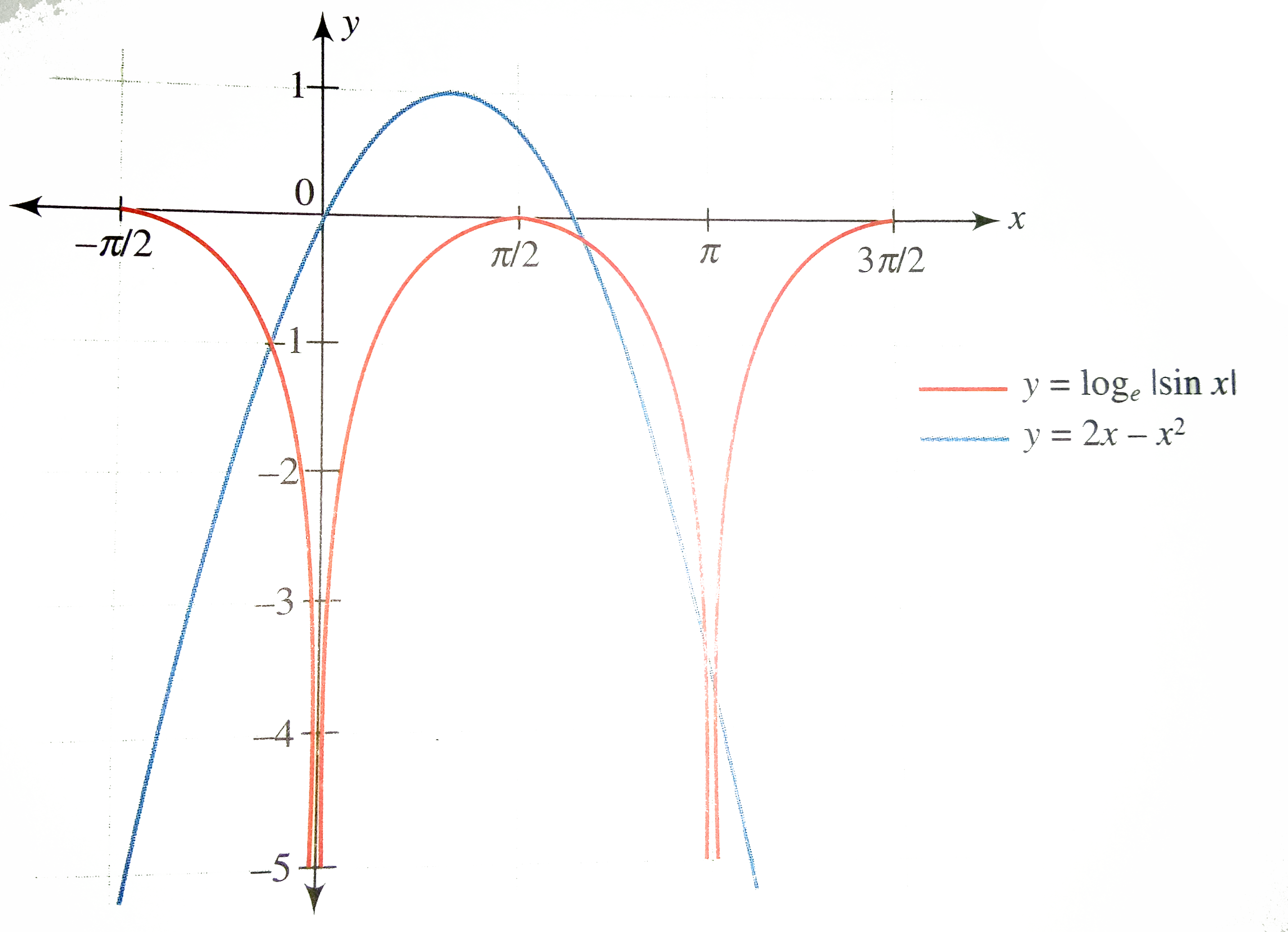 `log_(E)|sin X| = -x(x - 2)` Graphs of `y = log_(e)|sin x|` and `y = -x(x - 2)` MEET exactly four TIMES in `[-(pi)/(2), (3pi)/(2)],` hence four roots. |
|
| 20. |
Evalute the following integrals int (1)/(x sqrt(x^(2) + x + 1)) dx |
|
Answer» |
|
| 21. |
Let f:Wto W be defined as f (n)=n -1, if n is odd and f (n) =n +1, if n is even. Show that f is invertible. Find the inverse of f. Here, W is the set of all whole numbers. |
|
Answer» |
|
| 22. |
Show that the area enclosed by the curves x^(2)=4by and y=mx is (8)/(3)b^(2)m^(3) sq units. |
|
Answer» |
|
| 23. |
If A and B are two events such that P(A) =(1)/(4), P(B) = (1)/(2) and P(A cap B) = (1)/(8), find P (not A and not B). |
|
Answer» |
|
| 24. |
Evalute the following integrals int (dx)/(2 + 3 cos 2x ) |
|
Answer» |
|
| 25. |
Find the area of the region bounded by the curve y_(2) = x and the lines x = 1, x = 4 and the x-axis in the first quadrant. |
|
Answer» |
|
| 26. |
Write down and simplify 5th term in (3x - 4y)^7 |
|
Answer» |
|
| 27. |
For each opertion ** difined below, determine whether ** isw binary, commutative or associative. (i) On Z, define a **b =a - b (ii) On Q, define a **b =ab +1 (iii) On Q, define a **b = (ab)/( 2) (iv) On Z ^(+), define a **b = 2 ^(ab) (v) On Z ^(+), define a **b=a ^(b) (vi) On R - {-1}, define a **b= (a)/( b +1) |
|
Answer» (II) `**` is binary, commutative but not associative (iii) `**` is binary, both commutative and associative (iv) `**` is binary, cimmutative but not associative (v)` **` is binary but neither commutative nor associative (VI) `**` not binary |
|
| 28. |
Let z and z_(0)be two complex numbers. It is given that |z|=1and thatnumbersz,z_(0),zbarz_(0) 1, and0 arerepresented in a Argand diagram by thepoints P,P_(0),Q,Aandthe origin respectively. Showthat thetrianglesPOP_(0) and AOQ are congruent . Hence, orotherwise, prove that|z-z_(0)|= |z barz_(0) -1| |
|
Answer» SOLUTION :Given `OA = 1 and |z|=1` `therefore OP=|z-0| =|z| =1` `rArr OP = OA` `OP_(0) =|z_(0) -0| =|z_(0)|` `OQ =|zz_(0)-0|` `=|zz_(0)| =|z||z_(0)| =|z_(0)|` Also, `angle P_(0)OP = ARG((z_(0)-0)/(z-0))` `= arg((z_(0))/(z)) = arg ((zbarz_(0))/(zbarz))` `=-arg((zbarz_(0))/(1)) = -argbar((barzz_(0)))` `= -arg(zbarz_(0)) = arg((1)/(zbarz_(0)))` `= arg((1-0)/(zbarz_(0) -0))` `angle AOQ` Thus, the triangle `POP_(0)` and AOQ are congurent. HENCE `PP_(0) = AQ rArr |z-z_(0)| = |zbarz_(0) -1|` 
|
|
| 29. |
The total numberof relation fromtheset{1,6,7}} to the set{1,5} is- |
|
Answer» 66 |
|
| 30. |
Find the value of x^2-y^2+1/(2!)(x^4-y^4)+1/(3!)(x^6-y^6)+… |
| Answer» SOLUTION :`x^2-y^2+1/(2!)(x^4-y^4)+1/(3!)(x^6-y^6)+...=(x^2+(x^2)^2/(2!)+(x^3)^3/(3!)+....)-(y^2+(y^2)^2/(2!)+(y^3)^3/(3!)+...)=(E^(x^2)-1)-(e^(y^2)-1)=e^(x^2)-e^(y^2)` | |
| 31. |
Coefficient of x^(10) in (1-2x)/e^x is |
|
Answer» `(1+2n)/(N!)` |
|
| 32. |
If the area of the triangle with vertices (2a,a) (a, a), (a, 2a) is 18 sq.units then the circumcentre of the triangle is |
| Answer» Answer :C | |
| 33. |
If 1, m, n are in arithmetic progression, then the straight line lx+my+n=0 will pass through the point. |
|
Answer» `(-1,2)` |
|
| 34. |
Using integration, find the area of the following region : {(x, y) : x^(2) + y^(2) lt 1 le x + y} |
|
Answer» |
|
| 35. |
If a random variable X follows a poisson distribution such that P(X=1) =3P (X=2), then P(x=3)= |
|
Answer» `(4)/(81)e^(-(2)/(3))` |
|
| 36. |
Comprehension 1 Let I_(n,m)=intsin^(n)xcos^(m)x.dx. Then we can relate I_(n,m) with each of the following i) I_(n-2),m, ii) I_(n+2),m, iii) I_(n,m-2) iv) I_(n,m-2), v) I_(n-2,m+2), vi) I_(n+2,m-2) Suppose we want to establish a relation between I_(n,m) and I_(n,m-2), then we set P(x)=sin^(n+1)xcos^(m-1)x................(1) In I_(n,m) and I_(n,m-2) the exponent of cosx is m and m-2+1=m-1. Now choose the exponent m-1 of cosx in P(x). Similarly choose hte exponent of sinx for P(x). Now, differentiating both sides of (1), we get P^(')(x) = (n+1)sin^(n)xcos^(m)X-(m-1)sin^(n+2)Xcos^(m-2)X =(n+1)sin^(n)Xcos^(m)X-(m-1)sin^(n)x(1-cos^(2)x)cos^(m-2)X =(n+1)sin^(n)X cos^(m)X-(m-1)sin^(n)Xcos^(m-2)X+(m-1)sin^(n)Xcos^(m)X =(n+m)sin^(n)Xcos^(m)X-(m-1)sin^(n)Xcos^(m-2)X Now, integrating both sides, we get sin^(n+1)cos^(m-1)x=(n+m)I_(n,m)-(m-1)I_(n,m+2) Similarly, we can establish the other relations. The relation between I_(4,2) and I_(2,2) is |
|
Answer» `I_(4,2)=1/6 (-SIN^(3)xcos^(3)X+3I_(2,2))` |
|
| 37. |
A line makes an angle of measure alpha with X-axis and Y-axis cot alpha in .................... |
|
Answer» (0,1) |
|
| 38. |
If thequadratic x^(2) - (2a - 3)x + (a^(2) + 5) = 0hasroot s whosesum is five , whatis the productof the roots ofthe above quadraticequation ? |
|
Answer» 6 |
|
| 39. |
(1, 2) is a point on the circle x^2 + y^2 + 2x - 6y + 5 = 0 which is orthogonal to x^2 + y^2 = 5. The conjugate point of (1, 2) w.r.t the circle x^2+y^2 = 5 and which lies on the first circle is |
| Answer» Answer :C | |
| 40. |
To 100 gm oleum sapmleLabelled as ''118% oleum'', 9 gmof water is added. Select the correctoption/ optionsfor final solutions. |
|
Answer» It containsonly `H_(2)SO_(4)& SO_(3)` |
|
| 41. |
Write the value of int1/(x(Inx))dx |
| Answer» SOLUTION :`INT1/(X(INX))dx=int1/tdt` (where In x=t `rArr1/xdx=dt)` =In |t | =In |In x | +C | |
| 42. |
Check the injectivity and surjectivity of the following function . f:R rarrR , f(x) = {{:(-x+1,xge0),(x^2,x lt0):} |
|
Answer» |
|
| 43. |
The sum of the digits in the unit place of all the numbers formed with the help of 3,4,5,6 taken all at a time is |
|
Answer» 432 |
|
| 44. |
Define optimal solution in Linear Programming problem. |
|
Answer» |
|
| 45. |
A man notices two objects in a straight line due west. After walking a distance c due north, he observes that the objects subtend an angle alpha at his eye, and after walking a further distance 2c due north the angle becomes beta If the distance between the object is (kc)/(3 cot beta - cot alpha), then k = _____________ (Ignore the height of the man) |
|
Answer» |
|
| 46. |
If I_(m.n) = int sin^(m) x cos^(n) xdx then I_(5,4) = |
|
Answer» `(sin^(4)XCOS^(5)x)/(9) + (4)/(9) I_(3,4)` |
|
| 47. |
Find the second order derivative of the following functions x^2+3x+2 |
| Answer» SOLUTION :`y=x^2+3x+2,dy/dx=2x+3,(d^2y)/(dx^2)=2` | |
| 48. |
Three coins are tossed simultaneously. Consider the event E 'three heads or three tails', F 'at least two heads' and G ‘at most two heads'. Of the pairs (E,F), (E,G) and (F,G), which are independent? which are dependent? |
|
Answer» |
|
| 49. |
If l,m,n and l',m',n' be the direction cosines of two lines which include an angle theta, then |
|
Answer» `costheta=ll'+mm'+N n'` |
|