

Saved Bookmarks
This section includes 7 InterviewSolutions, each offering curated multiple-choice questions to sharpen your Current Affairs knowledge and support exam preparation. Choose a topic below to get started.
| 1. |
If y(x) is the solution of the differential equation (x+2)(dy)/(dx)=x^(2)+4x-9, x ne -2 and y(0)=0 then y(-4) is equal to |
| Answer» Answer :2 | |
| 2. |
Write the number of solution of the following system of equation. x-y=0 and 2x-2y=1 |
| Answer» SOLUTION :No solution | |
| 3. |
For unit vectors bar(a) and bar(b), if bar(a)+2bar(b) and 5bar(a)-4bar(b) are perpendicular to each other then the angle between bar(a) and bar(b) is …………. |
|
Answer» `45^(@)` |
|
| 4. |
Find the distance of the point (-2, 3, 4) from the line (x+2)/3=(2y+3)/4=(3z+4)/5 measured parallel to the plane 4x+12y-3z+1=0. |
|
Answer» |
|
| 5. |
If two distinct chords drawn from the point A (4,4) on the parabola y ^(2) =4x are bisected by the lince y = ax, then the interval in which a lies is |
|
Answer» `((1)/(2)- (1)/(sqrt2), (1)/(2) + (1)/(sqrt2))` |
|
| 6. |
From the equations which representsthe following Pair of lines y - 3x = 0 , y + 3x = 0 |
|
Answer» SOLUTION :y - 3x = 0 , y + 3x = 0 `THEREFORE` (y-3x)(y+3x) = 0 or, `y^2 - 9x^2 = 0 ` which is the EQUATION of a pair of lines. |
|
| 7. |
Verify Mean Value Theorem, if f(x)= x^(2)-4x-3 in the interval [a, b] where a=1 and b= 4. |
|
Answer» |
|
| 8. |
If either veca=vec0orvecb=vec0 , then vecaxxvecb=vec0 . Isthe converse true ? Justify your answer with an example. |
|
Answer» |
|
| 10. |
Examine the continuity of f, where f is defined by f(x)={{:(sin x+cos x," if "x ne 0),(1," if "x= 0):}. |
|
Answer» |
|
| 11. |
parallel to the vector bar (b) is bar (r) = bar a + lamda bar b , where lamda is a scalar. |
|
Answer» <P> Solution :Let L be a LINE in space passing through the point `(bar a )` and parallel to vector `bar(b)`.Let P be any point on the line ( other than A) whose position vector is `bar(R)` w.r.t O. Since `bar(AP)` is parallel to `bar (b)` ` thereforebar (AP) = lamda bar(b)` , where ` lamda ` is a scalar ` THEREFORE bar (r) = bar (a) = lamda bar (b)` `therefore bar(r) = bar(a) + lamda bar(b)` This is the vector from of the equation of the line . 
|
|
| 12. |
Ifsin ^(-1)""(x)/(3)+cosec ^(-1)""(13)/(12)= (pi)/(2),then x is |
| Answer» ANSWER :A | |
| 13. |
Differentiate (sin x)^(cos x) |
|
Answer» |
|
| 14. |
Find the area of the region bounded by the two parabolas y = x^(2) and y^(2) = x. |
|
Answer» |
|
| 15. |
Which of the following sentences are propositions and which are not ? Write with reason :Why are you crying ? |
| Answer» Solution :Why are you crying? Is not a STATEMENT as it is NEITHER TRUE nor FALSE. | |
| 16. |
(1 + x^(2))(dy)/(dx) + 2xy = (1)/(1 + x^(2)), y = 0 whenx= 1 |
|
Answer» |
|
| 17. |
Acute angle between the line (x-5)/2=(y+1)/-1=(z+4)/1 and the plane 3x-4y-z+5=0 is |
|
Answer» 1)`COS^(-1)(5/(2sqrt13))` |
|
| 18. |
Find the equation of locus of a point which is at a distance 5 from A (4, - 3). |
|
Answer» |
|
| 19. |
Three urns have the following composition of balls. {:("urn I","1 white","2 black"),("urn II","2 white","1 black"),("urn III","2 white","2 black"):} One of the urns is selected at random and a ball is drawn. It turns out to be white. Find the probability that it came from urn III. |
|
Answer» |
|
| 21. |
If S and S' are the foci of the ellipse (x^2)/(25)+(y^2)/(16)=1 and if PSP' is a focal chordwith SP =8 then SS'= |
|
Answer» <P>`4+S'P` |
|
| 22. |
How many on-to functions can be defined from a set A ={a_1,a_2,…..,a_n) to another set B= {x,y,z) such that a_1 is always mapped to x. |
|
Answer» |
|
| 23. |
The transformed equation of x^(4) + 4x^(3) + 2x^(2) - 4x - 2 = 0, by eliminating second term is |
|
Answer» `y^(5) - 7Y^(3) + 12y^(2) - 7y = 0` |
|
| 24. |
Prove that the average of the number n sin n^(@), n = 2,4, 6....., 180, is cot 1^(@) |
| Answer» | |
| 25. |
A: int (1)/(3+2 cos x)dx=(2)/(sqrt(5))"Tan"^(-1)((1)/(sqrt(5))"tan" (x)/(2))+c R: If a gt b then int (dx)/(a+b cosx)=(2)/(sqrt(a^(2)-b^(2)))Tan^(-1)[(sqrt(a-b))/(a+b)"tan"(x)/(2)]+c |
|
Answer» Both A and R are true and R is the CORRECT explanation of A |
|
| 27. |
Disucss the continuity of the function f given by f (x) = {:{ (-x, if x ge0) , (-x^(2) ,if x lt 0):} |
|
Answer» Solution :The function is defined at every REAL number. Graph is as shown. The domain of definition of f(x) inotthree DISJOINT subsets of the real line. Let ` D_(1) ={ x in R: x lt 0) ` ` D_(2) = {0}` `D_(3) = {x in R : x gt 0}` CASE I : x lt 0 , ` f(x) = -x^(2)` the function is continuous at all x lt 0 Case II : x gt 0 , f(x) = -x the function is continuous at all x gt 0 Case III : x=0 , f(0)=0 The left hand LIMIT of f(x) at x =0 is ` underset(x to 0^(-))lim f(x) = underset(x to 0^(-)) lim (-x) =0 ` The right hand limit of f(x) at x = 0 is ` underset(x to x^(+)) lim f(x) = lim(x to 0^(+)) ( -x) =0` The ` underset(x to 0) f(x) = 0= f(0) ` and HENCE f(x) is continuous at x =0 . This means that f(x) is continuous at every point in its domain. Hence , f(x) is a continuous function. 
|
|
| 28. |
It is given that a,b,c are vectors of lengths 6,8,10 respectively. If a is perpendicular to (b+c), b is perpendicular(c+a), and c is perpendicular to (a+b), then the length of the vector of a+b+c is |
|
Answer» `6sqrt2` |
|
| 29. |
Find the value of k and hence the point of contact of the tangent line x-y+k=0 with the ellise 9x^2+16y^2=144 |
|
Answer» |
|
| 30. |
If ABCDEF is regular hexagon, then AD+EB+FC is equal to |
|
Answer» 0 `implies AD=2BC` SIMILARLY, EB is parallel to FA `implies EB = 2FA` and FC is parallel to AB `impliesFC =2AB` Thus, `AD+EB +FC =2BC+2FA+2AB` `=2(FA+AB+BC)` `=2(FC=2(2AB)=4AB)` |
|
| 31. |
int e^(2x) ((Cot" 2x" - 1)/("cosxsinx"))dx = |
|
Answer» `e^(2X)`COSEC2X + c |
|
| 32. |
The number of triangles which can be formed by using the vertices of a regular polygon of (n + 3) sides is 220. Then n = |
|
Answer» 8 |
|
| 33. |
Find the maximum number of electron in Chromium which is present in axial set of p-orbital |
|
Answer» |
|
| 34. |
If S_n=sum_(r=1)^(n)T_r=n(n+1)(n+2)(n+3)" then "sum_(r=1)^(10) 1/T_r is equal to |
|
Answer» `75/1056` |
|
| 35. |
Prove that I = int_(0)^(x) sqrt(a^(2) - x^(2)) dx = (1)/(2) x sqrt(a^(2) - x^(2)) + (a^(2))/(2) "arc sin "(x)/(a) (0 lt x le a) |
|
Answer» |
|
| 36. |
The maximum value of [x(x-1)+1]^(1//3)0lexle1isa) (1/2)^(1/3) b)1/2 c) 1 d)0 |
|
Answer» `(1/2)^(1//3)` |
|
| 37. |
Draw the graph of y=tan^(-1)((3x-x^(3))/(1-3x^(2))). |
|
Answer» Solution :We have `y=f(x)=tan^(-1)((3x-x^(3))/(1-3x^(2)))` Domain of f(x) is `R={-1/SQRT3,1/sqrt3}` Let x `= tan theta, theta in (-pi//2, pi//2)` `rArr""theta=tan^(-1)x` Now `tan^(-1)((3x-x^(3))/(1-3x^(2)))=tan^(-1)((3tantheta-tan^(3)theta)/(1-3tan^(2)theta))` `=tan^(-1)(tan3theta)` `tan^(-1)(tanalpha),"where "ALPHAIN(-3pi//2,3pi//2)` Now consider the graph of `y=tan^(-1)(tan ALPHA)," where "alpha in (-3pi//2,3pi//2)`. 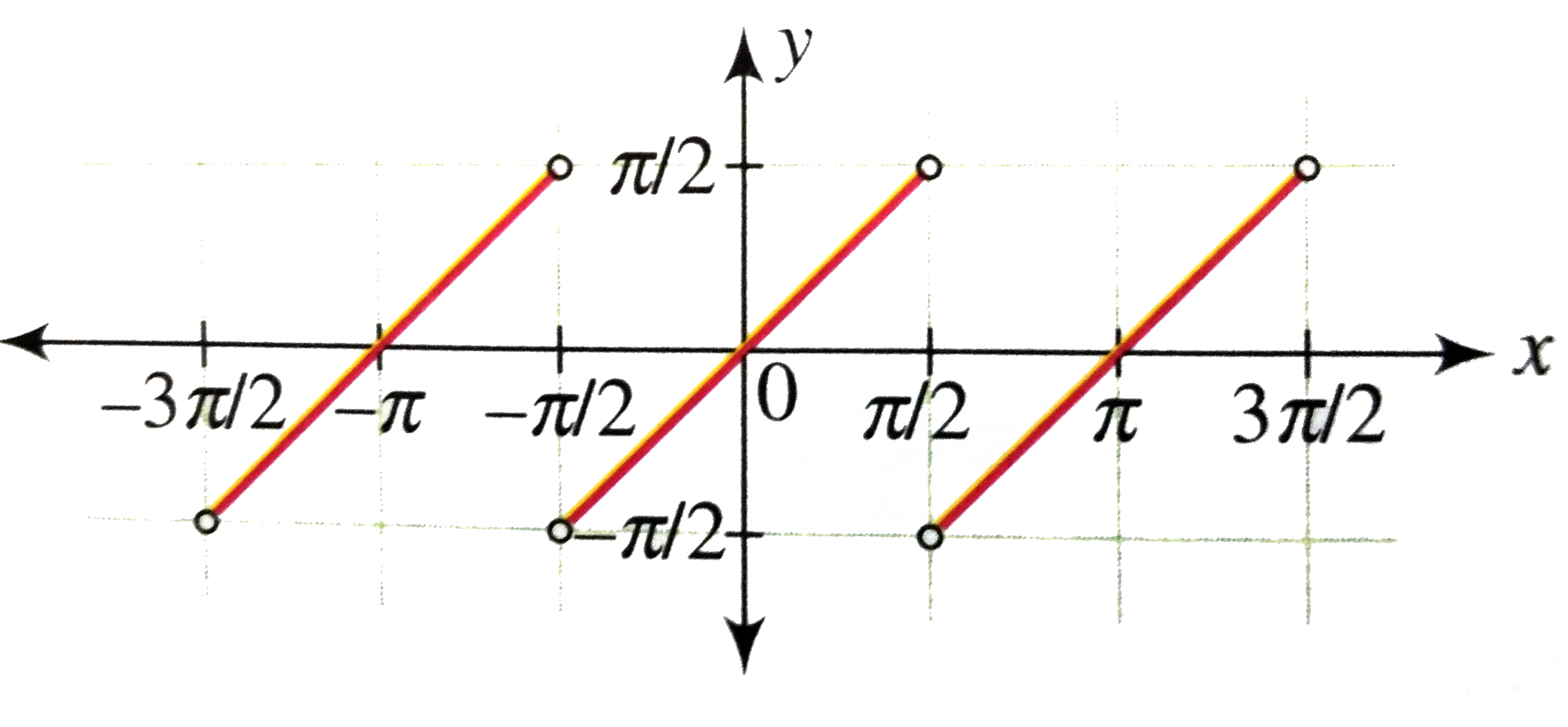 From the graph, `tan^(-1)((3x-x^(3))/(1-3x^(2)))=tan^(-1)(tan alpha)` `={{:(alpha+pi,-3pi//2ltalpha-pi//2),(alpha,-pi//2ltalphaltpi//2),(alpha-pi,pi//2ltalphalt3pi//2):}` `={{:(3 tan^(-1)x+pi,-3pi//2lttan^(-1)xlt-pi//2),(3 tan^(-1)x,-pi//2lt3tan^(-1)xltpi//2),(3tan^(-1)x-pi,pi//2lt3tan^(-1)xlt3pi//2):}` `={{:(3 tan^(-1)x+pi,-pi//2lttan^(-1)xlt-pi//6),(3 tan^(-1)x,-pi//6lttan^(-1)xltpi//6),(3tan^(-1)x-pi,pi//6lttan^(-1)xltpi//2):}` `={{:(3 tan^(-1)x+pi,-ooltxlt-1//2),(3 tan^(-1)x,-1//sqrt3ltxlt1//sqrt3),(3tan^(-1)x-pi,1//sqrt3ltxltoo):}` `tan^(-1)` is an invreasing function for `x in R`. So all brance functions in (i) are increasing functions `underset(xto-oo)(lim)(3 tan^(-1)x+pi)=-pi/2,underset(xto-1/sqrt3)(lim)(3 tan^(-1)x+pi)=pi/2` `3tan^(-1)x+pi=0:.x=-sqrt3` Thus, `tan^(-1)((3x-x^(3))/(1-3x^(2)))" increases from "-pi/2"to"pi/2"when x increases from "-oo"to"pi/2"intersecting the x-axis at x ="-sqrt3` `underset(xtooo)(lim)(3tan^(-1)x-pi)=pi/2,underset(xto1/sqrt3)(lim)(3tan^(-1)x-pi)=-pi/2` `3 tan^(-1)x-pi=0:.x=-sqrt3` Thus `tan^(-1)((3x-x^(2))/(1-3x^(2)))" increases form "-pi/2"to"pi/2" when x increases form "1/sqrt3" to " oo "intersecting the x-axis at x"=sqrt3` From this information, we can draw the graph of `y=tan^(-1)((3x-x^(2))/(1-3x^(2)))` can be DRAWN as follows. 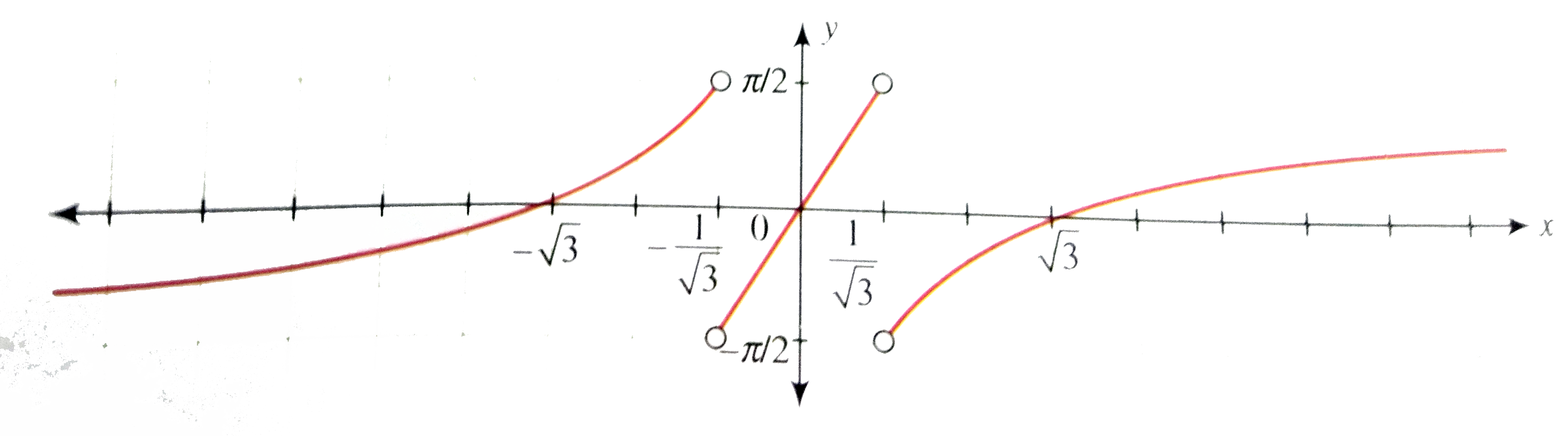
|
|
| 38. |
A multiple choice examinationhas 5 questions. Eachquestion has three alternative answer of which exctly one is correct . The probabilitythat a student willget 4 or more correct answersjust by guessing is |
|
Answer» `(17)/(3^(5))` |
|
| 39. |
Let alpha and beta be the roots of x^(2) + x + 1 = 0. If n be positive integer, then alpha^(n) + beta^(n) is |
| Answer» Answer :A | |
| 40. |
If int(x^(2)-1)/((x^(2)+1)sqrt(x^(4)+1))dx is equal to Atan^(-1)((1)/(sqrt(2))sqrt(x^(2)+1//x^(2)))+C then A is equal to |
|
Answer» |
|
| 41. |
Let a function f:(2,oo)rarr[0,oo)"defined as " f(x) = (|x-3|)/(|x-2|), then f is |
|
Answer» INJECTIVE & SURJECTIVE |
|
| 42. |
If f(x)={{:([x]+[-x],xne 2),(lambda,x=2):} is continuous at x = 2 then lambda = (where [.] denotes greatest integer) |
|
Answer» Solution :`lambda=lim_(X to 2) [x] + [-x]` =[x]-[x]-1 =-1 |
|
| 43. |
Find a unit vector perpendicualr to each of the vectors (vec(a)+vec(b)) and (vec(a)-vec(b)), where vec(a)=hati+hatj+hatk,vec(b)=hati+2hatj+3hatk. |
|
Answer» |
|
| 45. |
If x + ky -4 =0 and x+ y -5=0 are conjugate lines with respect to the circle (x -1) ^(2) + (y-1) ^(2) =3, thenk = |
|
Answer» 1 |
|
| 46. |
Try to construct an example of a proposition involving all connectives and also the modifier 'not'. |
| Answer» SOLUTION :If she do not come and take my help, then she neither UNDERSTAND the PROBLEM nor SOLVE then but she can CREATE other problems | |
| 47. |
If f(x) = |x^(2) -16| for all x in R, then the total number of points of R at which f: R rarr R attains local extreme values of |
|
Answer» 1 |
|
| 48. |
Integrate the following rational functions : int(x)/(1+x+x^(2)+x^(3))dx |
|
Answer» |
|